

MadKudu Review 2026: Predictive Lead Scoring for PLG — Pricing and Accuracy

By Kushal Magar · April 8, 2026 · 12 min read · Last updated: September 30, 2026
Key Takeaway
MadKudu is a predictive lead scoring platform built for PLG (product-led growth) companies. It combines firmographic data, behavioral signals, and product usage patterns into ML-powered scoring models that identify which free users are most likely to convert to paid. G2 rating is 4.5/5 from 46 reviews. Growth plan is $24,000/year (~$2,000/mo). Main limitations: scoring only (no contact database, no sequencing, no outreach), pricing is high relative to scope, and the platform provides limited value for companies without meaningful product usage data. HG Insights acquired MadKudu in August 2025, and as of September 2026 madkudu.com redirects to HG Insights, so pricing and packaging now run through HG.
MadKudu trains ML models on your historical conversion data to predict which free users and trial accounts will become paying customers. It scores every account on Customer Fit (firmographic ICP match) and Likelihood to Convert (product engagement patterns), then surfaces the accounts most worth a sales call. G2 rating is 4.5/5. Growth plan is $24,000/year (~$2,000/mo), annual commitment required.
The ML accuracy is higher than rule-based scoring when the model is properly trained — but that training requires historical conversion data, 10,000+ users for meaningful sample size, and 4–6 weeks of RevOps configuration. Teams without that infrastructure won't get the accuracy the platform promises.
One major change since this review first ran: HG Insights acquired MadKudu in August 2025. As of September 2026, madkudu.com redirects to HG Insights, and MadKudu's scoring and agentic workflows are being folded into HG's platform. The scoring approach below still describes what you are buying, but pricing and packaging now come from HG.
MadKudu Review: What You Get (and What You Don't)
MadKudu is one of the most established predictive scoring platforms for PLG companies. With a 4.5/5 rating on G2 from 46 reviews, users rate the scoring accuracy highly — but the review count reveals how niche the platform is.
| Feature | What's Included | Limitations |
|---|---|---|
| Predictive Lead Scoring | ML models scoring leads on firmographic, behavioral, and product data | Requires product usage data to be effective; limited without it |
| PQL Identification | Identifies product-qualified leads based on usage patterns | Only works for companies with freemium or free trial models |
| Score Explainability | AI-assisted explanations of what drives each lead's score | Explanations can be generic; reps still need context |
| CRM Integration | Salesforce, HubSpot, Marketo, Segment, Amplitude, Mixpanel | Some users report login/access issues via Salesforce |
| Contact Database | Not available | No prospecting, no enrichment, scoring only |
The takeaway: MadKudu scores your existing leads with high accuracy for PLG companies. What it does not do is find new leads, enrich contacts, detect outbound buying signals, or run outreach sequences.
MadKudu Predictive Scoring: How the ML Models Work
MadKudu builds custom ML models for each customer. The models train on your historical data: which leads converted to paid, what firmographic attributes they shared, what product actions they took before converting, and what behavioral patterns predicted success.
The scoring engine combines three data layers. Firmographic: company size, industry, technology stack, funding stage. Behavioral: website visits, content downloads, webinar attendance. Product usage: feature adoption, activation milestones, usage frequency, team size within the product.
What works well
The scoring is genuinely accurate for companies with sufficient historical data and meaningful product usage signals. Users on G2 report that MadKudu correctly identifies their best conversion opportunities. The 2025 update added AI-assisted "lead grade explainers" that help reps understand what is driving a specific score — for example, "this lead scored high because they invited 3 team members, used the API, and match your ICP firmographically."
Where it falls short
MadKudu only scores leads that are already in your system. It does not proactively find accounts showing buying signals in the wild — no hiring surge detection, no funding alerts, no competitor displacement signals, no job change monitoring. Teams that want to reach accounts before they sign up for the product need a separate signal or intent tool alongside it.
MadKudu PQL Identification and Product Signals
PQL (product-qualified lead) identification is MadKudu's core use case. The platform monitors product usage events from Segment, Amplitude, or Mixpanel and identifies users who are hitting activation milestones that historically predict conversion.
For example: a user who creates a workspace, invites 2+ team members, uses the API, and logs in 5+ times in their first week might score as a high-PQL. MadKudu pushes that score to Salesforce or HubSpot so your sales rep can reach out at the right moment.
PQL scoring limitations
PQL scoring only works if you have a freemium or free trial product with meaningful usage data. Companies with demo-request-only go-to-market motions, or products where usage does not vary much between casual and serious users, get limited value from MadKudu's product scoring layer. The firmographic scoring still works, but you can get that from cheaper tools. For broader signal detection, see our best buying intent data tools guide.
MadKudu Pricing Breakdown
MadKudu pricing was never fully transparent, and as of September 2026 there is no public price list at all: madkudu.com and its pricing page redirect to HG Insights. The tiers below are what public sources and user reports showed before the acquisition, so treat them as a benchmark and ask HG Insights for a current quote:
- •Starter (~$1,000/mo): Basic predictive scoring for lower lead volumes, CRM integration, firmographic + behavioral scoring
- •Growth ($24,000/yr / ~$2,000/mo): Full predictive engine, product usage scoring, PQL identification, custom models, Segment/Amplitude/Mixpanel integration
- •Enterprise (custom): Advanced models, dedicated data science support, custom integrations, higher lead volumes
What you actually pay
A PLG company with 10,000 monthly signups on the Growth plan pays $2,000/mo for scoring alone. That does not include the cost of your CRM ($150+/mo), your product analytics tool ($200+/mo), your enrichment tool ($100+/mo), or your outreach tool ($100+/user/mo). MadKudu is one piece of a larger — and expensive — GTM stack.
Hidden costs to watch
- Scoring only — no contact database, no sequencing, no outreach tools included
- Requires product analytics (Segment, Amplitude, Mixpanel) as a prerequisite — additional $200+/mo
- Annual contracts required on most plans
- Pricing scales with lead volume — high-signup companies pay significantly more
- Model accuracy depends on historical data quality — garbage in, garbage out
What Are the Downsides of Using MadKudu?
High price for scoring-only functionality
At $2,000/mo for the Growth plan, MadKudu is expensive for a tool that does exactly one thing: score leads. You are paying a premium for ML accuracy, and every other capability requires additional tools and spending.
Limited value without PLG product data
MadKudu's differentiator is product usage scoring. If your go-to-market is not product-led — if you rely on demos, outbound sales, or enterprise contracts without a self-serve product — you get firmographic and behavioral scoring at best. You can get that from cheaper alternatives.
Interface and customization limitations
Users on Reddit and Capterra flag that the interface offers limited customization options. Users want more granular control over signal weighting — for example, weighing API usage more heavily than login frequency for their specific product. The dashboard requires workarounds to surface top prospects without manual filtering.
No outbound signal detection
MadKudu scores people who already signed up for your product. It does not find companies that are hiring for roles that suggest they need your product, companies that just raised funding, companies where a champion just moved to a new role, or companies consuming content about your product category. Outbound opportunities are invisible to MadKudu. Review our buying intent data tools guide for platforms that capture these signals.
Bulk scoring workflows are clunky
Users report that the bulk scoring process is difficult when merging scores with existing spreadsheets or running batch operations. For teams that need to score large lists for ABM campaigns or territory planning, this adds manual work that should be automated.
MadKudu After the HG Insights Acquisition: What Changed
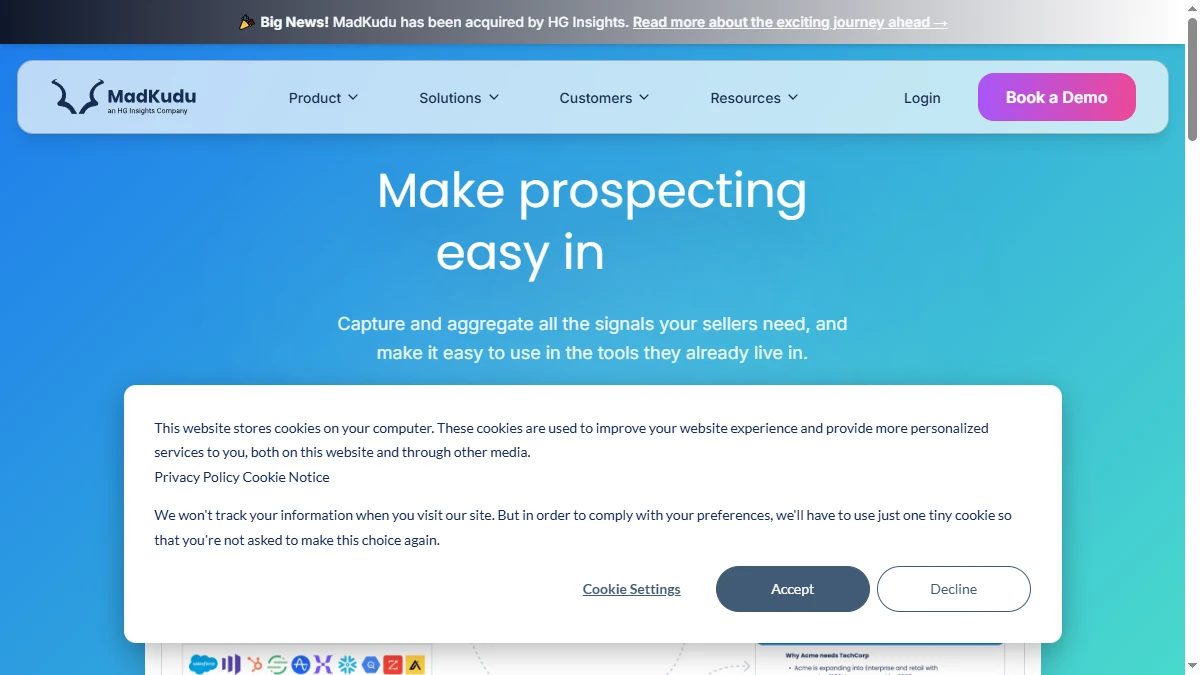
On August 11, 2025, HG Insights announced that it had acquired MadKudu, which had been one of its strategic partners, and launched what it calls a Revenue Growth Agentic Ecosystem. HG says MadKudu brings "proven agentic GTM solutions and playbooks" that orchestrate workflows powered by signals from both first- and third-party data. As of September 2026, madkudu.com and its pricing page redirect to hginsights.com, and MadKudu's capabilities are presented as part of HG's platform rather than as a standalone product.
For buyers, three things change:
- The buying path. There is no longer a MadKudu website to sign up from. Scoping, contracts, and support now run through HG Insights, which is best known for technographic and market intelligence data.
- Pricing.The Starter and Growth figures in this review predate the acquisition. HG does not publish MadKudu pricing, so budget for a fresh quote and expect packaging to follow HG's platform rather than MadKudu's old tiers.
- The roadmap.HG's announcement does not spell out a transition plan for existing MadKudu customers, product consolidation, or which integrations carry over. Before signing, ask which of the pieces reviewed here remain supported: the custom scoring models, PQL identification, lead grade explainers, and the Salesforce, HubSpot, Segment, Amplitude, and Mixpanel connections.
There is a potential upside. The biggest gap flagged in this review is that MadKudu on its own only sees leads already in your funnel. HG's stated direction, pairing first-party product signals with third-party data, speaks directly to that gap. Whether it delivers depends on how the combined product ships, so evaluate it on a live demo with your own data rather than on the announcement.
Is MadKudu Worth It?
MadKudu is worth it for PLG companies with meaningful product usage data, high signup volumes, and a sales-assist motion that needs to prioritize which free users get sales attention. The scoring accuracy is strong when the model has good training data. The customer success team is responsive and helps optimize models over time.
MadKudu is not the right choice for companies without a PLG motion, teams with budgets under $2K/mo for scoring alone, or organizations that need outbound signal detection alongside inbound scoring. At $24K/yr, you are paying for one capability — lead scoring — that CRMs such as Salesforce increasingly offer natively.
The verdict: best-in-class predictive scoring for PLG companies, but expensive, narrow, and now in transition inside HG Insights. If you have strong product usage data and the budget, get a current quote from HG and a clear answer on the scoring roadmap before signing an annual contract.
Comparing lead scoring and signal platforms? Read our reviews of 6sense, Koala, and our roundup of best buying intent data tools for 2026.
If MadKudu's inbound-only scoring is a dealbreaker, SyncGTM is one alternative worth a look: it tracks real-time buying signals like job changes, funding, and hiring, and scores leads against your ICP.