

6sense Review 2026: ABM and Intent Platform — Is Enterprise Pricing Justified?

By Kushal Magar · April 8, 2026 · 13 min read · Last updated: September 30, 2026
Key Takeaway
6sense is an enterprise ABM and revenue intelligence platform that uses AI to identify accounts in the dark funnel, predict buying windows, and orchestrate coordinated sales and marketing outreach. Pricing is not published — expect $60,000–$100,000+/year for most deployments, frequently exceeding $200,000+ for full enterprise access. Strong platform for companies with the budget, dedicated RevOps teams, and complex ABM programs to justify it. For most SMB and mid-market teams, the pricing is prohibitive, and the 1–3 month implementation adds real cost on top of the annual contract.
6sense is the enterprise standard for ABM and revenue intelligence. It uses AI to identify companies showing buying intent before they ever fill out a form — pulling signals from a proprietary network of B2B content and research activity across the web. The pitch: find your buyers in the dark funnel before your competitors do.
You are probably here because your enterprise team is evaluating 6sense, you have seen the pricing and need to determine whether the investment is justified, or you are looking for a more accessible alternative that delivers similar signal intelligence.
This 6sense review covers how the intent data works, what the ABM orchestration delivers, what it actually costs, and whether the enterprise pricing is justified for your specific situation.
6sense Review: What You Get (and What You Don't)
6sense is a full revenue intelligence platform that covers account identification, intent data, predictive scoring, advertising, and sales orchestration. See how users rate it on G2.
| Feature | What's Included | Limitations |
|---|---|---|
| Intent Data | Proprietary B2B research network signals | Accuracy varies by industry; not universal coverage |
| Account AI | Predictive scoring and dark funnel identification | Requires data volume to train predictions accurately |
| ABM Advertising | Programmatic display advertising to target accounts | Ad spend is additional — platform cost + media spend |
| CRM Integration | Deep Salesforce and HubSpot integration | Setup requires dedicated RevOps time |
| Pricing | Full enterprise platform | $60K–$300K+/year — excludes most teams |
The takeaway: 6sense is a genuinely powerful platform. The question is whether your organization has the budget, team, and program complexity to justify it.
6sense Intent Data: How the AI Identifies Buying Accounts
6sense's intent data comes from a proprietary publisher network — B2B content sites, research platforms, and review sites where buyers actively research solutions. When an account at a target company repeatedly visits content about your solution category, 6sense surfaces that account as showing intent.
The AI layers behavioral signals with firmographic data and historical buying patterns to generate a predictive score: how likely is this account to buy in the next 30–90 days? This is the core differentiation from simpler intent tools that just show you who is researching keywords.
How accurate is 6sense intent data?
G2 reviewers and user discussions on Reddit consistently note that intent data accuracy is strongest in technology, SaaS, and financial services verticals where 6sense's publisher network has dense coverage. Teams in niche industries or regions outside North America report weaker signal quality. The predictive AI is only as good as the training data it has for your specific segment.
6sense ABM Orchestration: Advertising, Outreach, and Workflows
Beyond intent data, 6sense includes a full ABM execution layer. You can run programmatic display advertising to identified in-market accounts, trigger Salesforce and HubSpot workflows based on intent score changes, and coordinate sales outreach sequences with marketing touchpoints.
This is the platform vision: identify who is buying, advertise to them to build brand awareness, alert sales when account scores spike, and coordinate the outreach. For large enterprises running coordinated account-based programs, this integrated approach has genuine value.
Do smaller teams need all of this?
Most SMB and mid-market teams do not need an integrated ABM advertising platform. They need buying signals and enrichment to prioritize outreach. The full 6sense platform is overbuilt and overpriced for teams that primarily want to know which accounts are in-market and reach them via email and LinkedIn. Those teams should either scope a single Sales Intelligence package (covered below) or compare narrower intent data tools before committing to the full platform.
How 6sense Works: From Setup to First Pipeline
6sense is easier to evaluate once you see the order in which its pieces switch on. Here is how a typical deployment runs, and where the RevOps effort mentioned above actually goes.
- Connect your systems. Sync Salesforce or HubSpot so 6sense can match accounts, read opportunity history, and surface scores inside CRM records. Sales engagement and conversation tools such as Salesloft and Gong can be connected as well.
- Define intent keywords. 6sense tracks keyword-level buying signals, so you choose the topics that describe your category, your competitors, and the problems you solve. Vague keyword lists produce noisy intent, so this step deserves real care.
- Train the predictive model. Predictive modeling combines your historical wins with intent and firmographic data to give each account a buying stage and a priority score. Thin opportunity history means weaker predictions, which is why smaller datasets struggle.
- Build segments and audiences. Use the audience and list builders to group in-market accounts by fit, stage, and region. Web deanonymization adds accounts that visit your site without filling out a form.
- Activate across channels. Push segments to Advertising 6AI for account-targeted display campaigns, fire sales alerts and intelligent workflows when scores change, and use the AI email agents to send outreach grounded in the same buying signals.
- Measure and tune. Review which segments turn into opportunities, then refine keywords and segment rules. This loop is where most of the setup time goes, and skipping it is behind the slow time-to-value some G2 reviewers describe.
How 6sense packages Sales Intelligence
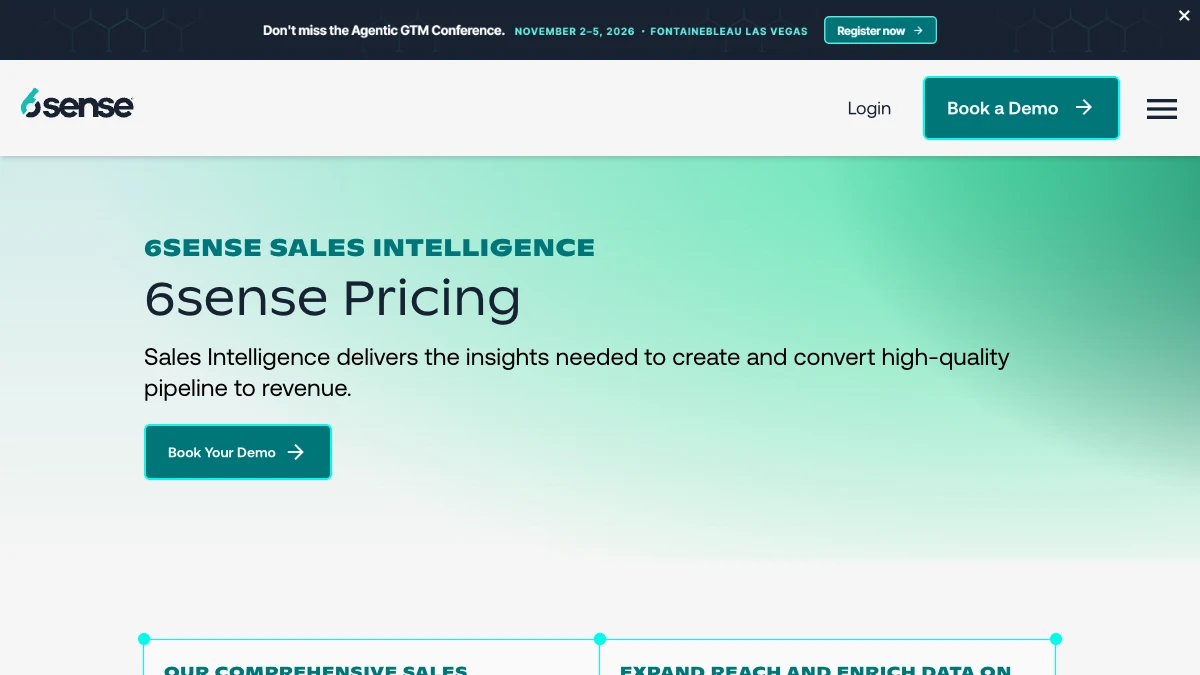
As of September 2026, 6sense's pricing page lists no prices. It shows Sales Intelligence in three combinations, and every quote starts with a demo:
| Package | What It Centers On | Fits Teams That |
|---|---|---|
| Sales Intelligence + Data Credits | Chrome extension, AI writer, company insights (persona mapping, technographics, psychographics), and data credits to unlock and export emails, phone numbers, and enriched records | Mainly need contact data and account research |
| Sales Intelligence + Predictive AI | Predictive model, scores, and dashboards, plus Sales Copilot with AI recommended actions and account summaries | Already have a contact data provider and want prioritization |
| Sales Intelligence + Data Credits + Predictive AI | Both of the above, plus buyer discovery, list builder, alerts, and intelligent workflows | Want prioritization and contact data under one contract |
Advertising and the Revenue Marketing product are not part of these Sales Intelligence packages, so expect a larger, separately scoped quote if you want the full ABM platform. That is how full deployments reach the enterprise ranges in the pricing breakdown below.
6sense Pricing Breakdown
6sense does not publish pricing publicly. All contracts require going through their enterprise sales process. Based on market intelligence, public disclosures, and user reports:
- •Free Tier: Limited features — basic account identification without full intent data or predictive AI
- •Growth (est. $60K–$100K/year): Intent data, predictive scoring, Salesforce/HubSpot integration, limited advertising
- •Enterprise (est. $150K–$300K+/year): Full platform including ABM advertising, advanced AI, custom integrations, dedicated CSM
What you actually pay
A typical mid-market SaaS company deploying 6sense for marketing and sales: $80,000–$120,000/year on a 1–2 year contract. That is $6,600–$10,000/month before advertising spend and before the RevOps implementation cost. The ROI math requires meaningful pipeline volume for it to work.
Hidden costs to watch
- Pricing is completely opaque — requires enterprise sales process to get quotes
- Minimum contract sizes exclude most SMB and many mid-market teams
- ABM advertising spend is additional — media budget on top of platform cost
- Implementation requires dedicated RevOps — add 1–3 months of setup time
What Are the Downsides of Using 6sense?
Pricing excludes most teams
At $60K–$300K+/year, 6sense is inaccessible to the majority of B2B companies. Even mid-market SaaS companies with $20–$50M ARR often find the ROI calculation challenging. The platform was built for enterprise and is priced accordingly.
Complex implementation
Getting value from 6sense requires significant setup investment — configuring intent topics, connecting CRM data, training the predictive models, and building the ABM program workflows. Teams without dedicated RevOps support often struggle to fully utilize what they are paying for. G2 reviewers frequently mention underwhelming time-to-value without proper setup.
Intent data accuracy varies
6sense's intent data is strongest in technology verticals in North America where its publisher network is densest. Teams in manufacturing, healthcare, professional services, or international markets often find the intent signal quality inconsistent. You are paying enterprise pricing for data that may be less reliable in your specific target market.
Annual contract lock-in
6sense requires annual contracts. If the implementation is slow or the signal quality does not meet expectations, you are committed for 12 months regardless. This is a significant risk for companies that have not run enterprise ABM programs before.
Is 6sense Worth It?
6sense is worth it for enterprise B2B companies with $100M+ ARR, large marketing and sales teams, dedicated RevOps, significant advertising budgets, and complex account-based programs where coordinating signals, advertising, and outreach across hundreds of target accounts delivers measurable pipeline impact.
6sense is not worth it for SMB teams, most mid-market companies, or any organization that primarily needs buying signals and enrichment without the full ABM advertising layer. The pricing is simply not justified for those use cases.
The verdict: industry-leading ABM platform — but the six-figure price tag means it is only justified at true enterprise scale. If you are on the fence, get a quote for a single Sales Intelligence package and pressure-test the intent data on your own target accounts before signing an annual contract.
Comparing intent data platforms? Read our reviews of Bombora, Demandbase, G2 Buyer Intent, and our roundup of best buying intent data tools for 2026.
If 6sense's annual contracts and quote-only pricing are a dealbreaker, SyncGTM is one alternative worth a look: it is free to start and tracks real-time buying signals such as job changes, funding, headcount growth, and hiring.