

Onfire Review 2026: Real-Time Buying Signals, Pricing, and Features

By Kushal Magar · April 8, 2026 · 11 min read · Last updated: September 30, 2026
Key Takeaway
Onfire is an AI-powered revenue intelligence platform that detects buying signals from developer communities — Reddit, Discord, StackOverflow, GitHub — and enriches target accounts with decision-maker contacts and technology stack data. Backed by $20M in funding from Grove Ventures and TLV Partners. Custom pricing across three tiers (Basic, Pro, Elite), each with a dedicated CSM. Developer-focused signals are uniquely valuable for companies selling to technical buyers. Main limitations: narrow signal coverage built for technical verticals, opaque pricing, no waterfall-verified contact data, and an early-stage platform still building feature depth.
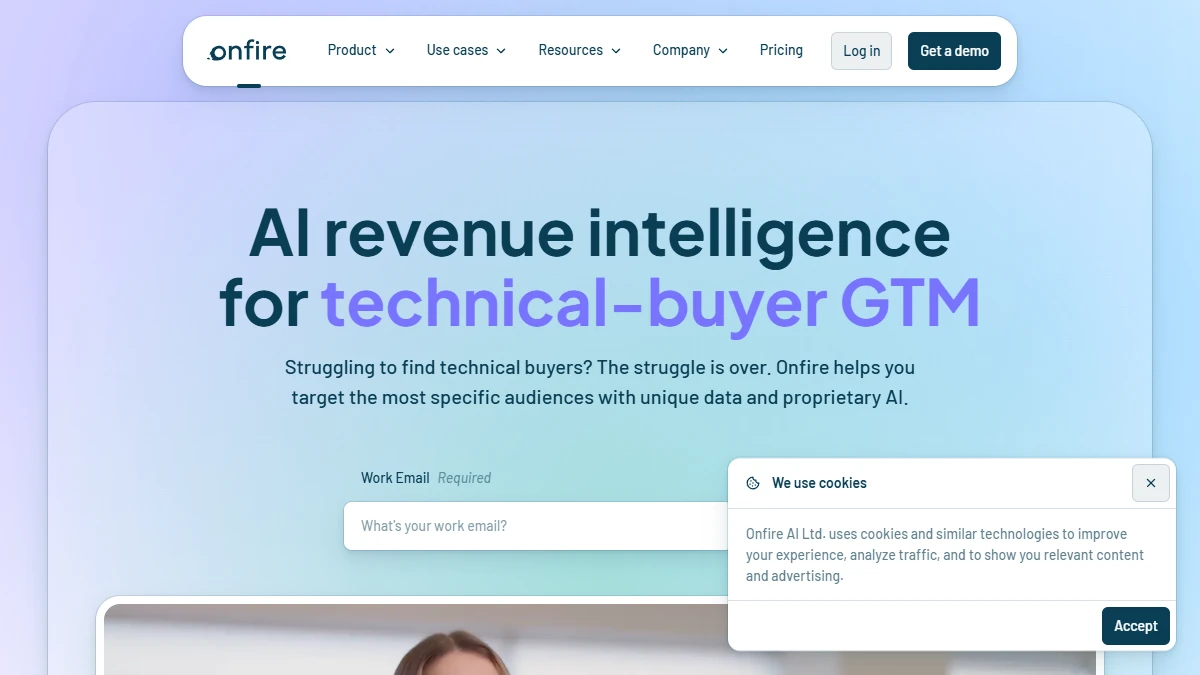
Onfire monitors Reddit, Discord, StackOverflow, and GitHub to find companies where developers are actively discussing problems your product solves. When a developer posts "we're evaluating X alternatives" in a Slack community or GitHub issue, Onfire surfaces the company, identifies decision-makers, and enriches the account with tech stack data. Backed by $20M from Grove Ventures and TLV Partners.
This signal type is genuinely unique — Bombora and G2 don't monitor developer forums. The constraint: Onfire's value is proportional to how much your buyers discuss their problems in developer communities. For developer tool vendors, it's differentiating. For companies selling to non-technical buyers, the signal won't be relevant.
Onfire Review: What You Get (and What You Don't)
Onfire came out of stealth in late 2025 with $20M in funding. Founded by Israeli intelligence veterans, the platform applies signal intelligence techniques to developer community data.
| Feature | What's Included | Limitations |
|---|---|---|
| Developer Community Signals | Monitors Reddit, Discord, StackOverflow, GitHub for buying intent | Developer-focused only; misses non-technical buyer signals |
| AI Account Enrichment | Identifies companies, decision-makers, and technology stacks | Attribution from anonymous forum posts has accuracy limits |
| Person-Level Signals | Links forum discussions to specific individuals at companies | Depends on public profile data; not always identifiable |
| Revenue Automation | Automated workflows triggered by signal detection | Early-stage; workflow depth limited vs established platforms |
| ICP Targeting | Define ideal customer profile; signals filtered to matching accounts | Signal volume depends on developer community activity in your space |
The takeaway: Onfire captures developer buying signals that traditional intent providers miss. It is built for technical verticals, so teams selling to non-technical buyers will find much less to work with.
Onfire Developer Signals: How It Tracks Buying Intent
Onfire scans millions of messages across developer communities in real-time. When a developer on Reddit asks "what's the best alternative to Terraform for infrastructure management?" — Onfire identifies the developer, maps them to their company, finds the decision-makers at that company, and surfaces the signal to your sales team with the original context.
The platform layers company context on top: technology stack composition, hiring patterns, product maturity, and known budget cycles. This means your SDR does not just see "Company X is evaluating infrastructure tools" — they see the developer's exact words, the company's current stack, who the decision-makers are, and when budget reviews happen.
What works well
The signal quality is high because it captures real conversations, not inferred intent from content consumption. A developer asking "has anyone migrated from Tool A to Tool B?" is a stronger buying signal than a company reading a blog post about Tool B. Onfire claims to have driven $50M+ in closed deals for early customers including ActiveFence, Aiven, Cyera, and Port.
Where it falls short
Developer communities are noisy. Not every Reddit post about a tool indicates buying intent — developers also ask questions out of curiosity, for side projects, or for academic research. The signal-to-noise ratio depends heavily on how well your ICP targeting is configured. And if your product is not discussed in developer communities, signal volume will be low, so ask for sample signals from your own ICP before you sign.
Onfire AI Enrichment and Account Context
Beyond signal detection, Onfire enriches accounts with technology stack data, hiring patterns, and decision-maker identification. When a signal fires, your team gets the full account picture: what tools the company uses, who makes purchasing decisions, and what their current pain points are — all derived from the original community discussion.
The AI layer attempts to link anonymous forum posts to real companies and individuals. This works well when developers use identifiable profiles (GitHub accounts linked to companies, LinkedIn-connected forum handles) but is less reliable for truly anonymous posts.
Enrichment depth vs. dedicated providers
Onfire's enrichment is built for context, not for comprehensive contact data. It tells you who the decision-makers are and what technology the company uses. It does not provide waterfall-verified emails, direct dials, or firmographic depth matching dedicated B2B data providers. For complete enrichment workflows, see our best CRM data enrichment tools guide.
Onfire Pricing Breakdown
Onfire uses custom pricing across three tiers. You can see the plan structure on their pricing page, but specific dollar amounts require a demo:
- •Basic (custom): 5,000+ credits, 5-9 users, prospect-level signals, ICP targeting, onboarding, revenue automation engine, dedicated CSM
- •Pro (custom): 80,000+ credits, 10-15 users, the same feature set as Basic at higher volume
- •Elite (custom): Custom credit volume and unlimited users, designed for enterprise-scale deployment
As of September 2026, the tiers differ by credit volume and user count rather than features: every plan lists prospect-level signals, ICP targeting, onboarding, a dedicated CSM, and the revenue automation engine. The pricing page does not define what a credit covers, so ask how credits are consumed per signal and per enriched contact during the demo.
What you can expect to pay
Onfire does not publish prices, which typically indicates enterprise-level pricing. Given the $20M funding, enterprise-first positioning, and customer base (Cyera, ActiveFence, Spectro Cloud), expect $2,000-$5,000+/mo for mid-market teams and higher for enterprise deployments. The minimum 5-user requirement on Basic also suggests this is not priced for small teams.
Hidden costs to watch
- No published pricing — requires a sales demo to learn costs
- Minimum 5 users on Basic plan — not accessible for small teams or individuals
- Credit-based system: Basic plan has 5,000 credits which may not last for high-volume teams
- Developer-focused signals only — non-technical buyer targeting requires additional tools
- Early-stage platform — feature depth is still maturing compared to established competitors
What Are the Downsides of Using Onfire?
Developer-only signal coverage
If your buyers are not developers — if you sell to marketing teams, finance departments, HR leaders, or operations managers — Onfire's signals will not capture their buying behavior. The platform is purpose-built for developer tool and infrastructure companies. Everyone else needs different signal sources.
Opaque pricing creates friction
No published pricing means you cannot evaluate Onfire without sitting through a sales demo. For GTM leaders evaluating multiple signal platforms, this adds weeks to the evaluation process. Transparent pricing builds trust. Onfire has not earned that trust yet.
Early-stage platform risks
Onfire launched publicly in late 2025. The customer base is small compared to established players like 6sense, Bombora, or Common Room. Feature depth, integration breadth, and support infrastructure are still maturing. Early adopters carry the risk of bugs, missing features, and product pivots.
Signal attribution accuracy
Linking anonymous forum posts to specific companies and individuals is inherently imprecise. A developer might post from a personal account, use a pseudonym, or discuss tools for a side project unrelated to their employer. Onfire's AI does its best, but false positives are inevitable — especially for signals from anonymous Reddit and Discord accounts.
No waterfall contact enrichment
Onfire identifies decision-makers at signal-flagged accounts but does not provide waterfall-verified contact data. You still need a separate enrichment tool to get verified emails, direct dials, and complete firmographic profiles for outreach. Review our CRM enrichment guide for platforms that handle this.
How Onfire Works: From Signal to Sequence
Onfire is easier to evaluate once you see the loop it runs. Here is how a typical deployment works, based on the review above and what Onfire lists on its own site as of September 2026.
- Define your ICP. Every plan includes ICP targeting and onboarding with a dedicated CSM. Tight filters matter here, because they decide how much community noise reaches your reps.
- Monitor the public footprint. Onfire says it tracks the public footprint of 800M prospects across communities, blogs, events, full job descriptions, and more, with developer forums such as Reddit, Discord, StackOverflow, and GitHub at the core.
- Add your first-party data. Trial signups and CRM notes can be connected so community signals are read alongside what you already know about an account.
- Review prospect-level signals. When a signal fires, reps see the original discussion, the company behind it, its technology stack, and the likely decision-makers, rather than a bare intent score.
- Act inside your existing tools. Onfire writes to the CRM, enrolls contacts in sequences, and answers questions inside tools like Claude and ChatGPT over MCP, so the next action can be triggered with a prompt.
- Fill the contact gaps. Onfire identifies decision-makers but does not deliver waterfall-verified emails or direct dials, so plan an enrichment step before outreach.
Two things are worth testing before you sign. First, ask for sample signals from your own ICP over a recent period and count how many your reps would act on; that ratio tells you more than any demo account. Second, clarify how credits are consumed, since the Basic plan starts at 5,000+ credits and the pricing page does not define a credit.
Security reviews should be straightforward: Onfire lists SOC 2 Type II and ISO 27001 certification, GDPR and CCPA compliance, and CSA STAR. Its public customer logos, including Cyera, Port, Aiven, Spectro Cloud, and YugabyteDB, confirm where it fits best: developer tools, data infrastructure, and security vendors selling to technical teams.
Is Onfire Worth It?
Onfire is worth evaluating for companies selling developer tools, infrastructure platforms, or DevOps products that have active community discussions. The ability to capture real developer conversations and link them to target accounts is genuinely unique. No other platform does this at Onfire's depth.
Onfire is not the right fit for companies selling to non-technical buyers, teams with budgets under $2K/mo, or organizations that need proven, at-scale platforms with deep integration ecosystems. The platform is early, pricing is opaque, and signal coverage is narrow.
The verdict: uniquely valuable developer community intelligence for the right audience, but too narrow and too early for most GTM teams. If you sell to technical buyers, ask Onfire for sample signals from your own ICP during the demo and judge the platform on how many of them your reps would actually act on.
Comparing signal intelligence platforms? Read our reviews of Common Room, Koala, and our roundup of best buying intent data tools for 2026.
If Onfire's focus on developer and technical buyers is a dealbreaker, SyncGTM is one alternative worth a look: it tracks real-time job change, funding, headcount growth, hiring, and web traffic signals.