

UserGems Review 2026: Job Change Signals for Warm Outbound — Pricing Tested

By Kushal Magar · April 9, 2026 · 11 min read · Last updated: September 30, 2026
Key Takeaway
UserGems tracks when existing customers, past buyers, and pipeline champions move to new companies — automatically creating warm outbound opportunities. When a former user takes a VP role at a new company, UserGems creates the lead in your CRM and triggers outreach workflows. As of September 2026 it also lists 30+ native signals and AI scoring, with published pricing from $40,000/year (Core) to $150,000/year (Elite). Strong Salesforce and HubSpot integrations. The core insight — people who bought from you before will often buy again at new companies — is genuinely valuable. Limitations: significant pricing tied to the size of your existing customer base, the most advanced signals reserved for the top plan, and detection lag for some job changes.
UserGems is built on one of the most reliable sales insights in B2B: buyers who chose you once are likely to choose you again. When a champion contact — a past buyer, an existing user, someone who was in an active deal — moves to a new company, that is a warm outbound opportunity most sales teams never catch. UserGems automates the tracking and creates the lead automatically.
You are probably here because your team has anecdotally seen warm outbound work — a champion moves and brings your product to their new company — but you have no systematic way to catch those moves before a competitor does.
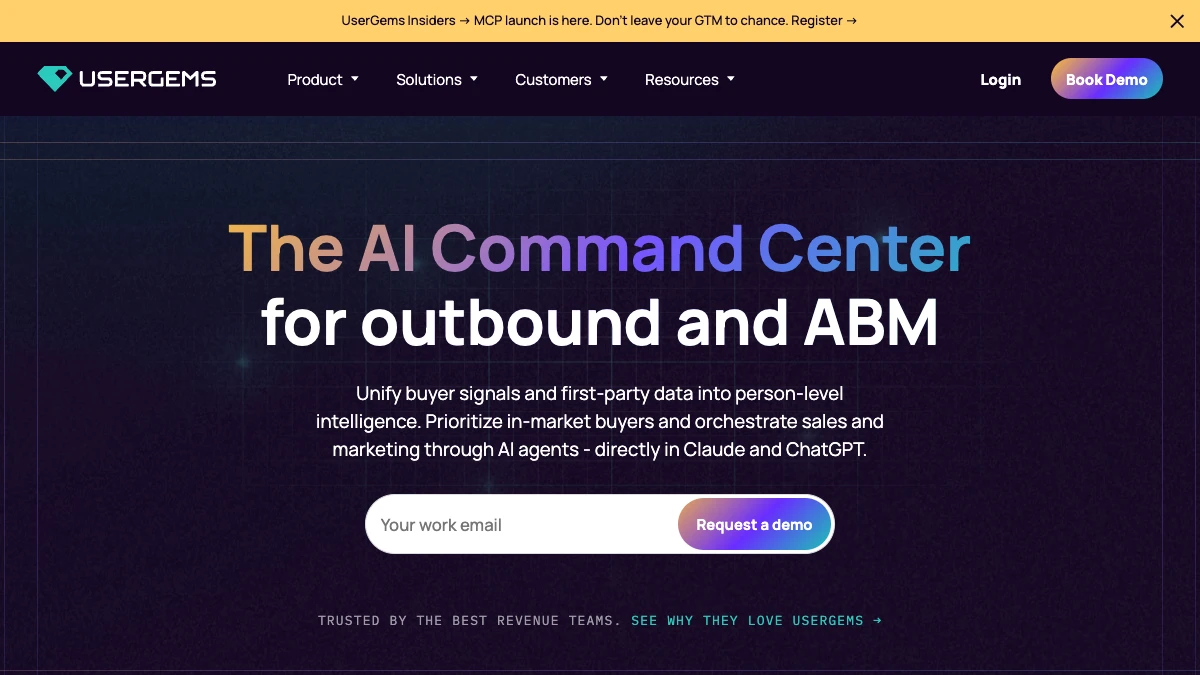
This UserGems review covers how the job change tracking works, how the warm outbound workflow is triggered, what it costs, and how far its newer signals and AI features extend beyond job changes.
UserGems Review: What You Get (and What You Don't)
UserGems monitors your existing CRM contacts, customers, and prospect database for job changes — LinkedIn profile updates, company changes, and title promotions. See user ratings on G2.
| Feature | What's Included | Limitations |
|---|---|---|
| Job Change Tracking | Monitors CRM contacts for company and title changes | Detection lags LinkedIn updates by days to weeks |
| Champion Monitoring | Tracks existing customers when they move to new companies | Value depends on the size of your existing customer base |
| CRM Automation | Auto-creates leads/contacts in Salesforce, HubSpot, and Dynamics | Setup requires CRM admin configuration |
| Outreach Workflows | Triggers sequences in Outreach, Salesloft, or Gong Engage when moves are detected | Requires integration with outreach tools |
| Broader Signals & AI | 30+ native signals, Gem-E AI scoring, and a Writing Agent | Contact-level intent and buying stages only on the Elite plan |
The core constraint: UserGems is at its best with people and accounts you already know — your customers, champions, and CRM contacts. Its newer signals widen the net, but the product's value still scales with the history in your CRM.
UserGems Job Change Tracking: How Champion Monitoring Works
UserGems connects to your CRM and monitors every contact in your database against LinkedIn profile changes, company databases, and professional network data. When a contact updates their LinkedIn to show a new employer or title, UserGems detects the change — typically within days to weeks of the actual move.
The platform enriches the signal with new company data: company size, industry, funding stage, and role seniority. If the new company fits your ICP, UserGems creates a new CRM lead automatically and triggers configured workflows — an email sequence, an SDR task, or a Slack notification to the account owner.
Why job changes create buying opportunities
Newly hired VPs and directors have budget to spend and vendors to evaluate. Research shows that new executives make 70% of their major software purchasing decisions within the first 90 days. A champion who used your product and moved to a new company is a pre-qualified prospect — they already know your product works, they have buying authority, and they are evaluating vendors right now.
UserGems Warm Outbound: Turning Job Changes Into Pipeline
The workflow UserGems enables: a former customer moves from Series B startup to VP Sales at a Series C company. UserGems detects the move, creates a new lead in Salesforce with enriched company data, assigns it to the right rep, and triggers a personalized outreach sequence referencing their previous experience with your product.
This is meaningfully different from cold outbound. Reply rates for warm outbound to former users are reported to be 3–5x higher than cold outreach to equivalent ICP targets. The ROI case for UserGems is strong when the customer base is large enough to generate sufficient signal volume.
When warm outbound volume is insufficient
For early-stage companies with small customer bases, UserGems generates limited signal volume. A company with 50 customers might see 5–10 job moves per quarter — not enough pipeline to justify a $40K+/year investment. The math only works at scale. Compare alternatives like LoneScale (hiring signals as buying signals) if your customer base is too small to feed UserGems.
UserGems Signals and AI: Beyond Job Changes
UserGems started as a job-change tracker, and many older reviews still describe it that way. As of September 2026, the product is considerably broader. Here is what now sits on top of the champion-tracking core.
- •30+ native signals. Alongside job changes, UserGems lists contact-level intent, website visits, M&A activity, and hiring, and a Research Agent can monitor custom signals you define. It combines these with first-party data from your CRM, call transcripts, and product usage.
- •Gem-E scoring. The Gem-E agent analyzes 600+ signals and learns from your closed-won deals to build a scoring model specific to your business, then feeds the results of new opportunities back into scoring.
- •Writing Agent. Drafts personalized outreach from the signal context, such as a champion's previous experience with your product.
- •Orchestration across channels. Agents run inside outbound and ABM campaigns, with integrations spanning CRMs (Salesforce, HubSpot, Microsoft Dynamics), marketing automation (Marketo, HubSpot), sales engagement (Outreach, Salesloft, Gong Engage), ad platforms (LinkedIn, Meta, Google Ads), and a Chrome extension.
- •MCP access on Advanced and up. The Advanced plan adds UserGems MCP access for working with the data from AI tools.
Two caveats apply. First, plan level matters: contact-level intent, buying stages, and CRM hygiene are reserved for the Elite plan at $150,000/year, so check which signals your tier actually includes before comparing UserGems with narrower tools. Second, Gem-E learns from your closed-won history, so companies with few past deals give it less to learn from. UserGems' published case studies cite reply rates of 11–16% at Docebo and 15–20% at Sendoso; treat those as vendor-reported best cases rather than benchmarks.
UserGems Pricing Breakdown
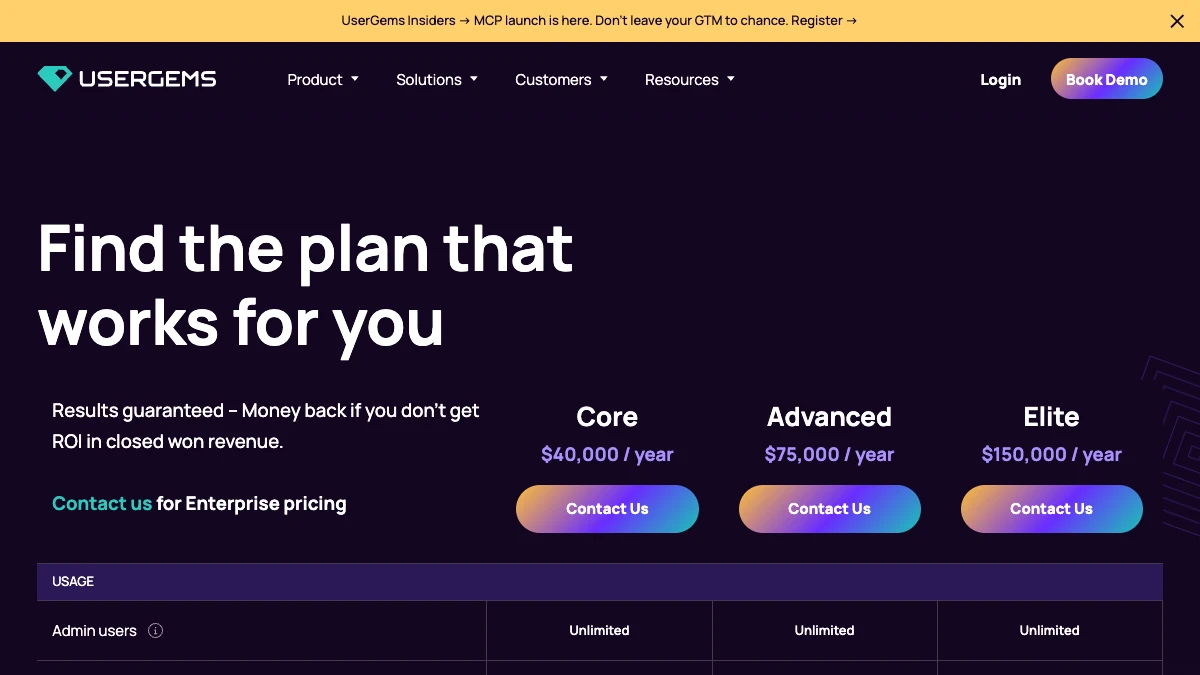
UserGems now publishes its pricing. As of September 2026, every standard plan is billed annually and includes unlimited admin and end users; the tiers differ by credits and features:
- •Core ($40,000/year): 4M credits (40K data or 400K AI actions), basic agents, core integrations
- •Advanced ($75,000/year): 10M credits (100K data or 1M AI actions), adds UserGems MCP access and additional features
- •Elite ($150,000/year): 25M credits (250K data or 2.5M AI actions), adds contact-level intent, buying stages, and CRM hygiene
- •Enterprise (custom): Contact sales for pricing
One-time implementation fees run $3,000–$10,000 depending on plan, and optional retroactive job change leads cost $3,000. UserGems also offers a money-back guarantee if you don't see ROI in closed-won revenue.
What you actually pay
A mid-market SaaS company on Core pays $40,000/year plus a one-time implementation fee, so first-year cost lands between $43,000 and $50,000. The ROI depends entirely on how many champion moves and other signals the system surfaces and how many convert to deals. The money-back guarantee helps, but read its terms closely before relying on it.
Hidden costs to watch
- No self-serve access — every plan goes through a demo or sales conversation
- Value scales with customer base size — small customer bases generate limited signals
- One-time implementation fees of $3,000–$10,000 on top of the subscription
- Annual contracts starting at $40,000/year
- Contact-level intent and buying stages are reserved for the $150,000/year Elite plan
What Are the Downsides of Using UserGems?
The broader signals are gated by plan
UserGems built its reputation on job changes, and that remains its most proven signal. The newer signal set is real, but the most advanced pieces are gated: contact-level intent and buying stages come only with the Elite plan at $150,000/year. Teams on Core should evaluate the signals available at their tier on their own accounts before assuming parity with dedicated intent tools.
Value tied to existing customer base size
Early-stage companies or those with small customer bases generate limited signal volume. If you only have 100 customers and 10 move per year, you are paying a significant annual fee for a small number of warm leads. The math improves significantly as customer base grows.
Detection lag
UserGems detects job changes after LinkedIn is updated, which typically happens days to weeks after the actual move. First-mover advantage matters in warm outbound — reaching a new VP in their first week versus month 3 of their new role makes a meaningful difference. User reviews on Reddit note this timing gap as a recurring frustration.
Is UserGems Worth It?
UserGems is worth it for B2B companies with 500+ customers, a history of product champions who move to adjacent companies, and the infrastructure to run warm outbound sequences when job change signals fire. When these conditions are met, the ROI is strong.
UserGems is not worth it for early-stage companies, teams without existing customer bases, or organizations that cannot commit to a $40,000+ annual contract.
The verdict: the best tool specifically for job change tracking and champion monitoring — when your customer base is large enough to generate ROI. Its newer signals and AI agents make it a broader pipeline platform than it used to be, but the pricing still assumes enterprise scale.
Comparing signal intelligence tools? Read our reviews of LoneScale, Koala, Warmly, and our best buying intent data tools for 2026 guide.
If UserGems' sales-led pricing and annual contracts are a dealbreaker, SyncGTM is one alternative worth a look: it is free to start and tracks real-time buying signals such as job changes, funding, headcount growth, and hiring.