

What Sales Intelligence and B2B Prospecting Software Has the Best Scalability: Expert Picks for 2026

By Kushal Magar · May 21, 2026 · 13 min read
Key Takeaway
SyncGTM wins on architecture scalability — waterfall enrichment across 50+ providers means coverage grows without vendor lock-in. Apollo.io wins on price-per-scale for mid-market. ZoomInfo wins on raw database size for enterprise. Avoid single-source tools with hard credit caps if you plan to grow fast.
TL;DR
- SyncGTM — Best architecture scalability. Waterfall enrichment across 50+ providers. Scales from 1 SDR to enterprise without renegotiating contracts. Starts at $99/mo.
- Apollo.io — Best scalability per dollar. 275M+ contacts, built-in sequences, intent signals. $49/mo. Ideal for fast-growing mid-market teams.
- ZoomInfo — Best raw database scale. 500M+ contacts, deepest enterprise integrations. Starts at ~$15k/year. Overkill below 20-person sales teams.
- Cognism — Best for European-scale teams. Phone-verified mobiles with GDPR compliance built in. Annual contracts from ~$15k/year.
- Lusha — Best for phone-first scaling. 100M+ contacts with direct dials. $49/mo to start.
- SalesIntel — Best for predictable cost scaling. Unlimited seat model means no per-user sticker shock as teams grow.
- Seamless.AI — Best for high-volume list building. Unlimited credits on enterprise plan. Good for quantity-over-quality outbound.
Why Scalability Matters in Sales Intelligence
Most teams pick a sales intelligence tool based on today's needs. Six months later, they hit a credit cap, an API rate limit, or a pricing tier that makes adding a new SDR cost more than their first hire.
Scalability in B2B prospecting software has three dimensions: data coverage (does match rate hold as your ICP expands?), cost structure (does price grow linearly with usage?), and infrastructure (does the platform support large team workflows, bulk exports, and API access?).
According to G2's 2026 Sales Intelligence category report, the top buyer complaints center on credit limits running out mid-quarter, data quality dropping for niche ICPs, and pricing that punishes growth. The tools below are ranked specifically on how well they solve those three problems.
For broader context on the B2B prospecting toolset, see our guide to B2B sales prospecting tools and our breakdown of what waterfall enrichment actually is.
1. SyncGTM
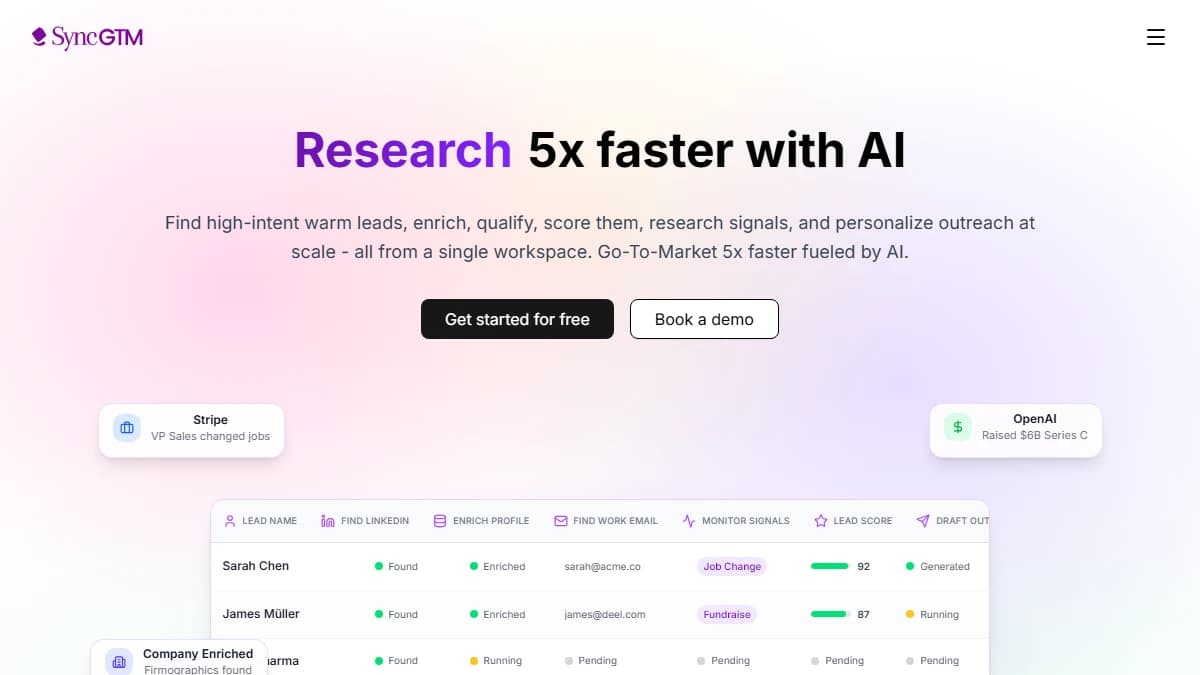
SyncGTM — waterfall enrichment across 50+ data providers with built-in workflow automation
SyncGTM is a data-first GTM platform built around waterfall enrichment. Instead of a single database, it queries 50+ data providers in sequence for each contact — using the first provider that returns a verified result. This architecture means coverage scales without hitting a ceiling.
For teams that run high-volume outbound, this matters. Single-source tools typically show 40–60% match rates on cold lists. SyncGTM's waterfall approach consistently achieves 70–85% verified coverage because gaps in one database get filled by the next.
Pros
- Waterfall enrichment across 50+ providers — highest match rate at scale
- Pay-per-verified-result model — no wasted credits on no-finds
- Workflow builder with CRM push — scales enrichment without manual ops
- AI web scraper for real-time company data — useful when static databases lag
- Month-to-month billing — no lock-in as your team grows
Cons
- No built-in email sequencing (integrates with Outreach, Salesloft, HubSpot)
- Not a fit for teams that want a single all-in-one sales engagement platform
Best for: Data-first GTM teams, RevOps, and growing SDR teams that want the highest contact coverage without vendor lock-in.
Pricing: Starts at $99/mo. Free tier available. Month-to-month.
2. Apollo.io
Apollo.io — 275M+ contact database with sequences and intent signals
Apollo.io is a sales intelligence and engagement platform with one of the largest self-serve databases available — 275M+ contacts across 73M+ companies. For growing teams, Apollo's scalability comes from its unified approach: prospecting, enrichment, sequences, and intent signals in one platform at $49/mo.
Apollo's credits scale with plan tier. The free plan includes 10,000 monthly export credits — more than enough for a solo SDR. Paid plans unlock bulk exports, advanced filters, and API access. For teams that want to grow from 1 to 10 SDRs without switching tools, Apollo handles it cleanly.
Pros
- 275M+ contacts — one of the largest self-serve databases
- Sequences, dialer, and intent signals built in — no extra tool needed
- Generous free tier (10,000 credits/mo) for testing at scale
- $49/mo starting price — strong value for mid-market teams
- API access on paid plans — supports custom enrichment workflows
Cons
- Data quality lags ZoomInfo and Cognism for phone numbers (direct dials ~40–50% mobile accuracy vs. Cognism's 70%+)
- Credit limits cap high-volume prospecting without upgrading plan
Best for: Mid-market and fast-growing SMB teams that want prospecting + engagement in one tool.
Pricing: Free tier available. Paid plans from $49/mo per user.
3. ZoomInfo
ZoomInfo — enterprise-grade data with 500M+ contacts and deep CRM integrations
ZoomInfo is the default choice for large enterprise sales teams that need the biggest B2B database available. With 500M+ contacts (more than double Apollo's count), intent data, conversation intelligence (Chorus), and deep integrations with Salesforce and HubSpot, it's built for scale from the ground up.
The scalability trade-off is cost. ZoomInfo contracts start at ~$15,000/year for a single seat and commonly run $30,000–$60,000+ for team plans. Annual auto-renewal makes it hard to downsize. For enterprises with 20+ SDRs and a stable ICP, that investment pays off. For growing teams, it's often overkill.
Pros
- 500M+ contacts — largest commercial B2B database available
- Intent data, conversation intelligence, and CRM sync built in
- Deep Salesforce and HubSpot integrations for enterprise workflows
- Verified phone numbers with higher direct dial accuracy than most
Cons
- Minimum $15,000/year contract — no monthly billing, no self-serve
- Notorious for aggressive auto-renewal and difficult cancellation
- Overkill for teams under 20 SDRs — cost-per-lead is hard to justify at SMB scale
Best for: Enterprise sales teams with 20+ reps, a defined ICP, and a $30k+ annual data budget.
Pricing: Custom quotes only. Starts ~$15,000/year. No free tier.
4. Cognism
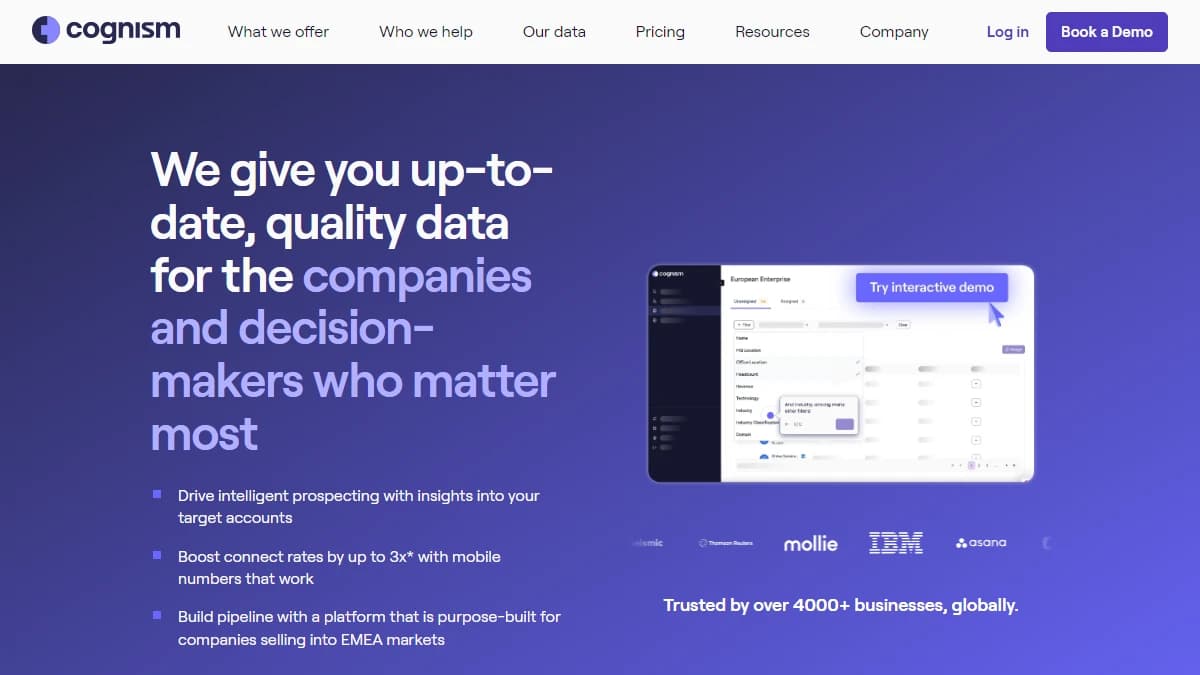
Cognism — phone-verified mobile data with GDPR compliance built in for European market scale
Cognism is the strongest option for European enterprise teams. Its Diamond Data tier — phone-verified mobile numbers with human confirmation — consistently achieves 70%+ connect rates, far ahead of unverified alternatives. GDPR compliance is built into the data layer, not bolted on.
Scalability is solid within European markets. Coverage thins outside EMEA, making it less suitable for global outbound at scale. Contracts start at approximately $15,000/year with annual commitments — similar to ZoomInfo on price, but with a more flexible credit model that doesn't penalize teams for low usage months.
Pros
- Diamond Data: phone-verified mobile numbers with 70%+ connect rates
- GDPR and CCPA compliance built into data sourcing
- Strong EMEA coverage — best European database of any platform
- Unlimited exports on most plans — no credit anxiety
Cons
- Annual contracts from ~$15k — no self-serve or monthly option
- Coverage drops significantly outside Europe and North America
- No built-in sequencing — requires Salesloft or Outreach
Best for: European enterprise teams or any global team where phone-verified mobile outreach is the primary motion.
Pricing: Annual contracts from ~$15,000/year.
5. Lusha
Lusha — 100M+ contacts with verified direct dials and one-click CRM enrichment
Lusha is a phone-first contact data platform with 100M+ records and a Chrome extension that layers on LinkedIn and company websites. It scales cleanly from individual SDRs (free tier: 50 credits/month) through mid-sized teams on the $49/mo plan.
Lusha's scalability ceiling is lower than ZoomInfo or Apollo — bulk list enrichment requires the Scale or Custom plan, and the database skews North American and European. For teams whose primary prospecting motion is phone outreach within those geographies, Lusha holds up well at scale.
Pros
- Free tier (50 credits/mo) for individual testing
- Direct dials and mobile numbers are the core strength
- Chrome extension for LinkedIn and website prospecting
- One-click Salesforce and HubSpot push
Cons
- Credit model penalizes scale — bulk operations require expensive Scale plan
- Coverage weaker in APAC and LATAM markets
- No built-in sequencing or engagement features
Best for: Teams whose primary motion is phone-first outreach within North America and Europe.
Pricing: Free (50 credits/mo). Paid from $49/mo. Scale plan for bulk usage.
6. SalesIntel
SalesIntel — human-verified contact data with unlimited seat plans for predictable cost scaling
SalesIntel differentiates on data verification — human researchers re-verify contacts every 90 days, targeting 95% accuracy across its 22M+ human-verified contacts. The scalability story here is about cost predictability: SalesIntel's unlimited seat model means adding team members doesn't trigger a per-user bill.
For revenue teams where predictable pricing matters as much as raw coverage, SalesIntel is a strong mid-tier option. The 22M verified contacts is significantly smaller than ZoomInfo or Apollo, so teams with very broad ICPs will hit coverage gaps faster.
Pros
- Human-verified contacts re-verified every 90 days — 95% accuracy claim
- Unlimited seats on most plans — cost scales with data usage, not headcount
- Research-on-demand: request contacts for specific companies
- Strong technographic and firmographic filters
Cons
- 22M human-verified contacts — smaller database than ZoomInfo or Apollo
- Verification latency: 90-day re-verification cycle means data can lag job changes
- No built-in sequencing or outreach features
Best for: Teams that prioritize data accuracy over volume and want predictable per-team pricing as headcount grows.
Pricing: Custom quotes. Unlimited seat model on most tiers. Roughly $5,000–$25,000/year.
7. Seamless.AI
Seamless.AI — real-time contact building with unlimited credits on the enterprise plan
Seamless.AI builds contact records in real time by crawling public web sources and verifying data on the fly. The scalability pitch is its unlimited credits model on the enterprise plan — teams can build as many lists as needed without worrying about credit depletion.
The real-time construction approach trades off consistency for freshness. Data quality varies by target persona — senior enterprise contacts tend to be well-covered, while mid-market and SMB contacts show more variance. For high-volume quantity-focused outbound, the unlimited credits model is genuinely useful.
Pros
- Unlimited credits on enterprise plan — best for pure volume outbound
- Real-time data construction — fresher than static databases
- LinkedIn, company website, and job board sourcing built in
- Starter plan from $147/mo covers small team needs
Cons
- Data quality inconsistent — real-time crawling produces variable accuracy across personas
- Aggressive upsell tactics noted in multiple G2 reviews
- No built-in sequencing; requires third-party integration
Best for: High-volume outbound teams that prioritize list quantity over contact-level accuracy.
Pricing: Free tier (50 credits). Basic from $147/mo. Enterprise: unlimited credits (custom pricing).
Side-by-Side Comparison
| Tool | Database Size | Scalability Model | Starting Price | Free Tier | Best Team Size |
|---|---|---|---|---|---|
| SyncGTM | 50+ providers (waterfall) | Pay per verified result | $99/mo | Yes | 1–500+ |
| Apollo.io | 275M+ contacts | Credit tiers by plan | $49/mo | Yes (10k credits/mo) | 1–100+ |
| ZoomInfo | 500M+ contacts | Annual contract + seats | ~$15k/year | No | 20–1000+ |
| Cognism | 400M+ profiles (EMEA-strong) | Annual contract, unlimited exports | ~$15k/year | No | 10–500+ |
| Lusha | 100M+ contacts | Credit tiers by plan | $49/mo | Yes (50 credits/mo) | 1–50+ |
| SalesIntel | 22M human-verified | Unlimited seats, usage-based | ~$5k/year | No | 5–200+ |
| Seamless.AI | Real-time (1.9B claimed) | Credit tiers / unlimited on enterprise | $147/mo | Yes (50 credits) | 1–200+ |
How to Choose the Right Tool for Your Scale
The right platform depends on where you are now and where you're going. Here are five decision points:
- Under 5 SDRs, under $200/mo budget:Start with Apollo.io's free tier or Lusha's free plan. Both give enough credits to validate your ICP without commitment.
- 5–20 SDRs, growing fast: SyncGTM or Apollo.io. SyncGTM wins if enrichment coverage is the constraint. Apollo wins if you want sequences + data in one place.
- 20+ SDRs, North American focus: ZoomInfo or Apollo.io. ZoomInfo for enterprise-grade integrations and the largest database. Apollo for cost-efficient scale without a $30k+ contract.
- European or GDPR-first team: Cognism. Phone-verified mobiles and GDPR compliance are built in — not retrofitted.
- Data accuracy over volume: SalesIntel. The unlimited seat model and 90-day re-verification make it the most predictable cost structure for teams that care about contact quality above all.
For more on building a scalable outbound system, see our post on how to scale B2B sales quickly and our comparison of the best waterfall contact providers in 2026.