

Winback Review 2026: Customer Reactivation Automated — Pricing and Results

By Kushal Magar · April 8, 2026 · 11 min read · Last updated: September 30, 2026
Key Takeaway
Winback covers two performance-based customer reactivation services. WinbackEngine uses trained human agents to call lapsed customers of multi-location service businesses like fitness studios, med spas, and dental practices; as of September 2026 it costs $1,000 to start a 30-day pilot plus 20% of net recovered revenue, with a 5x ROI guarantee or the fee back. Winback Labs brings an outsourced win-back program to SaaS companies with a 2x return guarantee. Main limitations: commission on every recovery, eligibility thresholds, a reactive strategy that depends on churn volume, and no help with why customers churned.
Winback is a customer reactivation service that recovers churned customers through targeted campaigns and trained human agents. The pitch: your lapsed customers are sitting revenue. Winback contacts them, gets them to rebook, and you only pay when it works.
You are probably here because churn is eating into your revenue and you want to know whether automated win-back campaigns actually deliver or whether you are better off investing in acquiring the right customers the first time.
This Winback review covers how the reactivation process works, what the performance-based pricing actually costs, where the model breaks down, and which of the two main Winback services fits your business.
Winback Review: What You Get (and What You Don't)
WinbackEngine and Winback Labs are two leading services in the customer reactivation space. Both use a performance-based model where you pay for results, not activity.
| Feature | What's Included | Limitations |
|---|---|---|
| Human Agents | WinbackEngine: trained agents make real phone calls to lapsed customers | Phone only; built for service businesses (fitness, dental, med spa, salons) |
| ROI Guarantee | WinbackEngine: 5x ROI in 30 days or the $1,000 fee back. Winback Labs: 2x return or the shortfall refunded | WinbackEngine also keeps 20% of net recovered revenue; Winback Labs' fee is not published |
| Recovery Campaigns | Winback Labs designs the offers, messaging, and sequences | Your team sends Winback Labs campaigns and carries the execution work |
| Churn Analytics | Recovery reporting; Winback Labs starts with an analysis of past customers and churn reasons | No churn prediction or prevention |
| SaaS Support | Winback Labs positions itself exclusively for SaaS companies | WinbackEngine is built for service businesses, not SaaS |
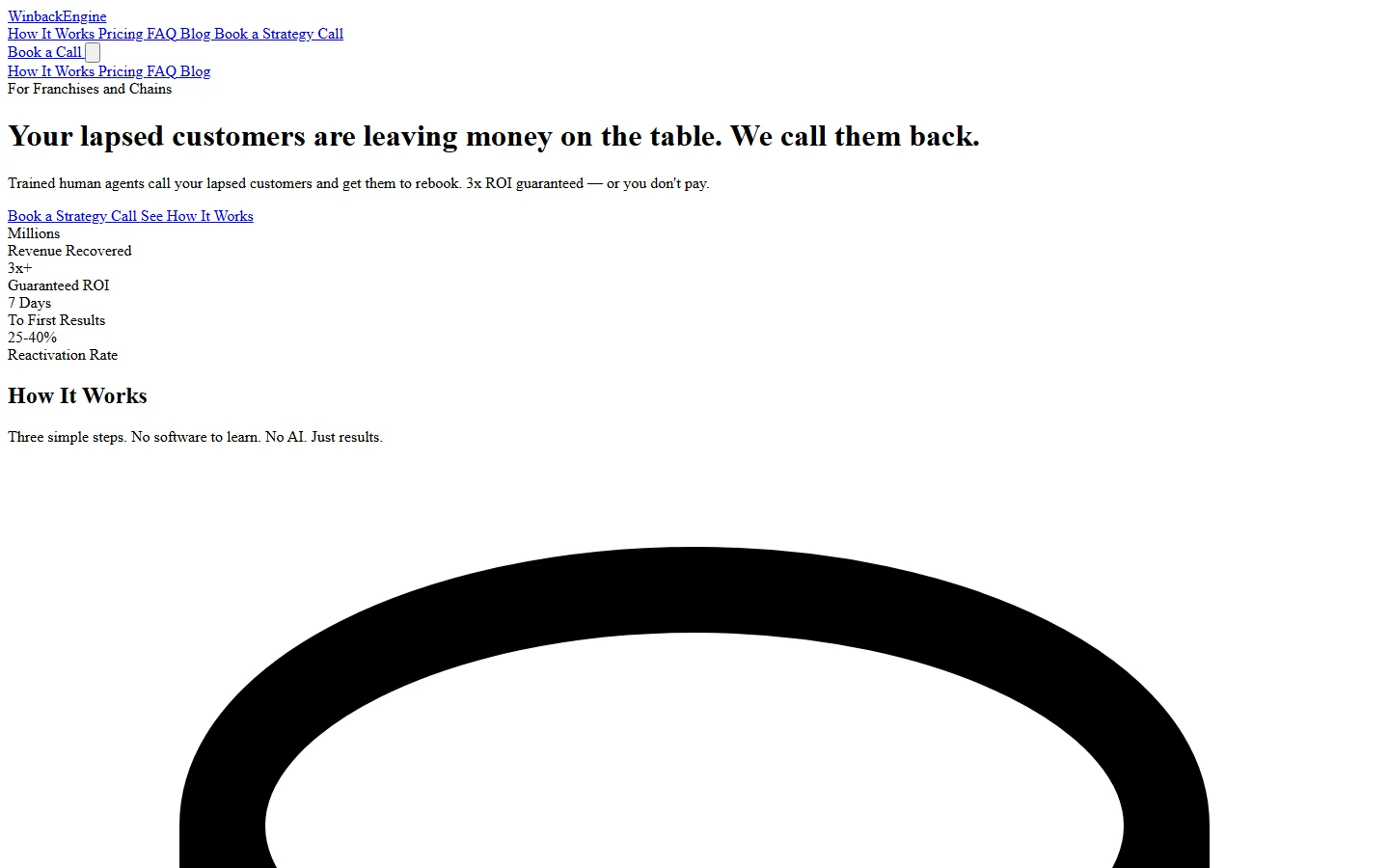
Winback homepage
The takeaway: WinbackEngine works well for recovering lapsed customers in service businesses, and Winback Labs brings a similar outsourced model to SaaS. Neither helps you acquire better customers in the first place or predict churn before it happens.
Winback Reactivation: How Customer Recovery Campaigns Work
WinbackEngine deploys trained human agents who call lapsed customers on your behalf. These are not robocalls or generic scripts. Each agent is briefed on your business, your service offerings, and common reasons customers leave. They make personalized calls to get lapsed members to rebook appointments and renew memberships.
According to WinbackEngine, the process runs in four steps. First, you connect your booking system or CRM; it integrates with Zenoti, Mindbody, Vagaro, WellnessLiving, Booker, Fresha, Phorest, and MarianaTek, or takes a CSV or API export. Second, the team builds tailored campaigns and call scripts. Third, agents are trained on your brand voice. Fourth, calls go out, and customers rebook or buy gift cards. Outreach is by phone — real calls from trained agents rather than email or SMS blasts — and most clients see bookings within 7 days of launch, the company says.
What works well
The performance-based model aligns incentives. As of September 2026, WinbackEngine asks for a $1,000 commitment fee to start a 30-day pilot, charges 20% of net recovered revenue billed weekly, and refunds the fee in full if it does not hit 5x ROI in 30 days. That keeps the cost of a trial low. Winback Labs, the SaaS-focused option, guarantees a 2x return on its program fee or refunds the difference.
Where it falls short
Winback is a reactive strategy. You are spending money to recover revenue that already left, and neither service does anything about why customers lapsed in the first place. Pair a win-back program with churn analysis — cancellation reasons, exit surveys, usage or visit drop-off — so fewer customers need winning back next quarter.
Winback Pricing Breakdown
Winback services use performance-based pricing rather than monthly subscriptions. Here are the two main options as of September 2026:
- •WinbackEngine ($1,000 to start): 30-day pilot, 20% of net recovered revenue billed weekly, 5x ROI guarantee in 30 days or the $1,000 commitment fee is refunded in full
- •Winback Labs (program fee not published): Outsourced win-back program for SaaS companies with a 2x return guarantee — for example, a $10,000 program fee must return $20,000+ in recovered revenue, or Winback Labs refunds the shortfall
What you actually pay
With WinbackEngine, the upfront cost is $1,000; after that, you pay 20% of net recovered revenue. A franchise with 500 lapsed members that recovers 50-100 at an average $200 lifetime value would generate $10,000-$20,000 in recovered revenue, of which roughly $2,000-$4,000 goes to WinbackEngine in commission. The guarantee protects the $1,000 fee, not the commission, so the real question is whether the recovered customers would have come back on their own.
Winback Labs requires a conversation to price. Use its 2x guarantee as the floor for your business case, and ask how recovered revenue will be measured before you sign.
Hidden costs to watch
- Commission on every recovery: WinbackEngine keeps 20% of net recovered revenue, billed weekly
- Unpublished pricing: Winback Labs' program fee requires a sales conversation
- Eligibility gates: WinbackEngine looks for 500+ lapsed customers and a $50+ average transaction; Winback Labs wants 2+ years of operating history
- Reactive model: you only benefit from churn, not from preventing it
What Are the Downsides of Using Winback?
Reactive, not proactive
Winback only generates revenue from customers who already churned. It does not help you prevent churn in the first place. Teams that invest heavily in win-back campaigns without fixing their acquisition quality end up in a cycle of churning and recovering the same customers.
Two services for two different markets
WinbackEngine is designed for service businesses: fitness studios, wax centers, spas, dental practices, med spas, chiropractic, salons, pet services, home services, and multi-location franchises. Winback Labs, by contrast, positions itself exclusively for SaaS companies. Make sure you are evaluating the right one. SaaS teams that would rather run win-back in-house can also look at software like ProsperStack or Recurly for subscription churn recovery.
Eligibility thresholds
Upfront cost is less of a barrier than it used to be: WinbackEngine's pilot starts at $1,000. The bigger gate is fit. WinbackEngine looks for businesses with 500+ lapsed customers and a $50+ average transaction, preferably multi-location, and Winback Labs wants 2+ years of operating history, a meaningful past-customer database, and no existing win-back program. Smaller businesses with limited churn volume may not qualify, or may not generate enough recoverable revenue to hit the guarantee thresholds.
Scalability ceiling
Win-back campaigns have a natural ceiling: your churned customer list is finite. Once you have recovered the high-value lapsed customers, recovery rates drop sharply. The strategy does not compound over time the way proactive acquisition does. Read our guide to best B2B prospecting tools for strategies that compound.
WinbackEngine vs Winback Labs: Which Fits Your Business
The two services share the win-back idea but serve different markets and work in different ways. Here is how they compare, based on each company's own site as of September 2026.
| Feature | WinbackEngine | Winback Labs |
|---|---|---|
| Built for | Service businesses: fitness, spas, dental, med spas, salons, pet and home services, franchises | SaaS companies |
| Upfront cost | $1,000 commitment fee for a 30-day pilot | Program fee not published |
| Ongoing cost | 20% of net recovered revenue, billed weekly | Not published |
| Guarantee | 5x ROI in 30 days, or the $1,000 fee is refunded in full | 2x return, or the shortfall is refunded |
| Who does the outreach | Trained human agents making phone calls | Winback Labs designs offers, messaging, and sequences; your team sends the campaigns |
| Data connections | Zenoti, Mindbody, Vagaro, WellnessLiving, Booker, Fresha, Phorest, MarianaTek, or a CSV/API export | Works from your past-customer data; recovered revenue is tracked in your own system |
| Best fit | 500+ lapsed customers, $50+ average transaction, multi-location preferred | 2+ years operating, a meaningful past-customer database, no existing win-back program |
Pick WinbackEngine if you run a membership or appointment business with a large lapsed-customer list and a booking system it already connects to. The phone-first model suits customers who respond to a personal call, and the $1,000 pilot makes it cheap to test; most clients see bookings within 7 days of launch, according to the company.
Pick Winback Labs if you are a SaaS company with years of churned accounts and no win-back program today. You keep control of the sends, which suits teams with strict brand or compliance rules, but you also carry the execution work. Winback Labs cites a 26% average recovery rate across 250+ benchmarked campaigns; treat that as a vendor benchmark and model your own pilot on a lower rate.
Whichever you choose, agree up front on how recovered revenue is measured. Both guarantees depend on it, and a clear definition of a recovered customer avoids disputes when the pilot ends.
Is Winback Worth It?
Winback is worth it for multi-location service businesses with high churn volumes and proven customer lifetime values. The performance-based pricing with ROI guarantees reduces risk. If you have hundreds or thousands of lapsed members and your average recovery is worth $200+, the math works in your favor.
WinbackEngine is not the right investment for SaaS companies — that is Winback Labs' market — or for businesses below its 500-lapsed-customer bar. And neither service is a substitute for fixing why customers leave: recovering churned customers is a band-aid if you keep acquiring low-fit customers.
The verdict:a valid revenue recovery channel with a natural ceiling. With WinbackEngine's pilot now starting at $1,000, the cheapest way to find out is to run one 30-day pilot and measure recovered revenue against the 5x guarantee.
Building a revenue strategy beyond reactivation? Read our guides on best buying intent data tools, best B2B prospecting tools, and our waterfall enrichment guide.
If Winback's focus on recovering churned customers rather than finding new ones is a dealbreaker, SyncGTM is one alternative worth a look: it tracks real-time buying signals such as job changes, funding, and hiring to surface in-market accounts.