

8 Best Sales Prospecting Tools for B2B Teams with Automated Contact Enrichment (2026)

By Kushal Magar · March 10, 2026 · 12 min read
Key Takeaway
This guide compares the 8 best sales prospecting tools for B2B teams with automated contact enrichment in 2026. SyncGTM leads with waterfall enrichment across 20 plus data sources, independent column refresh, AI research agents, and automated CRM push from $49 per month. Apollo.io offers a 275 million contact database with built-in email sequences from $49 per month. Explorium.ai provides agent-ready prospect and company enrichment across 146 million plus companies and 767 million plus professional profiles through an API and MCP server from $29.99 per credit package. Cognism specializes in GDPR-compliant European outbound with phone-verified mobile numbers at custom pricing. ZoomInfo delivers the deepest enterprise B2B database with 300 million contacts and intent signals starting at $15,000 per year. Lusha offers a browser extension for quick LinkedIn lookups from $36 per month. LinkedIn Sales Navigator provides LinkedIn-native prospecting with advanced account filters from $99.99 per month. TitanX adds a phone intent layer that identifies which prospects are actually reachable, with impact-based pricing and a 30-day pilot. The right choice depends on your enrichment needs, CRM stack, compliance requirements, and whether you need automation beyond basic contact lookup. For teams wanting automated waterfall enrichment with CRM push, SyncGTM offers the strongest value.
Finding the best sales prospecting tools for B2B teams with automated contact enrichment means looking past the database size claims. According to Salesforce's State of Sales report, sales reps spend only 28% of their week actually selling — the rest goes to manual data work, including looking up emails, verifying phone numbers, updating job titles, and chasing down company info that should already be in the CRM.
Automated contact enrichment fixes that. The right tool appends, verifies, and pushes contact data to your CRM automatically — so your reps hit the phones with complete records instead of spreadsheets full of gaps.
This post compares 7 sales prospecting tools built for B2B teams that need real automated contact enrichment — not just a database you manually export. Each has been evaluated on enrichment quality, CRM integration depth, credit efficiency, and true automation capability. SyncGTM customers report 42% more qualified meetings and 80% lower tool costs compared to running separate enrichment, outreach, and automation platforms.
Quick Summary
The best B2B sales prospecting tools with automated contact enrichment in 2026 are SyncGTM, Apollo.io, Explorium.ai, Cognism, ZoomInfo, Lusha, LinkedIn Sales Navigator, and TitanX. SyncGTM is the top pick for most GTM teams: it runs waterfall enrichment across 20+ data sources, charges credits only on successful matches, refreshes individual data columns on a schedule, and pushes enriched records directly to HubSpot, Salesforce, Pipedrive, or Attio — starting at $49/mo with no feature gates. Apollo.io ($49/mo) is the best budget all-in-one with a 275M+ contact database and built-in sequencing. Explorium.ai (from $29.99 per credit package) is the pick for teams automating prospecting inside AI agents via API or MCP, though it has no built-in sequencing. Cognism is the strongest choice for European outbound with phone-verified mobiles and GDPR compliance. ZoomInfo is the enterprise standard with 300M+ contacts and intent data, but starts at $15K+/year. Lusha is ideal for individual reps doing quick LinkedIn lookups at $36/mo per user.
TL;DR: Best Sales Prospecting Tools with Automated Contact Enrichment
- SyncGTM — Best overall for GTM teams. Waterfall enrichment across 20+ sources, independent column refresh, and CRM push from $49/mo.
- Apollo.io — Best for budget teams. 275M+ contacts with built-in sequencing from $49/mo.
- Explorium.ai — Best for AI-agent prospecting. 146M+ companies and 767M+ profiles via API and MCP server. Free trial (100 credits), then from $29.99 per credit package.
- Cognism — Best for GDPR-sensitive outbound. Phone-verified mobile numbers with strong European coverage.
- ZoomInfo — Best for enterprise. 300M+ contacts with buying intent signals — but requires a $15K+ annual contract.
- Lusha — Best for individual reps. Fast contact lookup via browser extension from $36/mo.
- LinkedIn Sales Navigator — Best for LinkedIn-first teams. Real-time signals and advanced filters directly inside LinkedIn.
- TitanX — Best for phone-led outbound. Phone intent data that prioritizes the prospects most likely to answer.
Why Automated Enrichment Changes B2B Prospecting
A contact database is not the same as automated enrichment. Most tools give you a list — it's on you to figure out what's missing, pull in the gaps, and sync it to your CRM manually.
Automated contact enrichment means the tool does the work: it identifies missing fields, pulls from multiple data providers in a cascade, verifies what it finds, and writes the result directly to your CRM record — without a human in the loop.
The difference matters at scale. A team running 500 outbound contacts per week without enrichment automation spends 10–15 hours on data work that should take zero. B2B contact data decays at roughly 30% per year — meaning nearly a third of your CRM is stale within 12 months without automated re-enrichment. The tools on this list eliminate that overhead — but they vary significantly in how automated that process actually is, and what it costs to access the CRM push features.
What we evaluated
- Enrichment depth: How many data points does the tool append automatically? Just email, or also mobile, LinkedIn URL, company tech stack, funding stage?
- Waterfall logic: Does the tool cascade across multiple providers to maximize match rates, or rely on a single source?
- CRM push automation: Can enriched data be pushed to HubSpot or Salesforce automatically — or does it require a manual export?
- Credit efficiency: Are you charged for failed lookups? Can you refresh only the fields that changed?
- Pricing transparency: Is the price published? Are key features gated behind enterprise tiers?
1. SyncGTM — Built for Automated Contact Enrichment from Day One
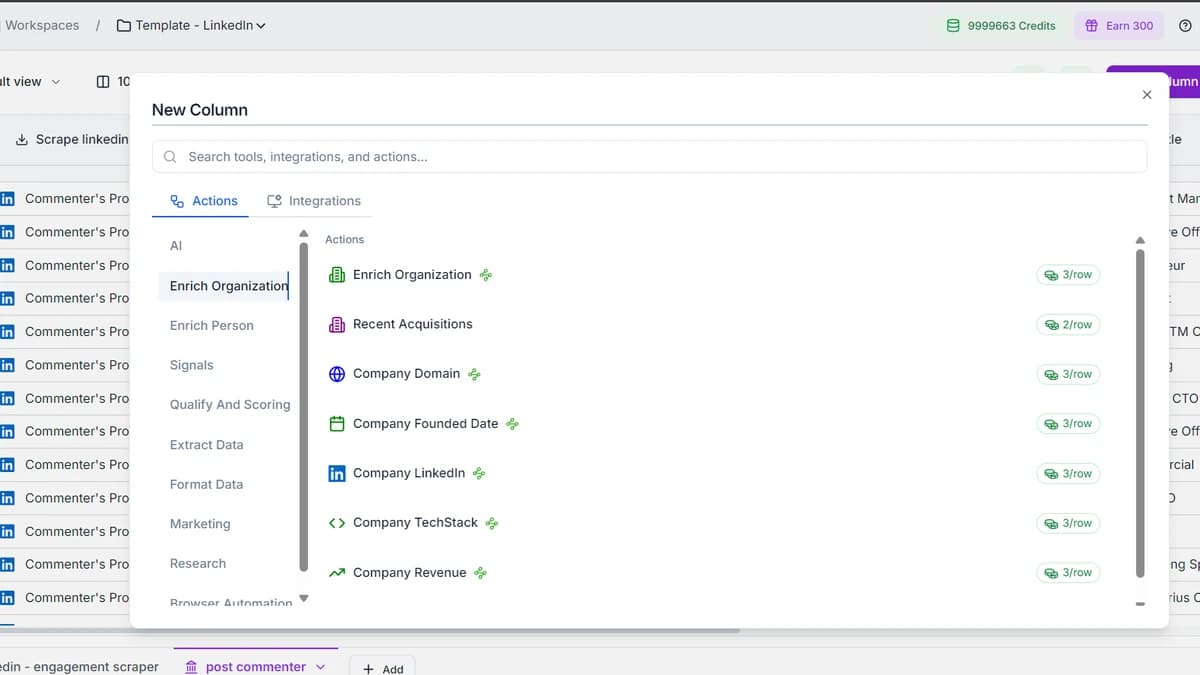
SyncGTM — waterfall enrichment across 20+ sources with automated CRM push
SyncGTM is an AI-native GTM platform purpose-built for automated contact enrichment workflows. Where most prospecting tools treat enrichment as a feature bolted on to a database, SyncGTM is designed around it — every workflow starts with sourcing leads, enriching them across multiple providers in a waterfall enrichment cascade, and pushing the verified results directly to your CRM.
The data enrichment runs across 20+ data sources. If the first provider can't return a verified email, it cascades to the next — and only charges a credit when a result is actually returned. That alone makes it meaningfully more credit-efficient than tools that charge per attempt.
Two features set SyncGTM apart from every other tool on this list. Independent column refresh lets you auto-update a single data field on a schedule — say, re-verifying job titles monthly — without re-running your entire table and burning credits on data you already have. Trigger columns let you set dependencies so downstream enrichment steps only fire when upstream conditions are met. No wasted lookups. The workflow builder makes this setup accessible without a dedicated RevOps engineer.
CRM integrations with HubSpot, Salesforce, Pipedrive, and Attio are available on every paid plan starting at $49/mo. Many enrichment tools lock the same feature behind higher tiers. SyncGTM also includes AI research agents on all plans — including the free tier — for prospect research, company intelligence, and workflow automation.
Pros
- ✓ Waterfall enrichment across 20+ providers — charges only on successful matches
- ✓ Independent column refresh — update one field without re-running the table
- ✓ CRM push (HubSpot, Salesforce, Pipedrive, Attio) from $49/mo
- ✓ AI research agents included on every plan including free
- ✓ Trigger columns prevent wasted credits on conditional workflows
- ✓ Live LinkedIn data — no 3-month lag
- ✓ Buying signals on all paid plans
Cons
- ✗ Smaller brand recognition than Apollo or ZoomInfo
- ✗ No built-in email sending sequences (pairs with your existing outreach tool)
- ✗ Free tier limited to 200 credits/mo for testing
Best for: GTM teams, RevOps, and outbound sales teams that need automated contact enrichment with direct CRM push — without paying enterprise prices for core workflow features.
Pricing: Free tier (200 credits/mo). Solo $49/mo (1,000 credits). Growth $99/mo (3,000 credits). Pro $249/mo (10,000 credits). Business $649/mo (40,000 credits). CRM integrations, HTTP requests, and webhooks available on all paid plans.
Start enriching contacts automatically. Try SyncGTM free — no credit card required. Or take a product tour to see the enrichment workflow live, or browse templates to get started instantly.
2. Apollo.io — Large Database with Built-in Sequencing
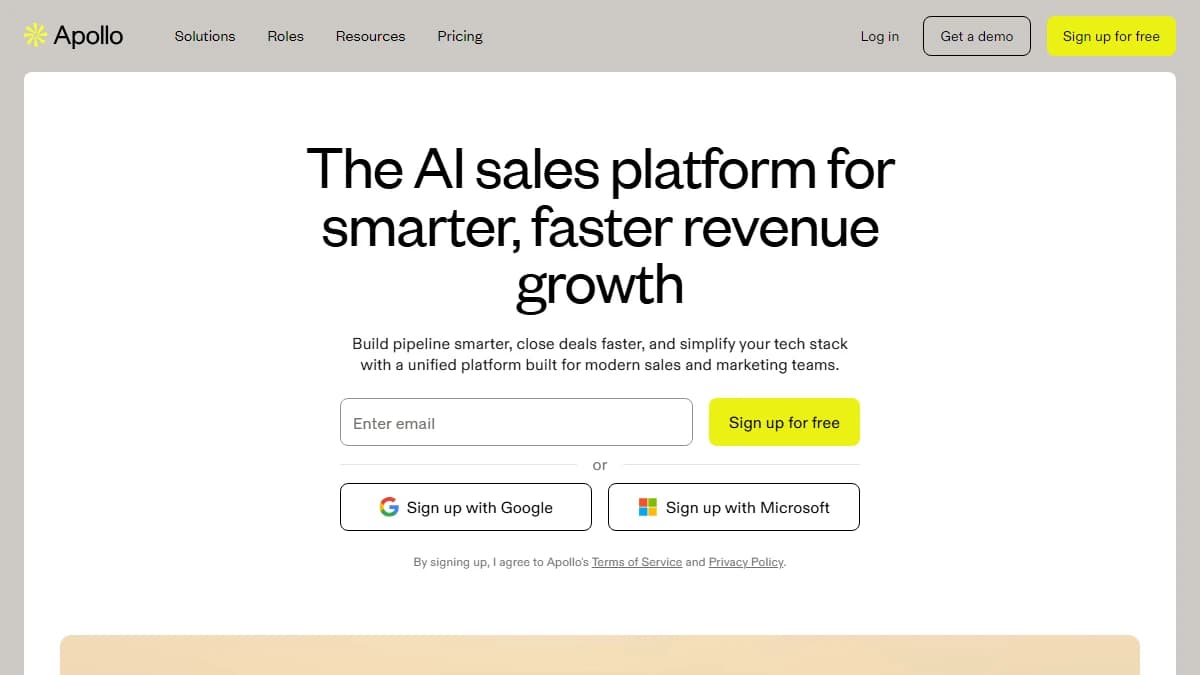
Apollo.io — 275M+ contact database with built-in email sequencing and enrichment
Apollo.io is the most widely adopted prospecting and enrichment platform for B2B sales teams, combining a 275M+ contact database with email sequencing, dialer, and enrichment in a single product.
Its enrichment feature lets you bulk-enrich existing contact lists — upload a CSV with names and companies, and Apollo appends emails, direct dials, LinkedIn URLs, and firmographic data. The enrichment relies primarily on Apollo's own database, which is strong for North American contacts but has mixed coverage in APAC and Southern Europe.
The CRM integration with HubSpot and Salesforce is available on paid plans and supports bidirectional sync — enriched records push back to your CRM automatically. The free tier is genuinely useful for small teams testing the database, though enrichment credits are limited.
Pros
- ✓ 275M+ contacts — one of the largest B2B databases available
- ✓ Enrichment + sequencing in a single platform
- ✓ HubSpot and Salesforce CRM sync on paid plans
- ✓ Accessible free tier for database testing
- ✓ Strong G2 rating (4.8/5 from 7,000+ verified reviews, per G2.com)
Cons
- ✗ Enrichment from a single source — no waterfall across providers
- ✗ Data quality drops outside North America
- ✗ Credit limits on free/basic tiers restrict enrichment volume
- ✗ No independent column refresh — full table re-runs burn credits
Best for: Growing B2B sales teams that want a combined prospecting database and outreach tool at an accessible price point.
Pricing: Free tier available. Basic $49/mo. Professional $99/mo. Organization $149/mo per user. Annual discounts available.
3. Explorium.ai — Agent-Ready Prospect Data and Enrichment API
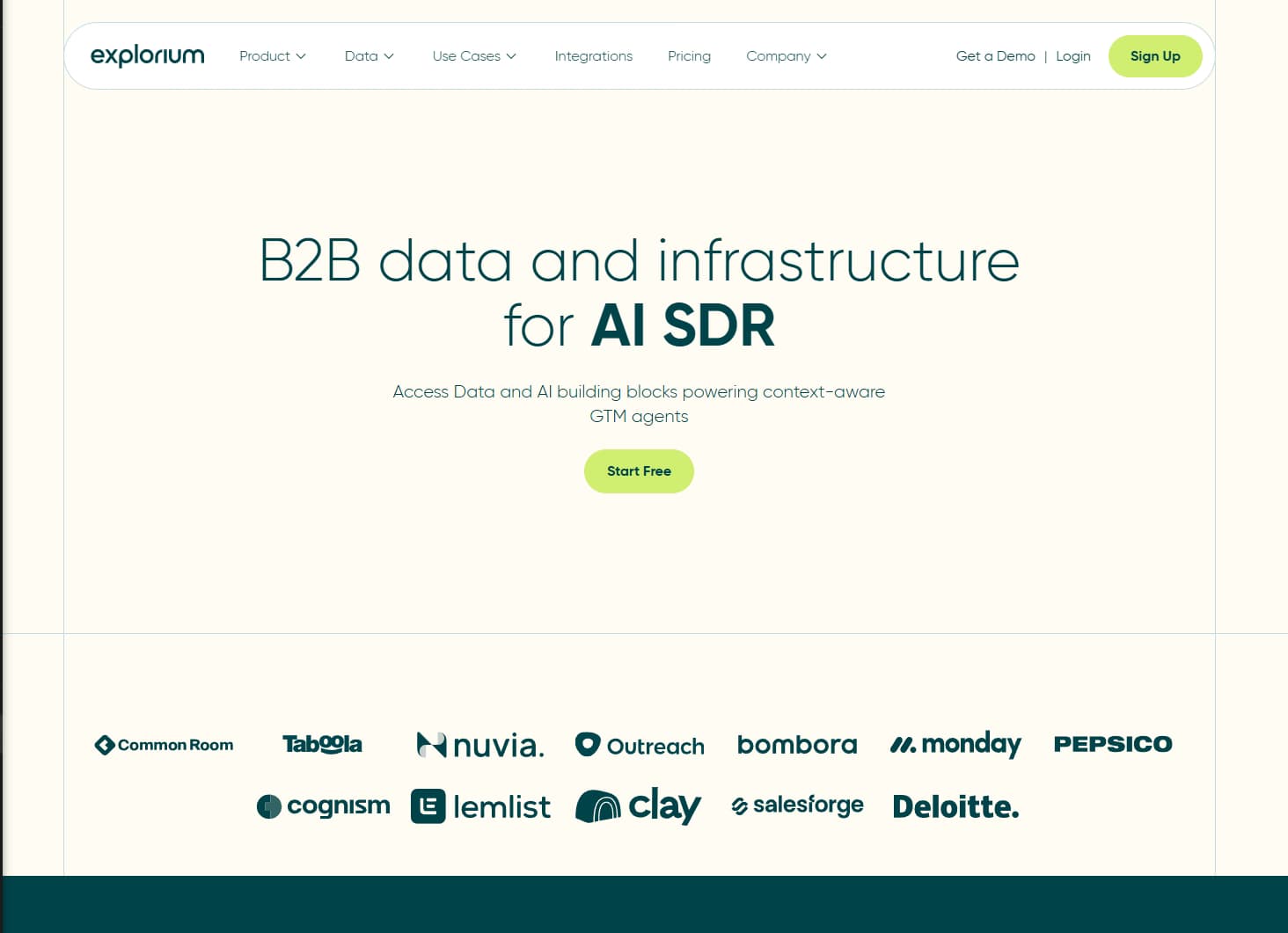
Explorium.ai — prospecting and contact enrichment through an API, MCP server, and plain-English prompts
Explorium.ai is a B2B data platform built for AI agents and the teams automating prospecting with them. Its dataset covers 146M+ companies and 767M+ professional profiles, and you reach it through the AgentSource REST API, a hosted MCP server, or Vibe Prospecting, which builds and enriches prospect lists from plain-English prompts inside Claude or ChatGPT.
For automated contact enrichment, AgentSource matches companies and prospects, then fills in work emails, phone numbers, professional history, firmographics, and technographics in bulk calls of up to 50 records. Event monitoring flags funding rounds, job changes, hiring, and tech changes, so an agent can re-enrich or re-prioritize prospects when something changes instead of on a fixed schedule. Explorium reports 97.8%+ company match accuracy.
The tradeoff is setup and scope. The API and MCP paths assume some technical comfort, and there is no built-in email sequencing, so enriched prospects still go to a separate sending tool. Native CRM integrations cover Salesforce and HubSpot; other CRMs need a custom integration on the Enterprise plan or your own API work. Credit cost also varies by enrichment type, from 1 to 5 credits per enrichment.
Pros
- ✓ 146M+ companies and 767M+ professional profiles from 100+ sources
- ✓ AgentSource API and hosted MCP server for enrichment inside AI agents
- ✓ Real-time events (funding, job changes, hiring, tech changes) to trigger re-enrichment
- ✓ Vibe Prospecting builds enriched prospect lists from plain-English prompts
Cons
- ✗ No built-in email sequencing, inbox, or dialer
- ✗ API and MCP paths require technical setup time
- ✗ Native CRM integrations limited to Salesforce and HubSpot below Enterprise
- ✗ Credit cost varies by enrichment type (1–5 credits per enrichment)
Best for: Technical GTM teams building AI agents or automated prospecting workflows that need contact and company enrichment on demand, and that run Salesforce or HubSpot.
Pricing: Free trial (100 credits). Lite $29.99 (500 credits). Starter $149.99 (5,000 credits). Growth $749.99 (30,000 credits). Scale $7,499.99 (500,000 credits). Enterprise custom.
4. Cognism — GDPR-Compliant Data with Phone-Verified Mobiles
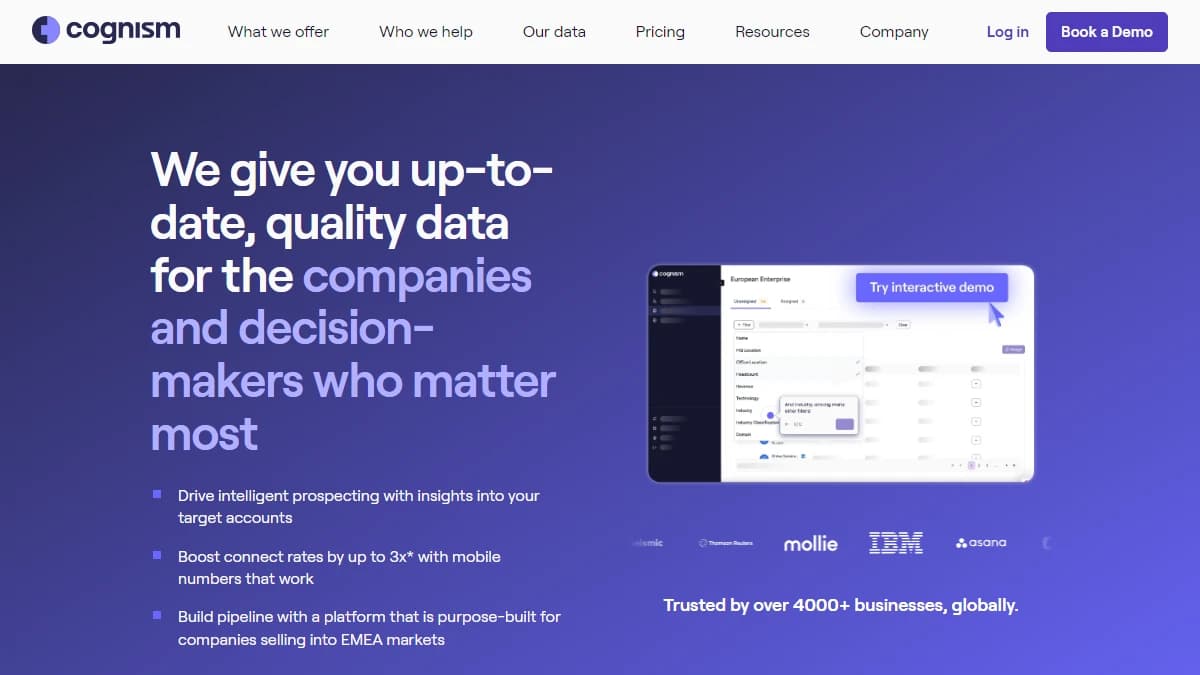
Cognism — GDPR-compliant B2B data with phone-verified mobile numbers
Cognism is a B2B data and contact enrichment platform with a specific differentiator: phone-verified mobile numbers. Most data providers return phone numbers from scraped or aggregated sources. Cognism runs a human verification step on mobile numbers — important for teams whose outbound relies on cold calling.
European data coverage is Cognism's strongest suit. If your ICP is in the UK, DACH, Nordics, or Southern Europe, Cognism will consistently outperform US-centric databases like Apollo or ZoomInfo on both accuracy and compliance. GDPR and CCPA compliance is built into the data collection and consent workflow.
The enrichment workflow connects to HubSpot, Salesforce, Pipedrive, and Outreach. Pricing is custom — you'll need a sales call to get a number. Most mid-market teams report spending $12,000–$30,000 per year depending on seat count and data volume.
Pros
- ✓ Phone-verified mobile numbers — higher connect rates on cold calls
- ✓ Best-in-class European data coverage
- ✓ GDPR and CCPA compliant by design
- ✓ CRM integrations with HubSpot, Salesforce, Pipedrive, Outreach
- ✓ Intent signals from Bombora included on higher tiers
Cons
- ✗ No published pricing — requires a sales call
- ✗ Typically $12K–$30K/year — not accessible for small teams
- ✗ Weaker coverage in North America vs. European markets
- ✗ No waterfall enrichment logic — single-source provider
Best for: B2B sales teams prospecting into European markets who need GDPR-safe data and rely on cold calling as a primary outbound channel.
Pricing: Custom. Estimated $12,000–$30,000/year depending on seats and data package. No self-serve option.
5. ZoomInfo — Enterprise-Scale Intelligence with Buying Intent
ZoomInfo — 300M+ B2B contacts with buyer intent signals and enterprise enrichment
ZoomInfo is the dominant enterprise B2B data and enrichment platform, covering 300M+ contacts with deep firmographic data, technographic signals, and proprietary buying intent data.
The buying intent layer is ZoomInfo's primary differentiator. The platform tracks when target accounts are researching topics related to your category — surfacing accounts that are actively in-market before they submit a form. For enterprise sales teams running account-based motions, this signal layer justifies the cost.
Enrichment is deep: ZoomInfo can append 200+ data fields to a contact or company record, including org charts, funding history, technographic stack, and department headcount. CRM sync with Salesforce, HubSpot, and Dynamics is native on paid tiers. The catch is the contract — ZoomInfo starts at $15,000+/year and typically requires a multi-year commitment.
Pros
- ✓ 300M+ contacts — largest verified B2B database
- ✓ Proprietary buying intent signals to surface in-market accounts
- ✓ 200+ data fields per contact including org chart and tech stack
- ✓ Native CRM sync with Salesforce, HubSpot, Dynamics
- ✓ Strong data accuracy — continuous verification process
Cons
- ✗ $15,000+ per year minimum — not viable for small teams
- ✗ Multi-year contracts are common; exit is difficult
- ✗ Complex platform — significant onboarding overhead
- ✗ Weaker coverage in APAC and emerging markets
Best for: Enterprise B2B sales teams running account-based programs who need the deepest possible contact data and buying intent signals.
Pricing: Custom. Starting at approximately $15,000/year. Most enterprise contracts run $25,000–$60,000+/year. No self-serve option.
6. Lusha — Fast Contact Lookup for Individual Reps
Lusha — real-time contact lookup via browser extension for B2B sales reps
Lusha is a contact data tool built around a browser extension that surfaces email addresses and direct dials while you browse LinkedIn profiles or company websites. It's the fastest way for individual reps to get contact data without leaving the workflow they're already in.
Lusha's bulk enrichment feature lets you upload a contact list and enrich it against Lusha's database — returning emails, direct dials, and company data. The database leans heavily on crowdsourced signals from its own user base, which creates broad coverage in tech and SaaS but thinner data in niche industries.
CRM integration (HubSpot, Salesforce, Pipedrive) is available on Team and Business plans. The free tier (5 credits/month) is mainly for testing. At $36/mo per user, Lusha is one of the most accessible enrichment tools — but it's better suited as a point lookup tool than a full enrichment automation platform.
Pros
- ✓ Browser extension — contact data in one click while on LinkedIn
- ✓ Accessible pricing from $36/mo per user
- ✓ Strong mobile number coverage in North America
- ✓ CRM sync with HubSpot, Salesforce, Pipedrive on Team plans
- ✓ Bulk enrichment available for list processing
Cons
- ✗ No waterfall enrichment — single-source lookups only
- ✗ No automated enrichment workflows or scheduling
- ✗ Thinner data in industries outside tech/SaaS
- ✗ Free tier too limited for real team usage (5 credits/mo)
Best for: Individual SDRs and AEs who need fast contact lookups while prospecting on LinkedIn — not teams running automated enrichment pipelines.
Pricing: Free (5 credits/mo). Pro $36/mo per user. Premium $59/mo per user. Team and Business plans with custom pricing for higher volumes.
7. LinkedIn Sales Navigator — Real-Time Signals for LinkedIn-First Teams
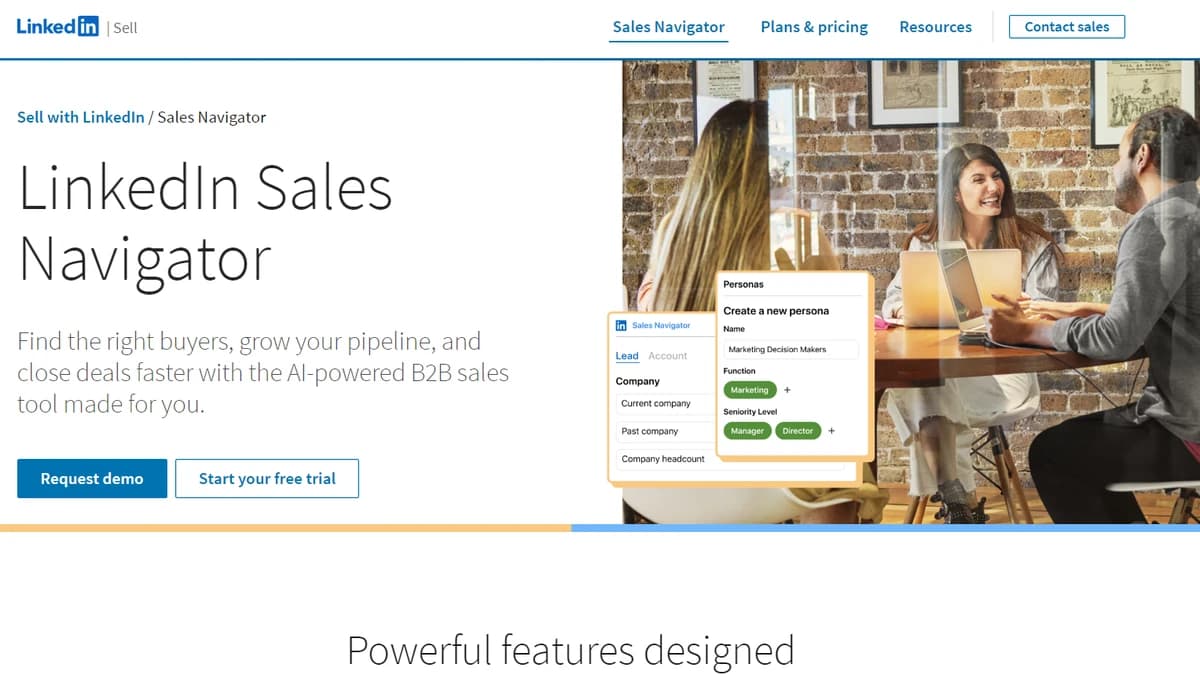
LinkedIn Sales Navigator — real-time LinkedIn signals and advanced account filters
LinkedIn Sales Navigator gives you the most accurate real-time professional data available — because it comes directly from the source. 900M+ professionals update their own LinkedIn profiles continuously, which means job titles, company changes, and career moves are captured the moment they happen, not months later.
The advanced search and filtering (300+ filter options) let you build highly specific prospect lists by seniority, function, company growth rate, recent headcount changes, or job posting activity. The "Alerts" feature surfaces buying signals automatically — job changes, mentions in the news, new posts from your saved accounts.
Where Sales Navigator falls short is enrichment automation. It's a sourcing tool, not an enrichment platform. You can't extract contact emails or phone numbers natively — you'll need to pair it with an enrichment tool like SyncGTM or Lusha to get actionable contact data. CRM sync is available with HubSpot and Salesforce but is limited compared to purpose-built enrichment platforms.
Pros
- ✓ Most accurate professional data — directly from LinkedIn profiles
- ✓ Real-time signals on job changes, company events, and account activity
- ✓ 300+ advanced search filters for precise ICP targeting
- ✓ InMail credits included for direct outreach on platform
- ✓ CRM sync with HubSpot and Salesforce
Cons
- ✗ No email or phone number export — requires pairing with enrichment tool
- ✗ Not an enrichment platform — no CRM data push automation
- ✗ $99.99/mo per user — adds up fast for teams
- ✗ LinkedIn platform restrictions limit outreach volume
Best for: Sales teams whose primary prospecting channel is LinkedIn and who need real-time account signals — best paired with an enrichment tool for contact data.
Pricing: Core $99.99/mo per user. Advanced $179.99/mo per user. Advanced Plus (with CRM sync) requires custom quote.
8. TitanX — Phone Intent Data That Finds Prospects Who Actually Answer
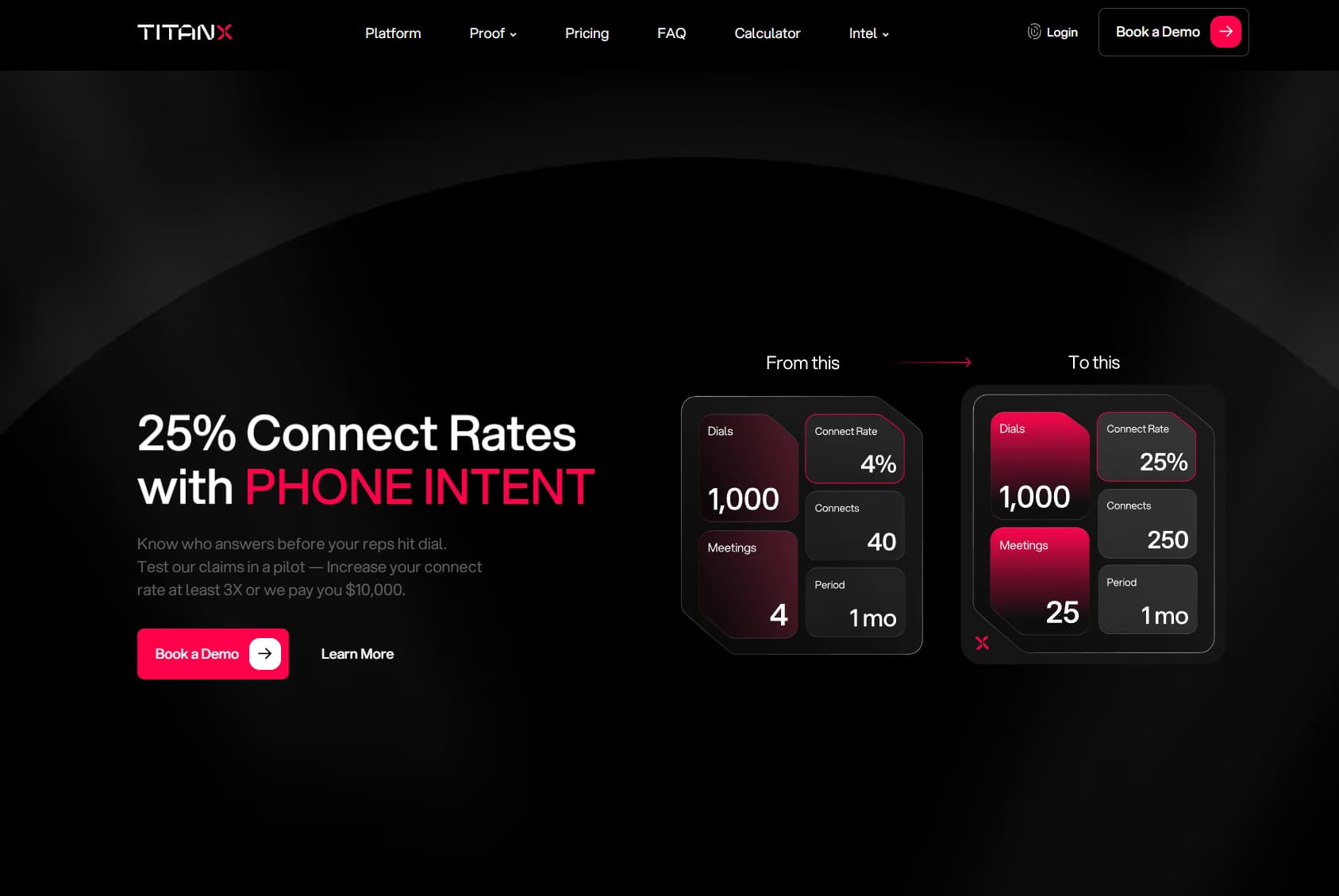
TitanX — Phone Intent Engine identifies active prospects to maximize dial-to-conversation ratios
TitanX is a specialized outbound intelligence platform built for the "Precision Era" of sales. Unlike tools that optimize for dial volume, TitanX focuses on conversation density by identifying which prospects are actually likely to answer. Its Phone Intent Engine analyzes behavioral patterns across 100 million+ phone numbers to surface the 20% of contacts who are active and reachable.
From an integration standpoint, TitanX is designed to be a plug-and-play layer that sits atop your existing GTM stack. It works natively with all major data providers, phone systems, and sales engagement platforms. By syncing directly with your dialer, it ensures reps only spend time on at-bats that have a high probability of connecting, effectively tripling connect rates without increasing headcount or burn.
Pros
- ✓ Stack-agnostic integration — works with any data provider, dialer, or sales engagement platform
- ✓ Immediate ROI — customers frequently report 3x to 5x increases in connect rates within the first week
- ✓ Reduces dead air — prevents the caller reputation damage and spam flagging caused by parallel dialers
- ✓ Behavioral intelligence — identifies the 20% answer rate pattern to prioritize outreach
Cons
- ✗ Phone-focused — does not include multi-channel sequence builders or email automation features
- ✗ Dependent on existing stack — requires an active dialer and data source to realize Phone Intent value
Best for: Sales teams and SDR managers who want to maximize conversation density and stop burning accounts with high-volume, low-precision dialing.
Pricing: Impact-based pricing (not seat-based). Offers a 30-day pilot with a 3X connect rate or $10,000 guarantee.
Side-by-Side Comparison: Sales Prospecting Tools with Automated Enrichment
Here's how all 7 tools compare on the criteria that matter most for B2B teams running automated contact enrichment workflows. SyncGTM's full pricing details are available on the pricing page.
| Tool | Best For | Free Tier | Starting Price | Standout Feature |
|---|---|---|---|---|
| SyncGTM | GTM teams that need automated enrichment + CRM push | Yes (200 credits/mo) | $49/mo | Waterfall enrichment across 20+ sources with independent column refresh |
| Apollo.io | Budget-conscious teams wanting database + sequencing | Yes (limited) | $49/mo | 275M+ contact database with built-in email sequences |
| Explorium.ai | Technical teams automating prospecting with AI agents | Yes (100-credit trial) | $29.99/pkg | AgentSource API + MCP server with real-time prospect events |
| Cognism | European outbound teams prioritizing GDPR compliance | No | Custom | Phone-verified mobile numbers with GDPR/CCPA coverage |
| ZoomInfo | Enterprise teams needing deep firmographic data | No | Custom ($15K+/yr) | Intent data + buyer signals across 300M+ contacts |
| Lusha | SMB reps who need quick contact lookups | Yes (5 credits/mo) | $36/mo | Browser extension for instant contact data on LinkedIn |
| LinkedIn Sales Navigator | Teams whose primary channel is LinkedIn outreach | No | $99.99/mo | Real-time LinkedIn signals and advanced account filters |
| TitanX | Outbound teams that want higher connect rates on the phone | No (30-day pilot) | Custom (impact-based) | Phone Intent Engine surfaces the 20% of contacts actually reachable |
How to Choose the Right Sales Prospecting Tool
The right choice depends on your team size, technical sophistication, budget, and how automated you need the enrichment to be. Here's a simple framework:
- If you need automated enrichment with direct CRM push from a low starting price — go with SyncGTM. It's the only tool on this list that gives you waterfall enrichment, independent column refresh, and CRM sync starting at $49/mo.
- If you want one tool for database + sequencing + enrichment on a tight budget — go with Apollo.io. $49/mo with 275M+ contacts is the most accessible all-in-one starting point.
- If you are building AI agents that prospect and enrich on their own — go with Explorium.ai. 146M+ companies, a hosted MCP server, and real-time prospect events — but pair it with a sending tool.
- If your ICP is in Europe and cold calling is core to your outbound — go with Cognism. Phone-verified mobiles and GDPR compliance are worth the custom pricing for European teams.
- If you're an enterprise team running account-based programs and need intent data — go with ZoomInfo. The depth of firmographic data and intent signals justify the $15K+ commitment at scale.
- If you're an individual rep doing point lookups while browsing LinkedIn — go with Lusha. $36/mo is the lowest price of entry for a real enrichment lookup tool.
Final Verdict
For most B2B sales teams running outbound with automated contact enrichment, the choice comes down to budget and how much automation you actually need. Apollo.io wins on price. ZoomInfo wins on data depth. Cognism wins in Europe. Explorium.ai wins for AI agents.
But if you need automated enrichment that actually runs without a human in the loop — with waterfall logic, independent column refresh, and automatic CRM push from a price that growing teams can justify — SyncGTM is the clearest answer. It's the only platform on this list built specifically around enrichment automation, not as an add-on to a database or a sequencing tool.
Start on the free tier to test the enrichment waterfall on your own contact list. Connect your CRM. See what fills in automatically. That's usually enough to know if the workflow fits — before committing to a paid plan.
This post was last reviewed in March 2026. Pricing and features are verified against each vendor's public pricing page as of that date. For the most current pricing, check each vendor directly.
Related reading
- The Best Clay Alternative for GTM Teams in 2026 — Full comparison of SyncGTM vs Clay on pricing, features, and credit efficiency.
- How to Add Data Enrichment to Zoho CRM — Step-by-step guide for enriching Zoho records with SyncGTM and other tools.
- SyncGTM Enrichment Templates — Pre-built enrichment workflows you can clone and run in minutes.