

Dealfront Review 2026: European Sales Intelligence — Pricing After Leadfeeder Merger

By Kushal Magar · April 9, 2026 · 11 min read · Last updated: September 30, 2026
Key Takeaway
Dealfront (rebranded as Leadfeeder in March 2026) is the go-to for GDPR-compliant European sales intelligence, but its value drops sharply outside DACH and Nordics. Pricing is now public: a free Lite plan, then paid tiers from €79/mo, with verified contact data starting at €369/mo on annual billing (as of September 2026).
If you're selling into Europe and using a US-first data provider, you've probably run into the GDPR wall. Contact data pulled from Apollo or ZoomInfo may not meet European data protection requirements — and that's a compliance risk that legal teams take seriously.
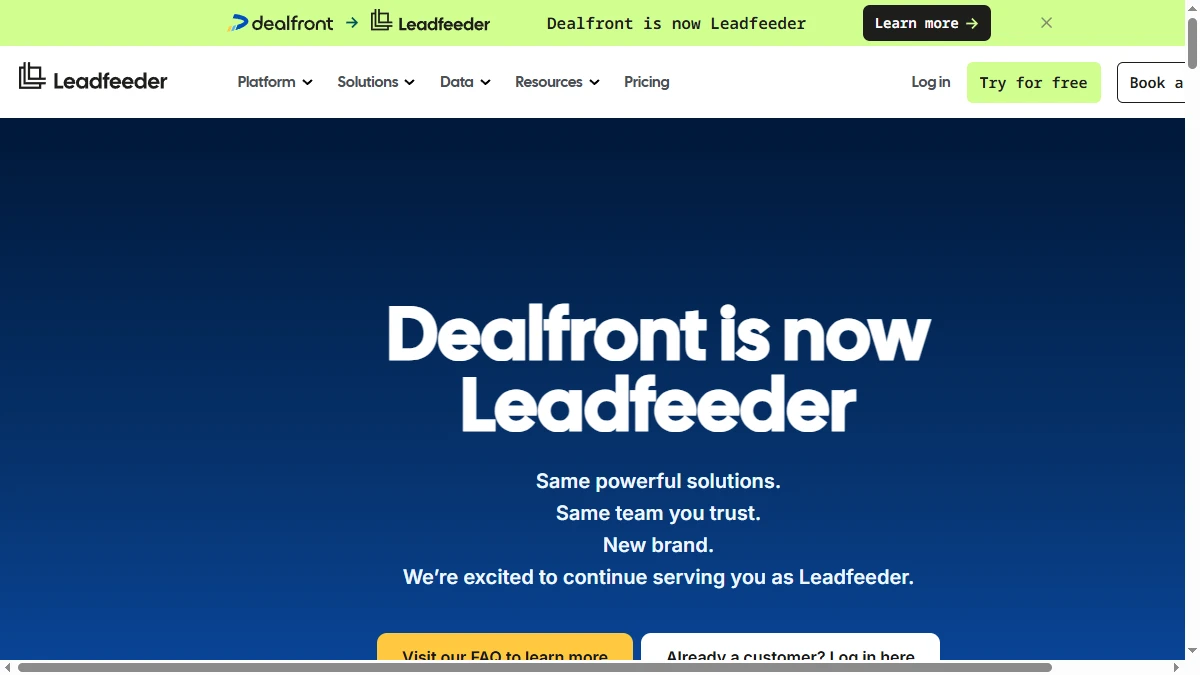
Dealfront was built specifically to solve this problem. Born from the merger of Echobot, Minttel, and Leadfeeder, it positions itself as the European alternative to US sales intelligence platforms — with GDPR-compliant B2B data and website visitor identification in a single platform. One thing to know up front: on March 24, 2026, Dealfront rebranded as Leadfeeder, so the same platform is now sold under that name.
This Dealfront review covers what changed after the Leadfeeder merger and the 2026 rebrand, where the data coverage holds up and where it doesn't, what the pricing actually looks like, and whether EMEA teams should be using it in 2026. If you're comparing Dealfront against Leadfeeder (now part of Dealfront) or looking at alternatives like Cognism, this review gives you the honest comparison.
Dealfront Review: What You Get (and What You Don't)
Dealfront is a modular platform combining European B2B company data, contact enrichment, website visitor identification, and buyer intent signals — all built with GDPR compliance as a core requirement rather than an afterthought.
| Feature | What's Included | Limitations |
|---|---|---|
| European B2B Data | Company records, contacts, financials from EU registries | Strongest in DACH and Nordics; uneven in Southern Europe |
| Website Visitor ID | Identify companies visiting your site (the Leadfeeder module, now called Web Visitors) | Person-level ID limited by cookie consent; GDPR impact |
| Buyer Intent | European intent data from content consumption signals | Weaker coverage than Bombora for US markets |
| Contact Enrichment | Email, phone, LinkedIn from European sources | Mobile/direct numbers harder to source under GDPR |
| CRM Integration | Salesforce, HubSpot, Pipedrive, Zoho native integrations | Some field mapping requires manual configuration |
| Prospecting | European company search with firmographic filters | Not competitive with Apollo for global prospecting volume |
European B2B Data: Coverage and GDPR Compliance
Dealfront sources data from official European company registries, public records, and GDPR-compliant data partnerships. This means the data is legally sound for European outreach — but it also means data depth is constrained compared to US providers that aggregate from broader (sometimes legally grey) sources.
Coverage is strongest in Germany, Austria, Switzerland (DACH), and the Nordic markets (Sweden, Denmark, Norway, Finland). These are markets where Echobot and Minttel had years of database investment before the merger. Southern Europe (Spain, Italy, Portugal) and Eastern Europe are materially weaker.
The GDPR compliance angle is genuinely valuable for European revenue teams. Using a platform built around compliant sourcing reduces legal risk and eliminates the need to manually validate data provenance. For any company with a legal or compliance team scrutinizing outreach data, this matters.
Dealfront vs. Cognism: European Data Compared
Cognism is Dealfront's strongest direct competitor for European B2B data. Cognism's mobile number coverage tends to be better in the UK and Western Europe. Dealfront's company financial data and DACH registry coverage is stronger. Teams selling primarily into Germany and Nordics typically prefer Dealfront; UK and Western Europe teams often favor Cognism.
Dealfront Pricing Breakdown
For years, Dealfront's pricing was modular and mostly hidden behind a sales call. That is no longer the case: as of September 2026, dealfront.com/pricing redirects to Leadfeeder's public pricing page, which lists a free plan and four paid tiers. Prices are in euros, and annual billing is 30% cheaper than paying monthly.
| Plan | Price (as of September 2026) | What You Get |
|---|---|---|
| Lite | €0, free forever after a 14-day trial | Up to 100 identified companies/mo, last 7 days of visitor history, unlimited users |
| Discover | From €79/mo billed annually (€113 billed monthly) | Reveal companies on your site, real-time account alerts, push accounts to CRM; tiered by companies identified |
| Activate | From €369/mo billed annually (€527 billed monthly) | Adds verified emails and phone numbers (200–1,500 credits/mo), intent signal filtering, B2B display campaigns, and CRM automations |
| Scale | From €599/mo, annual billing only | Adds unlimited data exports, automatic CRM data enrichment, and a dedicated CSM (1,000–5,500 credits/mo) |
| Enterprise | Custom | Custom company identification and credit volumes; requires a demo |
Every paid tier is priced by volume, so the "from" figures only cover the lowest band of identified companies and credits. The bigger catch for prospecting teams is that verified emails and phone numbers start at Activate, which puts real contact-data use at €369/mo or more on annual billing.
Leadfeeder's free tier survived both the merger and the rebrand: Lite still identifies up to 100 companies per month, though it only shows the last 7 days of visitor history. Teams on legacy Leadfeeder plans report pricing increases of 20–40% during the transition to the Dealfront platform.
For current pricing, visit Dealfront's pricing page (now hosted on leadfeeder.com) or request a demo.
The Leadfeeder Merger: What Changed?
Leadfeeder was a standalone website visitor identification tool — you installed a tracking script, it identified companies visiting your site, and you pushed those company records to your CRM. Simple, focused, and widely adopted in the European market.
The Dealfront merger — agreed in 2022 and launched under the Dealfront brand in April 2023 — combined Leadfeeder's visitor ID capability with Echobot's European company database and Minttel's Scandinavian data — creating a more comprehensive platform, but also a more complex and expensive one.
For existing Leadfeeder customers, the migration brought higher prices, a new interface, and a broader feature set many didn't need. Some smaller teams who used Leadfeeder as a simple visitor tracking tool found the Dealfront platform over-engineered for their use case. For teams that needed both visitor ID and European prospecting data, the combined platform reduced the number of tools required.
2026: Dealfront Becomes Leadfeeder
The story took another turn on March 24, 2026, when Dealfront rebranded as Leadfeeder, putting the whole platform under the name most customers already knew. According to the company's rebrand FAQ, subscriptions, pricing, features, data, and contracts stay the same. The visible changes are the app address (app.dealfront.com moved to app.leadfeeder.com), @leadfeeder.com email domains, and a few renamed modules: the visitor ID product is now called Web Visitors, and Promote is now Campaigns.
The name change also signals where the company is placing its bet. Leadfeeder frames the rebrand around turning B2B websites into lead generation engines, which puts website visitor identification, rather than European prospecting data, at the center of the product. If you are evaluating Dealfront today, expect the sales conversation, contract, and documentation to use the Leadfeeder name.
Dealfront Integrations: CRM and Sales Stack
Native CRM integrations cover Salesforce, HubSpot, Pipedrive, and Zoho. Dealfront pushes visitor ID signals as leads or activities, and company/contact data sync is available for enrichment workflows.
The integration quality is solid for HubSpot and Salesforce. Pipedrive integration is functional but less feature-rich. Zapier connectivity enables custom workflows for teams using tools outside the native integration list. As of September 2026, the pricing page also lists a browser extension, Google Ads and LinkedIn Audience Sync integrations for retargeting, MCP server access, and API access that varies by plan.
For outreach sequencing, there's no native integration with Salesloft, Outreach, or email tools like Woodpecker. Deals identified through Dealfront still require manual export to outreach platforms in most configurations.
What Are the Downsides of Using Dealfront?
Pricing Climbs With Volume
Dealfront's G2 reviews have long flagged pricing transparency as a pain point. Public list prices (as of September 2026) fix part of that, but every paid tier is priced by identified companies and credits, so the "from" price only covers the lowest volume band, and verified contact data does not arrive until the €369/mo Activate tier.
Uneven Coverage Outside DACH and Nordics
Dealfront's data investment is concentrated in Germany, Austria, Switzerland, and Scandinavia. Teams selling into Southern Europe, Eastern Europe, or the UK often find contact coverage thin and email/phone accuracy lower than in core markets. For UK-focused teams, Cognism is generally the stronger choice.
Leadfeeder Migration Friction
Former Leadfeeder customers navigating the migration report interface changes, pricing increases, and occasional data discrepancies between the old and new platforms. This isn't unique to Dealfront — all acquisitions have transition pain — but it's worth factoring in if you're a current Leadfeeder user evaluating whether to renew.
GDPR Constrains Data Depth
The compliance advantage is also a coverage constraint. GDPR limits the data types European providers can legitimately source and distribute. Direct mobile numbers are harder to come by. Email accuracy rates for individual contacts are lower than US platforms. This is a trade-off, not a flaw — but it means Dealfront won't match ZoomInfo or Apollo on raw contact volume.
No Strong Global Coverage
For teams selling globally — EMEA plus North America plus APAC — Dealfront covers only one region. You still need a separate data provider for other markets, which increases stack cost and creates data consistency challenges across regions.
- Volume-tiered pricing climbs quickly, and verified contact data only starts at the €369/mo Activate tier (annual billing)
- Data quality drops significantly outside DACH and Nordic markets
- Leadfeeder migration created friction for existing customers — some features changed
- Website visitor ID coverage is weaker for North American traffic
- No strong global prospecting capability — not a replacement for Apollo or ZoomInfo
- Onboarding complexity increases with the number of modules purchased
Is Dealfront Worth It?
Dealfront earns its place for EMEA-focused sales teams, particularly those selling into DACH and Nordic markets where data compliance is non-negotiable and local registry data adds depth that US providers can't match. The Leadfeeder visitor ID capability rounds out the platform for inbound-supported GTM motions.
Teams outside Europe — or teams selling globally — will find Dealfront too geographically limited to serve as a primary data platform. The volume-tiered pricing also makes it harder to justify as an add-on to an existing stack that already covers European markets reasonably well.
Final verdict: the right choice for European-first GTM teams that need GDPR compliance without compromising on data quality in core DACH and Nordic markets. Not the right choice for global prospecting or teams outside Europe.
If Dealfront's thin coverage outside DACH and the Nordics is a dealbreaker, SyncGTM is one alternative worth a look: its waterfall enrichment queries 50+ data providers for verified emails, phone numbers, and firmographics.