

Default 2026: Inbound Lead Routing — Review and Pricing for Fast-Growing Teams

By Kushal Magar · April 8, 2026 · 11 min read · Last updated: September 30, 2026
Key Takeaway
Default is an inbound lead routing platform that qualifies, assigns, and schedules meetings from form submissions in real time, and it has expanded into waterfall enrichment, website intent signals, and outbound automation. As of September 2026, the Growth plan costs $15,000 per year with 24,000 enrichment credits and 200,000 workflow runs, the Scale plan costs $36,000 per year, and seats cost $20 per user per month for scheduling or $45 for routing plus scheduling. Default excels at inbound velocity — most teams see leads routed in under a week of setup. Best for: inbound-heavy mid-market and enterprise teams that need fast lead routing, qualification, and scheduling in one platform. Main limitations: a high entry price for early-stage teams, per-seat fees on top of the platform price, and an annual enrichment credit pool that high-traffic sites can outgrow.
Default is an inbound lead routing platform that qualifies, assigns, and schedules meetings from form submissions — all in real time. A lead fills out your demo form, Default enriches the record, applies your qualification rules, routes to the right rep, and books the meeting before the prospect closes the tab.
You are probably here because your inbound leads are leaking. Forms submit, but routing takes hours. Reps fight over territory assignments. Prospects who requested a demo on Tuesday get a calendar link on Thursday. Default promises to fix that.
This Default review covers how the routing engine works, what the enrichment and scheduling features actually deliver, how far its newer signal and outbound features go, what each plan costs, and where the platform falls short.
Default Review: What You Get (and What You Don't)
Default positions itself as revenue-grade automation for inbound. Instead of buying separate tools for forms, routing, scheduling, and enrichment, Default bundles them into one workflow engine. See how verified users rate it on G2.
| Feature | What's Included | Limitations |
|---|---|---|
| Lead Routing | Rules-based assignment by territory, size, segment | Complex rule sets take time to design and maintain |
| Meeting Scheduling | Instant booking after form submission | Scheduling seats cost $20 per user per month |
| Lead Enrichment | Waterfall across providers like Clearbit, Apollo.io, and People Data Labs | Annual credit pool; extra credits cost $0.10 each |
| Qualification | AI-powered lead scoring and qualification rules | Only as good as the form and enrichment data behind it |
| Outbound Automation | Prospecting, enrichment, and sequencing on first-party signals | Enrichment and de-anonymization draw on the shared credit pool |
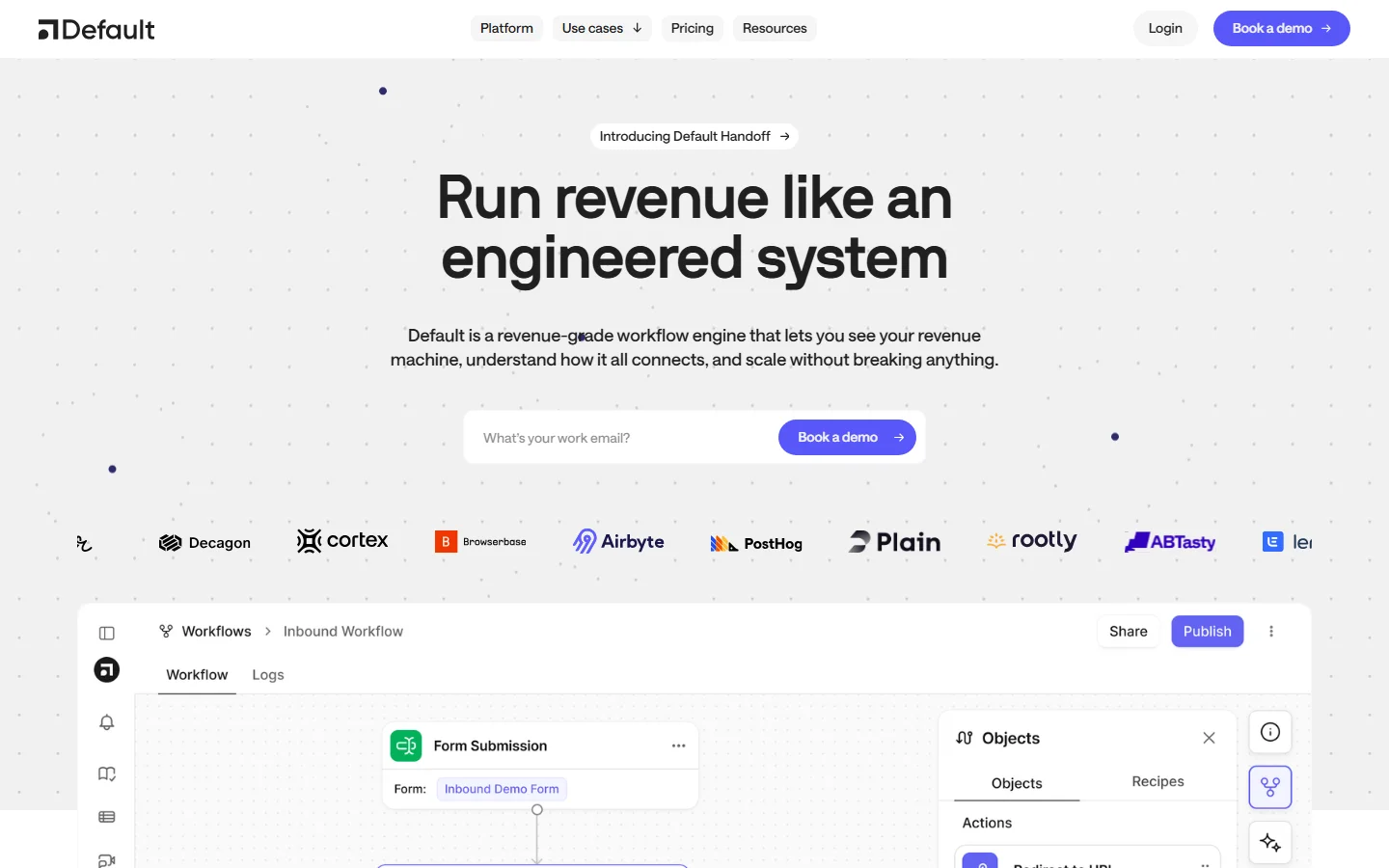
Default homepage
The takeaway: Default makes inbound routing fast and reliable, and it has grown into enrichment, intent signals, and outbound automation. The trade-off is price: it is built and priced for mid-market and enterprise teams, not early-stage startups.
Default Lead Routing: How the Inbound Engine Works
A prospect submits your form. Default immediately enriches the submission with firmographic data from connected providers like Clearbit. Based on your rules — company size, industry, geography, existing account ownership — Default assigns the lead to the right rep and presents a calendar for instant booking.
The no-code workflow builder lets you create branching logic: if the company has 500+ employees, route to enterprise AE. If they are in EMEA, route to the regional team. If they are an existing customer, route to their CSM. All of this happens before the prospect leaves the thank-you page.
What works well
Speed. G2 reviewers consistently highlight that Default reduced their inbound response time from hours to seconds. One verified reviewer stated their entire inbound engine runs on Default. The implementation is fast too — most teams go live within a week, which is faster than Chili Piper or LeanData deployments.
Where it falls short
Routing is only as good as the rules behind it. Complex rule sets covering territories, account ownership, and round-robin exceptions take time to design and need upkeep as your team changes. Default's built-in intent signals also center on your own website traffic; if you want third-party research intent as well, read our best buying intent data tools guide for more on the signal layer.
Default Enrichment and Scheduling: What's Built In
Default runs enrichment through third-party providers (its credits cover Abstract, Apollo.io, Clearbit, People Data Labs, and Wiza) to append firmographic and contact data to form submissions. This enrichment feeds the routing rules: a form submission with company size = 200 employees and industry = SaaS gets routed differently than a 10-person agency.
Enrichment depth
As of September 2026, Default runs waterfall enrichment, deep research, and validation on every record, with full provenance for where each data point came from. Coverage is still bounded by the providers in the waterfall, and every lookup draws on the plan's annual credit pool: 24,000 credits on Growth and 60,000 on Scale, with extra credits at $0.10 each. For a primer on how the fallback logic works, see our guide to waterfall enrichment.
Scheduling capabilities
The scheduling feature is tight. After routing, the prospect sees the assigned rep's calendar and books instantly. Round-robin distribution ensures even load across the team. CRM records are created or updated automatically in Salesforce or HubSpot with all enrichment data attached.
Default Pricing Breakdown
As of September 2026, Default uses a platform-plus-seat model published on its pricing page, with both platform plans billed annually:
- •Growth ($15,000/year, about $1,250/mo): 24,000 enrichment credits and 200,000 workflow runs per year, unlimited workflows, and a shared Slack support channel
- •Scale ($36,000/year, about $3,000/mo): 60,000 enrichment credits and 600,000 workflow runs per year, dedicated support, migration services, and custom integrations
- •Routing + Scheduling Seats ($45/user/mo): For AEs, CSMs, and BDRs who need full routing and scheduling capabilities
- •Scheduling Seats ($20/user/mo): For SEs, managers, and BDRs who need calendar booking but not routing control
- •Extra enrichment credits ($0.10 each): Website de-anonymization uses 3 credits per visitor
What you actually pay
A mid-market team on Growth with 5 AEs on routing + scheduling and 2 SDRs on scheduling only: $1,250 + (5 x $45) + (2 x $20) = $1,515/mo, or about $18,180 per year. Whether that is competitive depends on what it replaces. If Default takes over routing, scheduling, and enrichment you would otherwise buy from Chili Piper, LeanData, and a separate data provider, the math can work; for routing alone, get quotes from those tools first.
Hidden costs to watch
- $15,000/year platform fee before any seats — expensive floor for startups
- Enrichment beyond the annual credit pool costs $0.10 per credit
- Website de-anonymization uses 3 enrichment credits per visitor
- Per-seat pricing scales with team growth
What Are the Downsides of Using Default?
Built inbound-first
Default's strength is still inbound. Its outbound automation (prospecting, enrichment, assignment, and sequencing on first-party signals, with reps in the loop) is pitched as a replacement for tools like Clay and Apollo, but it is built around signals from your own funnel. Teams that run high-volume cold outbound should test it on their real target accounts before retiring a dedicated prospecting tool.
Expensive entry point for early-stage teams
As of September 2026, the Growth plan costs $15,000 per year, so a 2-person startup pays that minimum before adding any seats. For comparison, Chili Piper starts lower for basic scheduling, though it lacks Default's unified routing engine.
Enrichment is third-party dependent
Default does not own enrichment data. Its waterfall runs across third-party providers such as Clearbit, Apollo.io, People Data Labs, Wiza, and Abstract, so if none of them covers your ICP well, Default cannot fill the gap. Every lookup also draws on a fixed annual credit pool. For teams that need deep CRM enrichment, compare coverage on a sample of your own records before committing.
Signals are mostly first-party
Default's built-in signals center on your own website: intent triggers fire when a target account shows buying intent, and company de-anonymization identifies visiting accounts at 3 credits per visitor. Its site does not list third-party signals like job changes or funding rounds, so teams that rely on those will still need a separate signal source.
Default Beyond Inbound: Signals, Outbound, and AI Agents
Default built its name on inbound routing, but as of September 2026 its site pitches a broader GTM workflow platform. If you last evaluated it as a forms-and-routing tool, these are the pieces worth a second look.
Website intent signals and de-anonymization
Default can trigger workflows when a target account shows buying intent on your website, and it de-anonymizes visiting companies through providers such as Clearbit Reveal and Vector. Each de-anonymized visitor costs 3 enrichment credits. On the Growth plan's 24,000 credits per year, 1,000 de-anonymized visitors a month would use 36,000 credits a year on de-anonymization alone, so high-traffic sites should model this before turning it on for every visit.
Outbound automation
Default's outbound workflows prospect, enrich, assign, and sequence contacts based on first-party signals, with reps kept in the loop, and a Deep Research step identifies contacts at target accounts. Default positions this as a replacement for tools like Clay and Apollo. The practical test is whether your outbound starts from your own signals, such as site visits and CRM activity, or from cold list building. The first fits Default's model; the second is worth piloting before you cancel a prospecting database.
AI agents and the data stack
Default exposes an MCP (Model Context Protocol) server, so AI agents can trigger workflows, run enrichment jobs, and pull audit logs without anyone submitting a form. Beyond Salesforce and HubSpot, it connects to Slack, Google Calendar, Zoom, Gong, Segment, Zapier, and warehouses like Snowflake, BigQuery, and Databricks. Every run is logged, which matters when RevOps has to explain why a lead went to a particular rep.
What this means for buyers
The broader scope changes the pricing math. At $15,000 per year before seats, Default is hard to justify as a routing tool alone for a small team, but easier to justify if it replaces separate tools for scheduling, enrichment, and signal-based outbound. Map which of your current tools it would retire, then compare that total against the Default quote.
Is Default Worth It?
Default is worth it for inbound-heavy teams that need fast lead routing, qualification, and scheduling under one roof. The implementation is fast, the routing engine is reliable, and the pricing is transparent compared to competitors like Chili Piper and LeanData.
Default is harder to justify for early-stage teams or for anyone who only needs one piece of it. At $15,000 per year before seats, the value comes from consolidating routing, scheduling, enrichment, and signal-based workflows, and its newer outbound features are worth piloting before they replace a dedicated prospecting tool.
The verdict: best-in-class inbound routing with a growing enrichment and signal layer, priced for mid-market and enterprise teams rather than startups.
Comparing inbound tools? Read our reviews of Clearbit, Apollo.io, and our roundup of best RevOps AI tools for 2026.
If Default's high entry price for small teams is a dealbreaker, SyncGTM is one alternative worth a look: it is free to start and pairs waterfall enrichment across 50+ data providers with native HubSpot and Salesforce integrations.