

The Truth About Clearbit in 2026: Review and Pricing After the HubSpot Deal

By Kushal Magar · March 16, 2026 · 14 min read · Last updated: September 30, 2026
Clearbit is a B2B data enrichment tool that was acquired by HubSpot in 2023 and rebranded as Breeze Intelligence. It provides firmographic enrichment, visitor identification (Reveal), and form shortening — but now only works inside HubSpot. As of September 2026, HubSpot includes data enrichment with paid Starter, Professional, and Enterprise subscriptions and meters buyer intent with HubSpot Credits, so the real cost is your HubSpot plan plus intent usage. For teams using any CRM besides HubSpot, Clearbit is no longer an option.
You are probably here because you heard about the acquisition and want to know what actually happened to the product. Fair question. The short answer: standalone Clearbit is gone. What replaced it only works inside HubSpot.
Before the acquisition, Clearbit was a standalone data enrichment tool — competing head-to-head with platforms like Apollo.io and ZoomInfo. You could plug it into any CRM, any marketing stack, any workflow. It had an open API. It worked with Salesforce, Pipedrive, and dozens of other tools. That flexibility is what made it popular.
That product no longer exists. Since December 2023, Clearbit has been absorbed into HubSpot's ecosystem, first sold as Breeze Intelligence; HubSpot's current documentation describes the same capabilities as data enrichment and Buyer Intent. The API is being sunset. The Chrome extension is deprecated. If you do not use HubSpot, Clearbit is no longer an option.
This Clearbit review covers what actually remains of the product, what it costs when you add up HubSpot fees and credits, where the data quality stands in 2026, how it works inside HubSpot today, and which teams should still consider it.
Clearbit Review: What You Get (and What You Don't)
Clearbit (Breeze Intelligence) is a B2B data enrichment and visitor identification tool now embedded inside HubSpot. It appends firmographic and technographic data to your CRM contacts, identifies anonymous website visitors, and shortens forms by auto-filling known fields.
Here is a quick-reference table of what is included and what is missing:
| Feature | What's Included | Limitations |
|---|---|---|
| Data Enrichment | Firmographic, technographic, and employee data | Accuracy drops for companies under 50 employees; no control over which sources fill gaps |
| Reveal (Visitor ID) | Identifies companies visiting your website | Company-level only; no individual contact identification |
| Form Shortening | Auto-fills form fields for known visitors | Only works on HubSpot forms |
| CRM Integration | Native HubSpot sync | HubSpot only — no Salesforce, Pipedrive, or other CRMs |
| Buying Signals | HubSpot Buyer Intent signals (funding, executive hiring, tech investment) and contact job changes, as of September 2026 | Company-level visitor intent only; tracking companies costs HubSpot Credits every month |
| API Access | Being deprecated | Standalone API sunset in progress; all access via HubSpot |
The takeaway: Clearbit still enriches contact records and identifies website visitors. But everything else that made Clearbit flexible — the open API, the CRM-agnostic integrations, the standalone product — is gone.
Data Quality: How Accurate Is Clearbit Really?
Clearbit's data quality is the one area where the product still holds up — with caveats. For US-based companies with 50+ employees, firmographic data (industry, revenue range, employee count, tech stack) is consistently accurate. Multiple G2 reviewers rate accuracy in the 80-90% range for this segment.
Where accuracy drops
The story changes for three segments. Small companies under 50 employees see noticeably lower match rates. International companies outside North America and Western Europe have significant data gaps. And contact-level data — direct emails and phone numbers — is less reliable than firmographic data across the board.
As of September 2026, HubSpot says its enrichment draws on HubSpot's commercial dataset, third-party providers, and publicly available information. Whatever the mix behind it, you get that dataset as delivered: HubSpot does not document any way to choose, reorder, or add enrichment sources. When it misses a segment, the gap stays unless you add a second tool.
Teams selling into those segments often pair HubSpot with a second data source or a multi-provider waterfall enrichment tool, which queries several providers in sequence until one returns a match.
Clearbit Reveal: Visitor Identification Tested
Reveal (now part of Breeze Intelligence) identifies companies visiting your website by matching IP addresses to firmographic data. It does not identify individual people — only the company they work for.
In practice, Reveal works best for high-traffic B2B sites. If you get 10,000+ monthly visitors, you will see a meaningful number of company identifications. For smaller sites, the signal-to-noise ratio drops because fewer visitors can be matched to known company IPs.
The remote work problem
Reveal relies on IP-to-company matching. With the shift to remote and hybrid work, a growing percentage of B2B visitors browse from home networks, VPNs, or co-working spaces. These visitors are invisible to Reveal. Multiple users on Reddit report match rates dropping below 30% for their sites since 2024.
Credits still matter here. Under the original Breeze Intelligence pricing, each Reveal identification consumed a credit ($0.45 per credit on the 100-credit entry plan). As of September 2026, HubSpot charges HubSpot Credits when you add a net-new company identified by Buyer Intent (a one-time charge) and every month for each company you track for signals — so be selective when many identified visitors are outside your ICP.
Breeze Intelligence product page — March 2026
The HubSpot Lock-In: What Changed After the Acquisition
HubSpot acquired Clearbit in December 2023. Since then, the product has been fully absorbed into HubSpot's platform as Breeze Intelligence. This is the single biggest change and the reason most Clearbit review posts now come with a warning label.
What was lost
- The standalone Clearbit product is being sunset
- The open API that worked with any tool is being deprecated
- Salesforce, Pipedrive, and other CRM integrations are gone
- The Chrome extension for on-the-fly enrichment is deprecated
- Independent pricing — Clearbit now requires a paid HubSpot subscription as a baseline
Why this matters for your team
If your sales team uses Salesforce and you were relying on Clearbit for enrichment, you now have two options: migrate your entire CRM to HubSpot, or find a new enrichment provider. There is no middle ground. Clearbit does not work outside HubSpot anymore.
Even if you already use HubSpot, the lock-in has pricing implications. As of September 2026, data enrichment comes with paid Starter, Professional, and Enterprise subscriptions, but Buyer Intent draws on HubSpot Credits on top of your plan. You pay for the HubSpot tier first and for intent usage second, so the cost of Clearbit data is tied to how much HubSpot you buy.
Clearbit Pricing Breakdown (Breeze Intelligence)
Clearbit pricing has changed twice since the acquisition. When this review was first published in March 2026, Breeze Intelligence ran on a credit-based system inside HubSpot: one credit equaled one record enrichment or one Reveal identification, and credits reset monthly with no rollover. The tiers looked like this:
- --100 credits ($45/mo annual, $50/mo monthly): Basic enrichment, form shortening, Reveal visitor ID. Enough for testing, not production.
- --1,000 credits (~$450/mo estimated): All features plus continuous enrichment. Pricing is not publicly listed — you need to talk to sales.
- --10,000 credits (~$4,500/mo estimated): Full feature set with continuous enrichment. Enterprise-level volume. Also requires a sales conversation.
What changed (as of September 2026): HubSpot's documentation now states that data enrichment is included with paid Starter, Professional, and Enterprise subscriptions and does not consume HubSpot Credits. Buyer Intent, which now handles Reveal-style visitor identification, still does: adding a net-new company it identifies is a one-time charge, and tracking a company for signals is a monthly charge per company. HubSpot points to its Product & Services Catalog for current credit rates rather than listing them in its help docs.
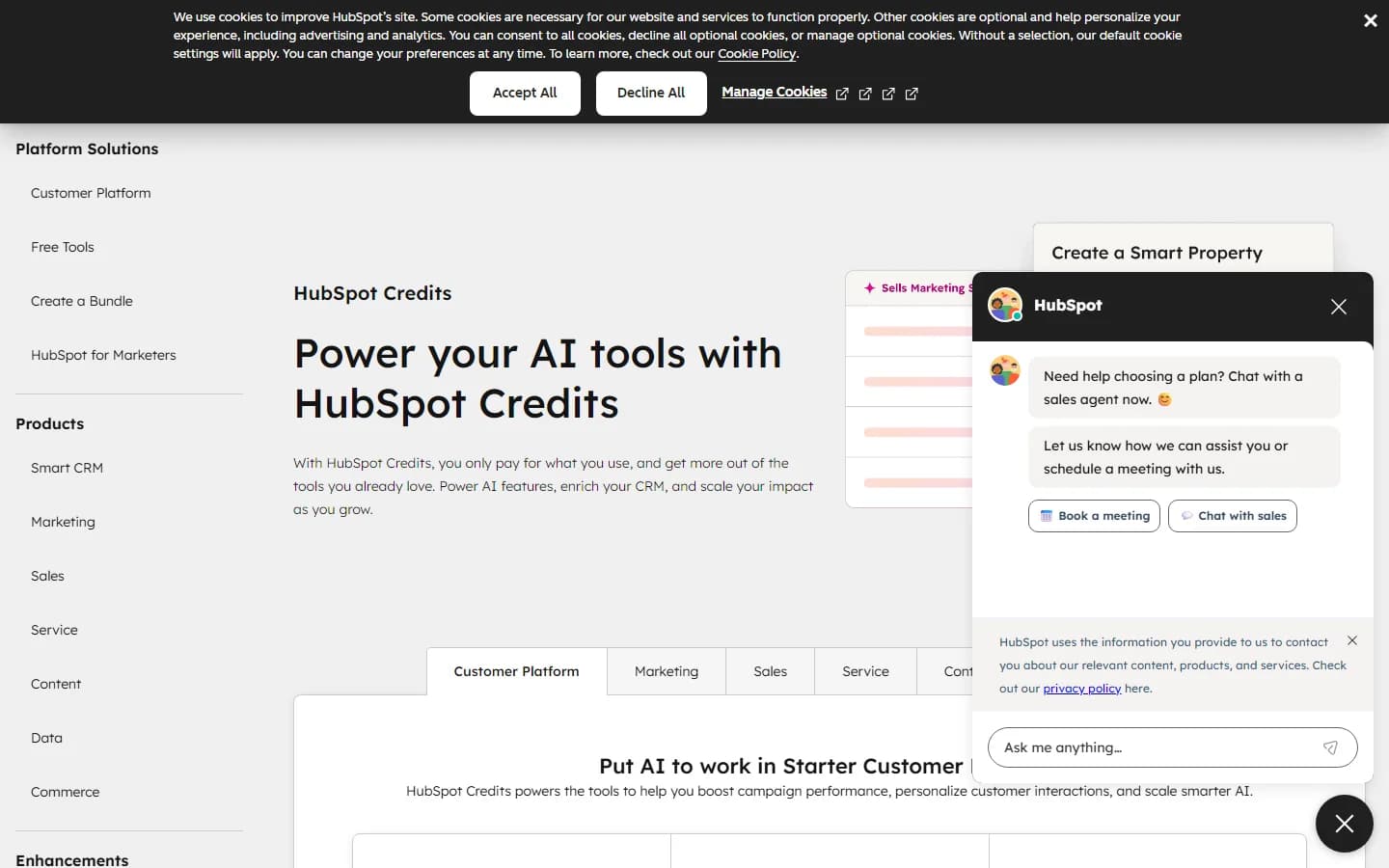
Breeze Intelligence pricing page — March 2026
What you actually pay: total cost of ownership
The credit price was only ever part of the story. At publication in March 2026, a realistic scenario for a mid-market sales team looked like this:
- HubSpot Sales Hub Professional: $890/mo (required baseline)
- Breeze Intelligence 1,000 credits: ~$450/mo
- Additional credit packs when you run out mid-month: variable
- Realistic monthly total: $1,340-2,000+/mo
As of September 2026, the enrichment line drops out, because enrichment no longer consumes credits and is available from the Starter tier up. The cost now sits in two places: the HubSpot subscription you need to access the data at all, and the HubSpot Credits you spend on Buyer Intent. Compare that to standalone Clearbit, which used to cost $99-499/mo with no CRM subscription required. For HubSpot customers, enrichment has become cheaper; for everyone else, the entry price is now a CRM migration.
Hidden costs to watch
- Recurring signal charges: Every company you track for signals is a monthly HubSpot Credits charge, so a large target account list becomes a standing cost.
- HubSpot subscription required: You cannot get Clearbit data without an active paid HubSpot plan (Starter or above).
- Custom Signals cost more: Custom Signals are charged per company, per signal, every month, at a higher rate than Standard Signals.
- Downgrade penalties: Downgrades only take effect at the end of your contractual commitment, not immediately.
- Opaque credit rates: HubSpot's help docs point to its Product & Services Catalog for per-action credit rates, so model your intent usage before you commit.
What Are the Downsides of Using Clearbit in 2026?
The biggest downsides of Clearbit in 2026 are the HubSpot lock-in that eliminates CRM flexibility, credit-metered intent features that make costs harder to predict, declining accuracy for smaller and international companies, company-level-only visitor intent, and the loss of the standalone product that made Clearbit popular in the first place.
HubSpot lock-in kills flexibility
This is the dealbreaker for most teams. If you use Salesforce, Pipedrive, Attio, Close, or any CRM besides HubSpot, Clearbit is off the table. Period. The standalone integrations are gone. The API is being deprecated. You either commit to HubSpot or you find a different enrichment tool.
Credit-based pricing creates budget anxiety
Under the original Breeze Intelligence model, every enrichment, every form fill, and every Reveal identification burned a credit, and credits expired monthly with no rollover. Teams reported running out mid-month and facing the choice between buying emergency credit packs at premium rates or going without enrichment until the cycle reset. As of September 2026, HubSpot says enrichment no longer consumes HubSpot Credits, but Buyer Intent still does, so the budget anxiety has moved from enrichment to intent.
One paraphrased Capterra reviewer: "We went through 100 credits in the first week without realizing Reveal was consuming them on every visitor. Had to upgrade mid-cycle."
Data accuracy gaps for SMBs and international markets
Clearbit's database is strongest for mid-market and enterprise US companies. Once you move below 50 employees or outside North America and Western Europe, match rates and accuracy drop noticeably. Tools like Cognism offer stronger European coverage, while People Data Labs provides broader global reach through its API. For teams selling globally or targeting startups, this is a real limitation.
Intent data is company-level and credit-metered
Clearbit on its own enriched static firmographic data. As of September 2026, HubSpot's Buyer Intent fills part of that gap with Standard Signals such as funding rounds, executive hiring and leadership changes, technology investment, and layoffs, plus job change signals on contacts. Two caveats remain: visitor identification stops at the company, never the person, and every tracked company is a recurring credit charge. If buying signals are a priority, compare it with the best CRM enrichment tools that include intent data.
Support quality has declined post-acquisition
Multiple reviewers on G2 report slower support response times since the acquisition. Clearbit-specific issues now route through HubSpot's general support team, which may not have deep expertise in the enrichment product. Dedicated Clearbit support is gone.
How Clearbit Data Works Inside HubSpot Today
If you are already on HubSpot, here is how the former Clearbit capabilities fit together as of September 2026, based on HubSpot's own documentation, and where credits come into play.
- Check your subscription. HubSpot lists data enrichment and Buyer Intent on paid Starter, Professional, and Enterprise tiers of Marketing Hub, Sales Hub, Service Hub, Data Hub, and Content Hub. The free CRM is not on that list.
- Turn on enrichment. Automatic enrichment is off by default. Switch it on, enrich individual records, or run bulk enrichment on existing contacts and companies. HubSpot matches contacts on first name, last name, and work email and companies on domain, and enrichment does not consume HubSpot Credits.
- Shorten your forms. When someone fills out a HubSpot form, form shortening checks the enrichment dataset and only shows the fields it cannot fill.
- Set up Buyer Intent. The Visitors tab identifies the company behind a website visit through an IP-address lookup, the Research tab monitors topic research, and the Signals tab tracks events at the companies you follow.
- Choose your signals. Standard Signals cover funding rounds, executive hiring and leadership changes, technology investment, expansion, layoffs, mergers and acquisitions, partnerships, product launches, and IPOs. Custom Signals let you describe a buying cue in plain language, and HubSpot's data agent checks tracked companies for it using public web content.
- Watch the credit meter. Adding a net-new company from Buyer Intent is a one-time HubSpot Credits charge, tracking a company for Standard Signals is a monthly charge per company, and Custom Signals cost more per company than Standard ones.
The result is a tighter loop than standalone Clearbit ever had: enriched properties, visitor identification, and signals all land on HubSpot records, where workflows and lead scoring can use them without an integration to maintain.
The trade-off is the one this review keeps coming back to. None of it leaves HubSpot, and the intent side of the product is metered, so a large tracked-account list turns into a recurring cost. Model how many companies you plan to add and track each month before you switch signals on across your whole target list.
Is Clearbit Worth It?
Clearbit is worth it for teams that are already fully committed to HubSpot and need native enrichment without leaving the platform. If your entire GTM stack runs on HubSpot — CRM, marketing, sales sequences, everything — then Breeze Intelligence adds enrichment data directly into your existing workflows with zero integration overhead.
Clearbit is not worth it for everyone else. If you use Salesforce, Pipedrive, Attio, or any other CRM, Clearbit is not an option. If you need to control which data providers fill your gaps, Clearbit is not an option. If you need person-level visitor identification, Clearbit is not an option. If you want transparent pricing without a mandatory platform subscription, Clearbit is not an option.
The verdict: Clearbit is a decent enrichment engine trapped inside a walled garden. The data quality is solid for US mid-market companies, but the HubSpot lock-in and credit-metered intent features make it a poor choice for teams that need flexibility. If you want enrichment that works with your stack — not one that forces you to change it — look at CRM-agnostic alternatives.
If Clearbit working only inside HubSpot is a dealbreaker, SyncGTM is one alternative worth a look: it runs waterfall enrichment across 50+ data providers with native Salesforce, Pipedrive, and Attio integrations.