

Apollo.io Review 2026: Features, Pricing and What Users Really Think

By Kushal Magar · March 16, 2026 · 15 min read · Last updated: September 30, 2026
You are probably here because Apollo.io keeps showing up in every "best sales tools" list and you want to know if it actually delivers. Fair question. With 240M+ contacts and a generous free plan, Apollo has become the default starting point for outbound sales teams.
Apollo.io is an AI GTM system powering modern go-to-market teams at startups, SMBs, mid-market, and enterprise companies, unifying data, intelligence, and execution in one connected system. Anchored by a network of 240M+ contacts and 30M+ companies with 98% email accuracy, Apollo is built open by design, meeting sellers inside the tools they already work in, from ChatGPT, Claude, Perplexity, Codex, Replit, and Cursor to Chrome, Salesforce, and Slack, rather than asking them to switch contexts to get value.
But here is the part most Apollo.io review posts skip: Apollo's buying signals cover intent, job changes, and website visitors, but teams running signal-led outbound often want a wider catalog of event triggers like funding rounds and tech changes. Competitors like ZoomInfo and Cognism offer deeper intent data, but at significantly higher price points.
We tested Apollo.io across prospecting, enrichment, sequencing, and CRM sync. This Apollo.io review covers what works, what does not, real pricing math, and where the gaps show up for teams that need more than a contact database.
Apollo.io Review: What You Get (and What You Don't)
Apollo.io is an all-in-one GTM platform. It combines a 240M+ contact database with waterfall enrichment, email sequences, a phone dialer, LinkedIn tracking, buying signals, and CRM integration. The idea is that you find leads, enrich them, and run outreach all in one tool.
Here is what is included versus what is gated or missing:
| Feature | What's Included | Limitations |
|---|---|---|
| Contact Database | 240M+ contacts and 30M+ companies with 98% email accuracy, 65+ search filters | International coverage varies by region |
| Data Enrichment | Firmographic, technographic, and contact data, with waterfall enrichment across 20+ data partners for emails and phones, plus CRM enrichment | Waterfall covers emails and phone numbers |
| Buying Intent | Buyer intent, job changes, news, and website visitor signals, consolidated in a unified person and company profile | Narrower signal catalog than dedicated signal platforms |
| Email Sequences | Multi-channel sequences across email, calls, and LinkedIn with A/B testing, sent from your own connected mailbox | 2 sequences on free; unlimited on paid. Free plan connects Gmail only |
| Deliverability | Domain warming, inbox rotation, and reputation monitoring | High-volume sending still requires careful domain setup |
| Phone Dialer | Click-to-call, parallel dialer, automatic call logging, call recording, international dialer (Org plan) | 5 mobile credits/mo on free; international dialer on Organization ($119/user/mo) |
| Inbound | Website visitor identification, form enrichment, lead scoring, inbound routing, and a meetings scheduler | Visitor identification requires installing a tracking script on your site |
| Conversation Intelligence | Call recording, conversation intelligence, and coaching tools, plus deal management and sales analytics | Teams already using a dedicated call-analysis tool may see overlap |
| AI Assistant & Workflows | AI Assistant for research, list building, and drafting; workflows and triggered actions when signals fire | AI drafts work best when edited for voice and context |
| Apollo MCP | Apollo inside ChatGPT, Claude, Perplexity, Codex, Replit, and Cursor: search prospects, enrich contacts, update records, enroll sequences, and manage tasks. OAuth sign-in, available on every plan including free, at no extra cost | Data access and action limits mirror your Apollo plan |
| Apollo CLI | Apollo commands in the terminal, pipeable into shell scripts and CI/CD, native in AI coding agents like Claude Code and Cursor; 25% fewer tokens than MCP for high-volume agent pipelines | Built for technical users comfortable in a terminal |
| Apollo API | 70+ REST endpoints across search, enrichment, sequencing, and analytics, including execution endpoints, not just data | Advanced API access is on custom plans |
| CRM Sync | 200+ integrations including HubSpot, Salesforce, Outreach, SalesLoft, and Slack; embedded in Salesforce and Slack; Chrome extension for LinkedIn, Gmail, and any website | Advanced sync features gated behind Professional ($79/user/mo) |
The takeaway: Apollo tries to do everything. It is a contact database, an enrichment engine, a sequencer, a dialer, and a CRM connector. That breadth is its selling point. If you need the widest possible catalog of buying signals, a dedicated signal platform can fill that gap.
How Apollo.io Works: From Search to Sequence
Apollo makes more sense once you see the order of operations. Most teams run the same loop: build a list, enrich it, push it into outreach, and sync the results back to the CRM. Here is how that loop runs and where credits get spent along the way.
- Build a list. Search the contact database with 65+ filters such as job title, industry, company size, and location, or use the Apollo Chrome extension to pull contact details while you work in other tools.
- Reveal and enrich. Revealing emails and phone numbers spends credits. Waterfall enrichment fills each record from Apollo's own database first, then cascades through 20+ data partners for a missing email or phone number.
- Keep records fresh. Upload a CSV or connect your CRM to enrich existing records, and use job change alerts to flag contacts who have moved companies.
- Watch export credits. Apollo spends export credits whenever a contact leaves the platform, whether through a CSV download, a CRM sync, or API enrichment pushed to tools like Outreach or Salesloft.
- Run sequences. Add contacts to multi-step sequences that mix automatic emails with manual tasks such as LinkedIn touches and calls. Emails go out from your own connected mailbox. Free accounts can only connect Gmail; Microsoft and other providers need a paid plan.
- Call and sync. On plans that include the dialer, reps place and record calls without leaving Apollo, then sync contacts, activities, and deal stages to HubSpot or Salesforce.
Two habits keep Apollo costs predictable. First, test filters and sequences on a small list before revealing contacts in bulk, because credits spent on bad-fit records do not come back. Second, decide early whether Apollo or your CRM is the system of record: if Apollo is mainly a data source, export credits become the binding limit; if reps work inside Apollo all day, seat count matters more.
Onboarding scales with team size. Apollo offers an Essential onboarding track aimed at teams of 1–20 and live sessions with an Apollo Onboarding Manager for teams of 20+, which is worth using given the learning curve covered later in this review.
Apollo.io Pricing: What You Actually Pay
Apollo.io pricing in 2026 starts at $0/mo for a free plan and scales to $119/user/month for the Organization tier. All paid plans use per-seat pricing, which means your cost multiplies with every team member. Here is the full breakdown, pulled from their pricing page:
- Free: $0/mo. 10,000 email credits/mo (corporate domain), 5 mobile credits/mo, 10 export credits/mo. 2 active sequences. Gmail integration only.
- Basic ($49/user/mo annual): 5,000 data credits/year. Unlimited sequences. CRM integration (HubSpot, Salesforce). Email open and click tracking.
- Professional ($79/user/mo annual): 10,000 data credits/year. Advanced reporting. AI-assisted email writing. Dialer with call recording. Advanced Salesforce/HubSpot sync.
- Organization ($119/user/mo annual): 15,000 data credits/year. 200 mobile credits/mo. International dialer. Custom reports. Advanced security and team permissions.
Real-world cost scenario: A team of 5 SDRs on the Professional plan pays $395/mo (billed annually). Add 2 AEs who need access and you are at $553/mo. Monthly billing pushes this to $690+/mo. Credits do not roll over; unused credits disappear at the end of each billing period. Overage credits cost $0.20 each with a 250-credit minimum purchase.
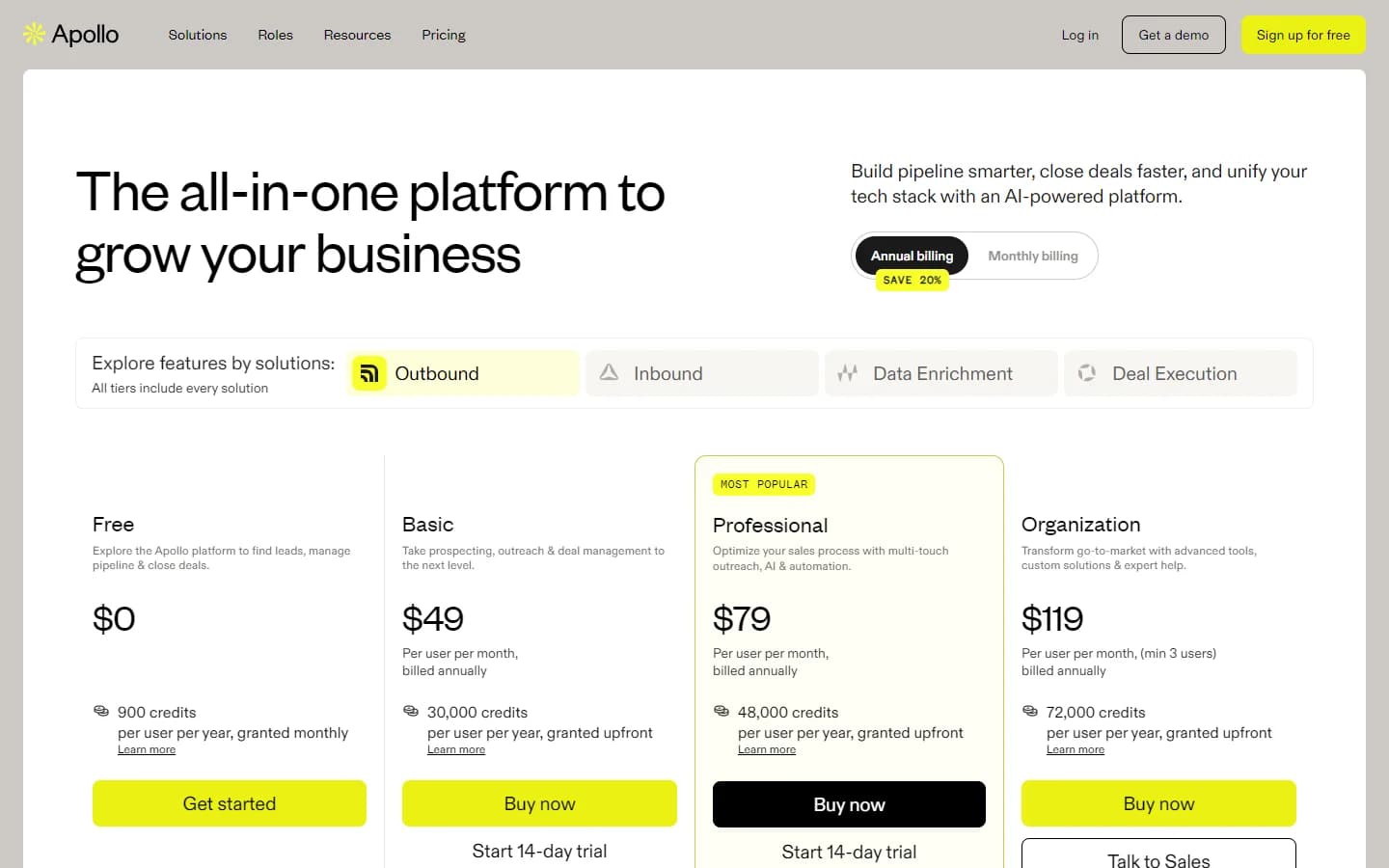
Apollo.io pricing page as of March 2026
Hidden costs to watch
- Per-seat multiplier: Every user pays the full plan price. A 10-person team on Basic = $490/mo, not $49/mo.
- Credit expiration: Data and mobile credits reset monthly. No rollover.
- Export credit limits: Syncing contacts outside Apollo consumes export credits, which are capped per plan.
- Non-Gmail email: Microsoft and other email providers require a paid plan. The free plan is Gmail only.
Apollo.io Data Quality: How Accurate Is It?
Apollo.io reports 98% email accuracy across its 240M+ contact database. US contact data is generally the strongest, while coverage quality varies by region outside North America. Multiple G2 reviewers report inconsistencies in European, APAC, and LATAM data, with outdated job titles and invalid phone numbers being the most common issues in those regions.
How Apollo's enrichment works
Apollo runs its own database first, then automatically cascades through 20+ data partners to fill missing emails and phone numbers, with email and phone validation built into the sequence. Apollo reports customers see 30 to 40% more enrichment when external lists are reprocessed through the waterfall.
Why waterfall depth matters
Like Clay, Apollo now offers waterfall enrichment that queries multiple data providers in sequence. Single-source enrichment caps out at 40 to 60% coverage for any given data field. Waterfall approaches that cascade through 20+ providers hit 85 to 95%. That gap directly impacts your email deliverability, phone connect rates, and pipeline quality.
Apollo.io data accuracy by region
US contacts are Apollo's strongest point. North American email and phone data holds up reasonably well. European data is inconsistent, since GDPR compliance has made it harder for any US-based provider to maintain fresh EU contacts. APAC and LATAM data is the weakest, with multiple G2 reviewers reporting outdated job titles and invalid phone numbers in these regions.
Apollo.io Sequences: Built-In Outreach
The built-in sequencer is Apollo's strongest feature and the main reason teams choose it over standalone databases. You can build multi-step email sequences with A/B testing, manual tasks (LinkedIn touches, phone calls), and conditional logic based on prospect behavior.
Having sequences in the same tool as your contact database removes the friction of exporting lists to a separate platform. You find a prospect, add them to a sequence, and the emails go out. That workflow is genuinely smooth.
Deliverability
Apollo sends sequences from your own connected Gmail or Microsoft mailbox, so your sender reputation is tied to your own domains rather than a shared server. Apollo's deliverability tools add domain warming, inbox rotation, and reputation monitoring. Some Capterra reviewers still prefer dedicated cold email tools like Instantly or Lemlist for very high-volume sending across many mailboxes.
Sequence limits on the free plan
Free users get 2 active sequences. That is enough to test the feature but not enough to run a real outbound program. Paid plans unlock unlimited sequences. If you are evaluating Apollo, expect to upgrade within the first week of serious testing.
Apollo.io Integrations: CRM, Outreach, and Beyond
Apollo offers 200+ integrations, including HubSpot, Salesforce, Outreach, SalesLoft, Marketo, LinkedIn, Sendgrid, and Slack, and it is embedded directly in Salesforce and Slack. The CRM integrations are the most important piece; they sync contacts, activities, and deal stages bidirectionally.
Does Apollo.io integrate with HubSpot?
Yes. HubSpot integration is available on all paid plans. The Basic plan ($49/user/mo) includes bidirectional contact sync. Advanced features like custom field mapping and deal sync require the Professional plan at $79/user/mo.
Does Apollo.io integrate with Salesforce?
Yes. Apollo is embedded directly in Salesforce, and sync is available from the Basic plan for simple contact push. Advanced Salesforce customization, reporting dashboards, and workflow rules require the Professional or Organization plan. The integration works, but some users report sync delays and occasional duplicate records that require manual cleanup.
Beyond the CRM
Apollo also runs outside its own UI. Apollo MCP puts Apollo's data and tools inside AI assistants, Apollo CLI runs Apollo commands in the terminal for scripting and CI/CD, and the Apollo API covers custom integrations, with advanced API access on custom plans. Apollo's CRM enrichment keeps records current as they enter your CRM. If your stack runs on Pipedrive, Attio, or Copper, check native support before committing.
Apollo.io AI Features: What's Real vs. What's Marketing
Apollo's AI Assistant handles lead research, list building, and personalized email drafting, and teams actively using it are up 2,156% since December 2025. Apollo MCP reached more than 11,000 teams in its first 11 weeks, with over 6 million requests to Apollo's data from AI tools like Claude, ChatGPT, and Perplexity.
AI email drafts: decent but generic
The AI-generated emails are usable as first drafts. They pull in relevant personalization variables and maintain a professional tone. Like any AI writing tool, they perform best when reps edit for voice and context before sending.
Buying intent: the thin spot
Apollo's buying signals cover topic-level intent, job changes, and website visitors. Teams building signal-led outbound often also want funding round alerts, technology stack changes, executive moves, and company growth metrics. If your outbound depends on those event triggers, plan on running a separate signal source alongside Apollo.
What Are the Downsides of Using Apollo.io?
The biggest downsides of Apollo.io are per-seat pricing that scales expensively, regional data coverage gaps, and a narrower buying signal catalog than dedicated signal platforms. Here is what users report on G2, Capterra, and testing.
- Buying signal catalog narrower than dedicated signal platforms
- Per-seat pricing makes costs multiply fast: 5 users on Pro = $395/mo
- Data coverage varies outside North America
- Steep learning curve for advanced features; the basic vs. power-user gap is wide
- Credits don’t roll over and expire at the end of each billing period
Regional data coverage is the biggest risk
For North American contacts, Apollo's coverage is strong. For European, APAC, and LATAM markets, G2 reviewers report stale job titles and invalid phone numbers. For outbound teams targeting international markets, the cost is wasted sequences and poor deliverability, so validate a sample before scaling a campaign. Apollo's waterfall enrichment and built-in validation partners help close those gaps.
Per-seat pricing scales expensively
Apollo's per-seat model sounds cheap at $49/user/mo. But sales teams grow. A team that starts with 3 SDRs at $147/mo on Basic quickly becomes a 10-person team at $490/mo. Add Professional features and you are at $790/mo for the same team. Per-seat pricing punishes growth, so model your cost at next year's headcount, not today's. Flat-rate tools avoid this trap entirely.
Signal coverage
Apollo tells you a company is researching "sales automation," that a contact changed jobs, or that an account visited your website. What it does not surface as a native trigger is that a company just raised a Series B or adopted a competitor's product. Those specific signals are what separate high-converting outbound from generic spray-and-pray. Teams serious about buying intent data will want a dedicated signal platform alongside Apollo.
The learning curve is real
Apollo has a lot of features. That sounds like a positive until your team spends two weeks figuring out how sequences, filters, integrations, and reporting all fit together. The gap between basic usage (find contacts, send emails) and advanced usage (workflows, waterfall configuration, API and MCP automation) is wide. Multiple G2 reviewers report that onboarding new reps takes longer than expected.
Apollo.io prospecting dashboard, March 2026
Is Apollo.io Worth It?
Apollo.io is worth it for teams that need an all-in-one tool to run outbound from one place. The free plan is generous, the Basic plan at $49/user/mo covers sequences and CRM sync, and it scales to enterprise: 100+ teams at Fortune 500 companies use Apollo. Independent spend data points the same way: according to Ramp's vendor data, as of September 2026 Apollo is used by 39% of businesses buying sales data tools (up 5 points year over year) and is the fastest-growing vendor in the category at +0.5 points per month.
Apollo.io is a harder fit for teams that need deep buying signals, flat pricing, or deep international data coverage. At $49 to $119 per seat, costs grow with the team, and the signal catalog is narrower than a dedicated signal platform. If you need GDPR-compliant European data, consider Lusha or Cognism. For a broader comparison, see our best Apollo alternatives guide.
The verdict: Apollo is a strong all-in-one platform for teams that want data, outreach, and execution in one place. Teams building a signal-led motion may want more signal depth than Apollo offers natively.
Bottom line: Apollo.io is a capable all-in-one platform whose per-seat pricing grows with your team. If you need richer signals from day one, compare the Apollo alternatives before you commit to annual seats.
Apollo.io Pros
- 240M+ contact database with 98% email accuracy and 65+ filters for targeted prospecting
- Built-in email sequences, phone dialer, and LinkedIn tracking in one tool
- Waterfall enrichment across 20+ data partners
- Generous free plan with 10,000 email credits per month
- Per-seat pricing starts low at $49/user/mo (annual) for Basic
- 200+ integrations, embedded in Salesforce and Slack
- 4.7/5 on G2 with 9,000+ reviews; strong user community
Apollo.io Cons
- Buying signal catalog narrower than dedicated signal platforms
- Per-seat pricing makes costs multiply fast: 5 users on Pro = $395/mo
- Data coverage varies outside North America
- Steep learning curve for advanced features; the basic vs. power-user gap is wide
- Credits don’t roll over and expire at the end of each billing period
If you want more event triggers on top of Apollo's signals, SyncGTM is one alternative worth a look: it tracks real-time buying signals such as funding, hiring, headcount growth, and executive moves.