

Demandbase Review 2026: ABM Platform Features and Pricing Deep Dive

By Kushal Magar · April 8, 2026 · 12 min read · Last updated: September 30, 2026
Key Takeaway
Demandbase is an enterprise ABM platform that combines account intelligence, intent data, programmatic advertising, and sales orchestration. Pricing is custom — a platform fee plus a flat per-user fee — and market estimates start at $50K–$80K/year, typically exceeding $100K–$200K/year with full ABM advertising. Deep integrations with Salesforce, Marketo, and HubSpot. Built for enterprise organizations with dedicated marketing operations and significant advertising budgets. For most SMB and mid-market teams, the pricing and complexity make it inaccessible; teams that only need ads or data can start with Demandbase's Advertising or standalone Data solutions.
Demandbase is the enterprise ABM platform for large B2B organizations running coordinated account-based programs. It combines account intelligence, intent data, programmatic advertising, and sales orchestration into one platform. The pitch: identify your best target accounts, advertise to them to build awareness, detect when they go in-market, and orchestrate sales outreach to coincide with the buying window.
You are probably here because your company is evaluating ABM platforms, Demandbase keeps coming up alongside 6sense, and you want to understand the real differences and whether the pricing is justified.
This Demandbase review covers how the account intelligence platform works, what the ABM advertising layer delivers, what it actually costs, and whether a full enterprise ABM platform is what your team actually needs.
Demandbase Review: What You Get (and What You Don't)
Demandbase acquired Engagio in 2020 to combine advertising-focused ABM with engagement-focused ABM — creating one of the most comprehensive enterprise ABM platforms in the market. See user ratings on G2.
| Feature | What's Included | Limitations |
|---|---|---|
| Account Intelligence | Intent data, firmographic data, engagement scoring | Account-level focus — less person-level detail |
| ABM Advertising | Programmatic display ads to target accounts | Ad spend additional to platform cost |
| Sales Intelligence | Account prioritization, CRM triggers, engagement alerts | Requires RevOps configuration to activate |
| CRM Integration | Salesforce, Marketo, HubSpot, and others | Deep integration setup requires dedicated time |
| Contact Enrichment | Limited — account-level primarily | Person-level contact data requires additional tools |
Demandbase Account Intelligence: Signals and Scoring
Demandbase's account intelligence layer pulls from multiple signal sources: web activity on the Demandbase network, intent data from third-party partners including Bombora, firmographic data, technographic data, and account engagement history.
The AI combines these signals into an account score that predicts purchase likelihood. High-scoring accounts trigger alerts to sales, adjustments in advertising targeting, and workflows in your CRM and MAP.
Demandbase vs. 6sense on intelligence
Both Demandbase and 6sense use AI to prioritize accounts. 6sense is often cited as having more sophisticated predictive modeling and a larger proprietary data network. Demandbase's strength is its deeper integration with advertising platforms and the combination of account intelligence with ad campaign management. Read our 6sense review for a direct comparison.
Demandbase Advertising: ABM Ads to Target Accounts
Demandbase's advertising module runs programmatic display ads targeting specific named accounts. You define your target account list, upload creative assets, and the platform manages programmatic buying to reach known IP addresses and corporate devices at those accounts.
The integration between advertising targeting and account intelligence is where Demandbase genuinely differentiates. When an account score spikes, ad intensity increases automatically. When an account converts to a meeting, advertising cools down. This coordination is difficult to replicate manually.
For companies already running ABM advertising programs, this automation saves significant campaign management time. For teams that have never run ABM advertising, the complexity and cost of launching the capability from scratch through Demandbase is substantial. User discussions on Reddit's marketing community frequently note that advertising ROI is hard to measure and requires significant budget to generate meaningful impressions.
How Demandbase Works: From Target Accounts to Measured Pipeline
Demandbase is sold as one platform for sales and marketing, so it helps to see how the pieces connect. As of September 2026, the platform is organized around four areas — Data, Marketing, Advertising, and Sales — with Demandbase AI working across them. A typical rollout runs in this order:
- Unify the data. Demandbase connects account, buying group, and engagement data — your CRM and marketing automation records alongside its own firmographic, technographic, and intent data — so every team works from the same account view. This is where most of the RevOps configuration time goes.
- Find and prioritize accounts.Demandbase AI analyzes signals, accounts, and buying group activity to surface in-market accounts, and you can segment them by journey stage. SAP Concur's insights lead describes using exactly that: segments built on journey stage combined with behavioral data.
- Activate marketing programs. Marketing builds coordinated programs around prioritized accounts and their buying groups rather than individual leads.
- Advertise to target accounts. The advertising module turns those signals into targeted programs, with ad intensity rising and cooling as account scores change. Media spend sits on top of the platform fee.
- Route to sales. Sellers see which accounts are active and which buying group members are involved, with alerts and CRM scoring feeding their prioritization.
- Measure what drives pipeline. Engagement and pipeline reporting shows which programs influence revenue — the step that ultimately proves, or disproves, the ABM investment.
The practical takeaway: the value compounds only when every step runs. Teams that buy Demandbase for one piece — just intent data, or just ads — pay platform-level prices for a fraction of the workflow. That is why the two narrower entry points matter: Demandbase positions its Advertising solution as a starting place, and its Data solutions can be used on their own to feed Demandbase data and AI-driven insights into existing systems.
On the enterprise checklist, Demandbase lists ISO/IEC 27001 and SOC 2 compliance, which shortens security review for the large organizations it targets.
Demandbase Pricing Breakdown
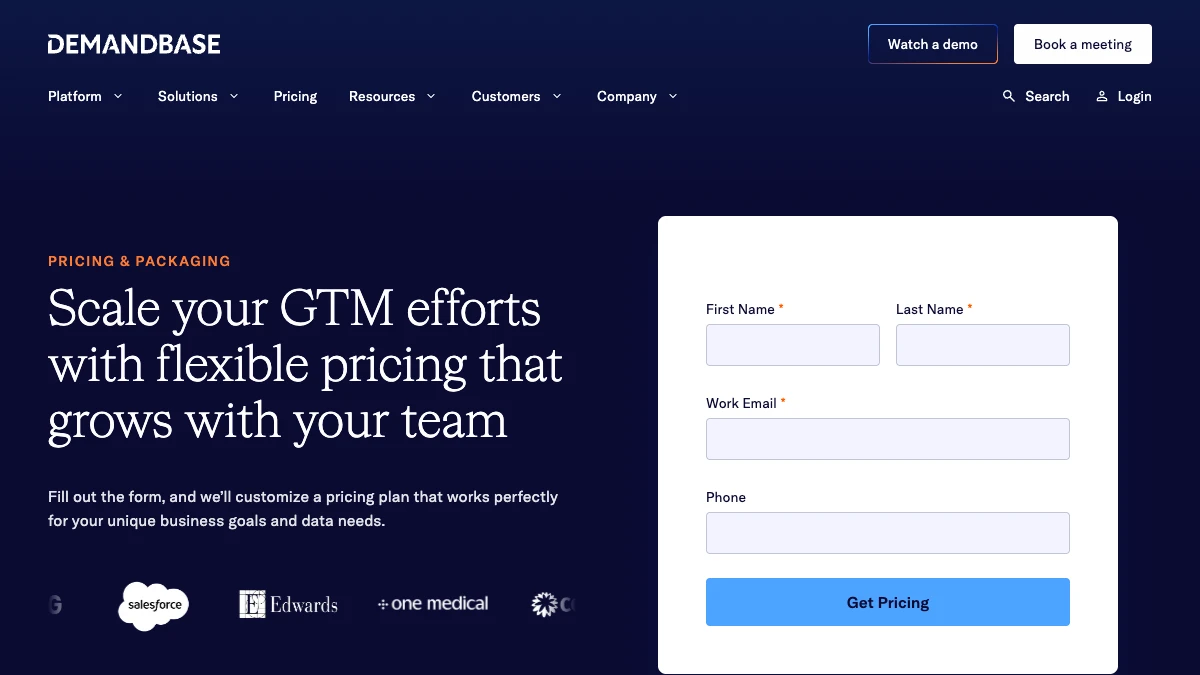
Demandbase does not publish pricing. As of September 2026, its pricing page describes the model instead: the flagship Demandbase platform for Sales and Marketing carries a platform fee that covers the core software and services, plus a flat fee per user. Demandbase won't sell Marketing or Sales as separate products, but it offers its Advertising solution as a starting place and sells Data solutions on their own. Market estimates from user reports:
- •Core platform (est. $50K–$80K/year): Intent data, firmographics, account scoring, CRM integration
- •Platform with advertising (est. $100K–$200K+/year): Full platform with advertising, campaigns, engagement programs
- •Enterprise (custom): Advanced customization, dedicated CSM, API access, custom integrations
What you actually pay
A mid-market SaaS company deploying the Demandbase platform plus advertising: $100,000–$150,000/year on a minimum 1-year contract — before advertising spend. Because users are billed on top of the platform fee, every additional seller or marketer you give access to raises that number.
Hidden costs to watch
- All pricing requires enterprise sales engagement — no self-serve
- A flat per-user fee sits on top of the platform fee, so costs grow with every seat
- Advertising media spend is additional to the platform fee
- Marketing operations overhead to manage the platform is significant
- Annual contract lock-in with limited exit options if results disappoint
What Are the Downsides of Using Demandbase?
Significant pricing and complexity
The combination of platform fees, advertising spend, and the dedicated marketing operations required to manage an ABM program means Demandbase is a seven-figure annual commitment for most enterprise deployments. This level of investment requires significant pipeline generation to justify.
Marketing-heavy, sales-secondary
Demandbase is primarily a marketing platform. Sales teams get account alerts and CRM scoring, but the platform was built around marketing campaign management. Sales-led teams that primarily need buying signals for outreach may find the marketing-centric UX and workflows harder to adopt than purpose-built sales intelligence tools.
ROI complexity
Proving ABM advertising ROI is notoriously difficult. Multi-touch attribution across display ads, intent signals, and sales outreach requires sophisticated analytics infrastructure. Many Demandbase users on G2 note challenges in connecting the platform's activity to actual pipeline and revenue outcomes.
Is Demandbase Worth It?
Demandbase is worth it for enterprise B2B companies with established marketing operations, significant advertising budgets, and mature ABM programs where coordinated account intelligence, advertising, and sales orchestration across hundreds of named accounts generates meaningful pipeline impact.
Demandbase is not worth it for most teams. The pricing, complexity, and marketing-centric design make it inaccessible and impractical outside of large enterprise deployments.
The verdict:enterprise ABM powerhouse with enterprise pricing to match — justified only at true enterprise scale. If you are not ready for the full platform, test the waters with Demandbase's Advertising or Data solutions, or compare lighter-weight intent and signal tools before signing a multi-year ABM contract.
Comparing ABM and intent platforms? Read our reviews of 6sense, Bombora, Warmly, and Koala.
If enterprise-level contracts and a dedicated marketing ops team are a dealbreaker, SyncGTM is one alternative worth a look: it tracks buying signals such as funding, hiring, and web traffic, scores leads against your ICP, and is free to start.