

G2 Buyer Intent 2026: Turn Software Reviews Into Pipeline — Pricing Guide

By Kushal Magar · April 9, 2026 · 11 min read · Last updated: September 30, 2026
Key Takeaway
G2 Buyer Intent shows you when companies are actively researching software in your category on G2 — visiting your profile, comparing you to competitors, reading reviews. The signals are unique and high-intent because they capture active research behavior, not passive browsing. Pricing starts at $20K–$30K/year and scales significantly. The main limitation: signals are only as valuable as your buyers' G2 usage. If your market does not actively research on G2, the signals are limited. Signals are also account-level, so you still need a separate way to find and reach the right people at flagged accounts.
G2 Buyer Intent gives you a window into active software research that no other data provider can replicate. When someone at a target account visits your G2 profile, compares your product to a competitor, or browses your software category, G2 surfaces that signal. It is genuinely unique: you are seeing buyers in active research mode, not just passively consuming content.
You are probably here because your sales team wants to know which companies are actively evaluating software right now — and G2 keeps coming up as the source of review-based intent signals. The question is whether the significant price tag is justified.
This G2 Buyer Intent review covers how the signals work, what category intent data provides, what it costs, and the coverage gap between review-based signals and the broader buying activity that happens outside G2.
G2 Buyer Intent Review: What You Get (and What You Don't)
G2 Buyer Intent is the data product layer on top of G2's software review platform. Companies with G2 profiles can see which buyer accounts are engaging with their listing and category.
| Feature | What's Included | Limitations |
|---|---|---|
| Profile Signals | Companies visiting your G2 product profile | Account-level only — no person-level detail |
| Category Intent | Companies researching your software category | Limited to G2 platform activity only |
| Competitor Research | Companies comparing you to specific competitors | Requires competitors to have G2 profiles too |
| Integrations | Salesforce, HubSpot, Marketo, plus 6sense, Demandbase, Outreach, LinkedIn, Chili Piper, and ZoomInfo | Setup requires RevOps configuration |
| Contact Enrichment | Not included | You still need to find who to contact at flagged accounts |
The key limitation: G2 Buyer Intent is only as valuable as your buyers' G2 usage. If your target market does not actively research on G2, the signal volume will be low.
G2 Buyer Intent Signals: How Review Activity Becomes Pipeline
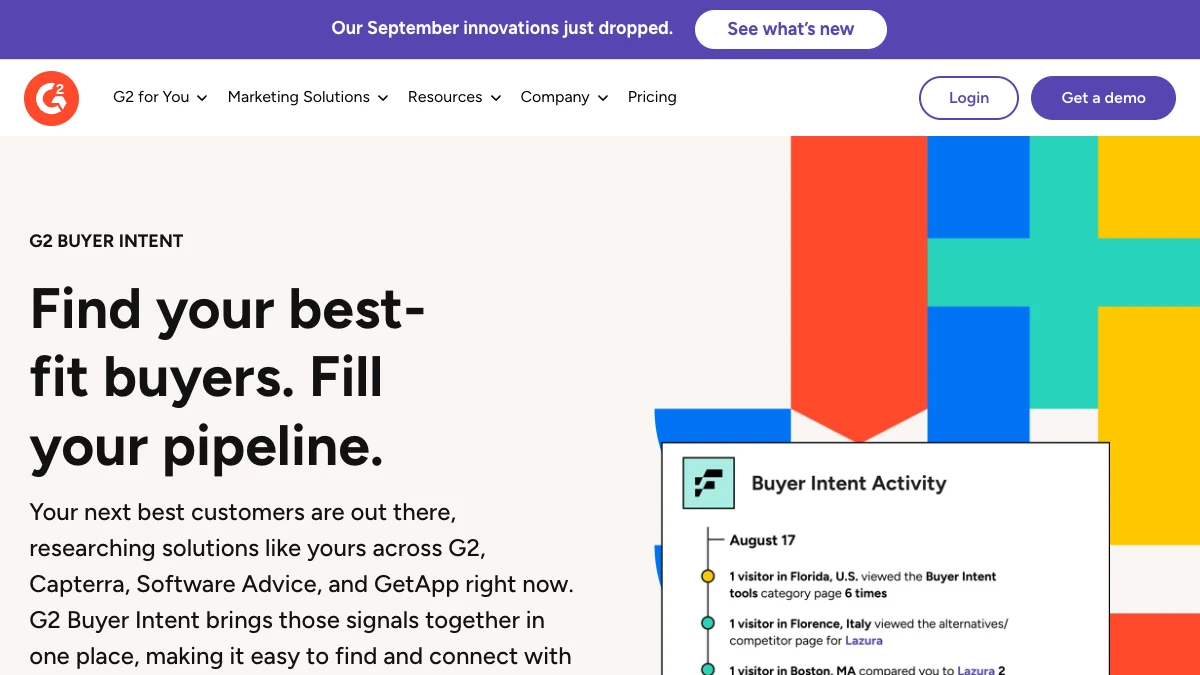
G2 identifies the company behind a profile visit using IP address resolution and reverse-IP lookup. When someone at a company visits your G2 listing, reads your reviews, or uses the comparison feature against competitors, G2 captures that activity and routes the signal to your CRM.
The quality of these signals is genuinely high compared to generic content-consumption intent data. Someone reading your G2 reviews is in active evaluation mode — not just broadly researching a topic. This specificity makes G2 Buyer Intent one of the highest-intent signals available when it fires.
When signals fire and when they do not
G2 signals only fire when buyers use G2. In B2B software and SaaS markets where G2 is a standard research tool, this covers a meaningful portion of the active buyer population. In industrial, healthcare, or enterprise markets where buyers research through analyst reports, vendor websites, and peer conversations rather than review sites, G2 signals may cover only a small fraction of in-market activity.
G2 Category Intent: Knowing Who Is Shopping Your Category
Beyond your own profile, G2 Buyer Intent can show you companies that are browsing your software category — not just your specific listing. This widens the signal universe significantly: you are not just seeing companies interested in you, but companies actively shopping for a solution like yours.
Category intent data is more expensive and requires higher-tier G2 contracts. For companies looking to expand their TAM reach rather than just monitor their own brand interest, this is the more valuable tier. However, the signal-to-noise ratio decreases as you broaden from profile signals to category signals — more accounts flagged, but not all are actively evaluating your specific solution.
G2 Buyer Intent Pricing Breakdown
G2 Buyer Intent pricing is not published publicly and requires direct engagement with G2's sales team. Based on market intelligence and user disclosures:
- •Profile Signals (est. $20K–$30K/year): Companies visiting your G2 profile, CRM integration
- •Category Intent (est. $40K–$100K+/year): Category browsing signals, competitor comparison data, API access
What you actually pay
A mid-market SaaS company buying profile signals at $25K/year plus category intent at $50K/year is paying $75K/year for G2 signals alone — before the enrichment and outreach tools needed to act on those signals. Because G2 does not publish prices, ask for its free, retroactive look at your Buyer Intent data first, so you can gauge real signal volume before negotiating a contract.
Hidden costs to watch
- Pricing requires enterprise sales process — no self-serve
- Signals cover only G2 activity — significant buying activity happens outside G2
- Contact enrichment is not included — still need a separate tool to find who to reach
- Signal volume depends on your G2 profile strength and review count
What Are the Downsides of Using G2 Buyer Intent?
G2-only coverage misses most buying activity
Most B2B buying activity does not happen on G2. Prospects research on vendor websites, analyst reports, LinkedIn, and through peer conversations. G2 Buyer Intent only captures the subset of research that happens on G2's platform. For some companies and verticals, this may be 10–20% of total buyer research activity.
Pricing vs. signal coverage mismatch
Paying $20K–$100K+/year for signals that only cover one platform's activity is a narrow investment. Combining G2 Buyer Intent with Bombora for broader intent coverage, plus enrichment tools, quickly pushes total spend to $100K+/year for what is still an incomplete picture of buying activity. User discussions on Reddit's marketing community highlight this frustration.
Account-level, not person-level
Like most intent data providers, G2 surfaces account-level signals. You know “Acme Corp is researching your category” but not which specific person at Acme. You still need to identify the right contact and find their verified contact information before you can act.
How to Act on G2 Buyer Intent Signals
G2 Buyer Intent only pays off if signals turn into outreach while the research is still fresh. Based on the activity types and integrations G2 lists on its Buyer Intent page (as of September 2026), a typical workflow looks like this:
- Decide which activities matter. G2 tracks product and category page views, competitor comparisons, pricing page engagement, and review consumption and contribution. A pricing page visit or a head-to-head comparison against your main competitor says far more than a single category page view, so weight them differently.
- Route signals into your system of record. Push signals into Salesforce or HubSpot so they land on the account record, and into Marketo if marketing runs nurture programs off intent.
- Score and prioritize. If you run an ABM platform, G2 connects to 6sense and Demandbase, so review-site activity can sit alongside your other intent data in account scoring instead of living in a separate dashboard.
- Find the right people. Signals identify companies, not contacts. Map flagged accounts to your buying committee personas and pull verified contact data from a separate source; G2 lists ZoomInfo among its integrations.
- Reach out while it matters. Enroll contacts in an Outreach sequence, use Chili Piper to route meeting requests, and run LinkedIn ads against flagged accounts so sales and marketing reach the same companies in the same week.
Two habits separate teams that get pipeline from G2 intent from teams that do not. The first is speed: treat comparison and pricing page activity like an inbound lead, not a list to work next quarter. The second is context: reference the problem an account is researching in your messaging, rather than the fact that you saw them on G2.
It also helps to know what the data can and cannot tell you. G2 says more than 100 million buyers use G2.com, which is broad reach for software categories, but the signal is still limited to research on G2 itself. Treat it as one high-intent input among several, not a full picture of who is in-market.
Is G2 Buyer Intent Worth It?
G2 Buyer Intent is worth it for B2B SaaS companies with strong G2 profiles, buyers who actively research on G2, and the budget to justify $20K–$100K+/year on a single-platform signal source. The signals are genuinely high-intent when they fire.
G2 Buyer Intent is not worth it for companies selling to markets that do not research on G2, teams without enrichment infrastructure to act on account-level signals, or organizations that need broader buying signal coverage at a more accessible price point.
The verdict:unique, high-quality signals — but only for the portion of buyer research that happens on G2's platform. Buy it when G2 is clearly part of how your buyers shortlist software, and plan for the contact data and outreach workflow needed to act on account-level signals.
Comparing intent data platforms? Read our reviews of Bombora, 6sense, Koala, and our best buying intent data tools for 2026 roundup.
If G2-only, account-level signals are a dealbreaker, SyncGTM is one alternative worth a look: it tracks real-time buying signals such as job changes, funding, and hiring, and finds verified emails and phone numbers through waterfall enrichment across 50+ data providers.