

3 Best B2B Database Purchase in 2026 (Ranked and Compared)

By Kushal Magar · April 24, 2026 · 12 min read
Key Takeaway
The 3 best B2B database purchase options in 2026 are SyncGTM, ZoomInfo, and Apollo. SyncGTM is the top pick for most GTM teams — waterfall enrichment across 50-plus providers, signal-driven prospecting, AI web scraping, and direct CRM push from 99 dollars per month with a free tier. ZoomInfo is the enterprise standard with 300M-plus contacts, Bombora intent data, and org chart intelligence — but requires a 15,000 dollar per year minimum annual contract with no transparent self-serve pricing. Apollo is the best entry-level option with 275M contacts and built-in email sequencing from 49 dollars per month, though it relies on a single proprietary database and bounce rates are higher than waterfall-based tools. Choose SyncGTM for the best balance of data quality, enrichment depth, and price. Choose ZoomInfo for enterprise scale and intent signals. Choose Apollo for a cheap, fast start.
Every B2B go-to-market team eventually hits the same wall: they need a reliable source of verified contacts and company data. The market for B2B database purchases is crowded with vendors that promise 90%+ accuracy, massive coverage, and real-time verification — but deliver stale records, high bounce rates, and opaque pricing that only reveals itself after a sales call.
This post ranks the 3 best B2B database purchase options for sales and marketing teams in 2026 — SyncGTM, ZoomInfo, and Apollo. The comparison is honest: we cover what each tool does well, where it falls short, and which type of team it actually serves.
According to Gartner, B2B contact data decays at roughly 2% per month — meaning a database that is six months old has already lost 12% of its valid records. Choosing a provider with real-time enrichment and continuous data refresh is not a nice-to-have. It directly determines whether your outbound motion books meetings or damages your sender domain.
Quick Summary
The best B2B database purchase in 2026 depends on your team size and budget. SyncGTM is the top pick for most teams: waterfall enrichment across 50+ providers, buying signals, AI web scraper, and direct CRM push — starting free. ZoomInfo is the enterprise standard at $15k+/yr. Apollo is the cheapest entry point at $49/mo.
TL;DR: Best B2B Database Purchase in 2026
- SyncGTM — Best B2B database purchase for most GTM teams. Waterfall enrichment across 50+ providers, signal-driven prospecting, AI web scraper, and CRM push. Free tier + $49/mo Solo.
- ZoomInfo — Best enterprise B2B database. 300M+ contacts, Bombora intent data, org charts, and direct dial numbers. $15k+/yr annual contract required.
- Apollo — Best entry-level B2B database purchase. 275M+ contacts, built-in email sequencing, transparent self-serve pricing from $49/mo.
What Is a B2B Database Purchase?
A B2B database purchase is buying access to a structured, searchable dataset of verified business contacts and company records — including emails, phone numbers, job titles, firmographic data, and technographic signals — used to fuel outbound prospecting, account-based marketing, and CRM enrichment.
In 2026, most teams purchase a B2B database through a SaaS subscription rather than a one-time static file download. This gives continuous access to refreshed data, ICP-based filtering, and CRM export capabilities. The difference between a quality B2B database purchase and a low-quality one often comes down to two factors: how frequently the data is verified, and whether the vendor cross-references multiple sources or relies on a single proprietary dataset.
The market has split into two distinct approaches. Single-source databases (ZoomInfo, Apollo) own their proprietary data and rely on it exclusively — delivering consistent depth within their coverage but producing gaps in niche industries or international markets. Waterfall enrichment platforms (SyncGTM) cascade across dozens of providers per contact field, cross-referencing sources until every email, phone, and company detail is filled and verified. According to G2 reviews of B2B data providers, waterfall enrichment consistently outperforms single-source tools on contact coverage and verified email accuracy.
For a broader look at how B2B databases feed into list building workflows, see our guide to the best B2B list building services in 2026.
How We Evaluated B2B Database Purchase Options
We evaluated each platform on the criteria that GTM teams actually care about — skipping vendor marketing claims and focusing on verified data, real-world pricing, and workflow fit.
- Data quality: Email accuracy, phone number verification, bounce rates on verified exports, and field-level freshness.
- Coverage depth: Single-source database vs. waterfall cascade; performance in niche industries and non-US markets.
- ICP filter depth: Firmographic filters (industry, headcount, revenue), technographic signals (tech stack), and buying intent signals.
- Integration depth: Native CRM connectors (HubSpot, Salesforce, Pipedrive, Attio), deduplication, field mapping, and API/webhooks.
- Pricing transparency: Self-serve vs. sales-gated, published pricing, contract terms, and total cost of ownership for a 5-person team.
1. SyncGTM — Best B2B Database Purchase for GTM Teams
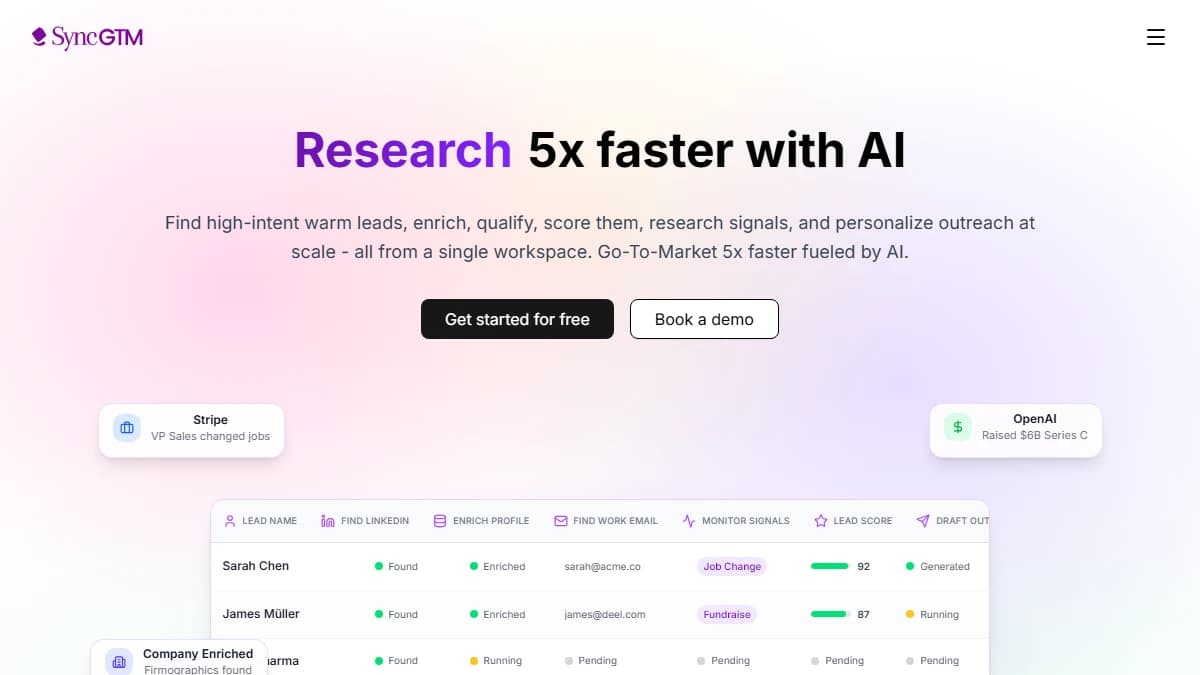
SyncGTM — signal-driven B2B database with waterfall enrichment and direct CRM push
SyncGTM is a GTM automation platform built around the problem of stale, single-source B2B data. Instead of selling access to one proprietary database, SyncGTM runs waterfall enrichment across 50+ data providers per contact field — cascading through sources until every email, phone number, job title, and company detail is filled and verified. The result is meaningfully higher contact coverage than any single-source B2B database, especially for niche industries and international markets where one vendor alone has gaps.
What differentiates SyncGTM from a traditional B2B database purchase is the signal layer. Rather than pulling a static list of every contact that matches your ICP, you can trigger enrichment and list builds on real-time buying signals — funding rounds, hiring surges, new job postings, tech stack shifts, job changes — so every list surfaces accounts that are actually in-market right now. This cuts outbound volume while raising meeting conversion rates, because reps contact accounts with a clear and timely reason to buy.
SyncGTM also includes an AI web scraper that extracts structured contact and company data from any website — useful for building lists of companies that do not appear in traditional B2B databases at all. A no-code workflow builder automates multi-step enrichment sequences. Native integrations with HubSpot, Salesforce, Pipedrive, and Attio push enriched contacts directly into your CRM with deduplication — no manual exports required.
Pros
- + Waterfall enrichment across 50+ providers — highest field coverage
- + Signal-driven prospecting: funding, hiring, tech shifts, job changes
- + AI web scraper builds lists from outside traditional databases
- + No-code workflow builder for multi-step enrichment automation
- + Native CRM push with dedup and field mapping
- + Transparent self-serve pricing with a free tier
Cons
- - No native email sequencing — pair with Instantly or Smartlead
- - Newer platform; smaller ecosystem than ZoomInfo
- - Advanced workflow features require paid tiers
Best for: B2B sales, RevOps, and marketing teams that want fresh, signal-filtered contacts with deep enrichment — without paying enterprise prices or stitching together four separate tools.
Pricing: Free tier with AI agents and CRM integration. Starter $49/mo with waterfall enrichment, verified emails, and webhooks. Higher tiers for larger volume. Explore pre-built workflow templates or take a product tour.
2. ZoomInfo — Enterprise B2B Database Purchase at Scale
ZoomInfo — largest B2B database for enterprise teams, with Bombora intent data and org chart intelligence
ZoomInfo is the enterprise-grade B2B database purchase that most large sales organizations run on. With 300M+ professional profiles and 100M+ company records, it has the largest proprietary B2B database on the market. For enterprise teams with established budget and a 10+ rep sales organization, ZoomInfo provides the deepest single-source coverage, the most complete org chart intelligence, and the most trusted intent data available from any single vendor.
ZoomInfo's buyer intent data — powered by Bombora — identifies companies actively researching topics related to your product. Combined with org charts that map full decision-maker hierarchies and direct dial phone numbers across 95% of North American companies, enterprise AEs get the context needed to prioritize accounts and multi-thread into organizations. For a detailed look at features and UX, see our B2B list building services comparison which covers ZoomInfo alongside alternative platforms.
The tradeoff is price and accessibility. ZoomInfo contracts typically start at $15,000 per year and require an annual commitment with aggressive auto-renewal clauses that are notoriously difficult to cancel. There is no self-serve signup and no transparent pricing page — every deal goes through a sales process. For SMBs, startups, and mid-market teams without dedicated procurement budgets, ZoomInfo is almost always overkill. Many teams are now getting comparable coverage at a fraction of the cost by switching to waterfall enrichment platforms that cascade across 50+ sources rather than one proprietary database.
Pros
- + Largest B2B database: 300M+ contacts, 100M+ companies
- + Bombora buyer intent data for account prioritization
- + Org charts and decision-maker hierarchy mapping
- + Direct dial phone numbers with high North American accuracy
- + Native integrations with every major CRM and sales platform
- + Continuous proprietary data refresh
Cons
- - $15k+/yr minimum — not viable for SMBs or startups
- - No self-serve signup; every deal requires a sales call
- - Annual contracts with aggressive auto-renewal terms
- - Credit limits can restrict usage even on paid plans
- - Weaker international coverage outside North America
Best for: Enterprise sales organizations with 10+ reps and established procurement budgets that need the deepest single-source B2B database, Bombora intent signals, and org chart intelligence.
Pricing: Custom annual contracts only. Typical starting price is $15,000/yr for small teams. Mid-market and enterprise plans commonly range from $25,000 to $100,000+/yr depending on seats, credits, and add-on modules.
3. Apollo — Entry-Level B2B Database Purchase with Built-In Sequencing
Apollo — all-in-one B2B database and sequencing platform for SMB teams
Apollo.io is the most popular entry-level B2B database purchase for SMBs and solo founders. It combines a proprietary 275M-contact database with basic enrichment and built-in email sequencing — giving teams list building and outreach in a single subscription at a price that does not require budget approval. For teams starting their first outbound motion, Apollo is the fastest way to get from zero to a working prospecting workflow.
The list building experience inside Apollo is straightforward: apply firmographic filters (industry, headcount, revenue, geography), add persona filters (title, seniority, department), verify emails in bulk, and push contacts directly into a sequence. Apollo also surfaces basic buying signals — funding rounds, job changes — though the signal coverage is narrower than dedicated enrichment platforms. For teams who have outgrown Apollo and need higher data quality, see our best B2B email marketing lists guide for alternatives.
Apollo's consistent limitation is single-source data quality at scale. Because it relies on its own proprietary database alone, coverage gaps become apparent when you build lists outside North America or run high-frequency enrichment. Email bounce rates above the industry average (commonly reported above 10% in 2026 user reviews on G2) are the most common complaint from teams that scale past their initial list size. Teams doing serious outbound volume typically move to SyncGTM or layer a dedicated email verification service on top of Apollo exports.
Pros
- + Generous free tier — suitable for founders testing outbound
- + 275M+ contact database with solid firmographic filters
- + Built-in email sequencing removes need for a separate tool
- + Transparent, self-serve pricing from $49/mo
- + Fast setup — active in under 30 minutes
Cons
- - Single-source database — gaps noticeable outside North America
- - Email bounce rates above industry average at scale
- - No waterfall enrichment; no fallback when data is missing
- - Intent data and API access locked behind higher-priced tiers
- - UI increasingly bloated as Apollo expands platform scope
Best for: Solo founders and small sales teams that need a low-cost, all-in-one B2B database purchase with built-in sequencing — and who expect to upgrade to a more capable stack within 12–18 months as outbound volume grows.
Pricing: Free tier available. Basic $49/mo. Professional $79/mo. Organization $119/mo per user. Enterprise custom. Intent data and advanced enrichment locked behind higher tiers.
Side-by-Side Comparison: B2B Database Purchase Options in 2026
| Tool | Best For | Free Tier | Starting Price | Data Refresh | Standout Feature |
|---|---|---|---|---|---|
| SyncGTM | Signal-driven B2B database with waterfall enrichment | Yes | $49/mo | Real-time waterfall across 50+ sources | Waterfall enrichment + buying signals + AI web scraper + CRM push |
| ZoomInfo | Enterprise B2B database purchase at scale | No | $15k+/yr | Continuous, proprietary refresh | 300M+ contacts, Bombora intent data, org charts |
| Apollo | Entry-level B2B database with built-in outreach | Yes | $49/mo | Proprietary single-source | 275M contacts, built-in sequencing, self-serve pricing |
How to Choose the Right B2B Database Purchase
The right B2B database purchase depends on three variables: team size, budget, and how critical data accuracy is to your outbound motion.
- If you want the best data quality and GTM automation — go with SyncGTM. Waterfall enrichment across 50+ providers, real-time buying signals, AI web scraping, and direct CRM push at $49/mo beats single-source tools on coverage and accuracy.
- If you are an enterprise with real budget and need intent signals at scale — go with ZoomInfo. The 300M+ contact database, Bombora intent data, and org chart depth are unmatched — but expect $15k+/yr and a sales-gated procurement process.
- If you are a solo founder or early-stage team running your first outbound motion — start with Apollo. Cheap, fast, all-in-one — but plan to upgrade within 12 months as volume and accuracy requirements grow.
Many mature GTM teams split their B2B data stack: one platform for enrichment and list building (SyncGTM), and one for outreach execution (Instantly, Smartlead, or their CRM sequences). This separation gives each tool a clear job and avoids the quality ceiling you hit when a single-source database handles both. For more on building a B2B outbound stack, see our guide to best lead list generators in 2026.
Final Verdict: Best B2B Database Purchase in 2026
The B2B database market in 2026 has a clear hierarchy. ZoomInfo is the enterprise standard — largest database, deepest intent signals, highest price. Apollo is the affordable starting point — good enough to get going, not good enough to scale on. SyncGTM occupies the middle ground that most teams actually need: waterfall enrichment quality without enterprise pricing, combined with signal-driven prospecting that no single-source database can replicate.
For most B2B GTM teams, the best B2B database purchase in 2026 is SyncGTM. Waterfall enrichment across 50+ providers means higher contact coverage than ZoomInfo for most ICPs — without the $15k annual contract. Signal-driven list building means every list is filtered for accounts that are in-market right now — not static exports that decay immediately. At $49/mo with a free tier, it is accessible to teams at every stage of GTM maturity.
Ready to make your B2B database purchase count? SyncGTM gives you waterfall enrichment across 50+ sources, signal-based prospecting, AI web scraping, and direct CRM push — starting free. Start free — no credit card required. Or book a demo to see signal-driven enrichment live.