

7 Best Fluar Alternatives in 2026 (Compared)

By Kushal Magar · March 9, 2026 · 12 min read · Last updated: September 28, 2026
Key Takeaway
This guide reviews seven Fluar alternatives for AI-powered lead enrichment in 2026. Fluar's key limits: no native CRM sync (webhooks only), no buying signal layer, and no outreach sequencing — you're enriching data but still need three more tools to act on it. SyncGTM is the top pick: AI enrichment across 50+ providers, real-time buying signals, native CRM writes, and workflow automation from $49/mo with a free tier. Explorium.ai brings ready-made data on 146M+ companies with real-time signals and Salesforce and HubSpot integrations, from $29.99 per credit package. Apollo.io combines a 275M+ contact database with built-in sequences from $49/mo. Instantly AI excels at high-volume cold email delivery where Fluar has no outreach layer. Bardeen brings browser-based automation and Instagram extraction for teams that want agent-driven scraping without CSV workflows. Lemlist adds personalized multichannel outreach on top of enriched lists. Cargo connects product usage signals to outbound sequences for PLG teams.
Fluar takes a genuinely interesting approach to AI enrichment: a spreadsheet-style interface where each column runs an autonomous AI research agent — scraping the web, calling APIs, processing files with OCR, and populating structured data for each row automatically. At $16/mo to start, it's one of the most accessible AI enrichment tools available.
The limitations become apparent when you try to act on the data Fluar collects. There's no native CRM sync — enriched leads move to HubSpot or Salesforce only through webhooks or manual CSV export. There's no buying signal layer to tell you when a target account is actively in-market. And there's no outreach sequencing: Fluar enriches your spreadsheet, then leaves the rest to you.
We evaluated seven alternatives across AI enrichment depth, verified provider coverage, CRM automation, buying signal detection, and outreach capability — to find which tools genuinely extend Fluar's AI-first approach rather than just replicating it.
Quick Summary
The best Fluar alternatives in 2026 are SyncGTM, Explorium.ai, Apollo.io, Instantly AI, and Bardeen. SyncGTM is the top pick for teams that want Fluar's AI research workflow plus the GTM automation layer Fluar stops short of — buying signals, native CRM sync to HubSpot and Salesforce, and workflow automation starting at $49/mo with a 200-credit free tier. Explorium.ai adds real-time signals on 146M+ companies through an API, MCP server, or plain-English prompts. Apollo.io combines enrichment with built-in outreach sequences. Instantly AI handles cold email delivery at scale where Fluar offers nothing. Bardeen adds browser-based agent automation and Instagram extraction. Lemlist brings multichannel personalized sequences. Cargo connects product signals to outbound for PLG teams.
TL;DR: Best Fluar Alternatives in 2026
- SyncGTM — Best overall. AI enrichment across 50+ providers with buying signals, CRM sync, and workflow automation from $49/mo.
- Explorium.ai — Best for AI-agent data and signals. 146M+ companies with real-time events via API, MCP, or plain-English prompts. Free trial (100 credits), then from $29.99 per credit package.
- Apollo.io — Best all-in-one. 275M+ database with built-in sequences and CRM from $49/mo.
- Instantly AI — Best for cold email volume. Unlimited email sending with warm-up infrastructure from $37/mo.
- Bardeen — Best for browser automation. AI agents for Instagram and web scraping without CSV uploads.
- Lemlist — Best for multichannel outreach. Email + LinkedIn + cold calling with personalization from $55/mo.
- Cargo — Best for PLG teams. Revenue data orchestration connecting product signals to outbound sequences.
Why Teams Look for Fluar Alternatives
Fluar solves a real problem well: it democratizes AI web research for non-engineers by embedding autonomous research agents directly into a spreadsheet interface. The AI Workflow Builder can find verified contact information, analyze business profiles, scrape Instagram and web pages, process uploaded files via OCR, and generate personalized content ideas — all without writing code. Independent benchmarks show that at nearly every pricing tier, Fluar delivers 15–40% lower cost per credit than comparable enrichment competitors.
The friction starts when Fluar-enriched data needs to move downstream. The platform's CRM integration story is webhook-only — no native HubSpot, Salesforce, or Pipedrive connectors that automatically write enriched fields to existing records. There's no buying signal layer: Fluar tells you what a company looks like today, not whether they're actively evaluating solutions right now. And there's no outreach sequencing built in — email sends, LinkedIn touches, and follow-up cadences require a separate tool entirely.
Teams that outgrow Fluar typically fall into one of three patterns: they need a verified provider waterfall (not just AI-generated research) for higher-confidence contact data, they need CRM automation so enriched data flows into their existing workflows without manual export, or they need a signal layer that tells them when to reach out — not just who to reach out to.
1. SyncGTM: AI Enrichment With Verified Provider Waterfall, Signals, and CRM Automation
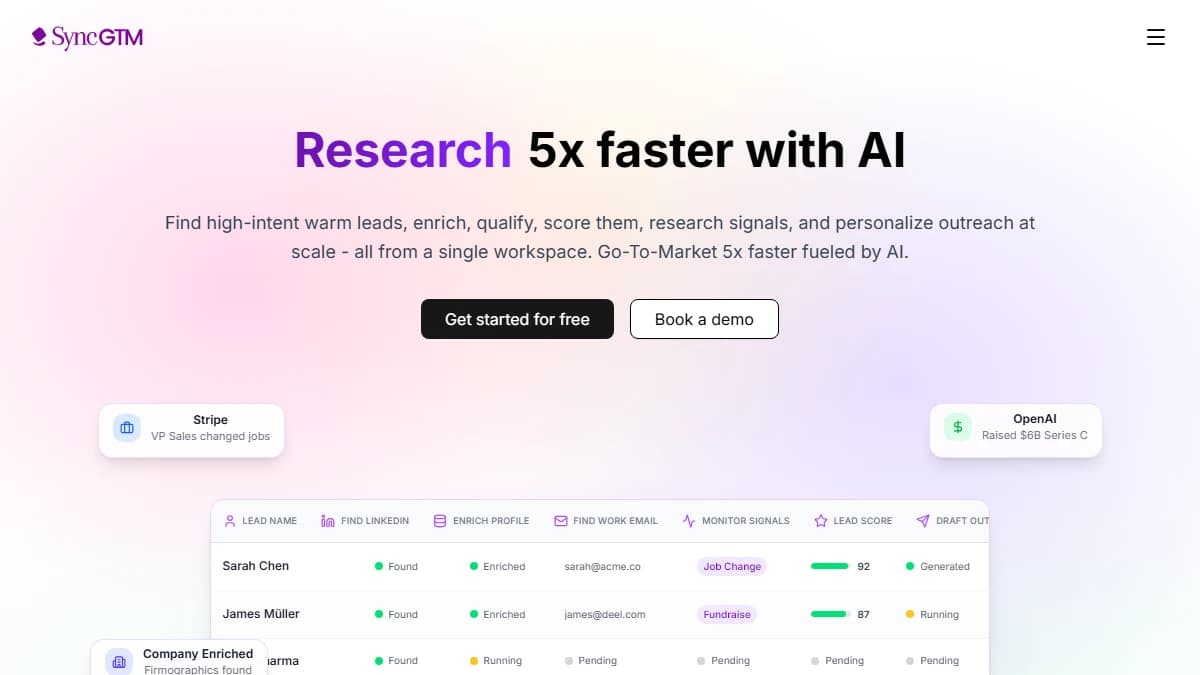
SyncGTM — AI enrichment across 50+ verified providers with real-time buying signals and native CRM sync from $49/mo
SyncGTM takes the same spreadsheet-style AI research approach as Fluar, but combines it with a verified provider waterfall across 50+ data sources — the distinction that matters for contact data accuracy. Fluar's AI agents conduct web research and synthesize results; SyncGTM cascades through 50+ verified B2B data providers in sequence until a verified email or phone number is confirmed, then layers AI research on top for enrichment fields that verified databases don't cover.
The GTM automation layer is where SyncGTM diverges most sharply from Fluar. Buying intent signals — hiring surges, funding rounds timed to announcement day, tech stack changes, executive job moves — are built into the platform, not bolted on. You can trigger enrichment or outreach automatically when a target account fires a signal, not just when you remember to run a batch export. Native CRM integrations write enriched data and signal alerts directly to HubSpot, Salesforce, Pipedrive, and Attio on every paid plan — no webhooks to configure, no Zapier middleware.
The free tier includes 200 credits per month with AI agents and CRM integrations active — enough to run a real parallel test against your existing Fluar workflow before switching. SyncGTM's Solo is $49/mo versus Fluar's $16/mo entry, but replaces the three to four tools Fluar requires downstream for CRM sync, signal monitoring, and outreach sequencing.
Pros
- ✓ 50+ verified provider waterfall (vs Fluar's AI-only research)
- ✓ Free tier with 200 credits/mo and CRM integrations active
- ✓ Native CRM sync to HubSpot, Salesforce, Pipedrive, Attio
- ✓ Real-time buying signal detection built in
- ✓ AI agents for custom research and personalization
- ✓ Workflow builder with branching automation logic
- ✓ Signal-triggered enrichment and outreach enrollment
- ✓ Independent column refresh reduces credit waste
Cons
- ✗ Starter at $99/mo vs Fluar's $16/mo entry point
- ✗ Smaller community than Apollo
- ✗ Less Instagram-specific scraping depth than Bardeen
Best for:GTM teams and RevOps that want Fluar's AI enrichment workflow plus verified provider coverage, real-time buying signals, and native CRM automation — without stitching together four separate tools to make enriched data actionable.
Pricing: Free tier (200 credits/mo) · Starter $99/mo · Growth $199/mo · Enterprise custom
2. Explorium.ai: Ready-Made B2B Data and Real-Time Signals for AI Agents
Explorium.ai takes a different route to the same goal as Fluar. Fluar sends an AI agent to research the web for each row of a spreadsheet. Explorium starts from data it already holds: 146M+ companies, 767M+ professional profiles, and 4,000+ data signals from 100+ sources, served through one REST API, a hosted MCP server, or Vibe Prospecting, a no-code app that builds and enriches lists from plain-English prompts.
The practical gain for a Fluar user is on the two gaps this guide keeps coming back to. Explorium tracks real-time events such as funding rounds, job changes, hiring, and tech changes, so you get a buying signal layer instead of a one-time snapshot. It also integrates with Salesforce and HubSpot instead of relying on webhooks. Company enrichment covers firmographics, technographics, funding data, and website changes; prospect enrichment adds work emails, phone numbers, and professional history.
The tradeoff is flexibility. Explorium has no spreadsheet-style column builder, so Fluar's custom per-column prompts don't carry over. Pricing runs on credit packages rather than a monthly plan: a 100-credit free trial, then $29.99 for 500 credits or $149.99 for 5,000, with 1 credit per search and 1-5 credits per enrichment. There is no outreach sequencing either, so you still need a sender.
Pros
- ✓ 146M+ companies and 767M+ professional profiles
- ✓ Real-time funding, job-change, hiring, and tech-change signals
- ✓ Salesforce and HubSpot integrations (custom CRMs on Enterprise)
- ✓ Hosted MCP server and Claude Code plugin for AI-agent workflows
- ✓ Vibe Prospecting for plain-English list building
- ✓ Free trial with 100 credits
Cons
- ✗ No spreadsheet-style column builder like Fluar's
- ✗ No native outreach sequencing
- ✗ Credit cost varies by enrichment type (1-5 credits)
- ✗ API and MCP paths assume some technical comfort
Best for:GTM teams and AI SDR builders that want ready-made company and contact data with the buying signals and CRM integrations Fluar doesn't offer, and don't need a spreadsheet interface.
Pricing: Free trial (100 credits) · Lite $29.99 · Starter $149.99 · Growth $749.99 · Enterprise custom
3. Apollo.io: Database + Enrichment + Outreach in One Platform
Apollo.io takes the opposite architectural approach from Fluar. Where Fluar runs AI research agents to crawl and synthesize web data per row, Apollo owns and maintains its own 275M+ contact and company database — no AI research steps, no per-row web crawling. The upside is consistency and speed: lookups resolve in milliseconds against a structured database. The downside: when Apollo's database doesn't have a record, there's no AI fallback to research it.
The critical advantage Apollo provides over Fluar is outreach integration. After enriching a contact in Fluar, you need a separate tool to send emails, manage sequences, and track replies. Apollo handles the complete workflow — find a contact, enrich their record, build a sequence, send a campaign, track engagement, and sync everything to your CRM — without leaving the platform. For teams that want fewer tools rather than more integration surface area, Apollo is the most complete replacement for a Fluar + outreach stack combined.
At $49/mo for the Basic plan with a free tier of 10,000 email credits per month, Apollo is priced below where Fluar's equivalent output starts requiring additional tools.
Pros
- ✓ 275M+ contact database owned and maintained
- ✓ Built-in sequences and email outreach
- ✓ Free tier with 10,000 email credits/mo
- ✓ Native CRM integrations on all paid plans
- ✓ $49/mo Basic accessible for small teams
- ✓ AI-powered contact search and ICP filters
Cons
- ✗ Single-source database — no AI web research fallback
- ✗ No Instagram or social profile scraping
- ✗ Data accuracy complaints for non-US markets on G2
- ✗ No real-time buying signal monitoring
- ✗ Can feel bloated for teams that only need enrichment
Best for:Sales teams that want to consolidate Fluar's enrichment workflow and a separate outreach tool into one platform — and whose ICP is well-covered by Apollo's 275M+ US-heavy database.
Pricing: Free tier · Basic $49/mo · Professional $99/mo · Organization $149/mo
4. Instantly AI: Cold Email Delivery at Volume Where Fluar Has No Outreach Layer
Instantly AI addresses the gap Fluar leaves entirely unaddressed: what happens after you have enriched contact data. Fluar populates your spreadsheet. Instantly sends the emails — at volume, with built-in warm-up infrastructure to protect sender reputation, and with AI-powered personalization that connects enrichment data to message content.
Instantly's Growth plan allows unlimited email sending on unlimited accounts from $37/mo — a pricing model that removes the per-send cost ceiling that makes tools like Lemlist or Apollo expensive for high-volume cold outreach. Email account warm-up is included across all plans, a requirement for sustainable deliverability that Fluar doesn't touch. Instantly also includes a built-in B2B contact database (Instantly Leads) for teams that want prospecting and delivery in one tool rather than pairing Fluar's enrichment with a separate sender.
The limitation is the opposite of Fluar's: Instantly handles outreach exceptionally well but has no AI web research capability, no OCR file processing, and no Instagram scraping. Teams use Fluar or another enrichment tool first, then hand off to Instantly for delivery — a common stack combination in the 2026 outbound ecosystem.
Pros
- ✓ Unlimited email sending on Growth plan ($37/mo)
- ✓ Built-in email account warm-up on all plans
- ✓ AI personalization pulling from enrichment data
- ✓ Instantly Leads database for built-in prospecting
- ✓ High deliverability infrastructure
- ✓ Integrates with SyncGTM and other enrichment tools via API
Cons
- ✗ No AI web research or enrichment capability
- ✗ No Instagram or social scraping
- ✗ No buying signal layer or intent monitoring
- ✗ Email-only — no LinkedIn or phone channel
- ✗ Requires a separate enrichment tool alongside it
Best for:Teams that use Fluar for enrichment and need a dedicated high-volume cold email delivery tool — the outreach layer Fluar explicitly doesn't provide.
Pricing: Growth $37/mo · Hypergrowth $97/mo · Light Speed $358/mo
5. Bardeen: Browser-Based AI Agents With Native Instagram Extraction
Bardeen approaches AI automation differently from Fluar: rather than a spreadsheet table where columns trigger AI research, Bardeen runs browser-based automation agents that operate inside the actual web pages you're visiting — scraping data in real time, navigating pagination, clicking through profiles, and extracting structured data without requiring a CSV upload or API integration first.
For teams specifically drawn to Fluar's Instagram extraction capability, Bardeen goes deeper: native playbooks for scraping Instagram followers, following lists, profile data, and engagement metrics — then exporting directly to Google Sheets, Airtable, Notion, or HubSpot. This is the most direct comparison point: Fluar's web scraping columns can hit Instagram public profiles as part of a broader AI research workflow; Bardeen has dedicated Instagram automation playbooks that handle pagination, rate limits, and structured export natively.
Bardeen also integrates with lead enrichment APIs, can validate and qualify leads via AI mid-scrape, and supports chained workflows where scraping triggers enrichment which triggers CRM write — without requiring the user to export and reimport between steps.
Pros
- ✓ Native Instagram follower and profile extraction playbooks
- ✓ Browser-based — no CSV required to start a scrape
- ✓ AI qualification mid-scrape before data export
- ✓ Exports directly to Sheets, Airtable, Notion, HubSpot
- ✓ Free plan for individual automations
- ✓ Chained workflows (scrape → enrich → CRM) without re-import
Cons
- ✗ Browser extension required — not fully cloud-native
- ✗ No verified B2B provider waterfall for email/phone
- ✗ No buying signal monitoring or intent detection
- ✗ Less structured for high-volume batch enrichment
- ✗ Instagram scraping subject to platform rate limits
Best for:Growth and marketing teams that need Instagram profile extraction, browser-based AI scraping, and workflow automation — a more browser-native approach than Fluar's spreadsheet research columns.
Pricing: Free plan · Professional $10/mo · Business $30/mo · Enterprise custom
6. Lemlist: Multichannel Personalized Outreach on Top of Enriched Lists
Lemlist addresses the final-mile problem that Fluar users consistently face: the platform enriches data well but leaves personalized, multi-touch outreach to other tools. Lemlist handles the outreach layer with email sequences, LinkedIn automation, and cold calling in one platform — pulling personalization variables directly from your enrichment data.
The differentiator is Lemlist's personalization engine. AI-generated personalized images (profile photos, company logos embedded in images), custom landing pages per prospect, and liquid-syntax variable injection let teams create outreach that references the specific enrichment data Fluar or another tool collected — company tech stack, recent funding, Instagram follower count, OCR-extracted data from uploaded files. Lemlist also includes a built-in prospecting database (lemlist database) with 450M+ contacts for teams that want to skip Fluar's enrichment step entirely for high-volume prospecting.
The platform is best used downstream of an enrichment tool rather than as a replacement: Fluar or SyncGTM for enrichment, Lemlist for multichannel sequence delivery and reply management.
Pros
- ✓ Email + LinkedIn + cold calling in one platform
- ✓ AI personalized images and custom landing pages per prospect
- ✓ 450M+ built-in prospect database (lemlist database)
- ✓ Reply detection and sequence auto-pause on response
- ✓ Native CRM integrations (HubSpot, Salesforce, Pipedrive)
- ✓ Strong deliverability infrastructure with warm-up included
Cons
- ✗ No AI web research or spreadsheet-style enrichment
- ✗ LinkedIn steps require LinkedIn Sales Navigator on some plans
- ✗ Per-seat pricing compounds for larger teams
- ✗ No buying signal monitoring or intent layer
- ✗ Learning curve for full personalization features
Best for: Sales and growth teams that use Fluar for enrichment and need a multichannel sequence platform for email, LinkedIn, and cold calling with deep personalization from enrichment variables.
Pricing: Email Starter $55/mo · Email Pro $79/mo · Multichannel Expert $99/mo · Outreach Scale $159/mo
7. Cargo: Revenue Data Orchestration for PLG Teams
Cargo solves a fundamentally different problem than Fluar. Where Fluar enriches cold lead lists with AI web research, Cargo connects existing product usage data, CRM events, and behavioral signals to outbound sequences — enabling revenue teams at product-led growth companies to act on signals that already live inside their own systems rather than researching them from scratch.
The core Cargo workflow: ingest product analytics (Mixpanel, Amplitude, Heap), CRM data (Salesforce, HubSpot), and enrichment signals; apply ICP scoring and intent scoring on top; then trigger automated outreach sequences when an account hits a defined activation threshold. This is a fundamentally different motion from Fluar's AI research workflow — Cargo assumes you already have the data and need to orchestrate actions from it, rather than building the dataset in the first place.
For PLG companies where the highest-intent signal is product behavior (a free user hitting an upgrade trigger, a team expanding feature usage, a trial nearing expiration), Cargo's orchestration layer is more relevant than Fluar's external enrichment approach. For sales-led teams without a self-serve product motion, Cargo's PLG-native design creates less applicable fit.
Pros
- ✓ Product signal to outbound sequence automation
- ✓ Connects Mixpanel, Amplitude, Heap natively
- ✓ ICP and intent scoring from combined signals
- ✓ Revenue orchestration without manual research steps
- ✓ Strong fit for PLG companies with existing product data
- ✓ Triggers sequences automatically from product events
Cons
- ✗ PLG-native — poor fit for sales-led teams without product data
- ✗ No AI web research or external enrichment capability
- ✗ No Instagram or social scraping
- ✗ Requires existing product analytics infrastructure
- ✗ Enterprise pricing — no self-serve plan
Best for:PLG companies with Mixpanel or Amplitude in place that want to convert product usage signals into automated outbound sequences — a use case Fluar's external web research approach does not serve.
Pricing: Custom — enterprise sales process required
Side-by-Side Comparison: Fluar vs 7 Alternatives
| Tool | Starting Price | AI Research | CRM Native | Buying Signals | Outreach Built-In | Free Tier |
|---|---|---|---|---|---|---|
| Fluar | $16/mo | ✓ Core feature | ✗ Webhooks only | ✗ | ✗ | ✓ Free to start |
| SyncGTM | $49/mo | ✓ AI + 50+ providers | ✓ All plans | ✓ Real-time | ✓ Sequences | ✓ 200/mo |
| Explorium.ai | $29.99/pkg | ✓ Vibe Prospecting | ✓ Salesforce, HubSpot | ✓ Real-time events | ✗ | ✓ 100-credit trial |
| Apollo.io | $49/mo | ✗ DB-only | ✓ All plans | Limited | ✓ Sequences | ✓ 10K/mo |
| Instantly AI | $37/mo | ✗ | Via Zapier | ✗ | ✓ Email only | ✗ Trial |
| Bardeen | Free / $10/mo | ✓ Browser agents | ✓ HubSpot etc. | ✗ | ✗ | ✓ Free plan |
| Lemlist | $55/mo | ✗ | ✓ Native | ✗ | ✓ Email + LinkedIn | 14-day trial |
| Cargo | Custom | ✗ | ✓ Native | ✓ Product signals | ✓ Sequences | ✗ |
How to Choose the Right Fluar Alternative
- If you need Fluar's AI enrichment plus CRM automation and buying signals → SyncGTM. AI research across 50+ verified providers, real-time signal detection, and native CRM writes — the complete workflow Fluar stops short of, from $49/mo with a 200-credit free tier.
- If you want ready-made company data and live signals for AI agents → Explorium.ai. 146M+ companies, real-time funding and job-change events, and Salesforce and HubSpot integrations, from $29.99 per credit package.
- If you want prospecting + enrichment + outreach in one platform → Apollo.io. 275M+ database with sequences, email tracking, and CRM integrations from $49/mo.
- If you use Fluar for enrichment and need high-volume cold email delivery → Instantly AI. Unlimited email sending with warm-up infrastructure — the outreach layer Fluar explicitly doesn't provide.
- If Instagram extraction and browser-based AI scraping are your primary use case → Bardeen. Native Instagram playbooks with browser automation — deeper than Fluar's web scraping columns for social data extraction.
- If you need multichannel personalized outreach after enrichment → Lemlist. Email + LinkedIn + cold calling with AI personalized images pulling from enrichment variables.
- If you're a PLG company and need product signals to trigger outbound → Cargo. Revenue orchestration connecting Mixpanel, Amplitude, and CRM signals to automated sequences — a motion Fluar's external research approach doesn't address.
Final Verdict
Fluar earns its place in the AI enrichment category. At $16/mo, it's the most accessible entry point for AI-powered web research in a spreadsheet interface — with genuine capabilities in OCR file processing, Instagram extraction, and autonomous column-level research that put it ahead of most enrichment tools on cost per credit at entry pricing.
The limitations that drive teams to alternatives are structural, not product quality issues. Fluar stops at the spreadsheet: enriched data moves downstream only through webhooks or manual export, there's no buying signal layer, and no outreach sequencing. In 2026, those aren't gaps you can patch with one additional tool — they typically require three.
For teams that want to preserve Fluar's AI research approach while adding the GTM automation layer it's missing, SyncGTM is the most complete replacement: 50+ verified provider waterfall alongside AI research, real-time buying signals, and native CRM sync that writes directly to HubSpot and Salesforce without webhook configuration. Start with the free tier (200 credits/mo) to run a parallel workflow test before committing.
For teams that want ready-made data and buying signals feeding AI agents, Explorium.ai provides 146M+ company records and real-time events, at the cost of Fluar's spreadsheet flexibility. For Instagram and browser automation specifically, Bardeen goes deeper than Fluar's web scraping columns with dedicated social automation playbooks. And for teams building a separate enrichment-plus-delivery stack, Instantly AI at $37/mo handles the email delivery side that Fluar leaves entirely to you.
Ready to go beyond Fluar's spreadsheet enrichment?
SyncGTM gives you AI enrichment across 50+ verified providers, real-time buying signal detection, AI research agents, and native CRM sync to HubSpot and Salesforce — starting at $49/mo with a 200-credit free tier. No webhook configuration. No manual CSV exports to move data downstream.