Gong Review 2026: Revenue Intelligence Worth the Enterprise Pricing?

By Kushal Magar · April 7, 2026 · 12 min read · Last updated: September 30, 2026
Key Takeaway
Gong is a revenue intelligence platform that records, transcribes, and analyzes sales calls using AI. It provides conversation intelligence, deal analytics, revenue forecasting, and rep coaching, with Gong Engage, Gong Enable, and AI agents built on the same interaction data. Gong does not publish prices: licenses are per user plus a platform fee, and third-party reports put a 10-person team at roughly $21,000/year. Gong integrates deeply with Salesforce, HubSpot, Zoom, and Teams. It excels at post-call analysis and coaching, but it is not a contact database or enrichment tool, and small teams with low call volume will struggle to justify the cost.
Gong is the gold standard for conversation intelligence. It records every sales call, transcribes it with AI, and surfaces insights about what top performers do differently. Deal analytics, revenue forecasting, and rep coaching round out the platform.
You are probably here because your sales team runs dozens of calls per week and you want data on what works. Gong delivers that, and in 2026 it reaches well beyond call recording: Gong Engage, Gong Forecast, Gong Enable, and a set of AI agents all run on the same record of customer interactions.
This Gong review covers the platform's strengths, how its modules fit together, what enterprise pricing really costs, and the downsides worth weighing before you sign an annual contract.
Gong Review: What You Get (and What You Don't)
Gong calls itself the Revenue AI Operating System. The platform captures every customer interaction — calls, emails, meetings — and uses AI to analyze them for patterns, risks, and coaching opportunities.
| Feature | What's Included | Limitations |
|---|---|---|
| Call Recording | Automatic recording and transcription across Zoom, Teams, Meet | Requires calendar and video tool integration |
| Deal Intelligence | AI-scored deal health, risk alerts, engagement tracking | Only as complete as the calls, emails, and meetings Gong captures |
| Revenue Forecasting | AI-driven pipeline and revenue predictions | Dependent on historical call data volume |
| Rep Coaching | Talk-to-listen ratios, keyword tracking, behavior analysis | Coaching insights lag — based on past calls |
| AI Agents | Agents that automate follow-ups, pipeline edits, enablement triggers, and forecast corrections | Output depends on how much interaction data Gong has captured |
The takeaway: Gong is strongest at analyzing customer conversations and turning them into coaching, deal, and forecast insight. It is not a contact database or data enrichment tool, so prospect data has to come from elsewhere.
Gong Conversation Intelligence: Call Recording and AI Analysis
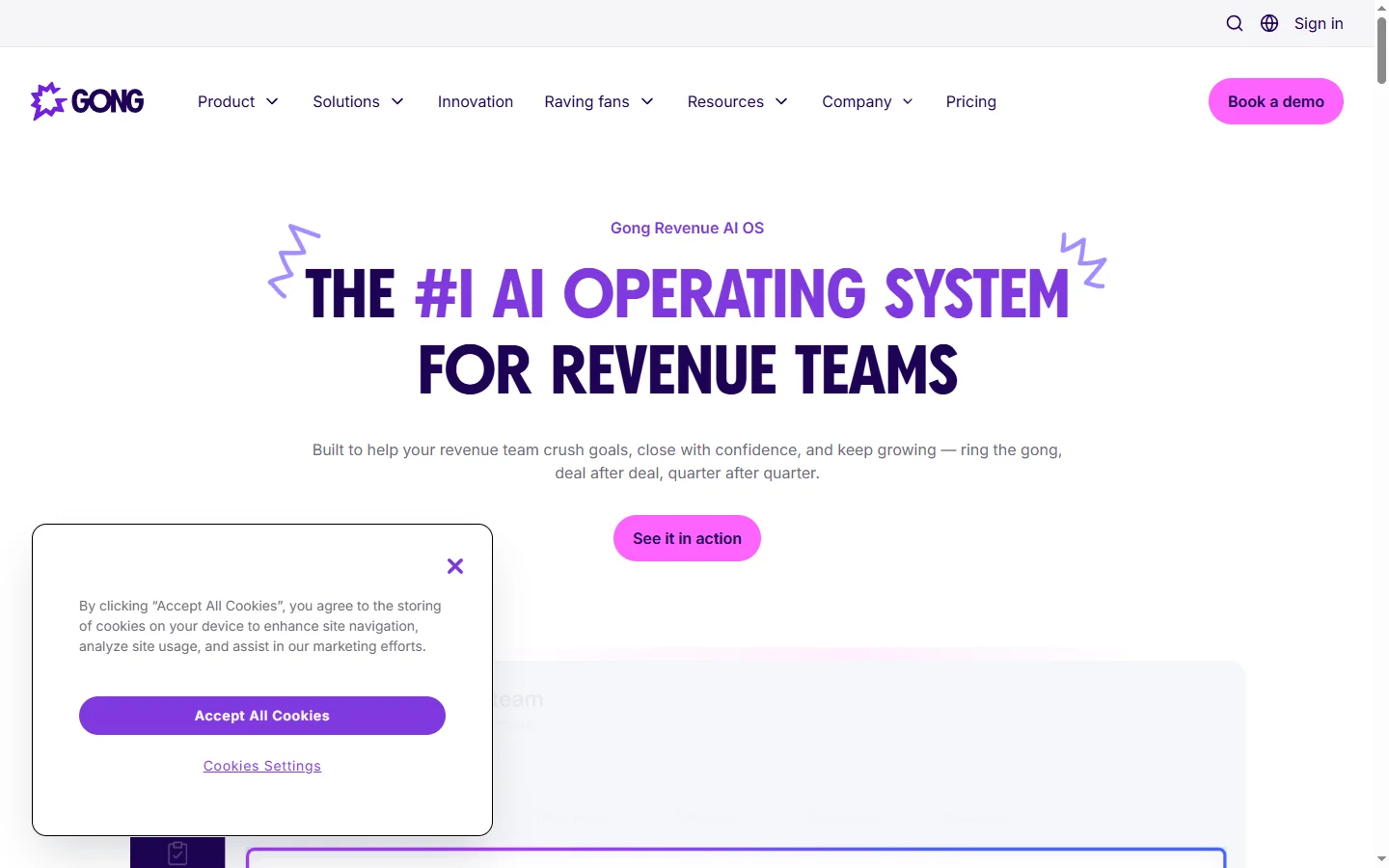
Gong records calls automatically via integrations with Zoom, Google Meet, and Microsoft Teams. The AI transcribes conversations with high accuracy, tracks keywords and topics, and surfaces patterns across your team's calls.
What works well
Talk-to-listen ratio analysis helps managers spot reps who talk too much. Keyword tracking reveals which pain points come up most often. Deal risk alerts flag conversations where competitors are mentioned or stakeholder engagement drops. Over 5,000 companies use Gong, and G2 reviewers consistently rate the conversation intelligence as best-in-class.
Where it falls short
Gong only analyzes what it captures, so coverage depends on connecting calendars and video tools like Zoom, Meet, and Teams; conversations outside those systems are invisible. Coaching insights are built from past calls, so they only change behavior when managers set aside time each week to review flagged calls with reps. And the sheer number of trackers and dashboards can bury the handful of insights a manager actually needs, especially in the first few weeks.
Gong Forecast: AI-Powered Revenue Predictions
Gong Forecast uses conversation data to predict deal outcomes and pipeline health. The AI analyzes engagement patterns, stakeholder involvement, and conversation sentiment to score each deal's probability of closing.
The accuracy improves with data volume. Teams with 6+ months of call history see better predictions. New Gong deployments take weeks to calibrate, and forecasting accuracy during that ramp period is limited.
Forecasting is valuable once it is calibrated. But a forecast tool cannot fix a weak pipeline. If your reps are having too few qualified conversations, Gong's forecast just tells you more precisely that you will miss the number.
Beyond Calls: Gong Engage, Enable, and AI Agents
Gong now positions itself as a Revenue AI Operating System rather than a call recorder. As of September 2026, its pricing page lists Gong Engage, Gong Forecast, Gong Enable, the Gong Revenue Graph, Gong AI, and Gong AI Agents. Here is what each piece does and how they connect.
- •Revenue Graph: the data layer underneath everything. Gong describes it as a living network that automatically captures and connects every customer interaction across your business.
- •Gong Engage: sales engagement software that uses AI to prioritize and personalize outreach. Its pitch is that engagement runs on the same interaction data as the rest of Gong, rather than in a separate sequencing tool.
- •Gong Forecast: the AI forecasting module covered above, which scores deals from engagement and conversation data.
- •Gong Enable: revenue enablement grounded in real customer interactions, so onboarding and training draw on your own calls rather than generic playbooks.
- •Gong Agents: AI agents for routine work, automating follow-ups, pipeline edits, enablement triggers, and forecast corrections. Named agents include AI Tracker and AI Trainer.
The modules share one real advantage: they read from the same interaction data, so a risk spotted on a call can inform the forecast, a coaching plan, and the next follow-up without exporting anything between tools. That is Gong's strongest argument against stitching together separate recording, engagement, enablement, and forecasting products.
The trade-off is cost and complexity. Gong prices licenses per user plus a platform fee based on the number of users supported, and pricing arrives as a custom proposal sized to your team. Ask for module-by-module pricing, start with core conversation intelligence, and add Engage, Enable, or Forecast once reps record consistently and managers actually review calls. Every extra module adds to the per-seat bill and to an onboarding load that G2 reviewers already describe as heavy.
Gong Pricing Breakdown
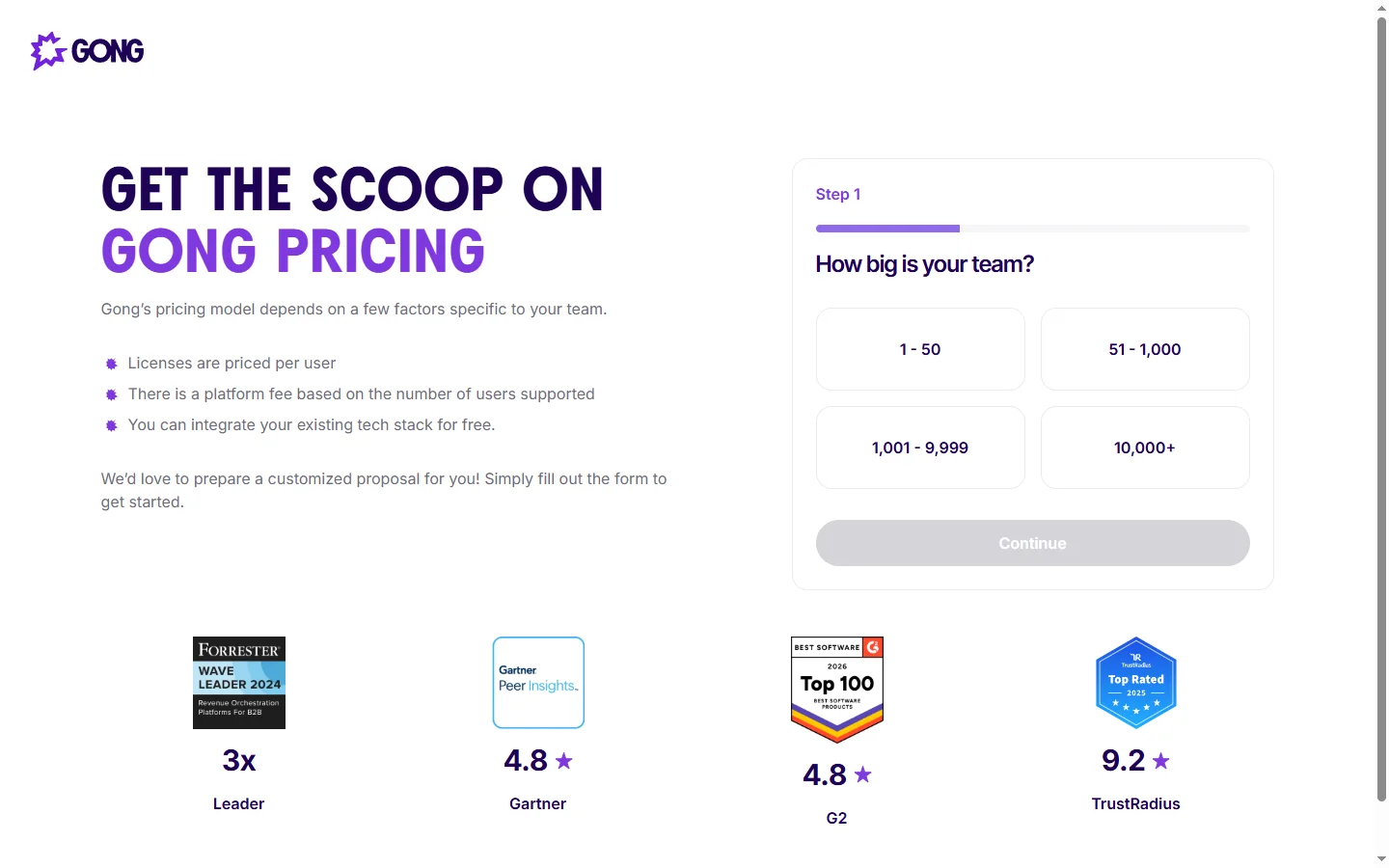
Gong does not publish prices on its website. As of September 2026, its pricing page confirms only the structure: licenses are priced per user, a platform fee is based on the number of users supported, and integrating your existing tech stack is free. Based on multiple sources including Claap, Capterra, and G2 user reports, here is what teams report paying in 2026:
- •Platform fee: ~$5,000/year reported for smaller teams (Gong says the fee scales with the number of users supported)
- •Under 49 users: $1,600/user/year (~$133/user/mo)
- •50-99 users: $1,520/user/year (~$127/user/mo)
- •100-249 users: $1,440/user/year (~$120/user/mo)
What you actually pay at scale
A 10-person sales team pays roughly $21,000/year ($5,000 platform + $16,000 in licenses). A 50-person team pays approximately $85,000 in year one. Mandatory professional services for onboarding add to the first-year bill.
Hidden costs to watch
- Annual contracts required — no monthly flexibility
- Mandatory onboarding fees increase year-one spend
- Per-seat pricing scales fast with team growth
- Platform fee on top of licenses, scaling with the number of users supported
What Are the Downsides of Using Gong?
Enterprise pricing locks out SMBs
At $21K+/year for a small team, Gong is built for mid-market and enterprise. Startups and teams under 10 reps struggle to justify the cost, especially when cheaper alternatives like Fireflies.ai ($10/user/mo) cover basic call recording.
Insights need volume to mature
Gong's AI improves with data. Forecasts are most accurate for teams with 6+ months of call history, and new deployments take weeks to calibrate. Teams with low call volume, or reps who skip recording, get thinner patterns and less useful coaching, which makes the per-seat price harder to justify.
Overwhelming interface
G2 reviewers note that the volume of data and features can feel overwhelming for new users. Onboarding takes weeks, and many features remain unused in smaller deployments. The learning curve is real.
No transparent pricing
Like most enterprise tools, Gong requires a sales conversation before you see pricing. This makes it hard for RevOps to build a business case internally without committing to a demo process.
Is Gong Worth It?
Gong is worth it for enterprise teams that run high-volume sales calls and need coaching, forecasting, and deal intelligence. The conversation AI is genuinely best-in-class. If you have 50+ reps and $85K+/year in budget, Gong delivers real value.
Gong is harder to justify for small teams with low call volume. Per-seat licenses plus a platform fee, annual contracts, and weeks of onboarding are built for organizations large enough to use coaching, forecasting, and deal analytics together. Teams that mainly need call recording and transcription can start with lighter tools like Fireflies.ai ($10/user/mo) or Claap ($30/user/mo).
The verdict: gold standard for conversation intelligence with enterprise pricing to match. Worth it when you have the call volume, the reps, and the manager time to act on what it surfaces.
Comparing other revenue tools? Read our in-depth reviews of Docket, Apollo.io, Reply.io, Instantly, Folk CRM, Gojiberry.ai, and MarketBetter.
Building out the rest of your revenue stack? Read what waterfall enrichment is and explore the best buying intent data tools for 2026. See also our best sales prospecting tools for B2B teams roundup.
If Gong having no contact database or prospect data is a dealbreaker, SyncGTM is one alternative worth a look: it pairs waterfall enrichment across 50+ data providers with real-time buying signals such as job changes, funding, and hiring.