

Intentsify Review 2026: Precision Intent Data — Pricing and Performance

By Kushal Magar · April 8, 2026 · 12 min read · Last updated: September 30, 2026
Key Takeaway
Intentsify is a Forrester Wave-recognized B2B intent data platform that aggregates signals from trillions of monthly events across publisher networks, content sites, and technology adoption data. Named the highest-scoring Current Offering in Forrester's Q1 2025 Wave. Pricing ranges from $12K to $100K+/year with usage-based platform pricing plus CPL and CPM activation models, and commitments can be monthly, quarterly, or annual. Acquired Salutary Data in January 2026 for technographic signals. Main limitations: enterprise pricing that locks out growth-stage teams, implementation work requiring dedicated RevOps, signals that stop at accounts and personas rather than named contacts, and no direct sales outreach.
Intentsify was named the Forrester Wave Leader for B2B intent data in Q1 2025 — highest Current Offering score in the category. It aggregates signals from publisher networks, behavioral data, and — since its January 2026 acquisition of Salutary Data — technology adoption signals. Pricing is not published: third-party data puts annual spend between $12K and $100K+, and commitments can be monthly, quarterly, or annual (as of September 2026). No self-serve option.
The multi-source aggregation is the genuine differentiator over single-source tools like Bombora. The constraint: this is an enterprise platform requiring dedicated RevOps resources, existing CRM and marketing automation infrastructure, and a $25K+ annual intent budget. Growth-stage teams typically cannot extract the full value.
Below: how multi-source intent aggregation works, what Intentsify actually costs, how a deployment runs, where the platform falls short, and which teams it fits.
Intentsify Review: What You Get (and What You Don't)
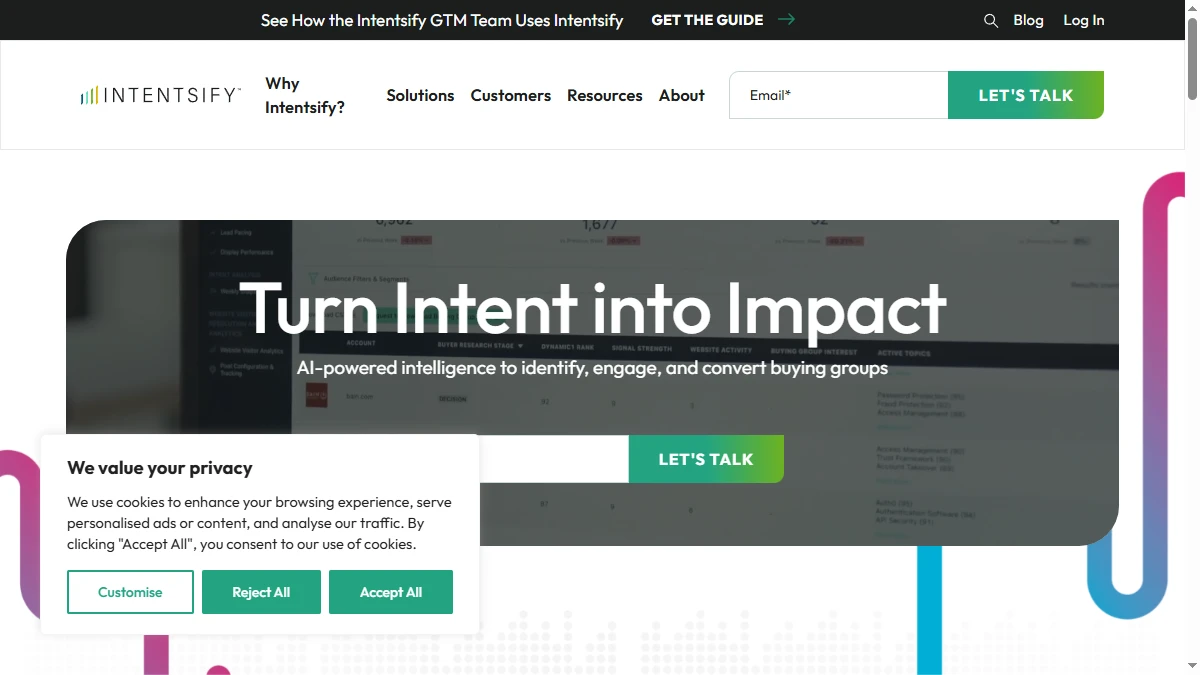
Intentsify monitors over a trillion monthly intent signals across hundreds of thousands of B2B content sites. Its Intelligence Activation Platform maps research patterns across entire buying committees, not just individual contacts. Recognized as a Forrester Wave Leader for B2B intent data — check ratings on G2 and TrustRadius.
| Feature | What's Included | Limitations |
|---|---|---|
| Multi-Source Intent | Aggregated signals from publisher networks, content sites, tech adoption | Account-level scores with persona-level Buying Group Intent — named leads only through paid CPL programs |
| Content Activation | Content syndication to in-market accounts | CPL pricing adds cost on top of platform fees |
| Programmatic Ads | Intent-driven display ad targeting | CPM pricing model with variable costs |
| Technographic Data | Technology install signals (via Salutary Data acquisition) | New capability — still being integrated as of early 2026 |
| Outreach Automation | Not available | No direct outreach — content and ads only |
The takeaway: Intentsify excels at identifying which accounts are researching topics and activating them through content and ads. What it does not do is enrich contacts or automate direct sales outreach, and its intent scores point to accounts and personas rather than named people.
Intentsify Intent Data: How Multi-Source Signals Work
Unlike single-source intent providers like Bombora (which relies primarily on its publisher cooperative), Intentsify aggregates signals from multiple sources. Their AI processes data from B2B content consumption across publisher networks, website visitor behavior, technology adoption signals (post-Salutary acquisition), and proprietary media ecosystems.
The platform maps research activity across buying committees — meaning it looks for patterns where multiple people at the same company are researching related topics. If three people at Acme Corp are reading about CRM enrichment tools, data quality solutions, and sales automation, Intentsify flags Acme as showing committee-level buying intent for your category.
The Forrester recognition
Intentsify earned the highest Current Offering score in Forrester's Q1 2025 Wave for B2B intent data providers, ahead of 6sense, Bombora, TechTarget, and Demandbase. That recognition validates the multi-source approach for enterprise buyers. Whether it translates to better pipeline outcomes for your specific vertical depends on your ICP overlap with their data sources.
Where signals meet activation
Intentsify does not just surface intent — it offers activation through content syndication (CPL model) and programmatic advertising (CPM model). You can push content to in-market accounts directly through the platform. The catch: activation costs are separate from the platform subscription, making total spend hard to predict.
Intentsify Pricing Breakdown
Intentsify does not publish pricing. Its FAQ describes usage-based pricing with monthly, quarterly, or annual commitments (as of September 2026). Based on public sources, third-party benchmarks, and procurement data, here is the pricing landscape:
- •Entry-Level ($12K-$25K/year): Basic intent data access, limited account universe, standard integrations
- •Mid-Market ($25K-$50K/year): Full multi-source intent data, broader account coverage, CRM integrations, content activation access
- •Enterprise ($50K-$100K+/year): Full platform with programmatic ads, content syndication, technographic data, custom integrations, managed services
Additional costs: content activation uses CPL pricing (variable per lead), programmatic ads use CPM pricing (variable per impression). These activation costs can double the platform fee depending on campaign volume.
What you actually pay
A mid-market B2B company running intent-based ABM with content activation: $35K/year platform + $15K-$25K/year in CPL activation = $50K-$60K total. For that budget, you get intent signals and content distribution but still need separate tools for enrichment, direct outreach, and CRM automation.
Hidden costs to watch
- CPL and CPM activation costs are separate from platform fees — total spend is unpredictable
- Custom, usage-based pricing with no published rates — hard to compare before a sales call
- Requires existing CRM and marketing automation infrastructure to leverage data
- Implementation needs dedicated RevOps resources for integration and optimization
- Intent accuracy varies by vertical — not all industries are equally well-covered
What Are the Downsides of Using Intentsify?
Enterprise pricing locks out growth-stage teams
At $25K-$100K+/year, Intentsify is built for companies with established ABM budgets. Growth-stage companies, startups, and mid-market teams with lean marketing ops cannot justify the investment. The ROI calculation requires a mature pipeline and enough deal volume to offset the data cost. See our 6sense review for another enterprise-tier comparison.
Signals point to accounts and personas, not named people
Intentsify tells you that Acme Corp is researching CRM tools, and its Buying Group Intent adds which personas are showing interest. Persona-level insight is not the same as a named contact list, so your sales team still needs to find the right people, verify their details, and craft outreach, unless you buy leads through Intentsify's content syndication programs.
No direct outreach automation
Intentsify activates through content syndication and programmatic ads — both demand generation channels. It does not automate direct sales outreach (email sequences, LinkedIn messages, CRM tasks). You need a separate outreach stack to convert intent signals into conversations. Read our guide on the best sales prospecting tools for the outreach layer Intentsify lacks.
Complex implementation
Intentsify says custom intent models take about two days to populate, but getting value from the platform still requires CRM integration, topic taxonomy configuration, account universe definition, and scoring threshold calibration. That work needs dedicated RevOps support before the platform is fully operational, which is a real cost on top of the subscription fee.
How Intentsify Works: From Setup to Activation
Intentsify is easier to evaluate once you see the workflow end to end. Based on the vendor's own FAQ (as of September 2026), a typical deployment runs like this:
- Define topics and target accounts. You choose the research topics and keywords that signal interest in your category, plus the account universe to monitor. Intentsify combines first-party data from your own website with third-party sources such as other websites and content platforms, using natural language processing to classify content by topic and research stage.
- Let the models populate. Intentsify says custom intent models take about two days to populate. Each account receives topic scores from 1 to 100, and Buying Group Intent adds persona-level detail on which roles are showing interest and how strongly.
- Sync scores to your systems. Scores flow into Salesforce, HubSpot, or Marketo, or into a CDP, data lake, or data warehouse, where RevOps can build routing and prioritization rules.
- Activate in-market accounts. Activation runs through managed content syndication, enhanced syndication with tele-verified disqualifying questions, tele-verified BANT leads, and programmatic advertising targeted by IP, hashed email, or device. Lead programs are priced per lead (CPL) and ads per thousand impressions (CPM), with rates that vary by targeting.
- Measure and adjust. Review which topics and personas turn into pipeline, then tighten topic lists and score thresholds so sales only sees the strongest signals.
Two details matter for budgeting. Intentsify describes usage-based pricing with monthly, quarterly, or annual commitments, and subscriptions can be cancelled up to 30 days before the renewal date. Activation spend still sits on top of the platform fee, so model both before you sign.
The step Intentsify does not cover is direct sales follow-up. Its activation channels are demand generation channels, so reps still need a separate prospecting and sequencing stack to turn scored accounts into conversations.
Is Intentsify Worth It?
Intentsify is worth it for enterprise B2B marketing teams with established ABM programs, $50K+ intent data budgets, and the RevOps infrastructure to integrate and act on multi-source intent signals. The Forrester Wave recognition validates the platform's depth. The Salutary Data acquisition adds a technographic layer that competitors lack.
Intentsify is not worth it for growth-stage companies, startups, or teams that need intent data and direct sales outreach in one tool. If you do not have a dedicated RevOps team, a mature CRM, and the budget for a separate outreach stack, Intentsify will give you data you cannot fully activate.
The verdict: best-in-class multi-source intent data for enterprise ABM, but priced and designed for large, resourced teams only.
Comparing intent data providers? Read our reviews of Bombora, 6sense, Demandbase, and our roundup of best buying intent data tools for 2026.
If Intentsify's lack of contact enrichment is a dealbreaker, SyncGTM is one alternative worth a look: it pairs real-time buying signals like job changes, funding, and hiring with waterfall enrichment across 50+ data providers.