

LeadFuze Review 2026: B2B Data Coverage, Pricing & SyncGTM Comparison

By Kushal Magar · May 28, 2026 · 11 min read
Key Takeaway
LeadFuze retired its self-serve tool and Fuzebot in 2026 and now sells only a full data license from ~$1,500/month. Its 269M+ profile US dataset is deep but single-source, US-centric, and refreshed monthly. For prospecting teams wanting the old tool, SyncGTM's waterfall enrichment across 50+ providers delivers higher hit rates and real-time data from $99/month.
This LeadFuze review covers the tool's data coverage, pricing, and accuracy in 2026 — and the big change most reviews miss: LeadFuze has shut down direct software access and now sells only a full data license from roughly $1,500/month. Its dataset is marketed at 269M+ US-focused profiles with monthly refreshes. Our rating: 3.9/5.
For years, LeadFuze's appeal was the Fuzebot list builder: set your filters once, and the tool kept adding matching prospects automatically. That product is gone.
In 2026, LeadFuze pivoted from a self-serve prospecting app into a contact data layer. You no longer log into a tool — you license the underlying US B2B/B2C dataset and pipe it into your own workflows. That single change reshapes who LeadFuze is for and how the pricing works, which is why a fresh lead enrichment comparison matters.
This review breaks down LeadFuze's new pricing, the real accuracy picture, what is actually included, the honest pros and cons, and a direct comparison with SyncGTM for teams weighing their options in 2026.
What Is LeadFuze?
LeadFuze is a US-focused B2B and B2C contact data provider. It built its reputation as a prospecting tool with Fuzebot — an automated list builder that continuously added new prospects matching your search parameters — aimed at sales teams, recruiters, and agencies.
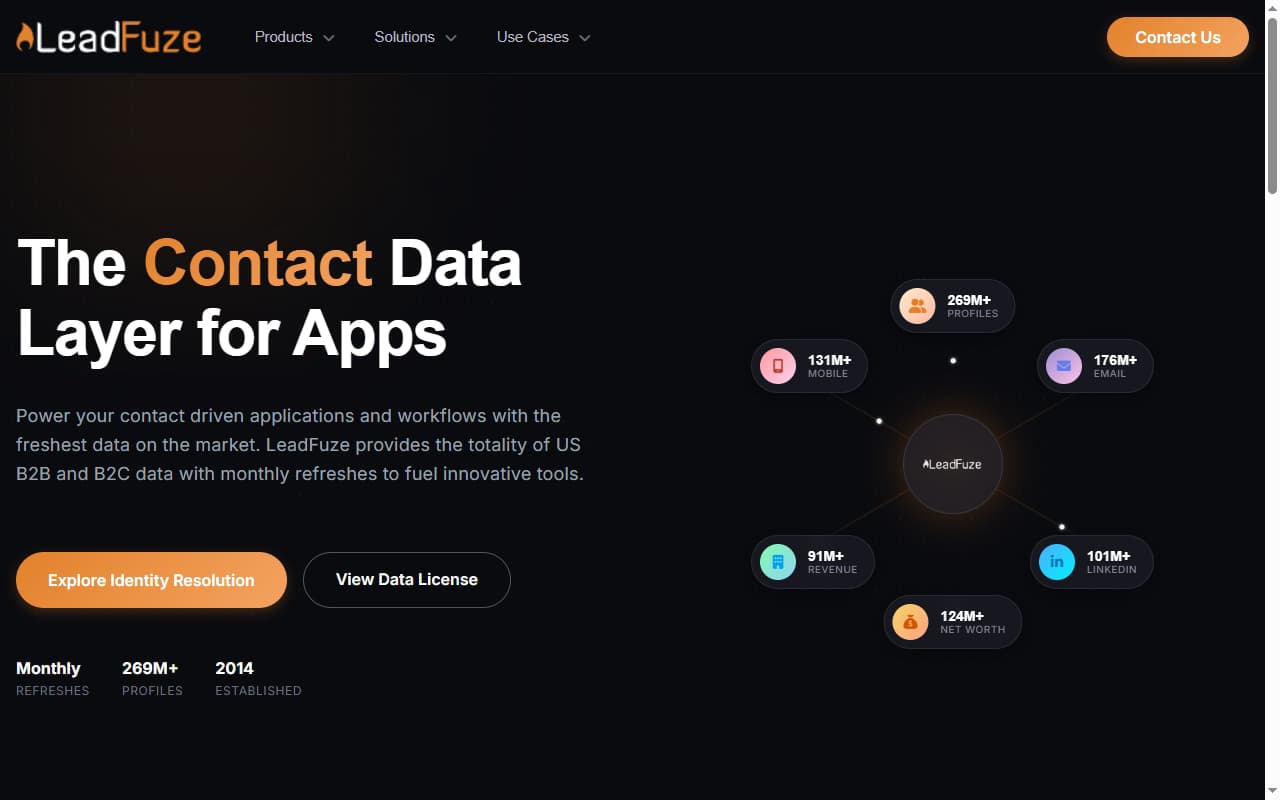
As of 2026, LeadFuze has retired direct software access entirely. The company now markets itself as “the contact data layer for apps,” selling a full data license rather than a login-based tool. The dataset is marketed at 269M+ profiles, 176M+ emails, 131M+ mobile numbers, and 101M+ LinkedIn matches, refreshed monthly.
The headline distinction from a platform like SyncGTM is the data model. LeadFuze is single-source: every record comes from one proprietary US-centric index, refreshed in monthly batches. A waterfall enrichment tool instead queries dozens of providers in real time and returns whichever one resolves the contact — a difference that shows up directly in coverage and freshness.
LeadFuze Pricing: The 2026 Data License and Legacy Plans
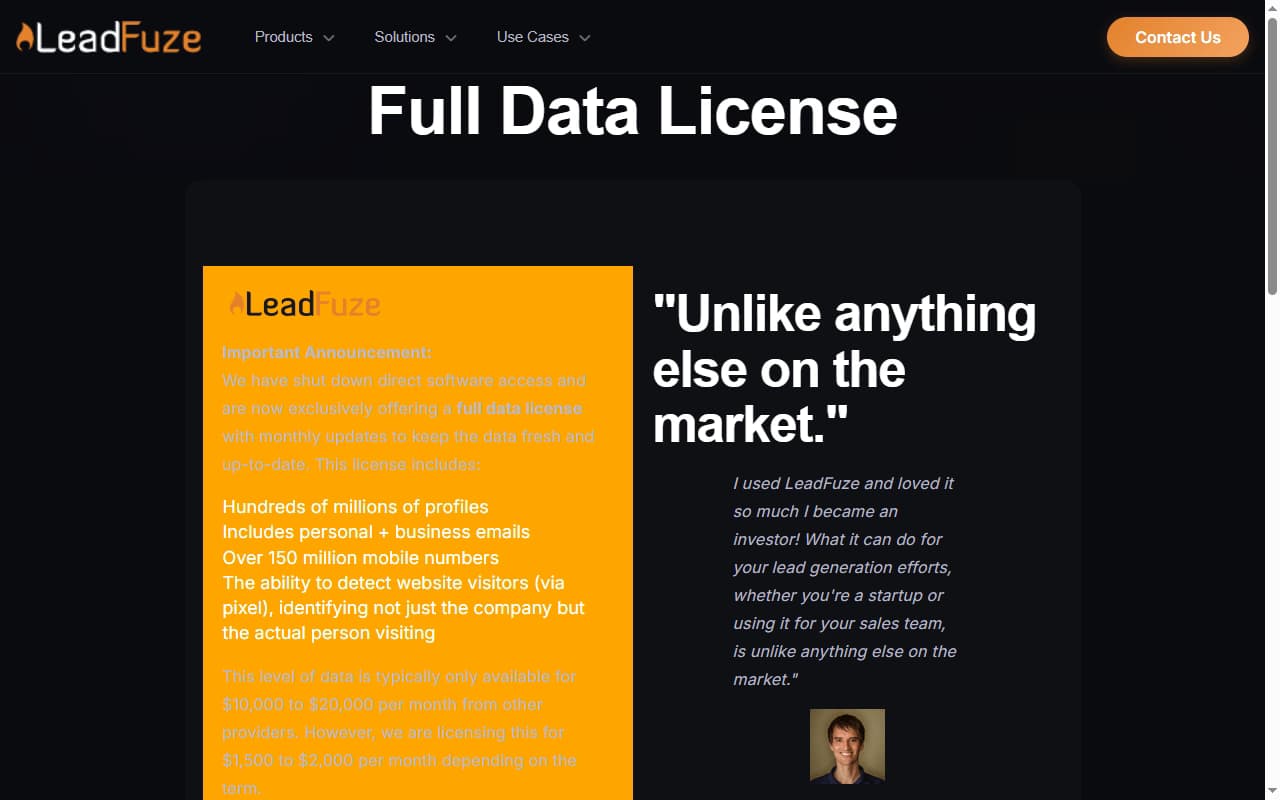
LeadFuze pricing changed fundamentally in 2026. The current offering is a full data license priced at roughly $1,500 to $2,000 per month depending on contract term. The legacy self-serve plans — which most existing reviews still describe — have been discontinued.
| Plan | Price | Includes | Status |
|---|---|---|---|
| Full Data License | ~$1,500–$2,000/mo | Entire US dataset, monthly refresh, visitor ID | Current |
| Unlimited (legacy) | $397/mo (annual) | Unlimited leads, 250/day cap | Discontinued |
| Scaling (legacy) | $497/mo | 2,500 lead credits/month | Discontinued |
| Custom | Negotiated | Tailored license terms and volume | Current |
The real cost math
LeadFuze frames the ~$1,500–$2,000/month license as a bargain against the $10,000–$20,000/month it says comparable full datasets cost elsewhere. That framing is fair if you are building a data product and need the whole index.
It is the wrong tool, though, if you just need verified emails or phones on a per-contact basis. A sales team that previously paid $397/month for the Unlimited plan now faces a 4x jump with no self-serve UI. For that use case, a credit-based or monthly platform is far cheaper — compare options in our roundup of the best B2B email finder tools.
LeadFuze Review: Data Coverage and Accuracy Tested
LeadFuze's strength is US depth. The dataset — 269M+ profiles, 176M+ emails, 131M+ mobile numbers — is genuinely dense across US B2B and B2C contacts, with double-verified emails sourced through cascading enrichment.
Two constraints temper that strength. First, coverage drops sharply outside North America: reviewers consistently flag thin European and international data. Second, the index refreshes monthly, so titles, job changes, and company moves can lag reality between cycles — unlike real-time enrichment that re-queries at the moment you need the contact.
Where the gap comes from
LeadFuze's verification quality describes accuracy for the contacts it actually holds. It does not describe coverage across a full prospecting list, where a meaningful share of records — non-US, niche industries, recently changed roles — simply will not resolve in any single index. That distinction between accuracy and coverage is where single-source providers lose ground.
User reviews reinforce the picture. LeadFuze holds strong ratings — a 4.7 out of 5 on G2 and a comparable 4.6 on Capterra — but those reviews largely reflect the now-retired self-serve tool, and several note bounce rates that pushed them to add a second verification step.
This is the core argument for waterfall enrichment. By querying 50+ providers and keeping the first verified result, a waterfall raises coverage on the exact contacts a single index misses — see our explainer on why waterfall email finders beat single-source tools on hit rate.
LeadFuze Key Features
LeadFuze's 2026 feature set centers on licensed data and identity resolution rather than the manual list-building it was known for. The highlights:
| Feature | What It Does |
|---|---|
| Full data license | The 2026 flagship offering — license the entire US B2B/B2C dataset with monthly refreshes to power your own apps and workflows. |
| 269M+ profile dataset | Marketed coverage of 269M+ profiles, 176M+ emails, 131M+ mobile numbers, and 101M+ LinkedIn matches, weighted toward US contacts. |
| Website-visitor identification | Pixel-based de-anonymization that identifies not just the company visiting your site, but the individual person, where data allows. |
| Identity resolution | Match and stitch fragmented identifiers — email, phone, LinkedIn — into unified contact records for downstream enrichment. |
| Fuzebot (legacy) | The retired automated list builder that continuously added prospects matching your filters — discontinued with direct software access. |
| Delivery & integrations | Licensed data delivered via CSV, native connections, and Zapier for the legacy tool; API and bulk delivery for the data license. |
LeadFuze Pros: What It Does Well
- ✓Deep US contact data. 269M+ profiles with 176M+ emails and 131M+ mobile numbers makes LeadFuze one of the denser single-source datasets for US B2B and B2C prospecting.
- ✓Full-dataset licensing. For companies building data products, licensing the whole index at ~$1,500/month undercuts the $10K+/month that comparable bulk datasets typically cost.
- ✓Website-visitor identification. Pixel-based de-anonymization can surface the individual person behind an anonymous visit, not just the company — useful for warm retargeting.
- ✓Double-verified emails. Cascading verification produces solid deliverability on US contacts, with reviewers reporting good results inside the index's coverage area.
- ✓Strong historical reviews. A 4.7 on G2 and 4.6 on Capterra reflect years of satisfied users — particularly with the now-retired Fuzebot list automation and responsive support.
LeadFuze Cons: Where It Falls Short
- No more self-serve tool. LeadFuze retired direct software access and the Fuzebot list builder in 2026. The product that most reviews describe — the app you log into to build lists — no longer exists; it is a data license now.
- Data-license pricing is a large commitment. At roughly $1,500-$2,000/month, the current model suits companies building data products, not individual reps or small teams that just need verified emails on a per-contact basis.
- Single-source, US-centric database. Everything comes from one proprietary index weighted toward US B2B/B2C. European and international coverage is thin — unlike waterfall enrichment, which queries 50+ providers and keeps whichever one resolves the record.
- Monthly refresh, not real-time. The dataset updates monthly rather than at query time, so titles, job changes, and companies can lag reality between refresh cycles.
- Email accuracy needs supplementary verification. Despite double-verified marketing, multiple reviewers report bounce rates high enough that they add a second verification step before sending.
- Legacy plan friction lingers. The retired SaaS tier carried a 250-lead-per-day cap and annual lock-in that generated frequent complaints — a reminder of how restrictive the prior model was at scale.
LeadFuze vs SyncGTM: Data License vs Waterfall Enrichment
LeadFuze and SyncGTM solve the same job — get verified emails and phone numbers — with opposite models. LeadFuze licenses one static US dataset refreshed monthly. SyncGTM runs a waterfall across 50+ providers in real time and keeps the first verified result, which is the difference between licensing one database and querying fifty on demand.
| Feature | LeadFuze | SyncGTM |
|---|---|---|
| Starting Price | ~$1,500/mo data license (legacy SaaS from $397/mo) | $99/mo |
| Access Model | Full data license — no direct software access | Self-serve platform + API |
| Data Sourcing Model | Single proprietary US index (269M+ profiles) | Waterfall across 50+ providers |
| Data Freshness | Monthly refresh | Real-time, on-demand enrichment |
| Geographic Coverage | US B2B/B2C heavy; thin international | Global via multi-provider waterfall |
| Email & Phone | 176M+ emails, 131M+ mobile numbers | Waterfall email + direct dials |
| Signals & Intent | Website-visitor (pixel) identification | Hiring, funding, tech-change, job-change |
| Native Outreach | None — data only | Built-in sequencing |
| CRM Integration | Via license delivery / CSV / API | HubSpot, Salesforce, Pipedrive, Attio |
| Free Tier | None on current license | Free plan available |
The honest take
LeadFuze wins if you are building a data product and want the whole US index licensed at a flat monthly rate. Its US depth and visitor-ID feature are real, and the license price beats most bulk-data alternatives.
SyncGTM wins on coverage, freshness, and workflow. Because it queries 50+ providers in real time instead of licensing one monthly snapshot, it resolves the contacts a single US index misses — and adds hiring, funding, and tech-change waterfall contact provider signals plus built-in outreach that LeadFuze does not offer. At $99/month with self-serve access, it is the practical replacement for teams that wanted the retired LeadFuze tool, not a $1,500/month data license.
Who Should Use LeadFuze?
LeadFuze in 2026 is the right tool in a narrow scenario: you are building a data-driven app or workflow and want to license a deep US contact dataset with monthly refreshes, rather than enrich contacts one at a time.
Use LeadFuze if:
- You are building a product or internal system that needs the entire US B2B/B2C dataset, not per-contact lookups.
- Your prospecting is US-focused, where the index is densest, and monthly freshness is acceptable for your use case.
- You can justify a ~$1,500–$2,000/month data license against the $10K+/month that comparable bulk datasets cost.
- You want pixel-based website-visitor identification down to the individual person for retargeting.
Look elsewhere if:
- You wanted the self-serve tool or Fuzebot — both are retired, so a platform like SyncGTM or Apollo is the real replacement.
- Coverage is your bottleneck — a single US index will miss international and niche contacts that a multi-provider waterfall resolves.
- You need real-time data, not a monthly snapshot, to act on job changes and new roles as they happen.
- You want buying signals — hiring, funding, tech adoption — and built-in outreach, not just a static dataset. Compare options in our roundup of B2B sales prospecting tools.
LeadFuze Review: Frequently Asked Questions
What is LeadFuze and how does it work in 2026?
LeadFuze is a US B2B and B2C contact data provider. As of 2026, it has shut down direct software access — including the self-serve app and the automated Fuzebot list builder it was known for — and now sells exclusively as a full data license. Instead of logging into a tool to build lists profile by profile, you license the underlying dataset and receive monthly refreshes to power your own apps, workflows, and enrichment. The dataset is marketed at 269M+ profiles, 176M+ emails, 131M+ mobile numbers, and 101M+ LinkedIn matches, with website-visitor identification via pixel. The model has moved from a prospecting tool to a contact data layer — which changes who it is for and how you buy it.
How much does LeadFuze cost per month?
LeadFuze's current full data license is priced at roughly $1,500 to $2,000 per month depending on the contract term — LeadFuze positions this against the $10,000-$20,000/month that comparable full datasets cost from other providers. This replaces the older self-serve SaaS plans, which started at $397/month (Unlimited, billed annually) and $497/month for the Scaling plan with 2,500 lead credits. The legacy plans also carried a 250-lead-per-day cap and annual lock-in that drew frequent complaints. For teams that just need verified emails or phones on a per-contact basis, the data-license price point is a large commitment compared with credit-based or monthly platform pricing.
How accurate is LeadFuze's contact data?
LeadFuze markets double-verified emails sourced through cascading enrichment, and reviewers generally report solid deliverability on US contacts. That said, multiple users note bounce rates high enough that they layer a secondary verification tool on top, and the dataset's biggest constraint is freshness: it refreshes monthly rather than at query time. Because LeadFuze draws from a single proprietary US-centric index, accuracy is strong where the index is dense — US B2B and B2C — and thinner for European and other international contacts. The distinction that matters is coverage versus accuracy: a verified email is only useful if the record exists in the index at all, which is exactly the gap a multi-provider waterfall is built to close.
Is LeadFuze still available as a self-serve tool?
No. LeadFuze has retired direct software access, including the self-serve dashboard and the Fuzebot automated list-building feature that defined the product for years. The company now offers a full data license only, delivered with monthly updates rather than an app you log into. If your team relied on Fuzebot's set-and-forget list building or the in-app search UI, that workflow is gone — you would either license the full dataset (a much larger commitment) or move to a self-serve enrichment platform. For most prospecting teams that wanted the old tool, an alternative such as SyncGTM, Apollo, or a waterfall enrichment platform is now the practical replacement.
What are the best LeadFuze alternatives in 2026?
The best LeadFuze alternative depends on what you valued. For higher hit rates than any single US index, a waterfall enrichment platform like SyncGTM queries 50+ providers and keeps the best verified result. For self-serve prospecting with built-in outreach, Apollo is the closest like-for-like replacement for the retired LeadFuze app. For Fuzebot-style automated, continuously refreshed lists, a signals-driven platform that monitors hiring, funding, and tech changes gets you closer to set-and-forget than a static monthly data dump. If you specifically need a licensed bulk dataset, BookYourData and ZoomInfo are the usual comparisons. See our full roundup of LeadFuze alternatives for a side-by-side breakdown.
Does LeadFuze cover international contacts?
Only partially. LeadFuze's dataset is heavily US-focused — it markets the totality of US B2B and B2C data as its core strength. European and other international coverage is comparatively thin, and reviewers consistently flag this as a limitation for teams targeting global markets. If your ICP sits primarily in the US, LeadFuze's depth is a genuine advantage. If you prospect into the EU, APAC, or LATAM, a global, multi-provider waterfall will resolve far more of your list than a single US-centric index. SyncGTM's waterfall pulls from providers with regional strengths, so coverage holds up outside North America where LeadFuze drops off.