
Minelead Review 2026: B2B Data Coverage, Pricing & SyncGTM Comparison

By Kushal Magar · May 31, 2026 · 11 min read
Key Takeaway
Minelead is a cheap, free-to-start email finder with a 500M+ email index, an API on every plan, and paid tiers from $39/month — but it publishes no accuracy rate, returns no phone numbers, offers no buying signals, and pulls from a single source. For coverage rather than cost, SyncGTM's waterfall enrichment across 50+ providers wins on hit rate, phone data, and intent signals.
This Minelead review covers the tool's data coverage, pricing, and accuracy in 2026 — and where it falls short against waterfall enrichment. Minelead is a free-to-start email finder and verifier built for B2B prospecting, with an index marketed at 500M+ emails across 100M+ businesses, paid plans from $39/month, and an API on every tier. Our rating: 3.5/5.
Minelead's appeal is simple: give it a company domain, and it returns the professional emails it has on file — free for the first 25 lookups a month, no credit card required. For email-only prospecting at small scale, that is a low-friction way to start.
The structural limit is just as simple. Minelead pulls every email from a single proprietary index. When that one database doesn't have a record, there is no second source to fall back on — which is exactly where waterfall enrichment pulls ahead by querying 50+ providers and keeping the best result.
This review breaks down Minelead's pricing math, the real accuracy picture versus the marketed claims, its key features, the honest pros and cons, and a direct comparison with SyncGTM for teams weighing their options in 2026.
What Is Minelead?
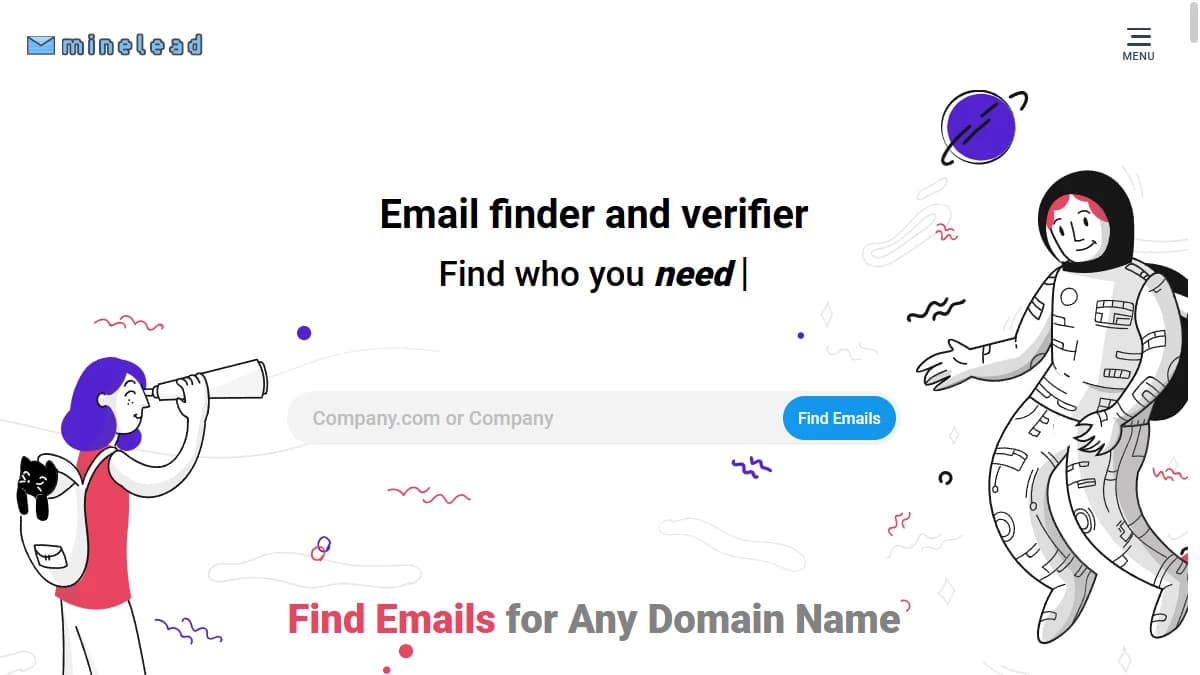
Minelead is a B2B email finder and verifier that returns professional email addresses from a company domain or a name-and-company pair. It works through a web app, a Chrome and Firefox extension, a Gmail add-on, and a documented API, and is aimed at marketers, recruiters, and sales reps who prospect by company.
Behind those entry points sits a proprietary index that Minelead markets at 500M+ emails across 100M+ businesses, with 100,000+ reported users. The platform adds email verification, bulk lookups, CSV export, lightweight campaigns, and integrations with HubSpot, Zoho, Zapier, and Google Sheets. Notably, it does not return phone or mobile numbers — Minelead is email-only.
The headline distinction from a platform like SyncGTM is the data model. Minelead is single-source: every lookup hits one index. A waterfall enrichment tool queries dozens of providers in sequence and returns whichever one resolves the contact — a structural difference that shows up directly in hit rate, which we cover in the data-coverage section below.
Minelead Pricing: Plans, Credits, and What You Actually Pay
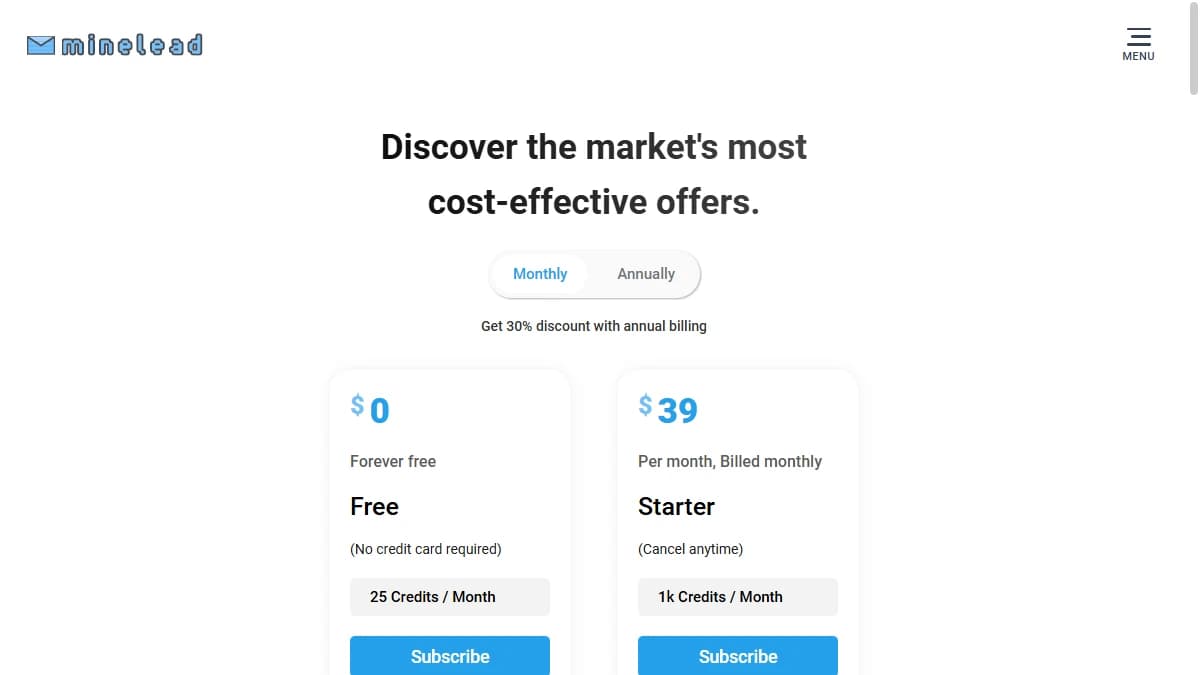
Minelead pricing starts free and scales by credit volume. A credit is consumed for each successful search, verification, or finder operation — and no credit is charged when the finder returns no email. There is no per-seat fee; instead, higher tiers unlock more multi-user seats.
| Plan | Monthly Price | Credits / mo | Notable Limits |
|---|---|---|---|
| Free | $0 | 25 | API throttled; bulk per 50 |
| Starter | $39/mo | 1,000 | Unlimited results; bulk per 50 |
| Pro | $69/mo | 10,000 | All integrations; 2 seats |
| Business | $149/mo | 50,000 | API support; 5 seats |
| Enterprise | $299/mo | 200,000 | Unlimited bulk; 10 seats |
The real cost math
On paper Minelead is cheap. The Starter plan's 1,000 credits at $39/month works out to roughly $0.039 per successful lookup, and annual billing trims another 30% off the rate. For an email-only tool at small volume, that undercuts most of the market.
The credit fine print is where it gets sharper. Only annual subscriptions let unused credits roll over within the year — monthly plans reset to zero each cycle, so a slow month is wasted budget. And because Minelead returns no phone numbers, any team that also needs mobile data is really pricing two tools, not one. For a broader market view, see our roundup of the best B2B email finder tools.
Minelead Review: Data Coverage and Accuracy Tested
Minelead's accuracy story has a hole in the middle: there is no published accuracy rate. The platform markets verified emails and “guaranteed deliverability,” but it backs neither claim with a stated bounce rate or an independent benchmark.
That matters more than it sounds. Most credible email finders publish a number — 95%, 97%, a measured bounce rate — even if it is self-reported. A tool that publishes nothing leaves you to discover its real hit rate on your own list, which is why testing the free 25 credits on your exact targets is the only honest way to evaluate it.
Where the gap comes from
User reports paint an uneven picture. Some reviewers say Minelead's finder returns only verified emails and performs well. Others report strong coverage for the US and Canada but high bounce rates in SEA, MEA, and LATAM — the regional inconsistency a single index struggles to avoid.
The third-party footprint is thin, too. Minelead has a small G2 review base, including at least one Capterra review citing buggy credit deductions, weak support, and alleged unauthorized card charges. Minelead is also absent from the large public enrichment studies — the kind that test 15+ tools against tens of thousands of contacts — where even strong single-source tools land real enrichment rates in the 40–77% range, far below any “guaranteed” claim.
This is the core argument for waterfall enrichment. By querying 50+ providers and keeping the first verified result, a waterfall raises coverage on the exact contacts a single index misses — see our explainer on why waterfall email finders beat single-source tools on hit rate.
Minelead Key Features
Minelead's feature set is built around domain-based email discovery and verification rather than full GTM workflows. The highlights:
| Feature | What It Does |
|---|---|
| Domain email finder | Enter a company domain and Minelead returns the professional email addresses it has indexed for that organization. |
| Email verifier | Checks deliverability and flags disposable or invalid addresses before you send, reducing bounce risk on lists you already have. |
| Browser extension (Chrome / Firefox) | Surfaces emails for the company you're viewing in the browser, plus a Gmail extension for finding contacts inside your inbox. |
| Bulk operations | Upload or queue many domains at once — batch size scales from 50 per operation on lower tiers to unlimited on Enterprise. |
| API access | Documented API available on every plan including the free tier, with throttling on the free plan, for programmatic email lookups. |
| Integrations & campaigns | Connects to HubSpot, Zoho, Zapier, and Google Sheets, with lightweight campaign organization for grouping and exporting leads. |
Minelead Pros: What It Does Well
- ✓Genuinely free to start. 25 credits a month, permanently, with no credit card — enough to test data quality on your own domains before you pay a cent.
- ✓Low entry price. Paid plans start at $39/month for 1,000 credits (~$0.039 each), with 30% off annual billing — cheaper than most email finders at small volume.
- ✓API on every plan. Even the free tier includes API access, which is rare — handy for developers prototyping a lookup before committing to a paid provider.
- ✓Pay only for results. Credits are consumed only when Minelead actually returns an email, so empty lookups don't burn budget.
- ✓Finder plus verifier in one. Minelead both finds and validates emails, so you can clean a list you already have without bolting on a separate verification tool.
Minelead Cons: Where It Falls Short
- No published accuracy rate. Minelead markets verified emails and "guaranteed deliverability" but backs neither with a bounce rate or an independent benchmark — a notable gap for an email finder, and a reason to test before you trust.
- Single-source database. Every email comes from one proprietary index. When that index doesn't have a contact, there's no fallback — unlike waterfall enrichment, which queries 50+ providers and keeps whichever one resolves the record.
- No phone or mobile numbers. Minelead is email-only. Sales and recruiting teams that also call prospects need a second tool, which raises total cost and fragments the data.
- Uneven regional coverage. Reviewers report strong results for the US and Canada but high bounce rates in SEA, MEA, and LATAM — the inconsistency a single index struggles to avoid.
- Thin, polarized reviews. Minelead has a small third-party footprint, with at least one Capterra report citing buggy credit deductions, weak support, and alleged unauthorized card charges. A light review base makes data quality hard to verify.
- No buying signals or technographics. Minelead offers no hiring, funding, intent, or tech-adoption data to prioritize which accounts to work first — it finds emails, nothing more.
Minelead vs SyncGTM: Waterfall Enrichment Compared
Minelead and SyncGTM both find verified emails, with opposite data models. Minelead queries one proprietary index and returns email only. SyncGTM runs a waterfall across 50+ providers, returns emails and phone numbers, and keeps the first verified result — the difference between asking one database and asking fifty.
| Feature | Minelead | SyncGTM |
|---|---|---|
| Starting Price (paid) | $39/mo (1,000 credits) | $99/mo |
| Data Sourcing Model | Single index (500M+ emails) | Waterfall across 50+ providers |
| Email Accuracy | No published accuracy rate | Higher via multi-provider fallback |
| Phone / Mobile Numbers | No | Yes — waterfall mobile + direct dials |
| Buying Signals / Intent | None | Hiring, funding, tech-change, job-change |
| Free Tier | 25 credits/mo | Free plan available |
| Browser Extension | Yes — Chrome / Firefox | Yes — plus workflow automation |
| API Access | Yes — on all plans, including free | Yes — full enrichment API |
| CRM Integrations | HubSpot, Zoho, Zapier, Google Sheets | HubSpot, Salesforce, Pipedrive, Attio |
| Credit Rollover | Annual only (within the year) | Plan-based verified email volumes |
The honest take
Minelead wins on price and ease of entry for email-only prospecting at small scale. If your workflow is domain-based discovery, you send only over email, and you value a free, no-card starting point, it is a sensible low-cost pick from $39/month.
SyncGTM wins on hit rate, phone coverage, and automation. Because it queries 50+ providers instead of one, it resolves the contacts Minelead's single index misses — adds the mobile numbers Minelead doesn't return at all — and layers on hiring, funding, and tech-change lead enrichment signals Minelead does not offer. At $99/month, that premium buys materially higher coverage plus phone data and buying signals — the lower total-cost option for teams whose bottleneck is finding the contact, not the per-credit price.
Who Should Use Minelead?
Minelead is the right tool in a specific scenario: low-cost, email-only contact-finding by a team that prospects by company domain and values a free starting point over maximum coverage.
Use Minelead if:
- You prospect by company domain and need professional emails, not phone numbers.
- You want a genuinely free entry point to test data quality before paying — the 25 free credits and API access make that easy.
- Your volumes are modest and price-per-lookup is your main constraint.
- You want a finder and a verifier in one cheap tool and primarily target US and Canadian contacts.
Look elsewhere if:
- Coverage is your bottleneck — a single-source index with no published accuracy rate will miss the harder-to-find contacts that a waterfall contact provider resolves.
- You need mobile or direct-dial phone numbers — Minelead returns none.
- You want buying signals — hiring, funding, tech adoption — to prioritize accounts, not just contact data.
- You target SEA, MEA, or LATAM at volume, where reviewers report weaker Minelead coverage.
Minelead Review: Frequently Asked Questions
What is Minelead and how does it work?
Minelead is a free-to-start email finder and verifier built for B2B prospecting. You give it a company domain or a person's name and company, and Minelead returns professional email addresses pulled from its own index of 500M+ emails across 100M+ businesses. It works through a web app, a Chrome and Firefox extension, and a documented API, and it can run bulk lookups against a list of domains. Behind all three is a single proprietary database. Unlike a waterfall enrichment platform that queries dozens of data vendors and keeps the best verified result, Minelead asks one source. That keeps it cheap and fast for domain-based discovery, but it caps your hit rate at whatever that one index holds for a given contact, and it offers no phone numbers at all.
How much does Minelead cost per month?
Minelead has a permanently free plan with 25 credits per month and API access, no credit card required. Paid plans start at $39/month for the Starter plan (1,000 credits), then $69/month for Pro (10,000 credits and integrations), $149/month for Business (50,000 credits and API support), and $299/month for Enterprise (200,000 credits). Annual billing cuts the price by 30%. A credit is consumed for each successful search, verification, or finder operation — and Minelead does not charge a credit when the finder returns no email. The catch on credits is rollover: only annual subscriptions pool unused credits across the year, while monthly plans reset to zero each cycle.
How accurate is Minelead's email data?
Minelead publishes no accuracy rate whatsoever, which is unusual for an email finder and the single biggest reason to test it on your own list before committing. The platform markets verified emails and "guaranteed deliverability" but backs neither claim with a published bounce rate or an independent benchmark. User reports are mixed: some reviewers say the finder only returns verified emails and performs well, while others note strong results for the US and Canada but high bounce rates in SEA, MEA, and LATAM. Minelead is also absent from the large public enrichment studies that test 15+ tools against tens of thousands of contacts, where even strong single-source tools land real enrichment rates in the 40–77% range. With no published number and a thin review base, treat the deliverability claim as unproven until you run a test batch.
Does Minelead find phone numbers?
No. Minelead is an email-only tool — it finds and verifies professional email addresses but does not return mobile numbers or direct-dial phone data. For teams that prospect entirely over email, that is fine. But for sales and recruiting workflows that also call prospects, you would need a second tool for phone numbers, which raises your total cost and adds another data silo to manage. A waterfall enrichment platform like SyncGTM covers both emails and phone numbers in one pass across 50+ providers, so you don't stitch two single-purpose tools together.
What are the best Minelead alternatives in 2026?
The best Minelead alternative depends on your priority. For higher hit rates and phone coverage on the same contacts, a waterfall enrichment platform like SyncGTM queries 50+ providers and keeps the best verified result, which beats any single index including Minelead's. For budget email-finding with a published track record, Hunter.io and Prospeo are strong single-source picks. For domain-based bulk discovery with verification built in, Snov.io overlaps most directly with Minelead's workflow. If your bottleneck is coverage and you also need mobile numbers and buying signals, the waterfall model is the structural upgrade — it is the difference between asking one database and asking fifty.
Does Minelead have a free plan?
Yes. Minelead's free plan gives you 25 credits per month, permanently, with no credit card required and API access included. That is enough to test whether the finder resolves the domains and contacts you care about, though it is roughly a third of the free allowance some competitors offer. Because a credit is only spent when Minelead actually returns an email, those 25 credits give you a clean look at data quality on your own targets before paying. For teams that want a more generous free starting point with multi-provider enrichment and buying signals built in, SyncGTM's free plan is the broader entry point.