

Octave Review 2026: AI Account Research Tool — Pricing and Performance

By Kushal Magar · April 18, 2026 · 11 min read · Last updated: September 30, 2026
Key Takeaway
Octave codifies your ICP into a machine-readable GTM brain — structured Offerings, Elements, and Playbooks that feed real account context into your AI agent stack. As of September 2026, the free Base plan includes 100 credits/mo and almost all functionality; Ultra starts at $1,500/mo, billed annually, with 10,000 credits, CRM integrations, and SSO. Steep free-to-paid cliff, no mid-tier, no contact enrichment. Best for GTM and RevOps teams that need consistent ICP context across AI workflows.
Octave is an AI GTM intelligence platform that turns your ICP into a structured, machine-readable model — then feeds that context into every AI agent, playbook, and outbound workflow in your stack. As of September 2026, the free Base plan includes 100 credits/mo and almost all functionality; Ultra starts at $1,500/mo, billed annually, with 10,000 credits, CRM integrations, and SSO.
The problem Octave solves: your AI-generated outreach sounds generic because it runs on generic LLM context. Octave gives agents your actual ICP — specific personas, competitors, use cases, proof points — so every output reflects real positioning rather than templated copy.
This Octave review covers how the ICP modeling and playbook builder actually work, what the agents deliver, what each plan costs, and where Octave's strategy layer ends and your data and execution tools begin.
Octave Review: What You Get (and What You Don't)
Octave is built around structured GTM knowledge — it calls this your "GTM brain." You encode your ICP (personas, segments, use cases, competitors) into the platform as Offerings and Elements. Octave then uses that structured context to run AI agents, generate playbooks, and power outbound messaging that actually reflects your positioning.
| Feature | What's Included | Limitations |
|---|---|---|
| ICP Modeling | Structured Offerings, Elements (personas, segments, use cases), and Playbooks | Base: 1 active Offering and 12 active Elements per workspace. Ultra: 2 Offerings and 36 Elements |
| AI Agents | ICP Agent, GTM Explorer, and agents for research and messaging; unlimited managed agents on Ultra | Credits consumed per agent run: 100/mo on Base, 10,000/mo on Ultra |
| Playbook Builder | Targeted messaging for personas, industries, compelling events | Base: 2 active Playbooks per workspace. Ultra: 8 |
| Integrations | APIs and MCP on every plan; Salesforce, HubSpot, Gong, and Clay integrations plus CLI/SDK on Ultra | Native CRM integrations require Ultra (from $1,500/mo, billed annually) |
| Lead Enrichment | Not included — Octave provides strategy and context, not contact data | Requires a separate enrichment tool (e.g., Clay) |
| Credits | Consumed per agent run; amount varies by agent configuration | Hard to predict usage before running agents in production |
The key distinction: Octave is a strategy and context platform, not a lead database or enrichment tool. It helps you define and operationalize your GTM strategy so that every AI agent and outbound workflow runs on accurate, current account intelligence — not generic LLM output.
ICP Modeling: Building Your GTM Brain
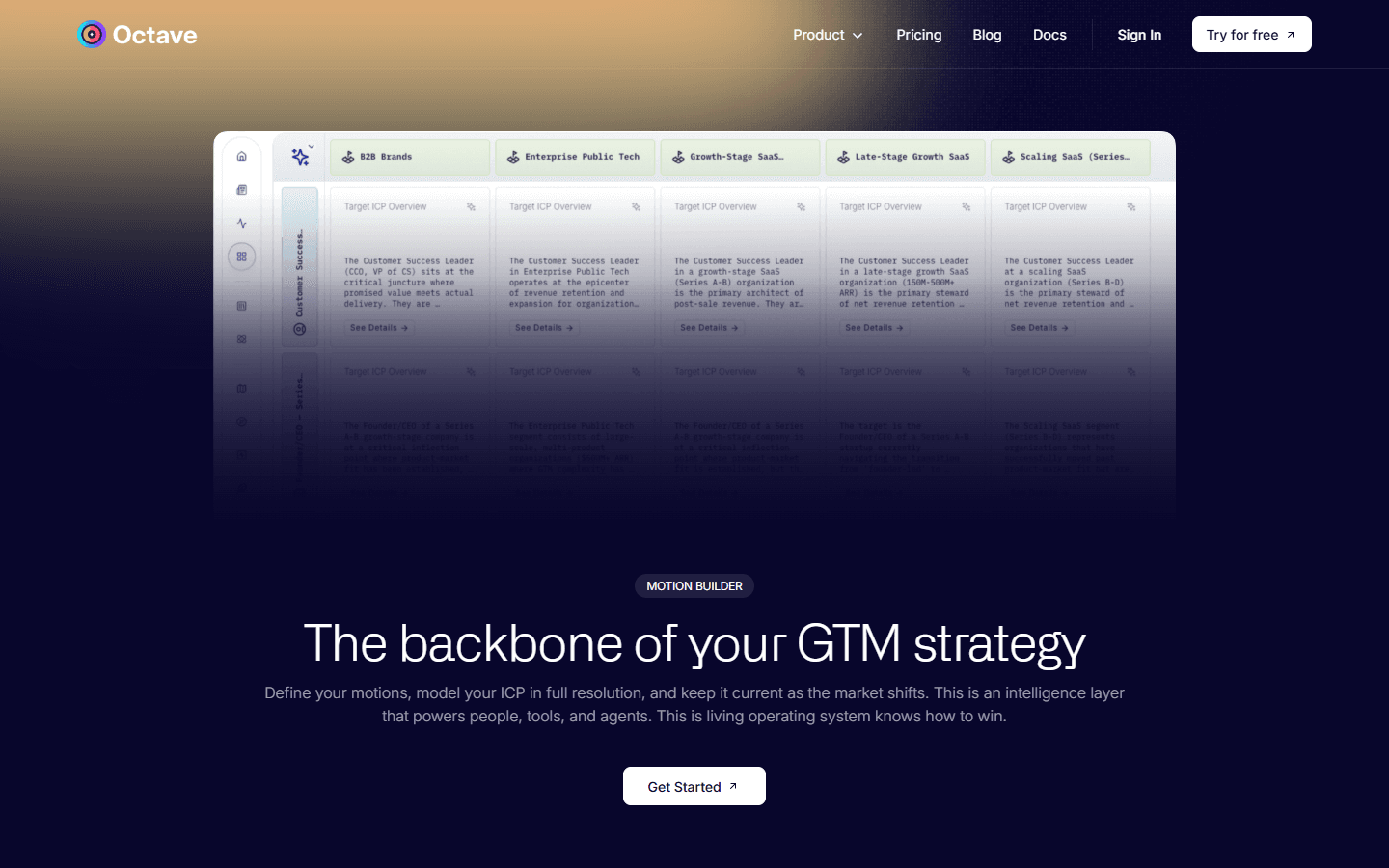
Octave's ICP modeling is its most distinctive capability. You start by defining your Offering — the product or service you sell — and then build out Elements: personas, use cases, market segments, reference customers, proof points, and competitors. This creates a structured, machine-readable model of your GTM strategy.
The system is more rigorous than a deck or a wiki. When you update a competitor entry or add a new segment, Octave propagates that change across all connected Playbooks and agents. The version control tracks every change, which is useful for teams that iterate their positioning frequently.
How Playbooks use your ICP model
Playbooks in Octave are messaging frameworks tied to specific targeting scenarios: a persona in a specific vertical dealing with a specific business initiative. Because the Playbook pulls from your structured ICP Elements, the output reflects your actual positioning rather than generic AI copy.
In practice: a Playbook for "VP Sales at a Series B SaaS company expanding into enterprise" will reference your specific competitors, your relevant use cases, and your proof points from similar customers. The output is notably more grounded than prompting a generic LLM with the same brief.
Where the ICP modeling approach has limits
The ICP modeling is only as good as the data you put in. Teams with unclear or constantly shifting ICPs will spend significant time maintaining the model before getting useful output. The tool assumes you already have a defined GTM strategy — it structures and operationalizes it, it does not develop it from scratch.
Octave AI Agents: Research Automation in Practice
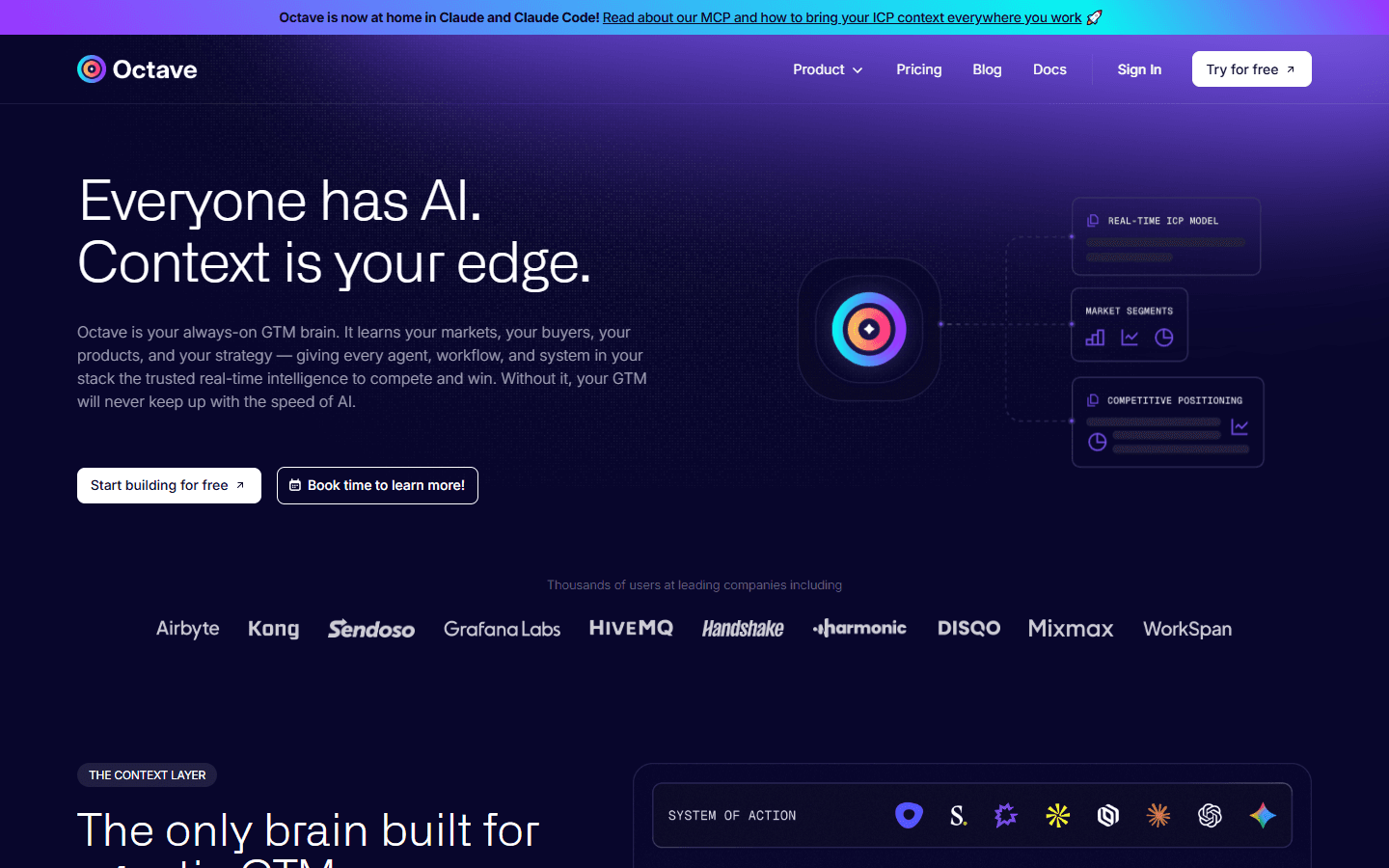
Octave's agents run against your ICP model to research accounts, surface relevant signals, and generate account-specific messaging. As of September 2026, even the free Base plan lists the ICP Agent and GTM Explorer, and every plan meters agent runs in credits, whether you run them in the in-app playground or through the API. Ultra adds unlimited managed agents and 10,000 credits a month.
MCP integration — the key differentiator
Octave supports MCP (Model Context Protocol), and as of September 2026 its pricing page lists MCP on the free Base plan as well as Ultra, which adds a CLI/SDK and a Claude Code plugin. This means any AI agent or workflow tool that supports MCP can pull your GTM context from Octave in real time. When your Clay table runs an AI enrichment step, it can call Octave's MCP to get your current persona descriptions, messaging weights, and competitive intelligence — rather than hardcoding that context in prompts.
For teams building complex AI agent stacks, this is a meaningful capability. It centralizes your GTM context in one place and distributes it automatically. The practical benefit: prompt consistency across dozens of agents without manually updating each one when your positioning changes.
What the agents do not do
Octave agents research and contextualize — they do not enrich contact data. You will not get verified email addresses or phone numbers from Octave. For the execution layer — finding accounts showing intent, enriching them with contact data, and pushing to your CRM — you need separate tools. See our guide to best B2B sales prospecting tools for the full stack picture.
Octave Pricing Breakdown
Octave publishes its pricing at octavehq.com/pricing. As of September 2026, it lists three plans:
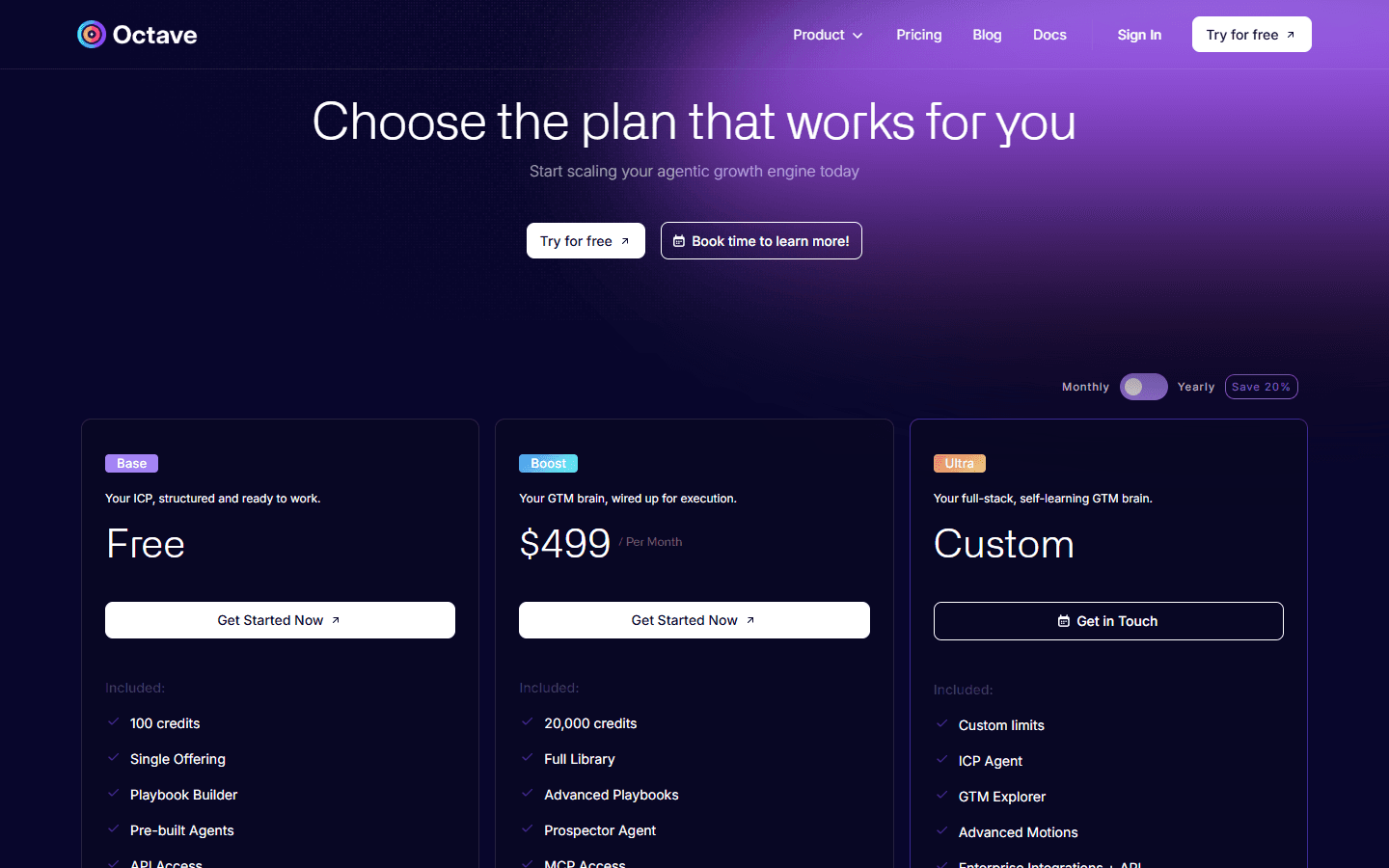
- •Base (Free): 100 credits/mo; 2 active workspaces, each with 1 active Offering, 12 active Elements, and 2 active Playbooks; ICP Library, version control, full history, Brand Voice, Smart CTAs, and Refine AI; ICP Agent and GTM Explorer; Agents, Read, Library, Playbook, and Workspace APIs plus MCP; community support. Not time-limited — Octave says it has access to almost all functionality, with a cap on how much you can generate.
- •Ultra (from $1,500/mo, billed annually): 10,000 credits/mo; unlimited users and managed agents; 2 active Offerings, 36 active Elements, and 8 active Playbooks per workspace, with unlimited created items; deal insights; Salesforce, HubSpot, Gong, and Clay integrations; Messaging Library and Motions; MCP, API, CLI/SDK, and a Claude Code plugin; real-time market and competitive intelligence; SSO and RBAC; dedicated CSM and private Slack channel. Bulk credit packs, GTME services, and a data warehouse connector are optional extras.
- •Custom: Custom limits for larger deployments. Requires direct contact.
What you actually pay — a real scenario
A two-person GTM team using Octave to maintain 3 ICPs, run research agents daily against a 200-account target list, and feed context into Clay workflows will outgrow Base quickly: 100 credits a month and 2 active Playbooks per workspace are testing limits, not production limits. The next step is Ultra, starting at $1,500/mo billed annually — $18,000 a year before any bulk credit packs. That is a serious budget line, especially when you still need a separate enrichment tool for contact data.
Hidden costs to watch
- Credit consumption per agent run varies — hard to forecast before running agents in production
- Free plan caps at 100 credits — enough to test but not to run ongoing campaigns
- No native lead data or enrichment — requires Clay or another data layer
- CRM integrations (Salesforce, HubSpot) and Gong start at Ultra ($1,500/mo, billed annually)
- Ultra is billed annually, so the first paid step is an $18,000 yearly commitment
What Are the Downsides of Octave?
The free-to-paid cliff
The gap between Base (free) and Ultra (from $1,500/mo, billed annually) is steep. As of September 2026 there is no mid-tier for growing teams. Once the free plan's 100 credits run out — which happens quickly if you are testing agents — the next step is an annual contract worth at least $18,000. Teams with tighter budgets or smaller use cases have no middle ground.
Credit opacity
Octave says credits are consumed when running agents, whether in the in-app playground or via the API, but its pricing page does not spell out how many credits a typical run uses. Without running agents in your specific setup, it is difficult to predict monthly credit consumption. Users on Reddit and early reviews note that the credit model requires a testing period before you can forecast usage reliably. Whether Ultra's 10,000 monthly credits cover your workload, or you will need bulk credit packs, only becomes clear after that calibration.
No contact data
Octave is explicitly a strategy and context platform. It does not provide verified email addresses or phone numbers, and while Ultra adds real-time market and competitive intelligence, that is context rather than a contact database. Every team using Octave for outbound execution still needs a separate data layer. This is not a flaw — it is a deliberate design choice — but it means Octave is always an add-on cost, not a replacement for enrichment tools.
CRM integrations start at Ultra
Native Salesforce and HubSpot integrations — the two most common CRMs for GTM teams — are listed on Ultra, along with Gong and Clay. Base users can still reach Octave through its APIs and MCP. But for teams that want Octave context to flow directly into their CRM without middleware, this requires the annual Ultra contract.
How Octave Works: From ICP Model to Agent Output
Octave rewards teams that treat setup as a project rather than a quick trial. Here is the order of operations, with the plan limits (as of September 2026) you will run into along the way.
- Create a workspace and your Offering. Define the product or service you sell. Base allows 2 active workspaces with 1 active Offering each; Ultra raises that to 2 Offerings per workspace.
- Add Elements. Encode personas, use cases, segments, reference customers, proof points, and competitors. Base caps you at 12 active Elements per workspace, which covers one tight ICP but not several; Ultra allows 36.
- Build Playbooks. Turn Elements into messaging frameworks for specific scenarios, such as one persona in one vertical facing one business initiative. Base allows 2 active Playbooks per workspace and Ultra 8.
- Run agents. Use agents such as the ICP Agent and GTM Explorer in the in-app playground or through the API. Every run consumes credits: 100 a month on Base, 10,000 on Ultra.
- Distribute the context.Connect other tools through Octave's APIs and MCP. Ultra adds a CLI/SDK, a Claude Code plugin, and native Salesforce, HubSpot, Gong, and Clay integrations.
- Maintain the model. Version control and full history track every change, and updates to Elements flow through to connected Playbooks and agents.
The practical takeaway: the free plan is enough to model one ICP properly and test how agents use it, which is the right first step before any budget conversation. Most of the value shows up once several agents and tools read from the same model, so plan the integration work before you judge the output.
Octave still does not supply contact data, so budget for a data layer as well. Our guide to the best CRM data enrichment tools covers the options.
Is Octave Worth It?
Octave is worth it for GTM teams that have a real ICP definition problem — teams whose AI-generated content is generic because there is no structured account context feeding it, or teams where different reps are using different positioning because there is no single source of truth. The ICP modeling and MCP integration are genuinely useful for teams building complex AI agent workflows on top of structured GTM strategy.
Octave is not enough if your primary need is leads. Neither Base nor Ultra includes email addresses or phone numbers. A team that needs a list of 500 VP Sales contacts at Series B companies that recently hired an SDR — and their verified contact data — will not find that in Octave. That is a job for a contact database or waterfall enrichment tools.
The verdict: the best structured ICP platform for teams building agentic GTM stacks — but with the paid tier starting at $1,500/mo billed annually, only justified when the context layer is your actual bottleneck, not your data. Start on the free Base plan and upgrade only when you hit its limits.
Looking at Octave alternatives? Read our reviews of Keyplay, Clay, and our guide to the best Clay alternatives for enrichment-focused use cases.
If Octave's lack of contact data is a dealbreaker, SyncGTM is one alternative worth a look: it runs waterfall enrichment across 50+ data providers for verified emails and phone numbers, plus AI lead scoring against your ICP.