

Top 5 AI GTM Engineering Courses in 2026 (Tested & Ranked)

By Kushal Magar · March 10, 2026 · 14 min read
The GTM engineering job market grew over 200% year-over-year through 2025. The training market followed — and now there are enough courses, bootcamps, and certifications that choosing the wrong one costs you real time and money.
This post ranks the top 5 GTM engineering courses in 2026 by curriculum depth, pricing, time commitment, and which skill level each course is actually built for. If you are transitioning from sales, RevOps, or a technical background and want to know where to start — or whether to pay at all — this is the guide.
According to LinkedIn's GTM engineering job listings, GTM engineering roles now rank among the fastest-growing revenue-adjacent job titles — with median compensation crossing $120,000 at the mid-level (see our full GTM engineer salary breakdown for band-by-band data). Picking the right course is not a small decision.
TL;DR: Top 5 GTM Engineering Courses in 2026
- Maven GTM Engineer Foundations — Best live cohort for career changers. $1,850, 6 weeks, capstone project with Clay's first GTM engineer as instructor.
- GTM Engineer School — Best for operator community and breadth. ~$2,500, cohort-based, 160+ peers, covers AI workflows end-to-end.
- StackOptimise GTM Engineer Course — Best self-paced option. 30 lessons, 7+ hours, real playbooks for Clay + Smartlead + GetSales.
- SyncGTM AI GTM Engineer Course — Best free option. 15 courses, 145 lessons, AI-native MCP workflows, and a working automation at the end of every course. Start here before paying for anything.
- GTM AI Academy — Best for AI-focused GTM training. $550–$999/year with live sessions and expert feedback at the Masters tier.
What to Look for in a GTM Engineering Course
Most GTM engineering courses sell on brand name and instructor credentials. The more useful filter is whether the course produces portfolio output — built workflows, documented results, and demonstrated tool fluency — that you can reference in interviews.
Four criteria distinguish the courses worth paying for from the ones that produce a certificate and nothing else.
- Hands-on builds, not just video walkthroughs. The best GTM engineering courses require you to ship real workflows — not just watch someone else do it. Clay, Smartlead, Make.com, and enrichment waterfalls must be in the curriculum by name. If you are not yet familiar with the core tool landscape, our best B2B sales prospecting tools guide is a useful starting point.
- Capstone or portfolio project. A structured final project that you own — and can reference when interviewing — is the single strongest ROI signal in any paid program.
- Instructor credibility in the current market. Course creators who last worked in GTM engineering three years ago are teaching an outdated stack. Look for instructors who are active practitioners in 2026.
- Community access. GTM engineering is a fast-moving field. Access to a Slack or Discord where practitioners share new workflows, prompts, and tool updates is often more valuable than the curriculum itself.
With those criteria in mind, here are the five GTM engineering courses worth your time in 2026 — ranked in order of overall value.
1. Maven GTM Engineer Foundations — Best Live Cohort for Career Changers
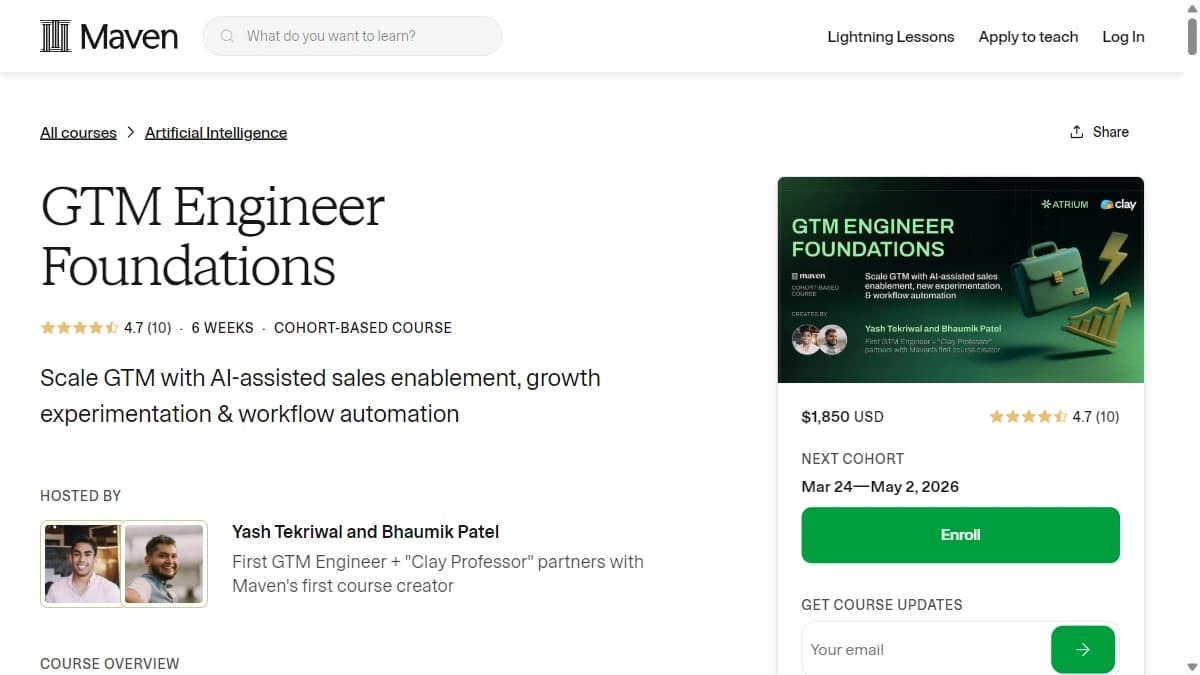
Maven GTM Engineer Foundations — live cohort taught by Clay's first GTM engineer
Maven GTM Engineer Foundations is a 6-week live cohort program priced at $1,850, taught by Yash Tekriwal — Clay's first GTM engineer — and Bhaumik Patel, a veteran course creator with over a decade in vocational training.
The curriculum covers signal-to-action conversion, research automation with human review checkpoints, personalization at scale, outbound and follow-up workflows, inbound lead triage, and CRM data hygiene. The time commitment is 5–7 hours per week across live sessions and project work.
What separates this course from lower-cost options is the capstone project. Students build a working GTM workflow for a real use case by the end of the cohort — giving them a portfolio artifact they can walk through in interviews. One participant noted: "The capstone project was cool — got to build something for work with expert guidance."
Pros
- Taught by Clay's first GTM engineer — practitioner-led, not theory-led
- Capstone project produces a portfolio artifact you own
- Live format means questions get answered in real time
- Covers modern stack: Clay, CRM enrichment, outbound automation, signal processing
- Strong cohort network — peers at a similar transition stage
Cons
- $1,850 is a significant investment — not justified if you already have hands-on Clay experience
- Fixed schedule (5–7 hours/week) does not suit people with unpredictable workloads
- Cohort-based means you must wait for the next intake
Best for: RevOps professionals, SDRs, and operators making a deliberate transition into a GTM engineering role who want structured accountability and a portfolio project.
Pricing: $1,850 per cohort. Next cohort: Mar 24 – May 2, 2026.
Time commitment: 5–7 hours/week over 6 weeks.
2. GTM Engineer School — Best for Operator Community and Breadth
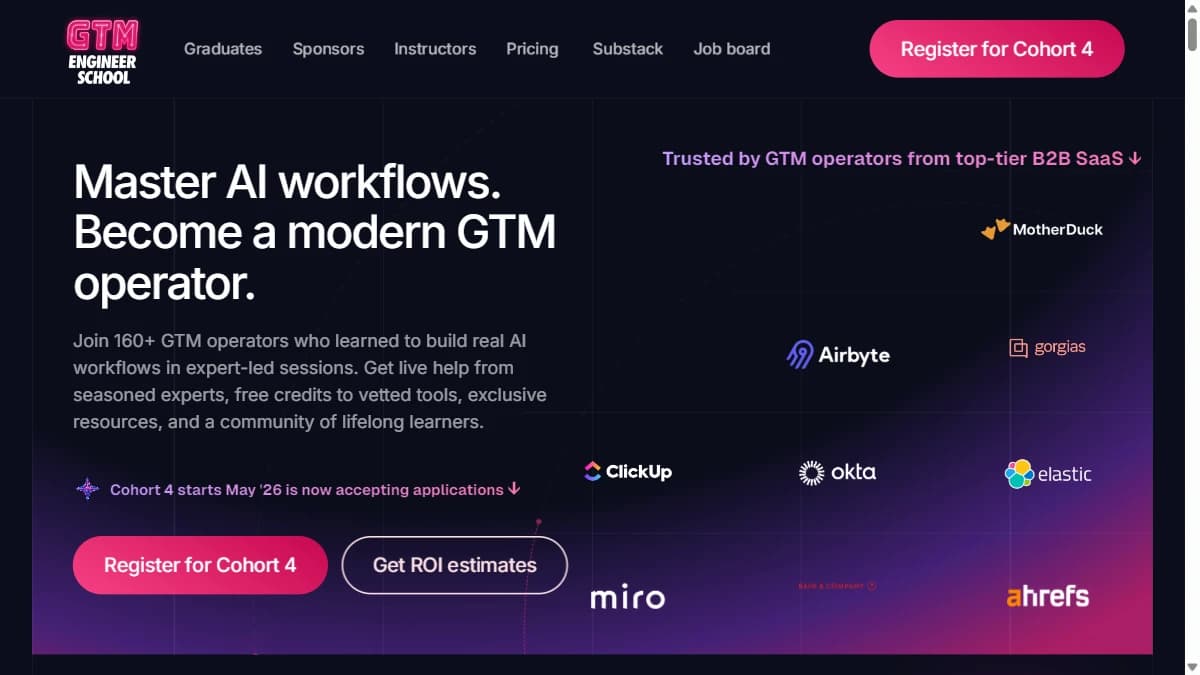
GTM Engineer School — live sessions with 160+ GTM operators
GTM Engineer School is a cohort-based program priced at approximately $2,500, designed for operators who want live instruction across the full GTM engineering stack — not just one tool.
The curriculum covers operational decision frameworks, process automation using Clay and Lemlist, AI workflow construction, and multi-tool integration patterns. Cohort 4 launched in February 2026 with over 160 participants — making it one of the largest active GTM engineering communities available through a structured program.
The primary differentiator is peer density. When 160+ GTM operators are learning alongside each other, the Slack discussions, shared playbooks, and asynchronous workflow reviews extend the learning well beyond what any curriculum alone can deliver. This is where GTM Engineer School earns its price tag.
Pros
- Largest cohort community of any GTM engineering program — 160+ active operators
- Breadth of tool coverage: Clay, Lemlist, AI workflow builders, integrations
- Live sessions provide real-time feedback and Q&A
- Strong peer-to-peer playbook sharing extends learning beyond sessions
Cons
- ~$2,500 is the highest price point among the five courses
- Breadth-focused curriculum means less depth on any single tool or workflow type
- No published capstone project requirement — portfolio output depends on self-initiative
Best for: Operators already working in GTM who want to systematize their skills, expand their tool stack, and join a large peer community.
Pricing: ~$2,500 per cohort. Cohort 4 launched February 2026.
Time commitment: Live sessions plus async project work — schedule varies by cohort.
3. StackOptimise GTM Engineer Course — Best Self-Paced Option
StackOptimise GTM Engineer Course — 30 lessons, 7+ hours, self-paced
StackOptimise's GTM Engineer Course is a self-paced program with 30 lessons across 6 modules and 7+ hours of step-by-step video training, taught by Felix and Penn — the founders of StackOptimise.
The curriculum is deliberately tool-specific: building signal-based lead lists with Clay, landing emails with Smartlead, running multi-channel outreach with GetSales, and automating sales workflows with Make.com. The course ships 24+ downloadable templates and playbooks, technical support access, and a private community with outbound specialists.
At $300–$500 for a self-paced format, this is the strongest mid-tier option for practitioners who cannot commit to a fixed cohort schedule. The playbooks are genuinely usable in client work — not just training exercises. As Tim Yakubson (Founder at Unlock Clay) noted: "Not only do they break down top technical strategies to get positive replies and book meetings, but they also cover how to build a portfolio."
Pros
- Self-paced — complete on your own schedule with no fixed cohort dates
- Specific, tool-named curriculum: Clay, Smartlead, GetSales, Make.com
- 24+ downloadable resources and templates that are immediately usable
- Portfolio-building guidance included alongside technical training
- Private community with outbound practitioners
Cons
- No live instruction — questions go to async community, not real-time Q&A
- Less structured than cohort programs — requires self-discipline to complete
- Narrower tool coverage than cohort programs (focused on Clay + email stack)
Best for: Practitioners with irregular schedules who need a self-paced deep-dive into Clay-based outbound systems, especially freelancers and agency operators.
Pricing: ~$300–$500 (self-paced, lifetime access).
Time commitment: 7+ hours of video content, self-directed.
4. SyncGTM AI GTM Engineer Course — Best Free AI GTM Engineering Course
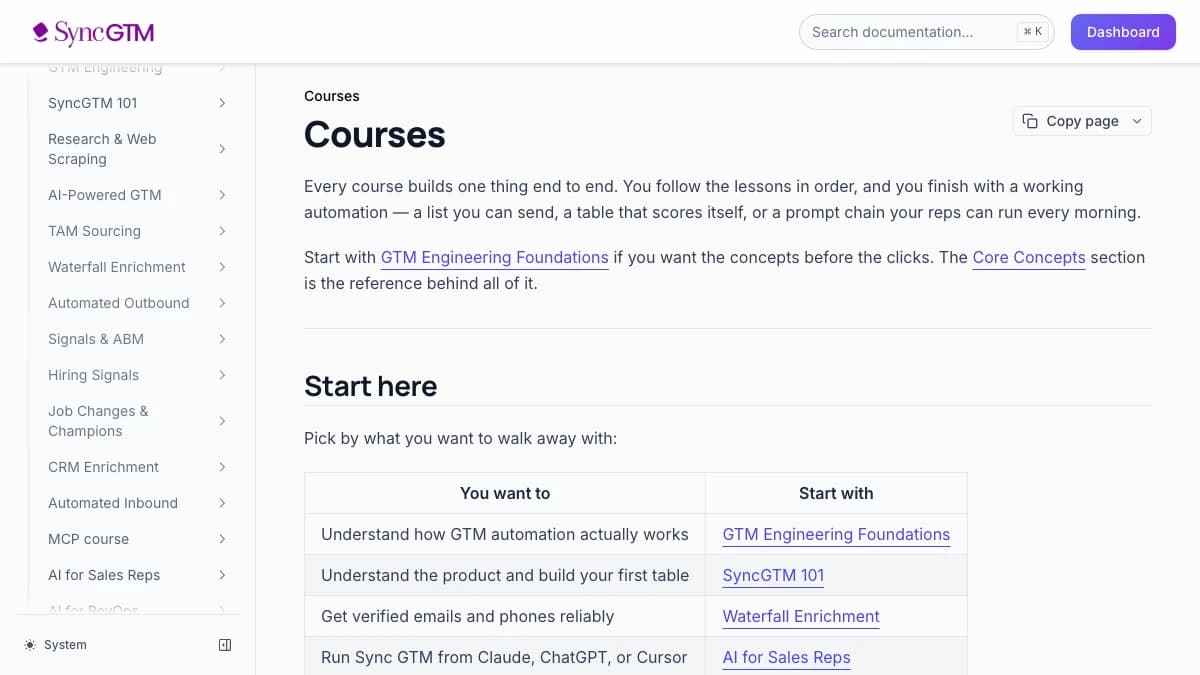
SyncGTM AI GTM Engineer Course — free, 15 courses, 145 lessons, no signup wall.
SyncGTM's AI GTM Engineer Course is a free library of 15 courses and 145 lessons that teaches GTM engineering through one framework — Find, Research, Enrich, Outreach — and ends every course with a working automation, not a certificate.
The curriculum starts with GTM Engineering Foundations (the data model, waterfalls, signals, scoring gates, and unit economics), then moves into TAM sourcing, waterfall enrichment, automated outbound, hiring signals, job-change tracking, CRM enrichment, and inbound routing. The AI-Powered GTM track covers where AI earns its cost, how to think in MCP tool chains, and three agentic builds: warm outbound, meeting research, and CRM repair.
What sets it apart is the AI-native delivery. Lessons run both in the SyncGTM app and from Claude, ChatGPT, or Cursor through the SyncGTM MCP server, so you learn to chain sourcing, enrichment, scoring, and CRM push into a single prompt-driven workflow — the exact skill set showing up in AI GTM engineer job descriptions in 2026. Each course states its credit cost and prerequisites up front, so you can judge fit before you spend anything.
Pros
- Free with no signup wall — zero financial risk
- AI-first: teaches MCP tool chains and agentic workflows from Claude, ChatGPT, and Cursor
- Every course ends in a built artefact — a scored list, a self-repairing CRM table, or a prompt chain you can demo in interviews
- Broadest free curriculum on this list — ~23 hours across foundations, list building, signals, and RevOps rollout
- Beginner to advanced tracks, so it scales past the entry level
Cons
- Hands-on builds run on SyncGTM (free-tier credits), not Clay — pair it with Clay practice if a target role lists Clay by name
- No live instruction or cohort — self-directed only
- Library is still growing — some later lessons are listed but not yet published
Best for: Beginners and working operators who want a free, AI-native path into GTM engineering — and a portfolio of working automations before paying for a cohort.
Pricing: Free.
Time commitment: ~23 hours across 15 courses; most individual courses take 1–3 hours.
5. GTM AI Academy — Best for AI-Focused GTM Training
GTM AI Academy — AI-native GTM training with flexible annual access tiers
GTM AI Academy is an annual subscription platform priced at two tiers — All Access Pass at $550/year and Masters Pass at $999/year — focused specifically on AI applications within GTM workflows.
The Masters Pass tier includes live sessions, expert feedback, and direct access to instructors. The All Access Pass covers the full curriculum library but at an async, self-directed pace. The platform runs on LearnWorlds with gamification, video transcripts, and certification tracking built in.
GTM AI Academy occupies a distinct position among the five courses: it is the only program that treats AI — not Clay, not cold email — as the primary subject. If your GTM engineering work is increasingly AI-workflow-driven (agent pipelines, LLM-based personalization, AI research automation) rather than tool-stack execution, this program covers territory the others do not.
Pros
- Only program with AI-first curriculum — covers agent workflows and LLM-based GTM execution
- Annual subscription model is lower upfront than cohort programs
- Two tiers let you start low-cost and upgrade to live feedback when ready
- Platform certifications tracked within the tool — easy to document for resume
Cons
- Annual subscription means ongoing cost — not a one-time purchase like StackOptimise
- Less hands-on clay/tool-specific coverage than the top three courses
- Live sessions only at Masters tier ($999/year) — All Access is self-directed
- Smaller peer community than GTM Engineer School
Best for: GTM operators who are already proficient in the core stack and want to go deeper on AI-native workflow design, agent pipelines, and LLM-driven personalization.
Pricing: $550/year (All Access) or $999/year (Masters with live sessions).
Time commitment: Self-directed at All Access tier; structured live sessions at Masters tier.
Side-by-Side Comparison: Top 5 GTM Engineering Courses
| Course | Format | Price | Duration | Best For | Portfolio Output |
|---|---|---|---|---|---|
| Maven GTM Engineer Foundations | Live cohort | $1,850 | 6 weeks | Career changers | Yes — capstone |
| GTM Engineer School | Live cohort | ~$2,500 | Cohort-based | Operators wanting community | Self-directed |
| StackOptimise GTM Course | Self-paced | ~$300–$500 | 7+ hours | Freelancers / agency ops | Templates included |
| SyncGTM AI GTM Engineer Course | Self-paced | Free | ~23 hours | Beginners → AI-native operators | Yes — built automation per course |
| GTM AI Academy | Self-paced / live | $550–$999/yr | Ongoing | AI-native GTM operators | Cert tracking |
Practice while you learn
Put your GTM engineering skills to work with SyncGTM
SyncGTM gives GTM engineers a live platform to build enrichment workflows, run waterfall pipelines, and sync data to any CRM — starting for free.
Which GTM Engineering Course Is Right for You?
The right course depends on where you are starting from — not on which program has the best marketing. Here is the decision framework.
- If you have never built a GTM workflow → Start with the SyncGTM AI GTM Engineer Course (free). Finish GTM Engineering Foundations and one build course before spending anything. If GTM engineering work feels right after a few hours of hands-on practice, then evaluate paid options.
- If you are making a deliberate career transition into GTM engineering → Maven GTM Engineer Foundations ($1,850) is the most structured path. The capstone project gives you a portfolio artifact, and the instructor network is the strongest of any program available today.
- If you want peer community and breadth over depth → GTM Engineer School (~$2,500) has the largest active operator cohort. The peer network compounds over time — the sessions alone do not justify the price, but the community does.
- If you need a self-paced option with real playbooks → StackOptimise ($300–$500) covers Clay, Smartlead, and Make.com with downloadable templates you can deploy immediately. No fixed schedule. If you prefer to outsource GTM execution entirely rather than learn, our best GTM agencies in 2026 roundup covers that path.
- If you are already proficient in Clay and want to go deeper on AI workflows → GTM AI Academy ($550–$999/year) covers territory none of the other four programs address — agent pipelines, LLM-based personalization, and AI-native GTM execution.
How SyncGTM Fits Into GTM Engineering Practice
GTM engineering courses teach you how to design and build GTM workflows. SyncGTM is the platform where those workflows run in production.
SyncGTM's feature set — waterfall enrichment across 20+ data sources, AI research agents, no-code workflow builder, and CRM integrations with HubSpot, Salesforce, Pipedrive, and Attio — is what GTM engineers use to operationalize what they learned in training. Completing a course gets you the skill. A platform like SyncGTM is where the skill generates measurable pipeline.
Many teams use SyncGTM as the execution layer under the strategy their GTM engineers design — the same way an architect uses a construction management tool to move from blueprint to build. If you are building your first GTM engineering portfolio project, SyncGTM's free tier is a practical environment to build and test enrichment workflows without needing a paid Clay subscription.
Final Verdict
The best GTM engineering course in 2026 depends on one question: what does the end of the course look like? If you finish with a deployed workflow, a documented result, and a portfolio project — the course was worth it. If you finish with a certificate and nothing built, you spent money on a credential that will not move a hiring manager.
Start with the free SyncGTM AI GTM Engineer Course regardless of your experience level. It costs nothing, the foundations course takes under two hours, and every course leaves you with a working automation — immediate signal about whether this type of work suits you. From there, Maven GTM Engineer Foundations offers the clearest career transition path, StackOptimise offers the best value for self-paced learners, and GTM Engineer School offers the largest peer community. Once you start building workflows, tools like Apollo and Clay become central — our Apollo.io review covers how it fits into a GTM engineer's stack.
For a broader look at the full landscape of GTM training — including strategy courses alongside engineering programs — see our full GTM courses comparison for 2026. And if you are evaluating the school vs. self-taught path more broadly, the GTM engineer school breakdown covers what hiring managers actually weight when reviewing candidates.
This post was last reviewed in September 2026.