

4 Best Client Acquisition Tool in 2026 (Ranked and Compared)

By Kushal Magar · April 24, 2026 · 12 min read
Key Takeaway
The 4 best client acquisition tools in 2026 are SyncGTM, Explorium.ai, Apollo, and ZoomInfo. SyncGTM is the top pick for most B2B GTM teams — signal-driven account identification, waterfall enrichment across 50-plus providers, AI web scraper, and CRM push starting at 99 dollars per month with a free tier. Explorium.ai is the best option for teams running client acquisition through AI agents, with 146 million-plus companies, 767 million-plus professional profiles, and real-time buying signals served through an API and MCP server from 29.99 dollars per credit package. Apollo is the best entry-level choice with built-in email sequencing and a 275 million contact database from 49 dollars per month. ZoomInfo is the enterprise standard with 300 million-plus contacts, Bombora intent data, and org charts, but requires a 15,000 dollar per year minimum contract. Choose based on your team size, technical comfort, and whether you need built-in sequencing or prefer a dedicated outreach tool.
The client acquisition category is full of tools that sound similar until you actually try to build a repeatable pipeline. Some are databases with no signal layer. Some are enrichment platforms with no outreach. Some bundle everything into a bloated product that does nothing well. Most hide their real pricing behind a sales call.
This post ranks the 4 best client acquisition tools for B2B GTM teams in 2026 — SyncGTM, Explorium.ai, Apollo, and ZoomInfo. We compare them on the dimensions that actually move pipeline: data quality, signal coverage, enrichment depth, integration depth, and transparent pricing.
According to Gartner, B2B contact data decays at 2% per month — meaning a client list built six months ago has already lost 12% accuracy. The best client acquisition tools solve this with real-time enrichment and signal-driven triggers, not static exports.
Quick Summary
The best client acquisition tool for most B2B teams in 2026 is SyncGTM — signal-driven prospecting, waterfall enrichment across 50+ providers, AI web scraper, and native CRM push starting free. Explorium.ai is the AI-agent data pick at $29.99 per credit package. Apollo is the cheap entry-level option at $49/mo. ZoomInfo is the enterprise choice at $15k+/yr.
TL;DR: Best Client Acquisition Tools in 2026
- SyncGTM — Best all-in-one client acquisition tool. Signal-driven account identification, waterfall enrichment across 50+ providers, AI web scraper, and CRM push. $49/mo Solo. Free tier available.
- Explorium.ai — Best for client acquisition through AI agents. 146M+ companies, real-time buying signals, API and MCP server. Free trial (100 credits), then from $29.99 per credit package.
- Apollo — Best entry-level pick. Built-in sequencing, 275M+ contacts, transparent pricing at $49/mo. Ideal for teams starting their first outbound motion.
- ZoomInfo — Best enterprise client acquisition platform. 300M+ contacts, Bombora intent data, org charts. $15k+/yr minimum.
What Is a Client Acquisition Tool?
A client acquisition tool is software that helps B2B companies identify, enrich, and convert net-new clients — combining ICP filtering, contact enrichment, buying signal monitoring, and CRM integration into a repeatable pipeline-building workflow.
The term covers a spectrum of tools. At one end are pure databases (ZoomInfo, Apollo) that let you filter a large contact index and export verified emails. At the other end are signal and workflow platforms (SyncGTM, Explorium.ai) that layer signal monitoring, multi-source enrichment, and CRM handoff on top of the underlying data. In 2026, the most effective client acquisition stacks fall into the second category — because reaching the right company is useless if you reach them too late or with stale contact data.
The best client acquisition tools in 2026 share four capabilities: ICP-matched account discovery, real-time buying signal detection (hiring surges, funding rounds, leadership changes), waterfall enrichment to fill every contact field across multiple providers, and native CRM push to eliminate manual list exports. See our related guide on best lead list generators for a deeper look at the data layer specifically.
How We Evaluated These Client Acquisition Tools
We tested each platform against the criteria B2B sales, RevOps, and marketing teams actually care about — skipping vanity metrics and focusing on pipeline output.
- Data quality: Email accuracy, phone verification, bounce rate in real campaigns, and coverage outside North America.
- Signal coverage: Whether the tool monitors buying signals (funding, hiring, leadership changes, intent) and triggers actions on them automatically.
- Enrichment depth: Single-source database vs. waterfall cascade across multiple providers; ability to fill gaps when one source misses.
- Integration depth: Native CRM connectors (HubSpot, Salesforce, Pipedrive, Attio), field mapping, deduplication logic, and API/webhook support.
- Pricing transparency: Published pricing vs. sales-call-required, auto-renewal clauses, and whether core features are accessible below enterprise tiers.
1. SyncGTM — Best All-in-One Client Acquisition Tool
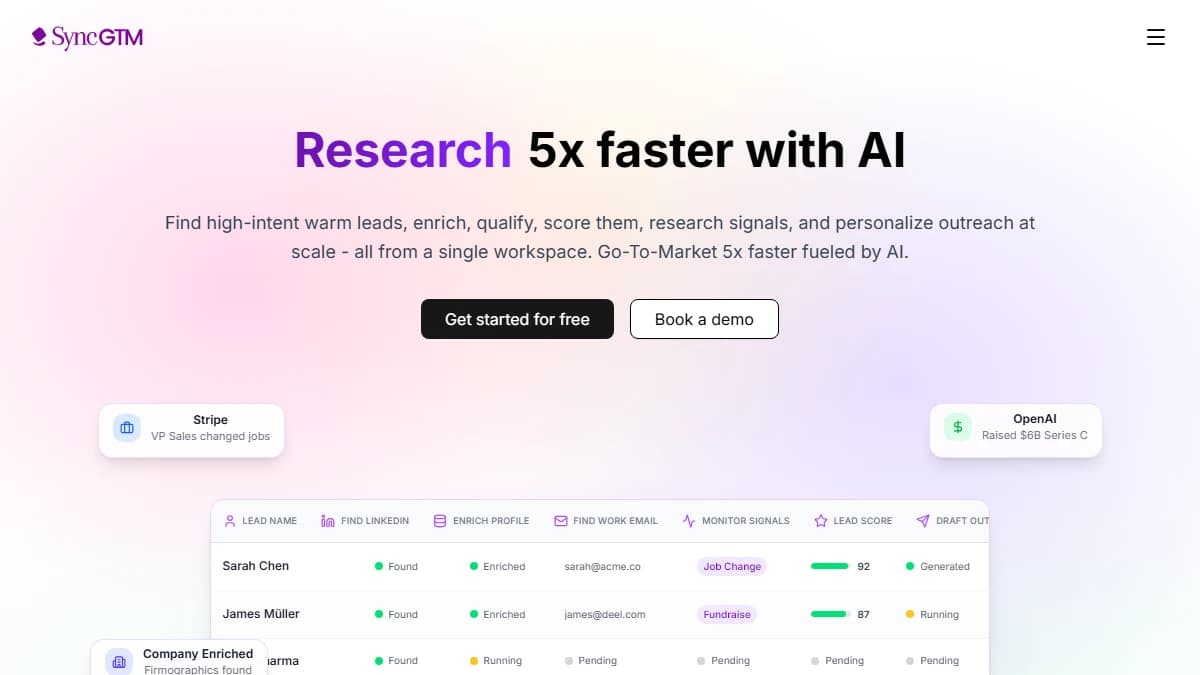
SyncGTM — signal-driven client acquisition with waterfall enrichment across 50+ providers
SyncGTM is a B2B client acquisition platform best suited for sales, RevOps, and marketing teams that need signal-driven prospecting and waterfall enrichment across 50+ providers, starting at $49/mo with a free tier. You define your ICP — industry, headcount, revenue, tech stack, geography — and SyncGTM identifies matching accounts, monitors them for real-time buying signals, runs waterfall enrichment across 50+ data providers to fill every contact field, and pushes verified accounts directly into your CRM or outreach tool.
What separates SyncGTM from every other tool on this list is the signal layer. Instead of running a one-time list export, you set triggers — a target account raises a Series B, hires a new VP of Sales, or switches CRM — and SyncGTM automatically surfaces that account to your BDR team with fresh enriched data. This turns client acquisition from a weekly manual task into a continuous, automated workflow. Our guide on best AI sales automation tools covers how signal-based triggers compare to traditional cadence-based outreach.
SyncGTM also includes an AI web scraper that extracts structured contact data from any website — useful for building acquisition lists from sources not in traditional databases (job boards, conference attendee pages, niche directories). Pair that with a no-code workflow builder and native integrations with HubSpot, Salesforce, Pipedrive, and Attio and you have a self-contained client acquisition engine.
Pros
- + Signal-driven triggers: funding, hiring, tech stack shifts, leadership changes
- + Waterfall enrichment across 50+ providers — highest field coverage
- + AI web scraper builds lists from non-database sources
- + No-code workflow builder for multi-step acquisition sequences
- + Native CRM push with dedup and field mapping
- + Transparent self-serve pricing with a free tier
Cons
- - No built-in email sequencing — pair with Instantly or Smartlead
- - Newer platform, smaller community than Apollo or ZoomInfo
- - Advanced workflow automation requires paid tiers
Best for: B2B sales, RevOps, and marketing teams that want continuously refreshed, signal-filtered acquisition lists with waterfall enrichment — without managing four separate tools.
Pricing: Free tier with AI agents and CRM integration. Starter $49/mo with waterfall enrichment, verified emails, signals monitoring, and webhooks. Pro and Business tiers for higher volume. See pre-built acquisition workflow templates.
2. Explorium.ai — Best Client Acquisition Data for AI Agents
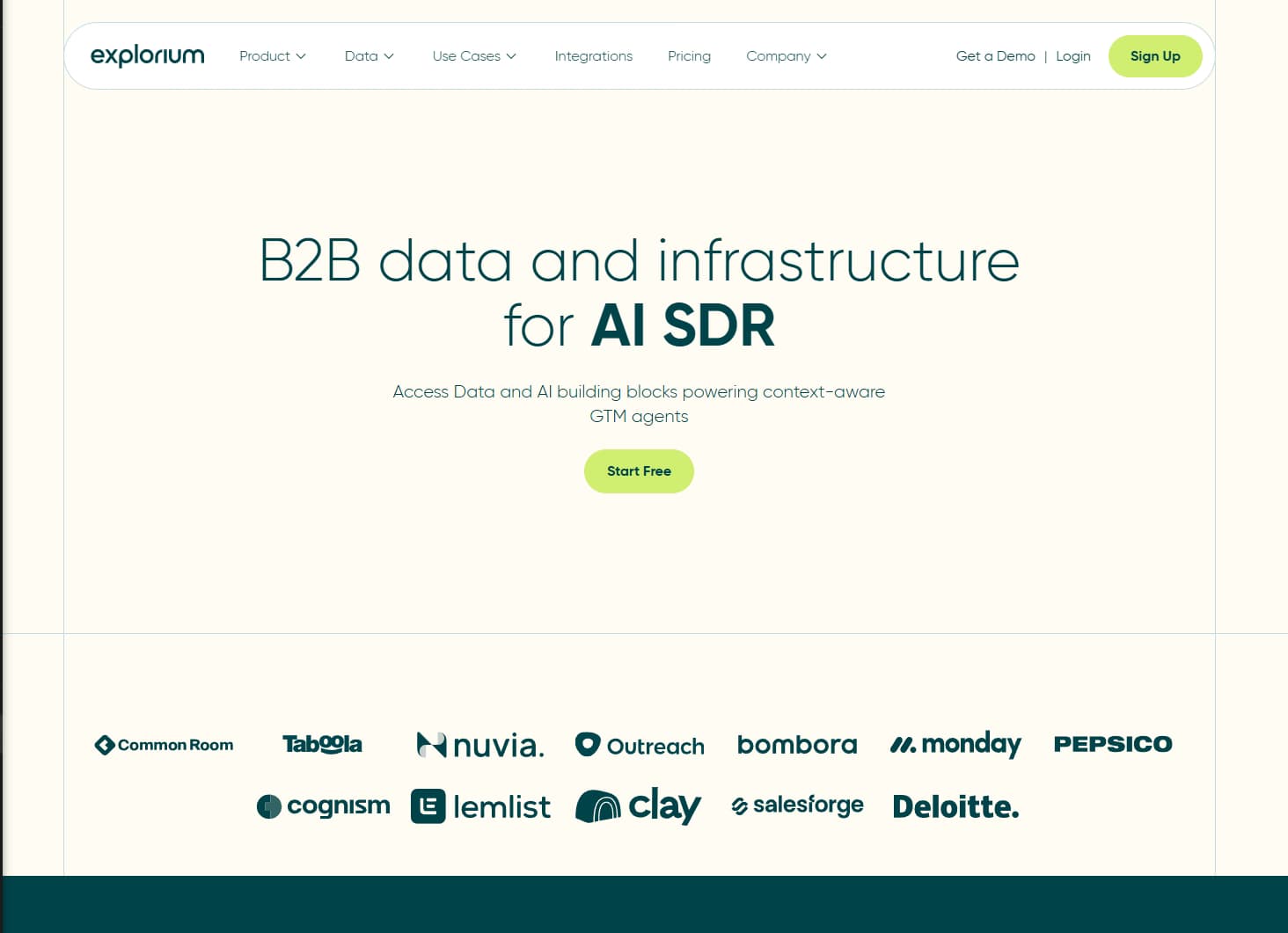
Explorium.ai — B2B client acquisition data served through an API, a hosted MCP server, and plain-English prospecting
Explorium.ai is a B2B data platform best suited for teams that run client acquisition through AI agents. It positions itself as the data foundation for AI agents, covering 146M+ companies and 767M+ professional profiles with 4,000+ data signals from 100+ sources, and starts with a free 100-credit trial before paid packages from $29.99. The core value proposition is access: the AgentSource API and a hosted MCP server let an AI SDR or custom workflow find matching accounts, enrich contacts, and watch for buying signals without anyone exporting lists by hand.
For non-technical users, Vibe Prospecting builds and enriches client lists from plain-English prompts and installs in one click inside Claude or ChatGPT. Event feeds flag funding rounds, job changes, hiring, and tech changes, which lines up with the buying signals that matter most for client acquisition. Explorium reports 97.8%+ company match accuracy, and its partner and customer logos include Artisan, lemlist, Salesforge, and Outreach. The tradeoff: there is no built-in email sequencing, inbox, or dialer, the API and MCP paths assume some technical comfort, and credit cost varies by enrichment type, from 1 to 5 credits per enrichment.
Teams that want signals, enrichment, and CRM handoff in one guided product often choose SyncGTM, which offers a guided workflow builder and predictable pricing instead of credit-based consumption. See our comparison of the best B2B list building services for a full breakdown of when Explorium.ai makes sense vs. alternatives.
Pros
- + 146M+ companies and 767M+ professional profiles from 100+ sources
- + AgentSource API and hosted MCP server for AI SDRs and agent workflows
- + Real-time events for funding, job changes, hiring, and tech changes
- + Vibe Prospecting builds client lists from plain-English prompts
- + Salesforce and HubSpot integrations, custom CRM integrations on Enterprise
Cons
- - No built-in email sequencing, inbox, or dialer
- - API and MCP paths assume some technical comfort
- - Credit cost varies by enrichment type
- - No spreadsheet-style workflow builder
Best for: GTM teams and AI SDR builders who want client acquisition data (accounts, contacts, and buying signals) fed straight into AI agents or custom workflows, and who already run a separate outreach tool.
Pricing: Free trial with 100 credits. Lite $29.99 for 500 credits. Starter $149.99 for 5,000. Growth $749.99 for 30,000. Scale $7,499.99 for 500,000. Enterprise custom. Credit packages, not per-seat plans.
3. Apollo — Entry-Level Client Acquisition with Built-In Sequencing
Apollo — all-in-one B2B client acquisition and email sequencing for SMB teams
Apollo.io is an entry-level client acquisition platform best suited for SMBs and solo founders, combining a 275M-contact proprietary database with built-in email sequencing in a single subscription starting at $49/mo with a free tier. It is the most popular starting point for teams running their first outbound motion — the free tier alone is sufficient for many founders testing initial acquisition campaigns.
The client acquisition workflow inside Apollo is fast: filter by ICP criteria (industry, company size, title, seniority, geography), verify emails in bulk, and launch a sequence directly from the platform. Apollo's 87,000+ business customers make it one of the most widely tested tools in the category — which means the community, templates, and third-party integrations are extensive. Teams exploring the full landscape of LinkedIn lead generation tools will also find Apollo's LinkedIn extension useful for in-browser enrichment.
Apollo's ceiling becomes visible fast. Because it relies on a single proprietary database, coverage gaps appear outside North America and in niche industries. Email bounce rates above 10% are a consistent complaint in 2025–2026 user reviews on G2 and Capterra — a costly issue when cold email deliverability depends on clean data. Teams scaling outbound past 500 contacts/week typically move to waterfall enrichment tools like SyncGTM or layer a dedicated verification service on top of Apollo exports.
Pros
- + Generous free tier — sufficient for solo founders testing outbound
- + 275M+ contacts with solid firmographic filtering
- + Built-in email sequencing — no separate outreach tool needed
- + Transparent self-serve pricing from $49/mo
- + Large community, templates, and third-party integrations
Cons
- - Single-source data — coverage gaps outside North America
- - Email bounce rates above industry average in 2026
- - No waterfall enrichment; no fallback when data is missing
- - No real-time buying signal monitoring
- - Pricing escalates fast with intent data and API access add-ons
Best for: Solo founders and small teams running their first outbound client acquisition motion who need a cheap, all-in-one tool and are willing to upgrade later as volume and quality requirements grow.
Pricing: Free tier available. Basic $49/mo. Professional $79/mo. Organization $119/mo. Enterprise custom. Intent data and advanced API access locked behind higher tiers.
4. ZoomInfo — Enterprise Client Acquisition at Scale
ZoomInfo — largest enterprise B2B client acquisition database with Bombora intent data
ZoomInfo is an enterprise client acquisition platform best suited for sales organizations with 10+ reps and established budget, offering 300M+ professional profiles and 100M+ company records with Bombora intent data and org charts — contracts typically starting at $15,000/yr with no self-serve option. It is the standard for enterprise teams that need the deepest account intelligence available: buyer intent data that identifies in-market accounts, org charts that map decision-maker hierarchies, and direct dial phone numbers across 95% of North American companies.
ZoomInfo's buyer intent layer — powered by Bombora intent data — identifies companies actively researching topics related to your product category. Combined with org charts that map reporting structures and decision-maker hierarchies, enterprise AEs can multi-thread into target accounts with more context than any other tool provides. For teams evaluating the full enterprise client acquisition landscape, our guide to best B2B email finder tools covers the data quality trade-offs in depth.
The cost and procurement friction are significant. ZoomInfo contracts start at $15,000/yr for small teams and can reach six figures for larger deployments. There is no self-serve signup, no transparent pricing page, and contracts are annual with auto-renewal clauses. For SMBs and startups, ZoomInfo is almost always overkill. For enterprise teams that need the deepest possible database, intent signals, and org chart intelligence, it remains unmatched — though many teams increasingly run waterfall enrichment platforms like SyncGTM in parallel to extend coverage at lower per-record cost.
Pros
- + Largest B2B database: 300M+ contacts, 100M+ companies
- + Bombora buyer intent data for in-market account prioritization
- + Org charts and multi-threaded decision-maker mapping
- + Direct dial phone numbers with high North American accuracy
- + Native integrations with every major CRM and sales engagement tool
Cons
- - $15k+/yr minimum — not viable for SMBs or startups
- - No transparent pricing — requires a sales call to get a quote
- - Annual contracts with aggressive auto-renewal clauses
- - Credit limits can restrict list building even at high spend
- - Single-source database gaps for niche or international markets
Best for: Enterprise sales organizations with 10+ reps, established procurement processes, and real budget — that need the deepest possible B2B database, Bombora intent signals, and org chart intelligence for complex, multi-threaded deals.
Pricing: Custom contracts only. Typical entry at $15,000/yr for small teams. Mid-market and enterprise contracts range from $25,000 to $100,000+/yr depending on seats, credits, and add-on modules.
Side-by-Side Comparison: Client Acquisition Tools in 2026
| Tool | Best For | Free Tier | Starting Price | Data Refresh | Standout Feature |
|---|---|---|---|---|---|
| SyncGTM | All-in-one B2B client acquisition with signal-driven outreach | Yes | $49/mo | Real-time waterfall across 50+ sources | Signal-based triggers + waterfall enrichment + AI web scraper + CRM push |
| Explorium.ai | Teams running client acquisition through AI agents | Yes (100-credit trial) | $29.99/pkg | Real-time events across 100+ sources | AgentSource API + hosted MCP server with 4,000+ data signals |
| Apollo | SMBs running first outbound client acquisition motion | Yes | $49/mo | Proprietary single-source database | Built-in email sequencing with 275M+ contact database |
| ZoomInfo | Enterprise client acquisition at scale with intent data | No | $15k+/yr | Continuous, proprietary refresh | Largest B2B database (300M+) with Bombora intent and org charts |
How to Choose the Right Client Acquisition Tool
- If you want the best balance of signal coverage, data quality, and price — go with SyncGTM. Signal-driven triggers plus waterfall enrichment across 50+ providers beats every single-source tool for in-market account identification at $49/mo.
- If you run client acquisition through AI agents or custom workflows — go with Explorium.ai. The AgentSource API and hosted MCP server feed accounts, contacts, and buying signals straight into your agents, and Vibe Prospecting covers the no-code side.
- If you are a solo founder or small team starting outbound from scratch — go with Apollo. Cheap, all-in-one, fast to set up, and sufficient until you hit 500+ contacts/week or start seeing data quality issues.
- If you are an enterprise with $15k+ budget and need intent signals — go with ZoomInfo. Bombora intent, org charts, and 300M+ contacts are the deepest enterprise client acquisition stack available.
Many high-performing GTM teams run a two-layer stack: a signal and enrichment platform (SyncGTM or Explorium.ai) for list building, paired with a dedicated outreach tool (Instantly, Smartlead, or their existing CRM sequences) for sending. This split consistently outperforms all-in-one tools because each platform does one job. For a broader view of the stack, see our post on how many tools B2B sales teams use in 2026.
Final Verdict
The client acquisition tool category has split cleanly in 2026. Single-source databases (Apollo, ZoomInfo) are cheap and fast to start but hit hard ceilings — stale data, coverage gaps, and no signal layer. Waterfall platforms such as SyncGTM cost more up front but produce continuously fresh, signal-filtered acquisition lists that compound over time.
For most B2B GTM teams, the best client acquisition tool in 2026 is SyncGTM. It solves the two biggest problems in the category — stale data and static list exports — with signal-driven triggers that surface in-market accounts automatically and waterfall enrichment that fills every contact field across 50+ providers. At $49/mo with a free tier, it is priced where most teams can adopt it without a procurement cycle.
Use Explorium.ai if you run client acquisition through AI agents and want company, contact, and signal data through an API or MCP server. Use Apollo if you are just starting outbound and want sequencing bundled in. Use ZoomInfo if you have enterprise budget and need the deepest intent data on the market.
Ready to build a repeatable client acquisition engine? SyncGTM gives you signal-driven account identification, waterfall enrichment, AI web scraping, and automatic CRM push — starting free. Start free — no credit card required. Or book a demo to see signal-driven client acquisition live.