

7 Best CompanyEnrich Alternatives in 2026 (Compared)

By Kushal Magar · March 7, 2026 · 12 min read · Last updated: September 28, 2026
Key Takeaway
This guide ranks the 7 best CompanyEnrich alternatives for 2026. CompanyEnrich excels at API-first company enrichment with AI lookalike discovery and technographic filtering, but it captures static snapshots with no buying signal layer and no native CRM connectors. SyncGTM is the top pick — it adds real-time hiring surge alerts, funding round detection, and tech stack change monitoring on top of waterfall enrichment from 40+ providers, starting at $49/mo with a free tier. Clearbit/HubSpot Breeze is the best fit if you are already on HubSpot. Apollo.io is the strongest all-in-one option with 275M+ contacts and built-in sequences from $49/mo. Explorium.ai is the closest API-first swap with a signal layer, covering 146M+ companies through an API and MCP server from $29.99 per credit package. People Data Labs is the deepest raw data API for developer-heavy teams building identity infrastructure. Coresignal delivers the most comprehensive historical technographic coverage for competitive displacement campaigns. Crustdata specialises in real-time employee count and headcount velocity for growth-signal prospecting.
CompanyEnrich built a well-priced API for company-level data — 30M validated company profiles, AI lookalike discovery, and technographic filtering from $49/mo. If you have a domain and need clean firmographic and tech stack data returned via REST API, it does that reliably. We covered it in depth in our CompanyEnrich review.
The reason teams look for alternatives is predictable: CompanyEnrich captures current state. It tells you what a company looks like today — industry, headcount, tech stack — but it does not tell you when that company just raised a Series B, started hiring 20 SDRs, or switched from Salesforce to HubSpot. There is no signal layer. There are no native CRM connectors. It is an enrichment API, not a GTM platform.
We evaluated 7 alternatives across API depth, technographic coverage, buying signal detection, CRM integration, and pricing. Here is what each one actually delivers and where CompanyEnrich still holds the edge. For context on the broader enrichment landscape, see our top data enrichment tools 2026 guide.
Quick Summary
The best CompanyEnrich alternatives in 2026 are SyncGTM, Apollo.io, Explorium.ai, People Data Labs, and Coresignal. SyncGTM is the top pick for GTM teams that need company enrichment plus real-time buying signals — hiring surges, funding alerts, tech stack changes — automatically synced to HubSpot or Salesforce from $49/mo. Apollo.io is the strongest all-in-one option with 275M+ contacts, built-in sequencing, and intent data from $49/mo. Explorium.ai is the best choice for teams that want an API-first company data layer with 4,000+ signals for AI agents. People Data Labs is the deepest raw API for developer-heavy applications. Coresignal delivers the most comprehensive historical technographic data for competitive displacement.
TL;DR: Best CompanyEnrich Alternatives in 2026
- SyncGTM — Best overall. Enrichment + real-time buying signals + CRM sync from $49/mo. Free tier. No API dev required.
- Clearbit / HubSpot Breeze — Best if already on HubSpot. Native enrichment auto-populating CRM records with Clearbit accuracy.
- Apollo.io — Best all-in-one. 275M+ contacts with sequences, intent signals, and company enrichment from $49/mo.
- Explorium.ai — Best API-first swap with signals. 146M+ companies, 4,000+ data signals, and a hosted MCP server from $29.99 per credit package.
- People Data Labs — Best raw API for developers. 70M+ company profiles with deep person-level linking for identity-heavy applications.
- Coresignal — Best technographic depth. Historical tech stack change tracking across 70M+ companies for displacement campaigns.
- Crustdata — Best headcount velocity signals. Real-time employee count changes + LinkedIn growth data for growth-signal prospecting.
Why Teams Look Beyond CompanyEnrich
CompanyEnrich is genuinely good at what it claims to do. The REST API is fast, the data schema is consistent, the credit model charges only on successful matches, and the AI lookalike discovery endpoint is more useful than generic keyword search for ICP expansion. We gave it 4.1 stars in our review. So why do developer and RevOps teams end up looking for alternatives?
The gap is signal versus snapshot. CompanyEnrich captures company state at a point in time — refreshed monthly, accurate for stable firmographics, technically sound. But modern outbound motions are triggered by change events, not static attributes. A company with 200 employees in fintech using Stripe is interesting. That same company posting 15 BDR roles last Tuesday is an active buying signal — and CompanyEnrich's API returns the same profile for both scenarios.
The second friction point is the CRM gap. CompanyEnrich returns structured JSON you then have to move into HubSpot, Salesforce, or your data warehouse yourself. There are no native integrations. For engineering-led teams, this is expected and fine. For RevOps and sales teams who want enrichment to flow automatically into their CRM without writing custom connectors, it creates a build-versus-buy decision that often tips toward an alternative.
The third factor is database coverage ceiling. At 30M validated companies, CompanyEnrich is accurate but limited. SMB-heavy markets, emerging geographies, and deeply niche verticals often fall outside the coverage window. Teams targeting long-tail ICPs frequently need a provider with a broader raw record count, even if that means accepting some tradeoff on per-record validation depth.
Here is how the 7 strongest alternatives perform across each of these dimensions.
1. SyncGTM: Company Enrichment Plus the Signal Layer CompanyEnrich Skips
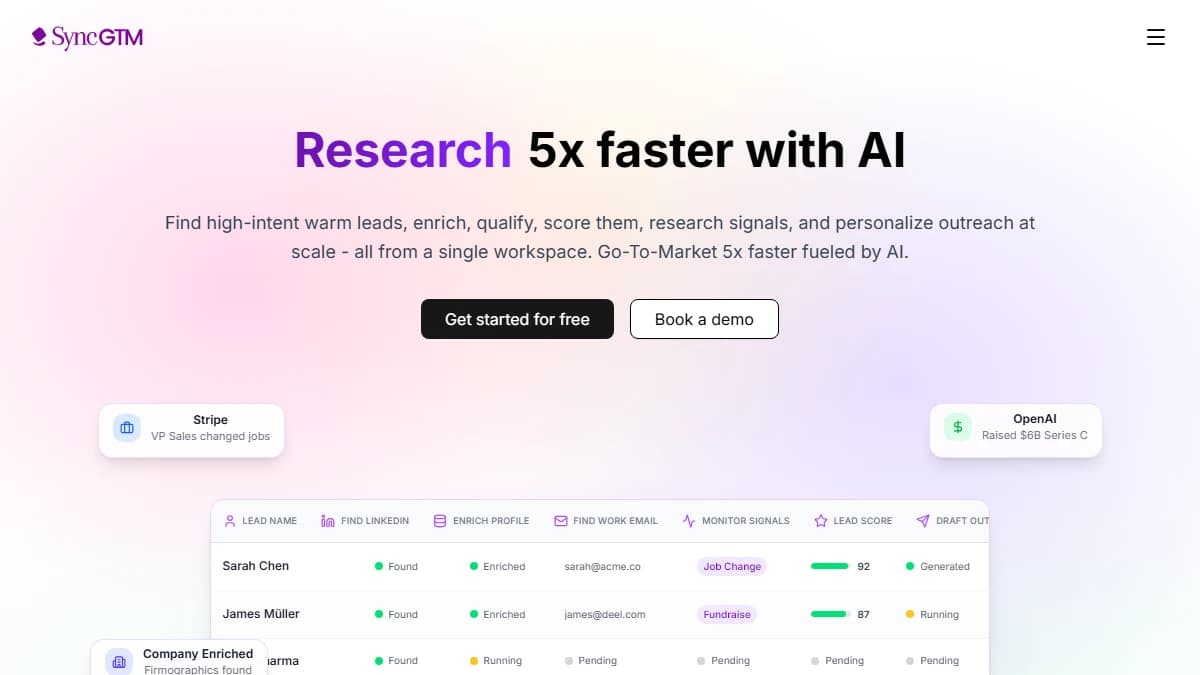
SyncGTM — enrichment, buying signals, and CRM sync from $49/mo
The structural difference between CompanyEnrich and SyncGTM is what happens after the company data lands. CompanyEnrich returns a profile. SyncGTM combines company enrichment from a 40+ provider waterfall with real-time buying signals — hiring surge detection, funding round alerts timed to announcement day, tech stack change monitoring, and job change tracking — and then syncs the full enriched record directly into HubSpot, Salesforce, Pipedrive, or Attio without any custom API work.
For teams that relied on CompanyEnrich's technographic filter to identify companies using a specific tech stack, SyncGTM goes one step further: it alerts you when a company in your target account list adopts or drops a tool, not just what their current stack looks like. That temporal dimension — knowing about the change event, not just the current state — is what turns company data into actionable pipeline. See our full comparison of buying intent signals available on the platform.
CompanyEnrich's lookalike API is a genuine differentiator — submit one domain, get a ranked list of similar companies. SyncGTM covers ICP expansion differently: define your ideal account criteria across industry, headcount, tech stack, and signal activity, and the system continuously surfaces matching companies as they enter your buying window. Less one-shot lookup, more ongoing identification.
Pros
- ✓ Real-time buying signals — hiring, funding, tech stack, job changes
- ✓ 40+ provider waterfall for higher fill rates than any single API
- ✓ Native CRM sync to HubSpot, Salesforce, Pipedrive, Attio
- ✓ Free tier (200 credits/mo) — CompanyEnrich has one-time 500 trial credits only
- ✓ No API development required — full no-code automation available
- ✓ AI agents for research and personalization on every paid plan
- ✓ Independent column refresh — only pay for data you need to update
Cons
- ✗ No single-domain lookalike discovery endpoint (CompanyEnrich's AI similar companies API)
- ✗ $99/mo vs CompanyEnrich's $49/mo starting price
- ✗ Smaller product community than Apollo or ZoomInfo
Best for: GTM teams that need company enrichment plus the buying signal layer to trigger outreach at the right moment — without building a custom API integration to get data into their CRM.
Pricing: Free (200 credits/mo), $49/mo Solo, $99/mo Growth, $249/mo Pro, $649/mo Business. See full pricing → Take the product tour →
2. Clearbit / HubSpot Breeze Intelligence: Best If You Live in HubSpot
Clearbit was the benchmark for company enrichment APIs for nearly a decade — accurate firmographics, reliable technographics, and a developer-friendly REST API that many teams built their enrichment pipelines around. HubSpot acquired Clearbit in 2023 and rebranded it as HubSpot Breeze Intelligence. The data quality is intact. The standalone API is gone.
For teams already on HubSpot, Breeze Intelligence is the strongest native enrichment option available. Company records auto-populate with Clearbit-sourced firmographics, technographics, and contact details directly inside the CRM — no API integration, no data pipeline, no CSV import. The enrichment triggers automatically on new contacts and can backfill existing records. This zero-integration-friction story is genuinely compelling if you are already paying for HubSpot.
For teams on Salesforce, Pipedrive, or any non-HubSpot CRM, the value proposition largely disappears. The data that was available via Clearbit's standalone API — which many teams used as a CompanyEnrich equivalent before CompanyEnrich existed — is now locked to the HubSpot ecosystem. That is the core reason the Clearbit acquisition drove so many developer teams toward CompanyEnrich and PDL as API alternatives.
Pros
- ✓ Clearbit data quality — still among the most accurate in the market
- ✓ Zero integration friction for HubSpot customers
- ✓ Auto-enriches new and existing CRM records natively
- ✓ Included in HubSpot Marketing Hub Enterprise plans
- ✓ Technographic data directly queryable inside HubSpot lists
Cons
- ✗ Standalone API no longer available — HubSpot customers only
- ✗ No lookalike discovery feature (CompanyEnrich's standout capability)
- ✗ No buying signal layer — enrichment only, no change event detection
- ✗ Pricing opaque — bundled into HubSpot tiers, not standalone
- ✗ No Salesforce, Pipedrive, or non-HubSpot CRM support
Best for: Teams already on HubSpot Marketing Hub who want automated company enrichment without building any integration layer — and who do not need the standalone API that CompanyEnrich provides.
Pricing: Bundled into HubSpot plans — available on Marketing Hub Professional ($800/mo) and Enterprise ($3,600/mo). Credit-based enrichment add-on available separately.
3. Apollo.io: All-in-One Prospecting That Goes Beyond Pure Company Data
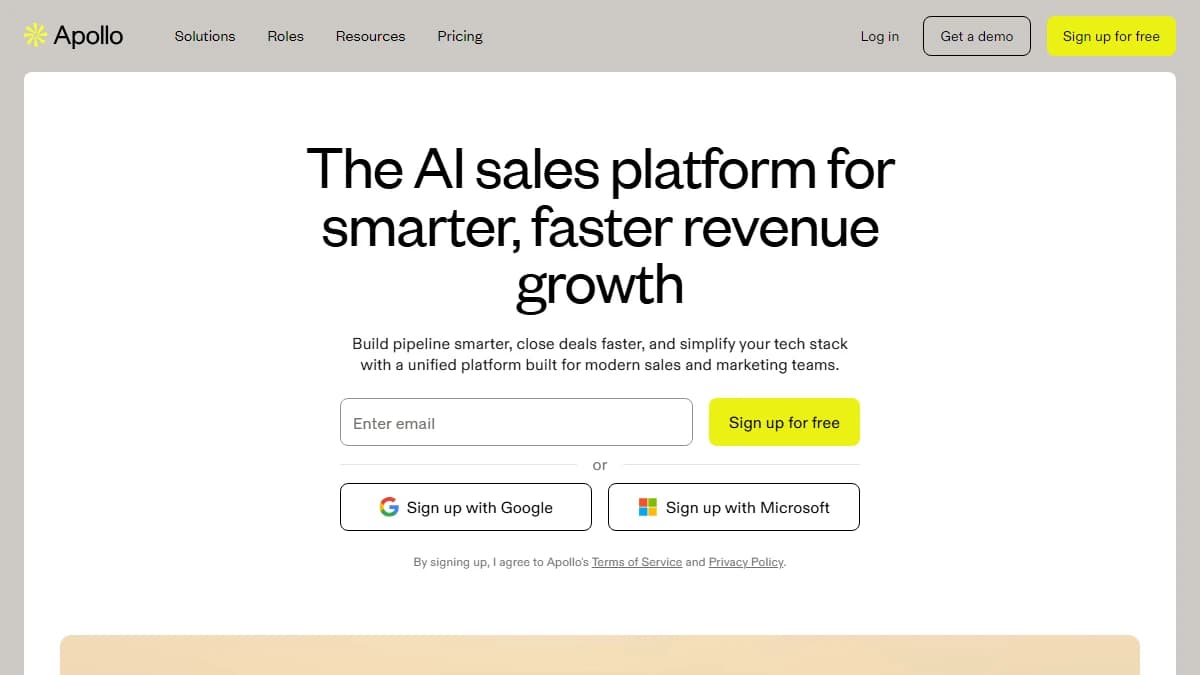
Apollo.io — company and contact enrichment with built-in sequences from $49/mo
Apollo.io approaches company data from the opposite direction to CompanyEnrich. CompanyEnrich is company-first and API-first — deep company profiles, no contact data noise. Apollo is a contact and company database with 275M+ verified contacts and 73M+ companies, plus built-in email sequencing, a power dialer, intent signals, and CRM sync. For our full breakdown, see the Apollo.io review.
The company enrichment use case is covered — Apollo returns firmographic and technographic data for companies in its database, and the account search allows filtering by tech stack, funding stage, headcount, industry, and revenue in the same way CompanyEnrich's Company Search API does. The key difference is context: Apollo's company data exists to help you find people to contact at those companies, not to power a standalone enrichment API. If your workflow involves finding the right company and then finding the right contact within it, Apollo does both in one platform at $49/mo.
Where CompanyEnrich holds the edge: the AI lookalike API has no Apollo equivalent. CompanyEnrich's semantic search across 30M companies — querying by concept rather than keyword — is also more contextually precise than Apollo's account filters for nuanced ICP definitions. If you are building data pipelines that consume company profiles programmatically, Apollo's enrichment API is less developer-native than CompanyEnrich's REST-first design.
Pros
- ✓ 275M+ contacts + 73M+ companies — CompanyEnrich's 30M companies only
- ✓ Free tier (10,000 email credits/mo)
- ✓ Built-in sequencing, dialer, and meeting scheduler
- ✓ Intent signals on paid plans (funding, hiring, tech, topics)
- ✓ CRM sync to Salesforce and HubSpot
- ✓ $49/mo vs CompanyEnrich's $49/mo — same price, more breadth
Cons
- ✗ No AI lookalike discovery (CompanyEnrich differentiator)
- ✗ Less developer-native API than CompanyEnrich
- ✗ Semantic company search less precise than CompanyEnrich's
- ✗ Data quality inconsistent for niche verticals and emerging markets
Best for:Sales and RevOps teams that want company and contact data in one platform with built-in outreach — and do not need CompanyEnrich's API-first architecture or lookalike discovery endpoint.
Pricing: Free (10,000 email credits/mo), $49/mo Basic, $99/mo Professional, custom Enterprise.
4. Explorium.ai: API-First Company Data With a Signal Layer
Explorium.ai is the closest match to CompanyEnrich's API-first model on this list, with a broader dataset behind it. Explorium reports 146M+ business entities and 767M+ professional profiles drawn from 100+ sources, against CompanyEnrich's 30M companies. Its AgentSource API resolves a domain or company name, then returns firmographics, technographics, funding data, workforce trends, and website changes, with bulk enrichment of up to 50 records per request.
What CompanyEnrich lacks, Explorium adds: an events layer. You can monitor companies for funding rounds, hiring, and tech changes, and prospects for job changes, drawn from 4,000+ data signals. The same data is available through a hosted MCP server, so AI agents can query it directly, and Vibe Prospecting gives non-technical users a plain-English way to build and enrich lists. Explorium reports 97.8%+ company match accuracy.
The tradeoff versus CompanyEnrich is pricing shape and scope. Explorium sells credit packages rather than a monthly plan: a free trial with 100 credits, then $29.99 for 500 credits, and each enrichment costs 1 to 5 credits depending on type. There is no sequencing, and the API and MCP paths assume some technical comfort. For teams that want company data plus signals from a clean API, it is a direct upgrade. For teams that need native CRM sync beyond Salesforce and HubSpot below the Enterprise tier, it is not.
Pros
- ✓ 146M+ companies vs CompanyEnrich's 30M (self-reported)
- ✓ Firmographics, technographics, funding, and workforce trends
- ✓ 4,000+ data signals for funding, hiring, and tech changes
- ✓ Hosted MCP server plus REST API for AI agents
- ✓ Credit packages from $29.99 with a 100-credit free trial
Cons
- ✗ Credit cost varies by enrichment type (1–5 credits)
- ✗ Native CRM sync limited to Salesforce and HubSpot below Enterprise
- ✗ No built-in sequencing — pair it with an engagement tool
- ✗ API and MCP paths assume some technical comfort
Best for:GTM engineers and RevOps teams that like CompanyEnrich's API-first model but need wider coverage and buying signals for AI agents or custom workflows.
Pricing: Free trial (100 credits), $29.99 Lite (500 credits), $149.99 Starter (5,000), $749.99 Growth (30,000), $7,499.99 Scale (500,000), custom Enterprise.
5. People Data Labs: The Deepest Raw API for Developer-Built Applications
People Data Labs (PDL) is the closest true API-to-API competitor to CompanyEnrich for developer teams. The Company Enrichment API covers 70M+ company profiles — more than double CompanyEnrich's 30M — and the match logic accepts domain, name, social profile, or phone as input identifiers, similar to CompanyEnrich's enrichment endpoint. Both tools charge per successful API call and offer credit rollover on active subscriptions.
Where PDL diverges from CompanyEnrich: the person-level data linking is dramatically deeper. PDL aggregates data from hundreds of sources and maintains person profiles that connect individuals to their employer companies, employment history, and professional network — making it the preferred API for HR tech, recruiting platforms, and identity intelligence applications where knowing who works at a company is as important as the company profile itself. CompanyEnrich is company-only by design.
PDL does not offer CompanyEnrich's AI lookalike discovery or semantic company search. The Company Search API uses structured filters rather than conceptual queries. PDL is also priced for enterprise volume — at $0.10 per company enrichment call at low volume, costs scale meaningfully above CompanyEnrich's credit model for teams doing high-frequency enrichment at moderate scale. PDL is most cost-effective when purchased as a licensed dataset rather than consumed through per-call APIs.
Pros
- ✓ 70M+ companies — 2x CompanyEnrich's 30M database
- ✓ Deep person-level data linking employees to companies
- ✓ 900M+ person profiles for identity-heavy applications
- ✓ Multiple input types: domain, name, social, phone
- ✓ Free tier for API testing before committing
- ✓ Bulk dataset licensing available for high-volume use cases
Cons
- ✗ No AI lookalike discovery (CompanyEnrich differentiator)
- ✗ No semantic company search — structured filters only
- ✗ Higher implementation complexity than CompanyEnrich
- ✗ Enterprise pricing — expensive for moderate-volume per-call use
- ✗ No buying signals, no CRM connectors
Best for:Developer teams building identity-heavy applications — HR tech, recruiting platforms, account intelligence tools — where person-to-company linking at depth matters more than CompanyEnrich's company-first simplicity.
Pricing: Free tier available, company enrichment from ~$0.10/call at low volume. Enterprise dataset licensing and API pricing on request.
6. Coresignal: Historical Technographic Depth That CompanyEnrich Cannot Match
Coresignal addresses the specific gap that makes CompanyEnrich's technographic data insufficient for competitive displacement campaigns: it tracks technology adoption and removal over time, not just current state. Where CompanyEnrich's Company Search API tells you which companies use a given technology today, Coresignal tells you which companies adopted, dropped, or switched that technology in the last 30, 60, or 90 days.
For sales teams running competitive displacement motions — targeting companies that just dropped a competitor's product or adopted a complementary tool — that temporal dimension is the entire value proposition. Reaching out to a company the week they switch from Salesforce to HubSpot is materially different from reaching out six months later because both companies happened to be in the same industry filter. Coresignal's Company Enrichment API covers 70M+ company profiles with technographic change events, employee count history, and leadership change tracking across a rolling historical window.
Coresignal is enterprise-priced and API-heavy — the implementation footprint is larger than CompanyEnrich and the cost per record is higher. It is not a self-serve $49/mo entry point. It is the right choice when technographic change event data is a core part of your GTM motion and the precision of that data justifies the additional cost and integration effort.
Pros
- ✓ Historical technographic change tracking — CompanyEnrich is current state only
- ✓ 70M+ company profiles with technology adoption timeline data
- ✓ Leadership change and employee count history
- ✓ Dataset and API access — flexible consumption model
- ✓ High-frequency refresh for near-real-time change detection
Cons
- ✗ Enterprise pricing — significantly above CompanyEnrich's $49/mo
- ✗ No self-serve trial or free tier
- ✗ Higher implementation complexity
- ✗ No AI lookalike discovery
- ✗ No CRM connectors or no-code enrichment workflows
Best for: Enterprise GTM teams running technographic displacement campaigns where knowing when a company adopted or dropped a specific tool is the core trigger — not just knowing their current tech stack.
Pricing: Enterprise pricing on request. Dataset and API packages available. No self-serve tier.
7. Crustdata: Real-Time Headcount Velocity for Growth-Signal Prospecting
Crustdata takes a focused approach to company intelligence: real-time employee count tracking and LinkedIn headcount growth signals for over 60M companies, updated weekly. Where CompanyEnrich gives you a static employee count derived from a monthly refresh, Crustdata shows you how fast that number is moving and in which departments — distinguishing companies hiring aggressively in sales from those growing in engineering or contracting overall.
For revenue teams that use headcount velocity as a buying signal — targeting companies in a rapid-growth phase before they become obvious prospects to every competitor — Crustdata's API delivers the granularity CompanyEnrich's monthly snapshot cannot. The Company Discovery API lets you filter companies by recent headcount growth percentage, department-level hiring activity, and LinkedIn follower growth, building lists of companies in an active scaling phase rather than companies that merely fit a size range at a point in time.
Crustdata is narrower than CompanyEnrich in scope — it is headcount and growth signals, not a full firmographic enrichment platform. It does not have technographic data, AI lookalike discovery, or the full data field set CompanyEnrich returns. The right use case is combining Crustdata's growth signal layer with a firmographic source like CompanyEnrich or SyncGTM, not replacing one with the other.
Pros
- ✓ Weekly headcount velocity — CompanyEnrich refreshes monthly at best
- ✓ Department-level hiring breakdown (sales, engineering, marketing)
- ✓ LinkedIn follower and engagement growth signals
- ✓ 60M+ companies with growth signal history
- ✓ REST API with clean developer documentation
Cons
- ✗ No technographic data or tech stack filtering
- ✗ No AI lookalike discovery
- ✗ Narrower data scope than CompanyEnrich's full firmographic set
- ✗ No CRM native connectors
- ✗ Not a full enrichment replacement — best as a signal layer add-on
Best for: Revenue teams using headcount growth velocity as a primary buying signal trigger — to identify companies in active scaling phases before they show up in competitor prospecting lists.
Pricing: Starts at $99/mo. API and dataset tiers available. Free trial on request.
Side-by-Side Comparison: CompanyEnrich Alternatives
| Tool | Best For | Free Tier | Starting Price | Buying Signals | CRM Native |
|---|---|---|---|---|---|
| SyncGTM | Enrichment + signals + CRM | ✓ 200 credits/mo | $49/mo | ✓ built-in | ✓ HubSpot, SF |
| Clearbit/Breeze | HubSpot customers | ~ bundled | $800+/mo HubSpot | ✗ | ✓ HubSpot only |
| Apollo.io | All-in-one prospecting | ✓ 10k credits/mo | $49/mo | ✓ paid plans | ✓ Salesforce, HubSpot |
| Explorium.ai | API-first data + signals | ~ 100-credit trial | $29.99/pkg | ✓ 4,000+ signals | ✓ Salesforce, HubSpot |
| People Data Labs | Developer API / identity | ✓ limited calls | ~$0.10/call | ✗ | ✗ |
| Coresignal | Technographic history | ✗ | Enterprise | ✓ tech change events | ✗ |
| Crustdata | Headcount velocity | ~ trial on request | $99/mo | ✓ growth signals | ✗ |
How to Choose the Right CompanyEnrich Alternative
- If you need company data plus the buying signal layer that triggers outreach → SyncGTM. Waterfall enrichment + hiring surges, funding alerts, tech stack changes, job change tracking — all synced to your CRM from $49/mo with a free tier.
- If you are already on HubSpot and want zero-integration-friction enrichment → HubSpot Breeze Intelligence. Clearbit data quality natively inside HubSpot with no additional integration work.
- If you need company data plus contact data and built-in outreach in one platform → Apollo.io. 275M+ contacts with sequences, intent data, and CRM sync from $49/mo.
- If you want CompanyEnrich's API-first model with more coverage and a signal layer → Explorium.ai. 146M+ companies, 4,000+ data signals, and a hosted MCP server for AI agents, from $29.99 per credit package.
- If you are building an identity-heavy product that links people to companies at scale → People Data Labs. 70M+ company profiles with 900M+ person records linking individuals to employer companies.
- If technographic change events — not just current tech stack — drive your displacement campaigns → Coresignal. Historical tech adoption and removal tracking across 70M+ companies for competitive displacement.
- If headcount velocity and department-level hiring growth are your primary qualification signal → Crustdata. Weekly headcount updates and LinkedIn growth signals for growth-phase prospecting from $99/mo.
Final Verdict
CompanyEnrich is a well-built API for what it does: reliable company firmographics and technographic snapshots, AI lookalike discovery, and semantic company search at $49/mo. For developer teams that need clean company data from a REST endpoint without overhead, it is hard to beat on price-to-accuracy at its tier.
The limitations become obvious when you need more than a snapshot. SyncGTM is the top pick for teams that need enrichment plus the signal layer that makes data actionable — hiring surges, funding rounds, tech stack changes — automatically synced to their CRM without API development. The $50 premium over CompanyEnrich covers waterfall enrichment across 40+ providers, real-time buying signals on every plan, and native CRM integrations that eliminate the build-it-yourself gap.
For all-in-one prospecting that combines company data with contact data and built-in outreach, Apollo.io matches CompanyEnrich's price at $49/mo and adds 275M+ contacts, sequences, and intent data. For teams on HubSpot, Breeze Intelligence delivers Clearbit-quality enrichment inside the CRM with no integration work. And for the specific case of technographic displacement campaigns, Coresignal's historical change event data turns static tech stack snapshots into time-triggered outreach signals.
For teams evaluating the broader data enrichment landscape, our top data enrichment tools 2026 guide covers additional options across the full enrichment stack.
pricing page before committing.