FullContact Review 2026: Identity Resolution Worth the Investment?

By Kushal Magar · March 17, 2026 · 11 min read
Key Takeaway
FullContact is an identity resolution platform with a patented identity graph covering over one billion person profiles and 22 million company profiles. It processes 30 million updates per day, connecting fragmented identifiers like emails, phones, social handles, and device IDs into unified person records. Pricing starts at $99 per month with 1,000 free API matches. Enterprise pricing is custom and typically requires annual commitments starting at $1,200 per year. The main limitations are API-only design that requires engineering resources, no buying signals or intent data, confusing pricing tiers with aggressive upselling reported by G2 reviewers, no native CRM connectors, and single-source enrichment with no waterfall fallback. FullContact excels at identity resolution for marketing teams running cross-channel campaigns. For GTM teams needing enrichment plus buying signals and CRM automation, SyncGTM delivers waterfall enrichment across 20 plus sources with native CRM sync on every plan from $99 per month.
FullContact is an identity resolution platform with a patented identity graph covering over one billion person profiles and 22 million company profiles. It processes 30 million updates per day, connecting fragmented identifiers — emails, phones, social handles, device IDs — into unified person records. Pricing starts at $99/mo with 1,000 free API matches.
You are probably here because your customer data is scattered across systems. FullContact promises to unify it. Tools like Clearbit and People Data Labs take different approaches with broader enrichment databases.
But identity resolution is one piece of the GTM puzzle. In 2026, the best teams need enrichment, buying signals, and CRM automation — not just resolved identities. This FullContact review covers what the platform delivers, what it costs, and whether SyncGTM is a better fit for teams that need GTM context on top of identity data.
FullContact Review: What You Get (and What You Don't)
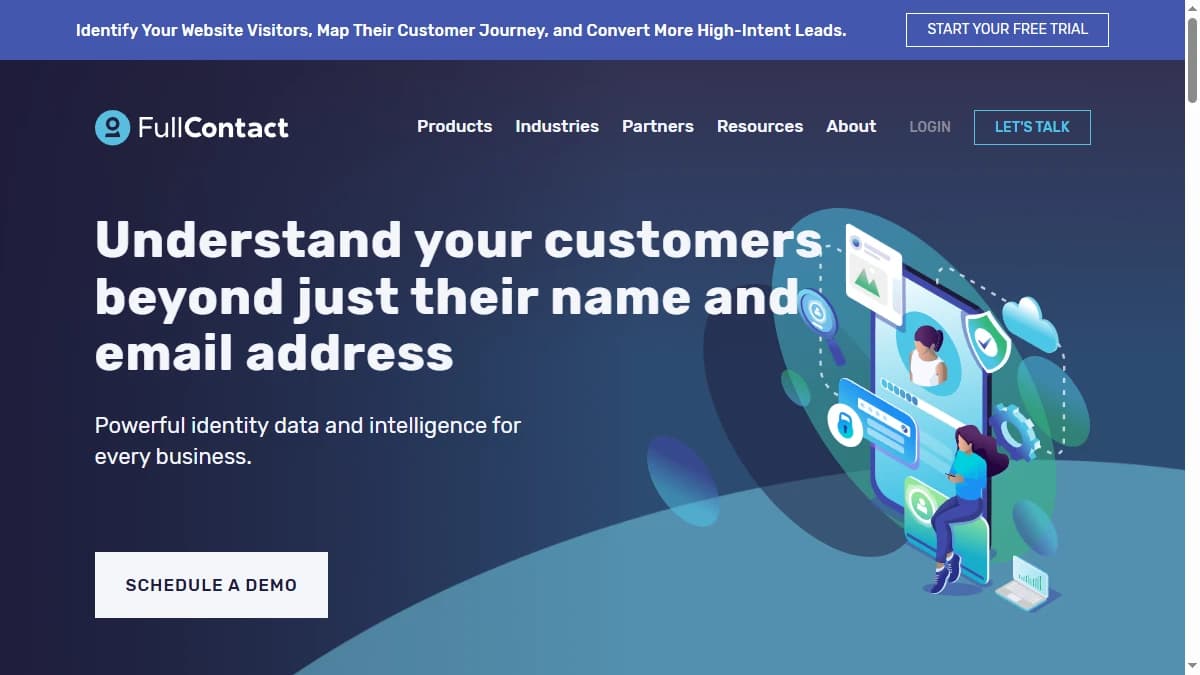
FullContact is an identity resolution company, not a traditional data enrichment vendor. Its core product is the Identity Graph — a patented system that matches and merges fragmented identifiers into unified person profiles.
Here is what is included and what is missing:
| Feature | What's Included | Limitations |
|---|---|---|
| Identity Graph | 1B+ person profiles, 22M company profiles, 30M daily updates | Identity resolution only — no enrichment waterfall |
| Person Enrichment | Name, age, gender, city, country, job details from email | Single source — no fallback when data is missing |
| Privacy Compliance | CCPA and GDPR compliant, privacy-safe design | Privacy focus limits some data depth |
| API Access | REST API for developer integrations | API-only — no UI dashboard for non-technical users |
| CRM Integration | Custom via API | No native connectors — requires engineering to build |
The takeaway: FullContact does identity resolution well. But it is not a GTM platform. If you need enrichment plus signals plus CRM sync, you need additional tools on top of FullContact.
FullContact's Identity Graph: How It Works
FullContact's patented identity graph ingests identifiers from multiple channels — email addresses, phone numbers, social profiles, device IDs, mailing addresses — and links them to a single person record. The graph processes 30 million updates daily.
This is useful for marketing teams running cross-channel campaigns who need to deduplicate and unify audience data. If you have the same person with three different email addresses in three different systems, FullContact can resolve them into one profile.
What works well
The graph is genuinely large and well-maintained. 1B+ profiles with daily updates means resolution accuracy is high for US and Western European contacts. The privacy-safe design is a differentiator for companies that need CCPA and GDPR compliance baked into their data layer. You can explore their approach on the FullContact website.
The limitation: identity resolution is not enrichment
Resolving who someone is does not tell you when to contact them. FullContact tells you that john@company.com and john.doe@gmail.com are the same person. It does not tell you that John just raised a Series B or hired 15 SDRs or adopted a new CRM.
SyncGTM resolves identities as part of its enrichment process and adds the GTM context — buying signals, funding alerts, hiring velocity, tech stack changes — that tell your team when to reach out.
FullContact Data Quality: How Accurate Is It Really?
FullContact's Enrich API returns person-level data including name, age range, gender, location, job title, company, and social profiles. Accuracy is strong for US contacts with active digital footprints. Match rates drop for international contacts and people with minimal online presence.
The enrichment depth is moderate. You get demographic and firmographic basics, but not the detailed data points that tools like Cognism or Apollo.io provide — direct dials, verified work emails, or detailed technographics.
The single-source limitation
FullContact relies on its own identity graph. When it cannot resolve an identifier, there is no fallback. No secondary provider is queried. No waterfall logic fills the gap.
Waterfall enrichment queries multiple providers in sequence to maximize match rates. SyncGTM checks 20+ data sources automatically, achieving 85-95% match rates compared to single-source tools at 60-75%.
FullContact Pricing Breakdown
FullContact pricing is not fully transparent. Here is what we found:
- --Free tier: 1,000 API matches per month. No credit card required.
- --Starter ($99/mo): Higher match limits, basic enrichment, API access.
- --Enterprise (custom): Annual commitments starting at $1,200/year. Custom volumes and SLAs.
What you actually pay: a realistic scenario
A marketing team resolving 10,000 identities per month will quickly exceed the free tier. Enterprise pricing kicks in, and G2 reviewers report that pricing tiers are confusing and salespeople push larger packages than needed.
Hidden costs to watch
- Complex pricing tiers: Users report confusing tier structures that make budgeting difficult.
- Aggressive upselling: Salespeople push larger packages. Multiple reviews mention pressure to upgrade.
- Per-match scaling: Costs scale unpredictably as match volume increases.
What Are the Downsides of Using FullContact?
The biggest downsides of FullContact in 2026 — as highlighted in FullContact reviews on G2 and Capterra — are the API-only design, missing buying signals, confusing pricing, and the gap between identity resolution and actionable GTM data.
No buying signals
FullContact resolves identities but does not track buying signals. No job change alerts. No funding round notifications. No hiring velocity data. No intent signals. You know who someone is but not when they are ready to buy.
API-first means engineering-dependent
There is no self-serve dashboard for sales or marketing teams. Every integration requires API development. If you do not have engineering resources, FullContact is inaccessible.
Opaque pricing
Users consistently flag pricing confusion. The tier structure is not straightforward, and enterprise contracts require a sales process. For a product that starts at $99/mo, the jump to enterprise pricing is steep and opaque.
No CRM automation
FullContact does not sync enriched data to your CRM automatically. You need to build custom pipelines via the API. Platforms like SyncGTM push enriched data directly into HubSpot, Salesforce, Pipedrive, Attio, and Zoho without any engineering work.
SyncGTM vs. FullContact: Feature-by-Feature Comparison
Here is how SyncGTM compares to FullContact across the features that matter most for GTM teams:
| Feature | SyncGTM | FullContact |
|---|---|---|
| Starting Price | $99/mo | $99/mo (API-only) |
| Data Sources | 20+ waterfall providers | Single identity graph |
| Buying Signals | Job changes, funding, hiring, tech stack, intent | Not available |
| CRM Integration | Native sync on all plans | API-only — requires engineering |
| Waterfall Enrichment | Built-in across 20+ sources | Not available |
| Self-Serve Access | Yes — sign up and start | API-first — needs developer setup |
Waterfall Enrichment
SyncGTM queries 20+ data providers in sequence. If one source misses, the next one picks up. Match rates reach 85-95% vs. FullContact's single-source 60-75%.
Multi-Signal Monitoring
Job changes, funding rounds, hiring velocity, tech stack shifts — SyncGTM monitors all buying signals in one dashboard. FullContact tracks none.
CRM Sync on Every Plan
HubSpot, Salesforce, Pipedrive, Attio, Zoho — SyncGTM connects to your CRM on every paid plan. No API development required.
Transparent Pricing
SyncGTM starts at $99/mo with no confusing tiers, no aggressive upselling, and no per-match surprises.
Is FullContact Worth It?
FullContact is worth it for teams that specifically need identity resolution — matching fragmented data across channels into unified profiles. The privacy-safe design and 1B+ profile graph are genuine strengths for marketing data teams.
FullContact is not worth it for GTM teams that need enrichment, buying signals, and CRM automation. The API-first design requires engineering. The pricing is opaque. And identity resolution alone does not tell you when a prospect is ready to buy.
The verdict: good identity resolution, but identity resolution alone does not drive pipeline in 2026. If you want enrichment that works with your stack, covers multiple buying signals, and scales without engineering overhead, look at multi-signal alternatives.