

Cognism Review 2026: Pricing and Data Quality and Real User Feedback

By Kushal Magar · March 16, 2026 · 14 min read · Last updated: September 30, 2026
Cognism is a GDPR-compliant B2B data provider with phone-verified mobile numbers (Diamond Data) that deliver 2-3x higher connect rates for European contacts. It is the best option for cold calling teams selling into the UK and EMEA. However, pricing reportedly starts at $15,000/year with no published rates, data accuracy drops outside Europe, buying signals and intent data are reserved for the Pro plan, and there are no built-in outreach tools. Our rating: 3.6/5.
You are probably here because your team is evaluating Cognism for prospecting and you want to know what the tool actually delivers before committing to a five-figure annual contract. We analyzed 500+ G2 reviews, pulled real pricing data from user reports, and tested the platform against our own prospect lists.
The short version: Cognism's Diamond Data is genuinely excellent for reaching decision-makers in Europe by phone. The GDPR compliance infrastructure is real, not marketing fluff. If your entire pipeline is UK and EMEA cold calls, Cognism delivers.
The longer version: Cognism is built around contact data. The signals that tell you when a company is ready to buy (hiring, funding and M&A, job changes) and its Bombora intent data only come with the Pro plan, intent is capped at 12 topics, and there is no built-in outreach. You get accurate phone numbers, but timing and execution depend on your plan and the rest of your stack. At a reported $15,000+ per year, those gaps matter.
This Cognism review covers exactly what we found: Diamond Data accuracy, real pricing math, data quality by region, how the workflow runs from search to CRM, and how its intent data stacks up against dedicated buying intent data tools.
Cognism Review: What You Get (and What You Don't)
Cognism is a B2B sales intelligence platform focused on contact data and compliance. The core value proposition is simple: accurate phone numbers for European prospects, verified by actual humans, with built-in GDPR and DNC list screening. It is built for SDR teams that run outbound cold calling campaigns.
The target user is a sales leader or SDR manager at a company selling into Europe who needs a reliable way to reach prospects by phone. Here is what is actually included and where the gaps show up.
| Feature | What's Included | Limitations |
|---|---|---|
| Diamond Data | Phone-verified mobile numbers with 98% accuracy claim. Human operators call each number before adding it to the dataset. | Concentrated on senior executives and UK contacts. Individual contributors and niche industries have lower coverage. |
| Contact Database | 400M+ contacts with business emails, mobile numbers, and work history. GDPR-screened against 15+ country DNC lists. | Accuracy drops outside EMEA. US mid-market and APAC coverage is limited compared to ZoomInfo or Apollo. |
| Intent Data | Bombora Company Surge intent data (up to 12 topics) on the Pro plan, plus hiring, funding/M&A, and job-change signals. | Not included on Standard. No tech stack change alerts listed, and 12 topics is a tight cap for multi-product companies. |
| Chrome Extension | Works on LinkedIn, Sales Navigator, and company websites. One-click contact reveal. | Limited to individual lookups. No bulk enrichment from the extension. |
| CRM Integrations | Salesforce, HubSpot, Microsoft Dynamics, Pipedrive, Outreach. | Core integrations push contacts on export. Automatic CRM enrichment is a separate add-on. |
| Outreach Tools | None. Cognism is a data-only platform. | You need Outreach, Salesloft, or another tool for sequencing. |
Cognism Diamond Data: Are Verified Mobiles Worth It?
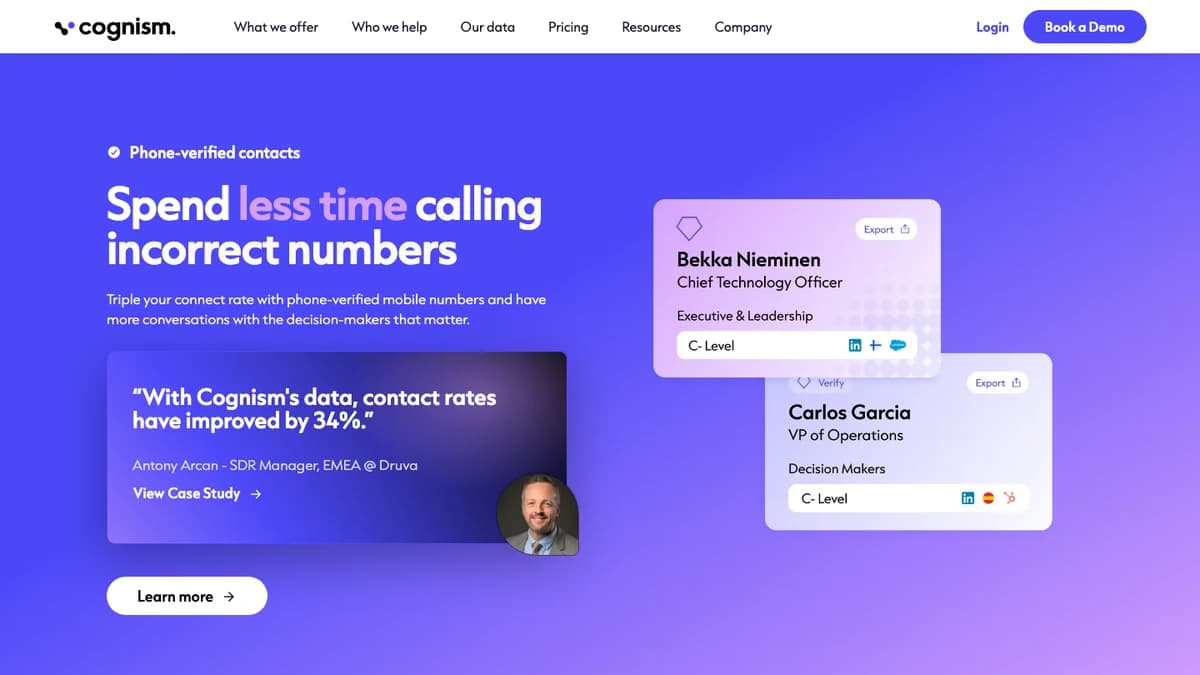
Diamond Data is the feature that justifies Cognism's premium pricing. The concept is straightforward: Cognism employs human operators who physically call each mobile number before adding it to the verified dataset. The result is a smaller but significantly more accurate pool of phone numbers.
Users consistently report connect rates 2-3x higher than standard databases when using Diamond Data numbers. For cold calling teams where every dial costs time and money, that accuracy premium is real. G2 reviewers rate Cognism 4.6/5 across 500+ reviews, and Diamond Data is the most frequently cited reason.
Cognism Diamond Data — phone-verified mobile numbers for cold calling teams
Where Diamond Data falls short
The 98% accuracy claim applies specifically to Diamond-verified numbers, not the entire database. An independent test found that 62.5% of Cognism's overall mobile numbers, direct dials, and landlines were incomplete. The gap between Diamond Data and the rest of the database is significant.
Diamond-verified numbers are also concentrated on senior executives and UK contacts. If you are targeting individual contributors, mid-level managers, or prospects in niche industries outside the UK, the verified coverage drops. Several Capterra reviewers note that Diamonds on Demand (requesting verification for specific contacts) is slow and does not always deliver.
Cognism Data Quality: How Accurate Is It Really?
Data quality is where the Cognism review gets complicated. The answer depends entirely on your geography and target persona.
Strong: UK and EMEA contacts
For UK and Western European contacts, Cognism's data is genuinely top-tier. Users report email accuracy rates above 90% and mobile connect rates 2-3x higher than competitors. The GDPR compliance infrastructure (screening against 15+ country do-not-call lists) is not just a checkbox feature — it is a meaningful differentiator for companies that face regulatory risk.
Weak: US mid-market and APAC
Multiple G2 and Capterra reviews flag data gaps for US mid-market companies and APAC regions. Coverage for North America exists but is not as deep as ZoomInfo or Apollo. For Asia-Pacific, users report limited records and lower accuracy on the contacts that do exist. If your team sells globally, Cognism alone will not cover all your markets.
Cognism product interface — contact search and company intelligence
Data freshness: the gap most reviews skip
Few Cognism reviews discuss update frequency. Cognism says its decision-maker data is refreshed every 30 days, and its CRM enrichment only spends credits again when key details change, such as a job move. Even so, user reports suggest stale records are a recurring issue — especially for fast-moving industries where people change roles every 12-18 months.
Cognism Pricing: What You Actually Pay
Cognism does not publish pricing on its website. As of September 2026, its pricing page lists two plans, Standard and Pro, each with 5 seats included. You must request a custom quote by booking a demo call. Based on user reports from G2, Capterra, and review sites, here is what each plan includes and what teams report paying.
Usage runs on credits: 1 credit reveals one contact, viewing a contact you already revealed is free, and the same credits work across the prospecting platform, Enrich, and the API. User reports from earlier contracts describe a platform fee plus per-seat costs, with annual contracts paid upfront and no monthly billing option.
- Standard: 5 seats included. Contact and company data, emails, mobiles, job titles, work history, technology usage, AI company research, MCP and API access, CSV enrichment, and SSO, with live chat support. CRM enrichment is available as an add-on.
- Pro: 5 seats included. Everything in Standard plus a premium mobile filter, mobile verification on demand, contextual signals (hiring, funding/M&A, and job changes), Bombora intent data (up to 12 topics), an AI persona builder, AI search, and account manager support.
- Reported costs: under the earlier Grow and Elevate plan names, users reported a ~$15,000/year platform fee + ~$1,500/user/year (Grow) and a ~$25,000/year platform fee + ~$2,500/user/year (Elevate). Treat these as benchmarks, not a quote.
- Extra intent topics: users have reported paying $200-$400 per additional topic per year.
- Onboarding fee: $500-$1,500 depending on integration complexity.
- Fair-use limits: Approximately 2,000 records per user per month. Exports over 25 contacts consume credits with potential caps.

Cognism pricing page — custom quotes required for all plans
What a 5-person SDR team actually pays
Using the user-reported Elevate figures, a team of 5 SDRs with 10 add-on intent topics paid roughly: $25,000 platform fee + $12,500 in seat costs + $3,000 in intent topic add-ons + $1,000 onboarding = $41,500 in year one. That is $8,300 per SDR per year, or $692 per SDR per month — for a tool that gives you data but no outreach capabilities. Current plans include 5 seats and up to 12 intent topics on Pro, so your quote may be structured differently; use this math as a benchmark when you negotiate.
Cognism contract traps to watch for
Contracts auto-renew unless you provide written notice 60 days before the renewal date. Expect 10-15% annual price increases at renewal without negotiation. According to benchmarking data, discounts of 28-52% off the initial quote are standard. Never accept the first number your rep gives you.
Cognism Intent Signals: What Is Covered (and What Is Not)
Cognism offers intent data through its Bombora partnership, using Company Surge data, on the Pro plan. Admins can select up to 12 intent topics from a library of 11,000+. As of September 2026, Pro also adds contextual signals for hiring, funding and M&A, and job changes.
This is where the Cognism review gets critical. Bombora intent data tells you which companies are researching specific topics, and the contextual signals cover the most common reasons to reach out. The gaps are in access and depth, not in the signal list itself.
What Cognism signals miss
Signals are a Pro feature. Standard buyers get technology usage data but none of the contextual signals or intent data, so the lower tier leaves timing entirely up to your team.
Tech stack changes are not listed as a signal. Technology usage shows what a company runs today, but the pricing page does not list alerts for when a prospect adds or drops a tool, such as a switch from Salesforce to HubSpot.
Intent is capped at 12 topics. With a library of 11,000+ topics, choosing 12 forces trade-offs for companies with several product lines or buyer personas.
If signals are central to your outbound motion, get the Pro plan quoted and compare it with dedicated buying intent data tools before you sign.
Cognism Integrations: CRM, Outreach, and Beyond
Cognism integrates with the major CRM and outreach platforms: Salesforce, HubSpot, Microsoft Dynamics, Pipedrive, and Outreach. The Chrome extension works with LinkedIn and Sales Navigator for individual contact lookups. These integrations are well-reviewed and generally reliable.
Does Cognism integrate with HubSpot?
Yes. Cognism has a native HubSpot integration that lets you push contacts directly into your CRM. You can map Cognism fields to HubSpot properties and create contacts or update existing records. Automatic enrichment of records already in HubSpot is sold separately, as covered below.
The integration gap: push vs. auto-enrichment
Cognism's core integrations are push-based. You find contacts in Cognism, then export them to your CRM. Auto-enrichment, where existing CRM records are updated as data changes, is a separate CRM Enrichment product that Cognism sells standalone or as an add-on, and it only spends credits again when key details change, such as a job move. Budget for it if keeping existing records fresh matters as much as finding new ones. For how other vendors handle this, see our roundup of the best CRM data enrichment tools.
What Are the Downsides of Using Cognism?
Every tool has trade-offs. Here are the ones that show up repeatedly in user reviews and our own testing.
- Pricing starts at $15,000/year with no monthly option. Custom quotes mean you cannot compare costs without sitting through a sales call.
- Data accuracy drops outside Europe. Users report incomplete records for US mid-market companies and poor coverage in APAC and Asia.
- Buying signals and intent data are locked to the Pro plan. Standard buyers get technology usage data but no hiring, funding, or job-change signals, and Pro caps intent at 12 Bombora topics.
- Diamond Data is concentrated on senior executives and UK contacts. Verified mobiles for individual contributors or prospects in niche industries are harder to find.
- It is a data-only platform. No built-in sequencer, no outreach automation. You still need Outreach, Salesloft, or another tool to actually reach prospects.
- An independent test found 62.5% of mobile numbers, direct dials, and landlines were incomplete. The 98% accuracy claim applies to Diamond-verified numbers only, not the full database.
Cognism pricing complaints from real users
Pricing is the single most cited complaint across G2 reviews. Users report that Cognism sales reps push annual contracts with no flexibility on billing terms. The custom pricing model means you cannot evaluate costs without sitting through a demo and negotiation. Multiple reviewers describe feeling locked into contracts that were hard to cancel.
On Trustpilot, the ratings tell a polarized story: 56% of 356 reviews give 5 stars, but 32% give just 1 star. The overall score is 3.2/5. Negative reviews cite poor data quality, GDPR concerns about personal numbers being sold without consent, and unresponsive support when issues arise. One reviewer noted getting calls on a TPS-registered number from contacts sourced through Cognism.
Data-only platform: no execution layer
Cognism gives you contacts but no way to reach them. You still need a separate outreach tool (Outreach, Salesloft, Instantly, Lemlist) to build sequences, send emails, or manage follow-ups. For a $15,000+/year tool, the absence of any execution capability is a significant gap. By comparison, platforms like Apollo.io include built-in sequencing.
How Cognism Works: From Search to First Dial
Once the contract is signed, Cognism's workflow is simple. Here is how a typical SDR team uses it, and where plan limits show up along the way.
- Build a target list. Search contacts and companies by firmographics, job title, and technology usage. Pro adds AI search, an AI persona builder, and a premium mobile filter.
- Reveal contacts with credits. One credit reveals one contact. Viewing a contact you already revealed is free, and the same credits work in the web platform, Enrich, and the API.
- Prospect from LinkedIn. The Chrome extension reveals emails and mobiles on LinkedIn, Sales Navigator, and company websites, one contact at a time.
- Verify the numbers that matter. Diamond Data covers phone-verified mobiles. On Pro, mobile verification on demand lets you request checks for specific contacts, though Capterra reviewers say turnaround can be slow.
- Push to your CRM and sequencer. Export to Salesforce, HubSpot, Pipedrive, and other connected tools, then build sequences in your outreach platform. Cognism does not send emails or run cadences itself.
- Keep records fresh. CSV enrichment is included. Ongoing CRM enrichment is an add-on that only spends credits again when key details change, such as a job move.
- Prioritize with signals (Pro only). Hiring, funding/M&A, and job-change signals, plus up to 12 Bombora intent topics, help decide which accounts to call first.
Two things decide whether this workflow pays off. The first is volume: users report fair-use limits of roughly 2,000 records per user per month, so size your lists and territories around that before you negotiate seats. The second is plan choice: nearly all of the timing features, including signals and intent data, sit on Pro. If your team will not act on them, Standard may be enough. If you will, get Pro quoted from the start rather than upgrading mid-contract.
Both plans also include MCP and API access, which lets technical teams pull Cognism data into custom workflows or AI assistants without exporting CSVs. It is a useful option for RevOps teams, but the day-to-day value for SDRs still comes from the search, reveal, and dial loop above.
Is Cognism Worth It?
Cognism is worth it if you run a European-focused SDR team that lives on cold calling. Diamond Data delivers verified mobile numbers that connect more often than any other platform we have tested. The GDPR compliance is thorough, the Chrome extension is fast, and the CRM integrations work. For UK and EMEA cold calling, Cognism is the market leader. If you need a similar GDPR-compliant tool with a lower price point, Lusha is worth comparing.
Cognism is not worth it if you need more than contact data at a mid-market price. If your team sells globally, needs buying signals without paying for the Pro tier, wants built-in sequencing, or cannot justify a $15,000+ annual contract for a data-only tool — you should look elsewhere. Teams that need custom enrichment workflows often gravitate toward Clay, while those wanting a broader comparison can see our best CRM data enrichment tools roundup. Outside Europe, the geographic reach is too uneven, and the price is high for what is mainly a contacts database.
Our verdict: Cognism excels in a specific lane: compliant, phone-verified European data for teams that dial. If that is your motion, it earns its price. If it is not, you are paying a premium for strengths you will not use.
If Cognism's uneven coverage outside Europe is a dealbreaker, SyncGTM is one alternative worth a look: it runs waterfall enrichment across 50+ data providers for verified emails, phone numbers, and firmographics.