

People Data Labs 2026: Developer-First Enrichment Reviewed (Pricing and Coverage)

By Kushal Magar · March 16, 2026 · 13 min read · Last updated: September 30, 2026
You are probably here because your engineering team recommended People Data Labs and your revenue team wants to know if it actually works for sales and marketing — not just for data science projects. Fair question.
This People Data Labs review answers it directly. People Data Labs (PDL) is a B2B data provider that gives developers API access to 3B+ person records, 100M+ company profiles, resume data, and IP-to-company mapping. The documentation is excellent. The API is clean. The data is broad. It earns a 4.3-star rating on G2 and developers genuinely like it.
But the People Data Labs that works for a data engineer building an enrichment pipeline is not the same product for an SDR team trying to fill a CRM with verified contacts. There is no dashboard. No CRM integration. No intent signals. No outreach automation. This review covers both sides so you can decide whether PDL fits your team — or whether a no-code enrichment platform gets you further without the engineering overhead.
People Data Labs Review: What You Get (and What You Don't)
People Data Labs is an API-first B2B data provider. It sells raw data through REST APIs and bulk downloads. The product is designed for developers, data engineers, and data scientists who want to build enrichment, identity resolution, or audience-building pipelines on top of a massive person and company dataset.
Here is a quick-reference table of what is included and where the gaps are:
| Feature | What's Included | Limitations |
|---|---|---|
| Person Enrichment API | 3B+ person records with emails, phones, social profiles, job titles | Cached data updated monthly; no freshness guarantee |
| Company Enrichment API | 100M+ company profiles with firmographics and technographics | Smaller company coverage is thinner than enterprise |
| Resume Data | Education history, skills, certifications, work history | Available on all plans but consumes additional fields |
| Person Search API | SQL-like query builder across the full person dataset | Rate-limited; throttle on queries per minute |
| IP Enrichment | Map IP addresses to companies for website visitor identification | Company-level only; no individual identification |
| CRM Integration | None natively | Requires custom development or third-party middleware |
| Intent / Signal Data | None | No hiring signals, funding alerts, or buying intent |
The takeaway: People Data Labs gives you a massive raw dataset through a well-documented API. But every feature that turns raw data into pipeline — CRM sync, intent signals, outreach triggers, dashboards — is missing. You build those yourself or you look elsewhere.
People Data Labs Data Coverage: 3B+ Records Explained
People Data Labs claims 3B+ person records across 200+ countries. That number is real, but context matters. The 3B figure includes historical records, duplicate entries across data sources, and profiles with minimal information. The number of actionable, current records with verified contact details is considerably smaller.
Where People Data Labs data is strong
North American tech workers are well covered. If your ICP is software engineers, product managers, or technical leaders at US companies with 50+ employees, PDL will return rich profiles with emails, phone numbers, social URLs, and detailed work history. The resume data — education, skills, certifications — adds depth that most competitors do not offer.
Where the data falls short
Coverage drops for non-technical roles, non-English-speaking regions, and smaller companies. Alternative providers like Coresignal offer fresher data for some segments through real-time web scraping. Multiple G2 reviewers report that PDL's data "trusts LinkedIn too much" and includes profiles where job titles do not match reality. One reviewer found cases where random LinkedIn profiles claimed to be a company's CEO with no corroboration from other public sources.
Data freshness: the monthly batch problem
When you call the People Data Labs API, you are querying a database of pre-crawled, cached data. PDL updates its dataset monthly by default. That means the profile you pull today could reflect a job someone left three weeks ago. For teams running time-sensitive outbound campaigns, stale job titles and departed employees waste credits and damage sender reputation.
This is the core limitation of a single-source cached model. Tools that use waterfall enrichment query several providers per lookup, so a stale record in one source can be caught by a second or third.
People Data Labs API: The Developer Experience
The API is People Data Labs' best feature and the reason engineers recommend it. The documentation is thorough, well-organized, and includes working code samples in Python, Node.js, Ruby, Go, and cURL. Authentication is straightforward — a single API key in the header. Response payloads are clean JSON with predictable field structures.
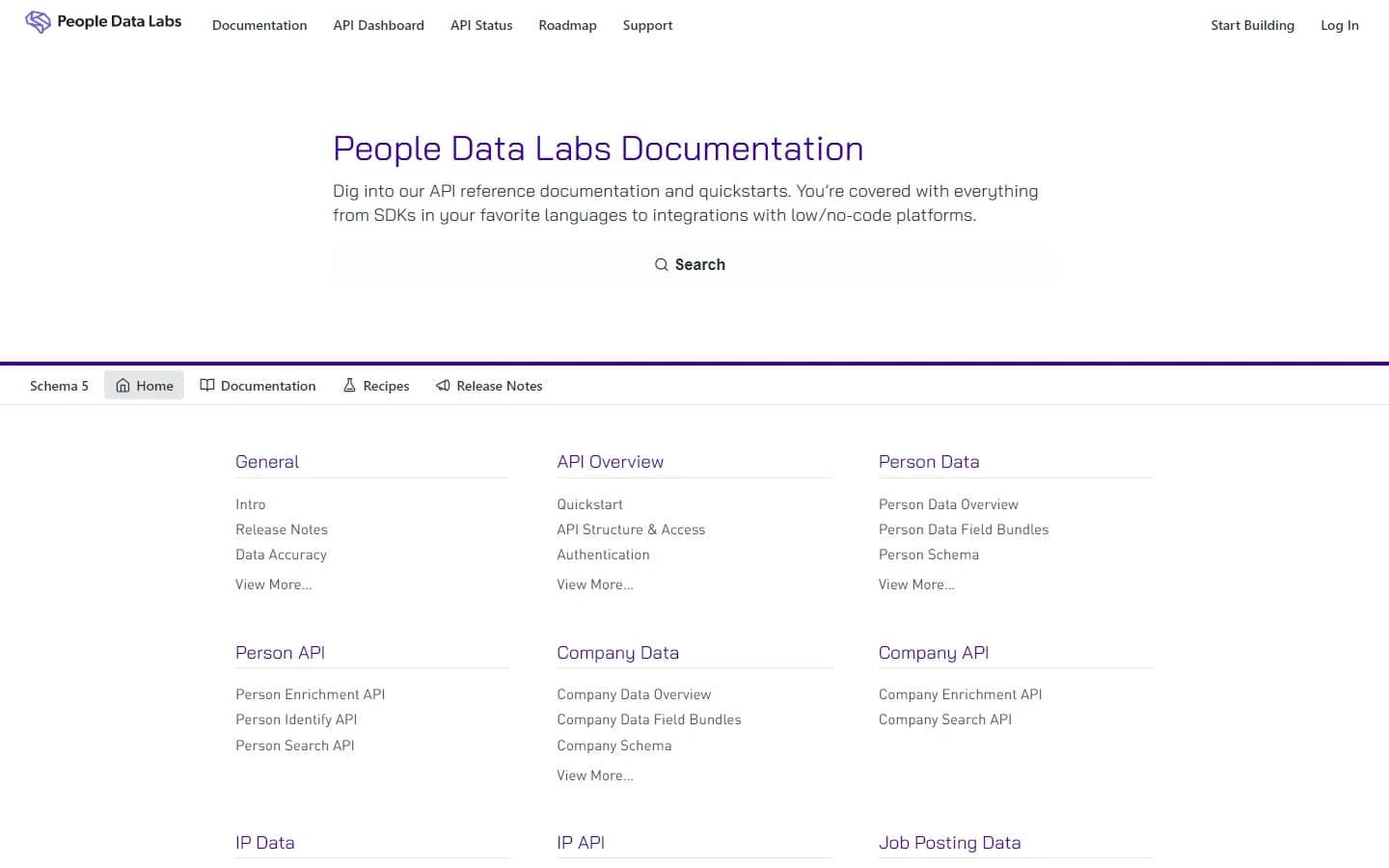
People Data Labs developer documentation — March 2026
What developers like about the PDL API
- Clean RESTful design with consistent endpoint patterns across Person, Company, and IP APIs
- SQL-like Person Search API lets you query the full dataset with boolean filters
- SDKs in Python and Node.js reduce boilerplate
- Sandbox mode with free credits for testing before committing to a paid plan
- ISO 27001 and SOC 2 Type 2 compliance for security-conscious teams
The developer-only problem
The same thing that makes PDL great for engineers makes it unusable for everyone else. There is no web dashboard for browsing or searching contacts. There is no CSV upload and enrich flow. There is no drag-and-drop workflow builder. If your sales ops manager or marketing lead wants to enrich a list, they need to open a ticket with engineering and wait.
For teams where the GTM org operates independently from engineering — which is most B2B startups and mid-market companies — this is a dealbreaker. You cannot ship outbound campaigns while waiting for a developer to build and maintain a custom enrichment pipeline. That is the fundamental gap no-code enrichment platforms exist to fill.
Resume Data: The Feature Most Reviews Skip
People Data Labs includes resume-level data in its person records — education history, skills, certifications, languages, and complete work history with dates. Most competing data providers stop at current job title and company. PDL goes deeper.
This matters for specific use cases:
- Recruiting and talent intelligence: Search for candidates by skill set, degree, or past employer without paying for a dedicated ATS data add-on
- Account-based marketing: Identify prospects who previously worked at a customer company and already know your product
- Identity resolution: Match partial records across systems using education and work history as additional signals
- Competitive intelligence: Track where employees are leaving and joining to spot market shifts
The resume data is a genuine differentiator. ZoomInfo, Apollo, Cognism, and Lusha do not offer comparable depth on education and skills. If your use case depends on career trajectory data, PDL is the strongest option in the market.
The caveat: resume data quality depends on public profile completeness. If a person has a sparse LinkedIn profile or no public presence, PDL's resume fields will be empty. Coverage is strongest for tech workers in the US who maintain detailed online profiles.
People Data Labs Pricing: What You Actually Pay
People Data Labs pricing is transparent compared to competitors like ZoomInfo and Cognism. They publish plan details on their website. Here is the breakdown as of March 2026:
- –Free ($0/mo): 100 person/company lookups per month, 25 IP lookups. Always free. Good for testing the API before committing. ISO and SOC 2 Type 2 compliant data included.
- –Pro ($98/mo or $940/yr): 350 person enrichment credits and 1,000 company lookups per month. Access to premium fields. Email support. The annual plan saves 20%. Per-credit cost: $0.28 on monthly billing.
- –Enterprise (custom pricing): Custom volume requirements. Bulk data licensing. Formal data testing. Dedicated success team. SSO/SAML. Flexible payment terms. API or data license feeds. Estimated starting point around $2,500/mo based on user reports.
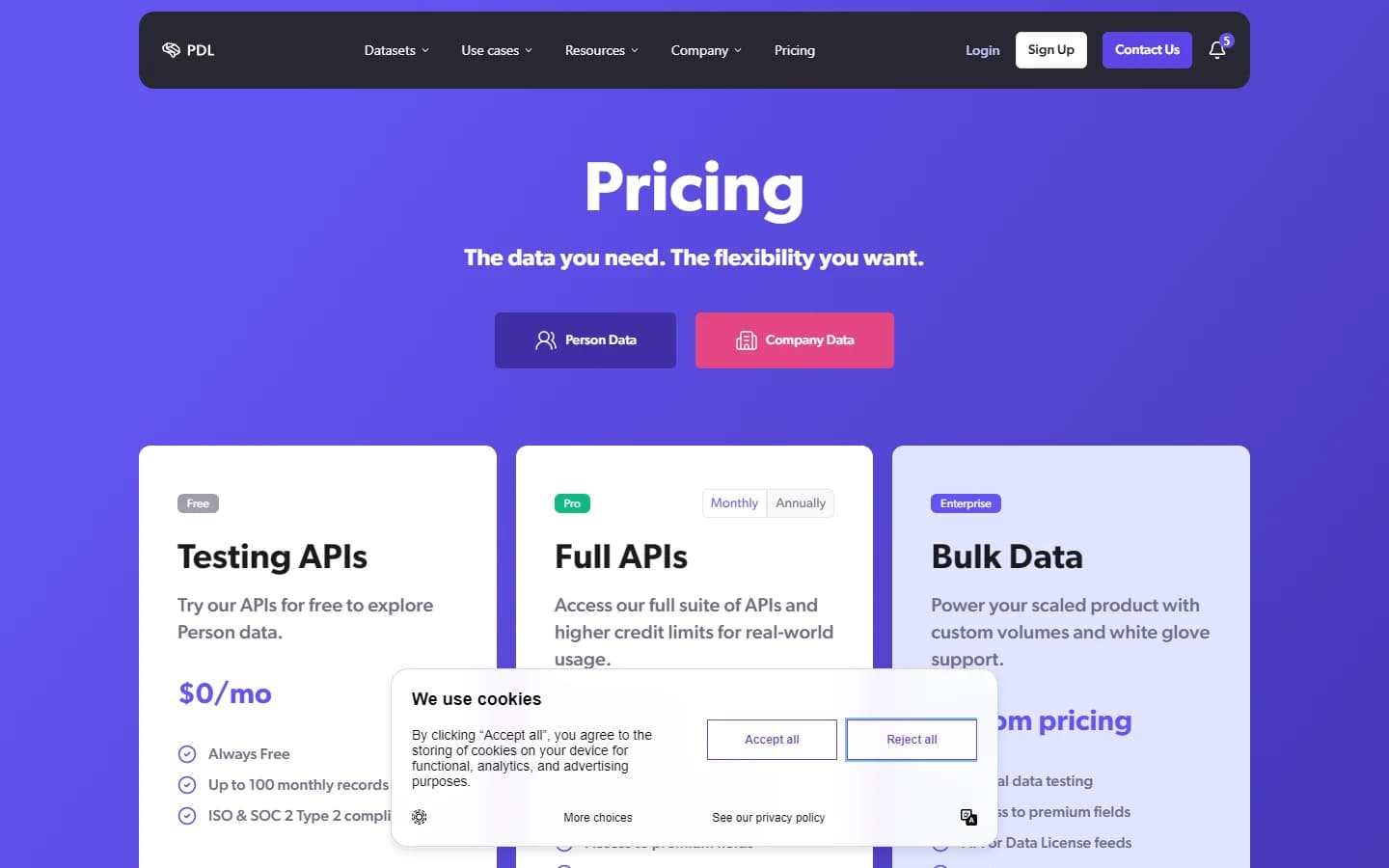
People Data Labs pricing page — March 2026
What you actually pay: a real scenario
A startup with 2 SDRs running outbound prospecting needs to enrich 500 contacts per month:
- Pro plan gives 350 person credits/mo — not enough for 500 lookups
- You need to buy additional credits or negotiate a custom plan
- At $0.28 per credit, 500 lookups = $140/mo minimum (if you add overage credits)
- Realistically, teams doing meaningful outbound spend $200–$500/mo on PDL credits
- Plus you still need a developer to build the pipeline, maintain it, and connect it to your CRM
- Engineering time at $75–$150/hr adds $2,000–$5,000+ in hidden setup costs
Hidden costs to watch
- Per-credit pricing adds up fast: At $0.28 per person lookup, enriching a 10,000-record list costs $2,800 before any volume discount.
- Engineering time is not free: PDL has no UI. Building the enrichment workflow, error handling, CRM connector, and data mapping costs engineering sprints that never appear on the PDL invoice.
- Credits consumed on empty responses: Successful API requests consume one credit even if the returned data is sparse. You pay $0.28 for a record that might only have a name and LinkedIn URL.
- No credit rollover on the Pro plan: Unused monthly credits do not accumulate. If you do not use your 350 credits in a given month, they expire.
What Are the Downsides of Using People Data Labs?
People Data Labs' biggest downsides are its developer-only access model, monthly cached data that introduces freshness risk, per-credit pricing that scales poorly for high-volume teams, rate-limited search queries, and zero native CRM or workflow integrations.
No dashboard, no UI, no self-serve for revenue teams
People Data Labs has no web interface for non-technical users. There is no search bar. No list management. No export button. Every interaction with the product requires API calls. If your sales manager asks "can I look up a prospect?" the answer is "ask engineering to build you something." For revenue teams used to tools like Apollo, ZoomInfo, or modern prospecting platforms, this is a non-starter.
Data freshness is a recurring complaint
PDL updates its dataset monthly from aggregated sources. That means you can pull a contact today and discover they left that company two weeks ago. Multiple Trustpilot and G2 reviewers flag data staleness as a top concern. The platform includes a "job_last_updated" timestamp, which helps, but it does not solve the underlying issue: you are querying a cache, not a live source.
Rate limiting slows bulk operations
The Person Search API has a throttle limit on queries per minute. If you are building a pipeline that needs to process thousands of records in batch, rate limiting forces you to add retry logic, queue management, and sleep intervals. It works, but it adds complexity to what should be a simple enrichment workflow. G2 reviewers call this "a little prohibitive" for high-volume use cases.
No CRM integration means manual data movement
PDL does not integrate with HubSpot, Salesforce, Pipedrive, or any CRM. There is no Zapier connector maintained by PDL. If you want enriched data in your CRM, you build the integration yourself or pay for a middleware layer. Every manual step in the data pipeline introduces errors, delays, and maintenance overhead.
Account management concerns
One Trustpilot reviewer reported having their paid account disabled days after upgrading to a $100/month plan, with no explanation and unresponsive support. While this appears to be an isolated case, it highlights a risk for teams relying on PDL as a critical infrastructure dependency without a dedicated account manager (which requires Enterprise pricing).
How to Use People Data Labs: From API Key to Enriched Records
Because People Data Labs has no enrichment dashboard, the order of operations lives in code. Here is how a typical integration comes together, and where credits and rate limits show up along the way.
- Start on the free plan. Create an API key and use the 100 free monthly person or company lookups (plus 25 IP lookups) and sandbox mode to test response shapes before paying.
- Match known contacts first. Send the Person Enrichment API whatever identifiers you have, such as an email, a LinkedIn URL, or a name plus company, and set a minimum likelihood so low-confidence matches are rejected rather than accepted as good data.
- Batch the backlog. The Bulk Person Enrichment API enriches multiple profiles in a single request, which is the practical way to process an existing CRM export.
- Discover net-new records. The Person Search API takes SQL-like queries across the full dataset, such as title, seniority, location, and past employers. It is rate-limited per minute, so large pulls need queuing and retry logic.
- Add company and IP context. The Company Enrichment API returns firmographics and technographics, and IP Enrichment maps website traffic to companies for account-level visitor identification.
- Filter for freshness and write back. Check the job_last_updated timestamp before trusting a title, verify emails before sending, then map fields into your CRM yourself, since PDL has no native CRM connector.
Budget credits around matches, not rows. Every successful request consumes a credit even when the returned record is sparse, and unused Pro credits do not roll over, so dedupe inputs and set sensible likelihood thresholds before running large jobs. Teams that do this well get a flexible, well-documented data layer; teams that skip it pay for thin records and stale titles.
Is People Data Labs Worth It?
People Data Labs is worth it for engineering teams and data scientists who need raw B2B person data through a clean API. The documentation is excellent, the data breadth is massive, the resume data is a genuine differentiator, and the free tier lets you test before committing. If you are building a custom enrichment pipeline, identity resolution system, or talent intelligence product, PDL is one of the best raw data sources available.
People Data Labs is not worth it for revenue teams — SDRs, sales ops, marketing ops, growth teams — who need enrichment that flows into a CRM, triggers based on buying signals, or outbound sequences that fire automatically. PDL has no dashboard, no CRM connector, no signal monitoring, and no workflow automation. Tools like Clearbit at least offer native CRM enrichment (though only for HubSpot). You need a developer to do anything with PDL's data, and every hour of engineering time is a hidden cost that PDL's $98/mo price tag does not reflect.
The verdict: People Data Labs is the best raw data API for developers in the B2B space. The problem is that most teams searching for "People Data Labs review" are not developers — they are revenue leaders trying to solve an enrichment problem without building custom infrastructure. For those teams, a no-code enrichment tool with native CRM integrations will get results faster than a custom pipeline built on PDL's API.
If needing a developer to get People Data Labs data into your CRM is a dealbreaker, SyncGTM is one alternative worth a look: it pairs waterfall enrichment across 50+ data providers with native HubSpot, Salesforce, and Pipedrive integrations.