5 Best Import.io Alternatives for B2B Enrichment in 2026

By Kushal Magar · June 9, 2026 · 12 min read
Key Takeaway
Import.io was a web data extraction platform that turned pages into structured datasets, then pivoted to B2B intent data under Cyance — leaving its scraping users looking for a replacement. For B2B prospecting you need a tool that sources, enriches, and verifies contacts, not just extracts rows. The 5 best Import.io alternatives in 2026 are: SyncGTM (waterfall enrichment across 50+ providers with buying signals and CRM sync from $99/mo), Clay (150+ provider waterfall plus web scraping and AI research from $185/mo), Bright Data (enterprise-grade web scraping with a 400M+ proxy network, pay-as-you-go), Octoparse (no-code visual web scraper from $99/mo), and Apify (developer scraping platform with a marketplace of ready-made Actors from $29/mo).
If you are searching for Import.io alternatives, you are not alone. Import.io built its name on no-code web data extraction — point it at a page, get a clean structured dataset — but the product pivoted to B2B intent data and was folded into Cyance, leaving its scraping and lead-data users without the tool they relied on.
That pivot is why this list exists. Teams that used Import.io to pull web data and build prospect lists now need a replacement, and the right one depends on what you were actually using it for.
For raw web scraping, there are strong dedicated platforms. For B2B prospecting, the better move is a tool that does not stop at the scraped row — one that sources, enriches, and verifies contacts so the output is leads you can email, not data you still have to clean. This guide covers five Import.io alternatives across both needs, starting with the strongest pick for revenue teams.
Quick Summary
The best Import.io alternatives in 2026 are SyncGTM, Clay, Bright Data, Octoparse, and Apify. SyncGTM is the top pick for most B2B teams — waterfall enrichment across 50+ providers, 76+ data points per lead, buying signal detection, and native CRM integrations from $99/mo with a free tier. Clay adds web scraping and AI research on top of a 150+ provider waterfall from $185/mo. Bright Data is the most powerful raw-scraping engine with a 400M+ proxy network. Octoparse is the cleanest no-code visual scraper. Apify is the best developer platform with a marketplace of ready-made scrapers.
TL;DR: Best Import.io Alternatives in 2026
- SyncGTM — Best overall for B2B. Waterfall enrichment across 50+ providers, 76+ data points, buying signals, and CRM sync from $99/mo with a free tier.
- Clay — Best for scraping plus enrichment. Web scraping and AI research on top of a 150+ provider waterfall from $185/mo.
- Bright Data — Best for large-scale scraping. 400M+ proxy network and pre-built Web Scraper APIs, pay-as-you-go.
- Octoparse — Best no-code scraper. Point-and-click visual extraction with scheduled cloud runs from $99/mo.
- Apify — Best developer platform. Marketplace of ready-made scraper Actors plus proxies from $29/mo.
Why B2B Teams Need Import.io Alternatives
Import.io was built to extract structured data from web pages. It was a capable scraper, but two things now push teams to look elsewhere: the product pivot, and the limits of raw extraction for B2B sales.
The product moved on. Import.io repositioned around B2B intent data under the Cyance brand, so the self-serve web extraction workflow many teams adopted is no longer the focus. If your scraping pipelines depended on it, you need a replacement that is actively built for extraction.
Scraping is not enrichment. Even at its best, Import.io extracted what was rendered on a page. Decision-maker emails and direct dials rarely sit in a public HTML table, so the data you actually need for outreach was never there. You left with company names and URLs, then started the real work of finding contacts elsewhere.
No verification, no outreach layer. A scraped dataset has no deliverability check and no path to a sent message. Every record still has to be enriched, verified, and loaded into a separate stack of tools before a rep can touch it.
According to a Gartner analysis of B2B data quality, B2B contact data decays at roughly 30% per year. A snapshot scraped from a page is already aging the moment you export it. Waterfall enrichment across multiple live providers is the only reliable way to keep hit rate high as that decay compounds.
According to G2's sales intelligence category data, teams that move from manual scraping to waterfall enrichment platforms report 35–50% higher email deliverability and spend 60% less time on manual data cleanup. The five Import.io alternatives below split into two camps: dedicated scrapers for raw web data, and enrichment platforms that turn data into outreach-ready leads.
1. SyncGTM
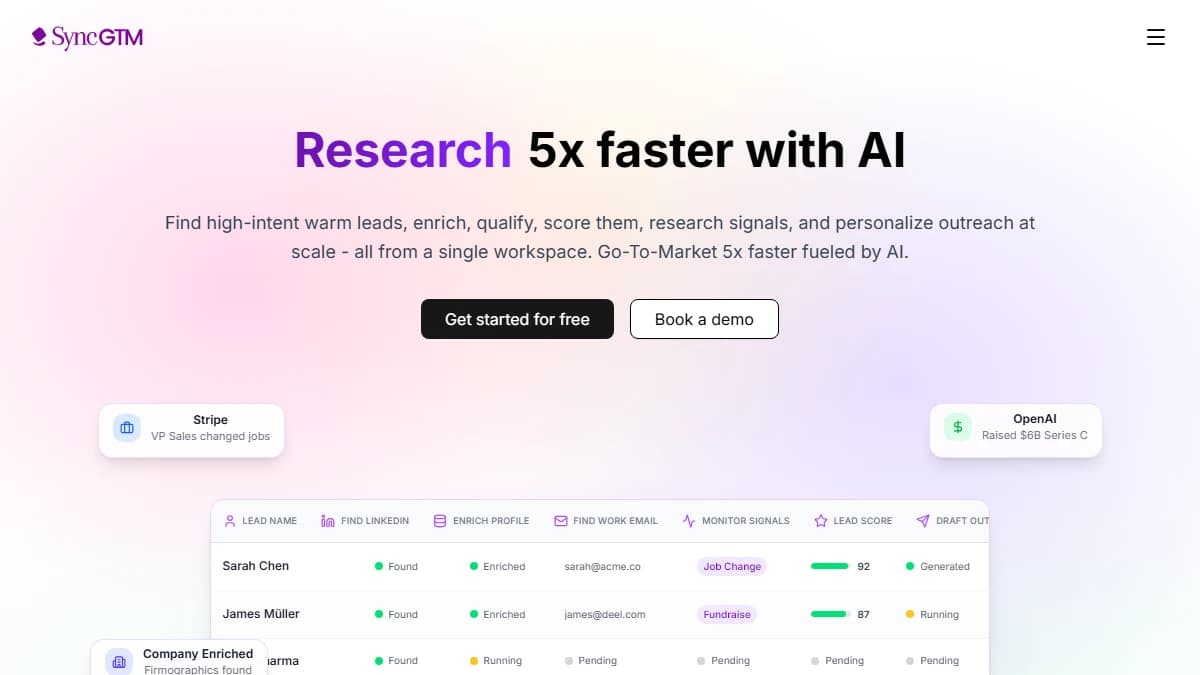
SyncGTM — waterfall enrichment across 50+ providers with buying signals and integrated outreach
SyncGTM is a B2B prospecting platform built around waterfall enrichment — querying 50+ data providers in sequence until verified contact data is found. Where Import.io extracted a row off a page, SyncGTM takes a name, company, or domain and returns a verified email, direct dial, and 76+ firmographic data points.
The difference in output is the whole point. Import.io gave you a dataset that still needed contacts found and verified. SyncGTM gives you CRM-ready leads with deliverable emails, plus buying signal detection and a built-in path into outreach — no separate enrichment or verification step required.
SyncGTM's waterfall approach delivers 20–40% higher contact coverage than any single data provider, including Apollo, ZoomInfo, or Lusha. For teams doing high-volume outbound, that coverage difference means more reachable contacts per list without scraping more pages. If you want the mechanics, see our explainer on how waterfall enrichment works.
Pros
- • Waterfall enrichment across 50+ providers — verified emails and phones, not raw scraped rows
- • 76+ data points per lead: verified email, direct dial, LinkedIn, firmographics, technographics
- • Buying signal detection to surface in-market accounts before competitors
- • Native CRM sync (HubSpot, Salesforce, Pipedrive, Attio, Zoho) — no Zapier required
- • AI research agents and AI web scraper for custom data beyond standard fields
- • Free tier with 200 credits/month and no credit card required
Cons
- • Starter plan at $99/mo is a higher entry point than a pure pay-as-you-go scraper
- • Not a general-purpose page scraper — if you only need raw web data, a dedicated tool like Bright Data fits better
Best for: B2B sales teams that need enriched, verified, CRM-ready leads at scale without building a multi-tool stack.
Pricing: Free tier (200 credits/mo). Starter $99/mo. Pro $249/mo. Business $649/mo. See full SyncGTM pricing.
2. Clay
Clay — web scraping and AI research on top of a 150+ provider waterfall
Clay is the closest like-for-like upgrade from Import.io. It includes web scraping and AI research agents to pull structured data from pages — then layers waterfall enrichment across 150+ providers on top, so a scraped company name becomes a full contact record with a verified email and firmographics.
The AI formula builder lets you write enrichment rules in plain language: "Scrape this directory, then try Apollo, then ZoomInfo, and stop when a verified email is found." No code. This is the workflow Import.io users ended up building by hand across several tools — Clay does it in one canvas.
According to Clay's pricing page, the Launch plan starts at $185/mo with 10,000 Actions and full marketplace access. The Growth plan at $495/mo adds CRM integrations, HTTP APIs, and 40,000 Actions per month.
Pros
- • Built-in web scraping plus 150+ provider waterfall — scrape and enrich in one place
- • AI research agents and AI formula builder for custom data without code
- • Only charges data credits when data is found — no wasted spend on failed lookups
- • Deepest provider coverage of any enrichment platform
- • Strong fit for agencies and GTM engineers building custom pipelines
Cons
- • Launch plan at $185/mo — higher entry price than the dedicated scrapers in this list
- • CRM integrations locked to Growth plan at $495/mo
- • Two separate credit types (Actions + Data Credits) adds billing complexity
- • Steeper learning curve than a point-and-click scraper
Best for: Growth teams and agencies that want to scrape data and enrich it in one place with custom logic.
Pricing: Free (100 Data Credits/mo). Launch $185/mo. Growth $495/mo. Enterprise custom.
3. Bright Data
Bright Data — enterprise web scraping with a 400M+ proxy network and pre-built Web Scraper APIs
Bright Data is the most powerful raw web scraping engine on this list. It pairs a 400M+ residential proxy network with pre-built Web Scraper APIs that handle IP rotation and CAPTCHA solving, so it can collect data from sites that block simpler scrapers — exactly the kind of resilient, high-volume extraction Import.io users with hard targets needed.
Beyond scraping tools, Bright Data sells ready-to-use datasets you can buy without writing a single line of code, plus a Scraping Browser for sites that require full automation. For pure data-collection scale and anti-bot resilience, nothing else here matches it.
The trade-off is the same as every dedicated scraper: it extracts web data, but it does not verify B2B emails or find direct dials. Bright Data runs on a pay-as-you-go model with a free trial. Its Web Scraper APIs start around $1.50 per 1,000 records, and residential proxy usage is billed per GB. For outreach-ready contacts you would pair it with an enrichment layer.
Pros
- • 400M+ residential proxy network — scrapes sites that block other tools
- • Pre-built Web Scraper APIs with automatic IP rotation and CAPTCHA handling
- • Ready-to-use datasets you can buy without coding
- • Pay-as-you-go pricing with a free trial — no fixed monthly minimum to start
- • Serves 20,000+ customers, with enterprise-grade compliance and scale
Cons
- • Raw extraction only — no verified B2B emails, phones, or firmographics
- • Usage-based billing can get expensive and hard to predict at high volume
- • Steeper setup than no-code tools; proxy and API concepts assume technical users
- • No native outreach or CRM layer — needs a separate enrichment and sequencing stack
Best for: Engineering and data teams running large-scale, anti-bot-resistant web scraping where coverage and reliability matter most.
Pricing: Pay-as-you-go with a free trial. Web Scraper APIs from ~$1.50/1,000 records; residential proxies billed per GB.
4. Octoparse
Octoparse — no-code, point-and-click visual web scraper with scheduled cloud extraction
Octoparse is the closest no-code match to what Import.io was known for. You click the elements you want on a page, Octoparse builds a scraping template, and it extracts the data into a structured table — no coding required. It handles pagination, infinite scroll, and scheduled cloud runs.
For teams that liked Import.io's visual, point-and-click approach, Octoparse is the most familiar swap. Pre-built templates for common sites get you running fast, and the cloud platform can run extractions on a schedule without keeping your machine on.
The limits are the usual ones for a pure scraper. It pulls whatever text is on a page but does not confirm an email is deliverable or find a mobile direct dial. Templates can also break quietly when a target site changes its HTML. The free plan covers up to 10 local tasks; the Standard plan starts at $99/mo for scheduled cloud extraction and higher concurrency. See our full Octoparse alternatives comparison for more.
Pros
- • True no-code, point-and-click scraping — the closest feel to Import.io
- • Pre-built templates for popular sites speed up setup
- • Scheduled cloud extraction runs without keeping your machine on
- • Handles pagination and infinite scroll out of the box
- • Free plan with up to 10 local scraping tasks
Cons
- • Scrapes only — no email verification, phone enrichment, or firmographics
- • Cloud runs, higher concurrency, and API export sit behind paid tiers
- • Desktop app is Windows-first, which frustrates Mac and Linux users
- • Templates break when a target site changes its layout
Best for: Non-technical teams that want Import.io's visual scraping experience for collecting public web data.
Pricing: Free (up to 10 local tasks). Standard $99/mo. Professional $249/mo. Enterprise custom.
5. Apify
Apify — developer scraping platform with a marketplace of ready-made Actors and built-in proxies
Apify is a developer-first web scraping and automation platform. Its core idea is the Actor — a serverless program that scrapes or automates a task. The Apify Store offers thousands of ready-made Actors for popular sites, so you can run a scraper without building one from scratch.
For Import.io users who want more flexibility than a point-and-click tool, Apify hits a middle ground: use a pre-built Actor for speed, or write your own with the SDK for full control. Built-in proxies, scheduling, and a generous API make it a strong fit for engineering teams.
Like the other scrapers here, Apify extracts data but does not verify B2B contacts. It runs on prepaid platform usage plus pay-as-you-go compute. The free plan includes $5 of monthly usage; Starter is $29/mo and Scale is $199/mo, both with credits to spend in the store or on your own Actors.
Pros
- • Marketplace of thousands of ready-made scraper Actors — run, don't build
- • Build custom scrapers with a full SDK for total control
- • Built-in proxies, scheduling, storage, and a strong API
- • Lowest paid entry point of the scrapers here at $29/mo
- • Free plan with $5 of monthly platform usage to test
Cons
- • Extraction only — no verified emails, phones, or firmographics for outreach
- • Compute-unit billing is harder to forecast than flat pricing
- • Most flexibility requires developer skills or SDK familiarity
- • Third-party Actor quality and maintenance vary across the store
Best for: Developers and technical teams that want pre-built scrapers plus the option to build custom Actors.
Pricing: Free ($5 usage/mo). Starter $29/mo. Scale $199/mo. Business $999/mo. Enterprise custom.
Side-by-Side Comparison
| Tool | Starting Price | Free Tier | Waterfall Enrichment | Verified Contacts | Native Outreach | Best For |
|---|---|---|---|---|---|---|
| SyncGTM | $99/mo | 200 credits | 50+ providers | Yes | Yes | Full B2B workflow |
| Clay | $185/mo | 100 credits | 150+ providers | Via providers | No | Scrape + enrich |
| Bright Data | Pay-as-you-go | Free trial | No | No (raw data) | No | Large-scale scraping |
| Octoparse | $99/mo | 10 tasks | No | No (raw data) | No | No-code scraping |
| Apify | $29/mo | $5 usage | No | No (raw data) | No | Developer scraping |
| Import.io | Custom | No | No | No | No | Pivoted to intent data |
How to Choose the Right Import.io Alternative
- You need verified contacts + outreach + CRM sync in one workflow: Choose SyncGTM. Waterfall enrichment across 50+ providers with buying signals and native CRM integrations turns a name or domain into a CRM-ready lead — no scraping-then-hunting required.
- You want to scrape pages and enrich the results in one place: Choose Clay. Web scraping plus a 150+ provider waterfall is the natural upgrade from a no-code extraction tool.
- You need large-scale, anti-bot-resistant web scraping: Choose Bright Data. The 400M+ proxy network and pre-built Web Scraper APIs reach sites that block lighter tools.
- You want Import.io's point-and-click feel with no code: Choose Octoparse. It is the closest visual scraper to the original Import.io experience.
- You are a developer who wants ready-made plus custom scrapers: Choose Apify. The Actor marketplace and SDK give you speed and full control on one platform.
Final Verdict
Import.io was a capable web data extraction tool, but its pivot to intent data under Cyance left its scraping users needing a replacement. The right Import.io alternative depends on whether you want raw web data or outreach-ready leads.
For most B2B sales teams, SyncGTM is the strongest replacement: waterfall enrichment across 50+ providers, 76+ data points per lead, buying signal detection, and native CRM integrations from $99/mo. It produces the verified, reachable contacts that a page scraper never could.
Teams that want to scrape and enrich in one canvas should evaluate Clay at $185/mo. For raw extraction at scale, Bright Data is the most powerful engine, Octoparse is the cleanest no-code option, and Apify is the best developer platform.
The pattern is consistent: moving from a pure scraper to a purpose-built B2B enrichment platform gives you verified contacts instead of raw rows, raises email deliverability, and removes the export-and-rebuild friction between scraping and outreach.
Read more in our guides to how waterfall enrichment works, the best waterfall contact providers for 2026, and the top Outscraper alternatives.