5 Best Coresignal Alternatives for B2B Enrichment in 2026

By Kushal Magar · June 1, 2026 · 12 min read
Key Takeaway
Coresignal is a serious B2B data infrastructure product — 1.6B+ profile records, 100M+ company records, 300+ data points per company, monthly refresh, billed from $1,000+/mo for production volume. It is also the wrong tool for the majority of revenue teams that buy it. Every workflow needs engineering, there are no direct dial phone numbers, and the monthly refresh cadence lags multi-week behind contact-verification tools. SyncGTM is the top pick for revenue teams — waterfall enrichment across 50+ providers, 76+ data points per lead, buying signals, AI agents, and CRM sync from $99/mo. People Data Labs is the closest API-first swap for data teams. ZoomInfo wins on verified direct dials. Apollo.io is the cheapest contacts-plus-sequences bundle. Crustdata is best for real-time multi-source intelligence.
Coresignal is the data infrastructure layer behind dozens of B2B products — 1.6B+ profile records, 100M+ company records, 300+ data points per company, and bulk dataset delivery from $1,000+/mo.
That makes Coresignal excellent for data teams building enrichment pipelines, market intelligence products, or analytical workloads. It makes Coresignal painful for revenue teams that just want enriched contacts pushed into a CRM.
Every workflow requires engineering. Most datasets refresh once per month, so freshness lags multi-week. And the public-web sourcing model produces no business phone numbers or direct dials — a hard gap for outbound sales teams.
We evaluated five Coresignal alternatives across enrichment depth, freshness, CRM-readiness, and fit for different teams. For broader context, see our roundup of the best waterfall contact providers and our deep dive on B2B lead enrichment.
According to G2 and Gartner, Coresignal reviewers consistently flag integration effort, monthly refresh cadence, and lack of direct dial phone numbers as the top reasons they evaluate alternatives.
Already running Coresignal and want a deeper look at what it does well? See our full Coresignal review.
TL;DR
| Tool | Best For | Starting Price | Free Tier |
|---|---|---|---|
| SyncGTM | Revenue teams that want waterfall enrichment + signals + outreach in one tool | $99/mo | Yes (50 credits) |
| People Data Labs | Data teams building enrichment pipelines and ML scoring models | $0.005/record | Yes (limited credits) |
| ZoomInfo | Enterprise teams that need verified direct dials and MCP-first delivery | Custom (~$15K+/yr) | Trial only |
| Apollo.io | Outbound-led teams that want contacts and sequences in one product | $59/user/mo | Yes |
| Crustdata | Teams that want real-time multi-source company intelligence | Custom API | Trial |
Verdict: SyncGTM is the best overall Coresignal replacement for revenue teams — waterfall enrichment across 50+ providers, 76+ data points per lead, buying signals, and outreach in one subscription from $99/mo. People Data Labs is the closest API-first swap. ZoomInfo wins on verified phone data. Apollo.io is the cheapest contacts-plus-sequences bundle. Crustdata is the strongest pick for real-time multi-source intelligence.
Why Teams Look for Coresignal Alternatives

Coresignal — multi-source firmographic API with 1.6B+ profile and 100M+ company records
Coresignal is a serious data product for serious data teams. Three structural patterns keep pushing buyers toward Coresignal alternatives.
- Engineering tax on every workflow. Coresignal ships raw API records and bulk datasets. Pushing those records into a CRM, deduplicating against existing leads, and orchestrating multi-step enrichment all require engineering time. Revenue teams without a data engineer never get workflows live.
- Monthly refresh cadence. Most Coresignal datasets refresh once per month. That works for analytical workloads but lags multi-week behind tools that re-verify on lookup — the gap shows up as bounced emails, disconnected mobile numbers, and outdated job titles.
- No business phone numbers. Coresignal's public-web sourcing model produces no direct dials in its standard datasets. Outbound sales teams that need verified mobile numbers either pair Coresignal with a separate phone enrichment provider or replace it entirely with a waterfall enrichment tool that bundles phone data with everything else.
For more on building a CRM-ready enrichment stack without an engineering team, see our guide to the best waterfall enrichment tools and our breakdown of buying signals tools.
1. SyncGTM
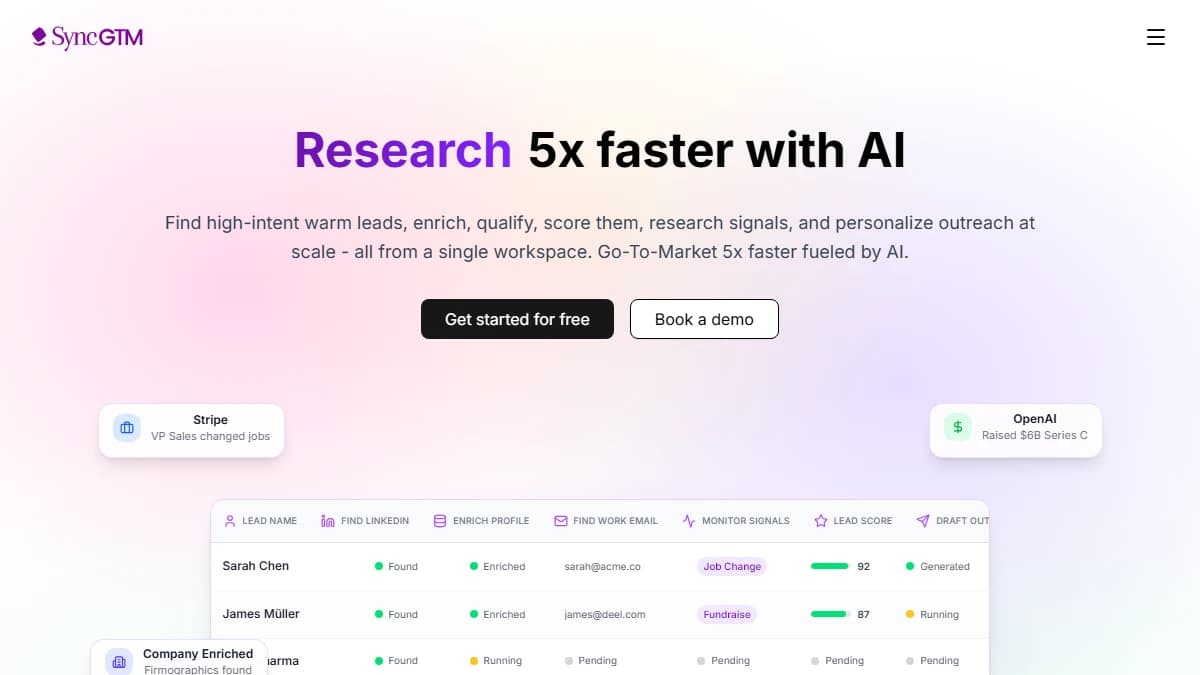
SyncGTM — waterfall enrichment across 50+ providers and outreach in one subscription
SyncGTM is a B2B data enrichment and outreach platform best suited for revenue teams that want enriched leads in their CRM without writing code, offering waterfall data from 50+ providers and integrated outreach from $99/mo with a free tier.
Where Coresignal ships raw API records and bulk datasets that leave orchestration to your engineering team, SyncGTM runs each lookup through a waterfall of 50+ providers — only charging when a verified record is returned.
No engineering team required. No monthly bulk snapshots. Native sync into HubSpot, Salesforce, Pipedrive, Attio, and Zoho means enriched records land in your CRM the moment they are returned.
The data depth is the real differentiator. SyncGTM returns 76+ data points per lead — verified email, mobile direct dial, firmographics, technographics, funding stage, headcount, LinkedIn URL, job history, and buying signals like recent funding rounds, hiring spikes, and tech-stack changes.
SyncGTM's AI agents handle workflow orchestration — triggering enrichment on CRM events, firing outreach when buying signals appear, and routing leads automatically. See the full plan breakdown on the pricing page.
Pros
- Waterfall enrichment across 50+ providers — 76+ data points per record
- Verified mobile direct dials included — no separate phone provider needed
- Works with HubSpot, Salesforce, Pipedrive, Attio, and Zoho out of the box
- No engineering team required — no-code orchestration
- Buying signals (funding, hiring, tech-stack changes) built in
- AI agents for workflow automation
- Transparent pricing from $99/mo
- Only charged when a verified record is returned
Cons
- Not a raw bulk dataset product — built for record-level enrichment
- Free tier capped at 50 credits
- Smaller brand footprint than ZoomInfo or PDL in legacy enterprise procurement
- Not designed for analytical or data-science workloads
Best for: Revenue teams that want waterfall enrichment, buying signals, and outreach in one subscription without an engineering integration project.
Pricing: Free (50 credits) · Starter $99/mo · Pro $249/mo · Business $649/mo
2. People Data Labs
People Data Labs — developer-first B2B data API with 1.5B+ person and 70M+ company records
People Data Labs (PDL) is a B2B data infrastructure platform best suited for data teams and engineers building products on raw person and company records, offering 1.5B+ profile records, 70M+ company records, and self-serve pricing from $0.005 per record.
PDL is the closest like-for-like Coresignal swap for engineering-led teams. Both ship raw API access plus bulk datasets, both are billed per record, and both expect your team to handle deduplication, orchestration, and CRM push.
The differentiator on PDL is the self-serve entry point. Where Coresignal production starts at $1,000+/mo, PDL self-serve starts at $0.005 per record — much friendlier for small data teams prototyping a pipeline before committing to production volume.
The tradeoff is the same engineering tax as Coresignal — no native CRM sync, no outreach, no workflow layer. Revenue teams without a data engineer get nothing actionable out of the box. See our full People Data Labs review and the PDL alternatives roundup for the deep dive.
Pros
- Closest API-first replacement for Coresignal workloads
- 1.5B+ profile records and 70M+ company records
- Broadest SDK coverage (Python, JS, Ruby, Go, Rust)
- Self-serve pricing from $0.005 per record
- Built for data teams and product engineering
Cons
- Same engineering tax as Coresignal — no native CRM sync
- Per-record credit math scales aggressively at volume
- Single-source data — no waterfall logic
- No outreach, no signals, no workflow layer
Best for: Data teams and engineers building enrichment pipelines, ML scoring models, or third-party data products on raw B2B records.
Pricing: Self-serve from $0.005/record · Custom enterprise contracts
3. ZoomInfo
ZoomInfo — enterprise B2B intelligence platform with verified phone data and intent signals
ZoomInfo is an enterprise B2B sales intelligence platform best suited for mid-market and enterprise revenue teams that need verified direct dials and intent data, with annual contracts typically starting around $15K and a first-class MCP server for AI workflows.
ZoomInfo is the Coresignal swap for teams whose actual gap was verified phone data. ZoomInfo's contributory network, manual verification team, and decades of legacy data investment produce direct dials at hit rates Coresignal's public-web sourcing cannot match.
The MCP server is the 2026 differentiator. ZoomInfo ships a production Model Context Protocol server that plugs verified contact and intent data directly into AI agents — meaningfully more useful for teams building agent-driven outbound than a raw dataset that requires an engineering integration layer.
The tradeoff is price and procurement. ZoomInfo annual contracts typically land in the $15K–$80K+/yr range with no published self-serve tier, and the procurement cycle measures in weeks. See our full ZoomInfo review and the ZoomInfo alternatives roundup for cheaper paths.
Pros
- Verified direct dial phone numbers — gap that Coresignal does not fill
- Production MCP server for AI agent workflows
- Intent data and buying-signal coverage
- Enterprise procurement-ready
- Deep CRM integrations across Salesforce, HubSpot, and others
Cons
- Annual contracts typically $15K+/yr — no published self-serve
- Procurement cycle measured in weeks, not days
- Aggressive auto-renewal clauses flagged by G2 reviewers
- Per-seat pricing makes small teams uneconomical
Best for: Mid-market and enterprise revenue teams that need verified direct dials, intent data, and MCP-first delivery — and can absorb annual enterprise pricing.
Pricing: Custom annual contracts (~$15K+/yr) · No published self-serve tier
4. Apollo.io
Apollo.io — 275M+ contact database bundled with sequences, dialer, and basic enrichment
Apollo.io is a B2B sales engagement platform best suited for outbound-led teams that want contacts, sequences, and a dialer in one product, offering a 275M+ profile database with enrichment from $59/user/month and a free tier.
Apollo is the cheapest Coresignal swap for teams whose actual problem was contact lookup plus outreach, not raw data infrastructure. The published per-seat pricing and free tier make it accessible to founders and small teams from day one — no engineering, no procurement.
Where Coresignal ships raw firmographic records, Apollo collapses the entire outbound motion into one workspace — contact lookup, list building, sequences, and a power dialer all run from the same tool. Single-source enrichment is built in.
The tradeoff is depth. Apollo's enrichment is single-source and the data hit rate on direct dials and international contacts trails waterfall layers like SyncGTM. Most teams running serious outbound pair Apollo with a waterfall layer for the lookups Apollo misses. See our Apollo alternatives roundup.
Pros
- Cheapest entry point — free tier and $59/user/mo
- 275M+ contact database
- Bundled sequences and dialer — no integration project
- Works with any CRM
- Self-serve onboarding for revenue teams
Cons
- Single-source enrichment — no waterfall
- Direct dial and international hit rates trail SyncGTM and ZoomInfo
- Heavy use of credit-style limits on free and starter tiers
- Not a raw data infrastructure product like Coresignal
Best for: Outbound-led teams and founders that want contacts, sequences, and a dialer in one cheap product.
Pricing: Free tier · Basic $59/user/mo · Professional $99/user/mo · Custom enterprise
5. Crustdata

Crustdata — real-time multi-source company intelligence API with headcount velocity signals
Crustdata is a real-time B2B company data API best suited for teams that need multi-source intelligence beyond what single-source datasets cover, aggregating from 10+ sources including LinkedIn headcount, app store reviews, and web traffic patterns.
Crustdata is the Coresignal swap for teams whose pain was data freshness, not depth. Where Coresignal refreshes most datasets monthly, Crustdata pulls real-time signals — headcount velocity, app review trends, traffic data — that show what is actually happening at a target account right now.
The multi-source aggregation is the differentiator. Crustdata pulls from 10+ sources that traditional firmographic providers skip — app store reviews flag product momentum, headcount velocity flags growth-stage shifts, web traffic flags brand momentum. Useful for account-based intelligence strategies where surface-level firmographics are not enough.
The tradeoff is the same engineering tax as Coresignal. Crustdata is API-first, developer-focused, no native CRM sync, no outreach. Revenue teams that want signals plus action in one tool typically pick SyncGTM, which bundles buying signals (funding, hiring, tech-stack) with enrichment and outreach.
Pros
- Real-time multi-source data (10+ providers) — beats monthly refresh
- Headcount velocity and growth-stage signals
- App store and web traffic data traditional providers miss
- Strong fit for account-based intelligence strategies
- Self-serve API onboarding
Cons
- API-first — no native CRM sync or no-code workflow builder
- No outreach or sequencing layer
- Limited contact data depth — company-side focused
- Custom pricing — no published self-serve tiers
Best for: Account-based intelligence teams that need real-time multi-source signals beyond traditional firmographics.
Pricing: Trial available · Custom API pricing based on call volume
Side-by-Side Comparison
| Tool | Standout | Starting Price | G2 |
|---|---|---|---|
| SyncGTM | 50+ providers, 76+ data points, AI agents, every major CRM | $99/mo | 4.8 |
| People Data Labs | 1.5B+ profile records, raw API for engineers | $0.005/record | 4.4 |
| ZoomInfo | Verified phone data, intent signals, MCP server | Custom (~$15K+/yr) | 4.5 |
| Apollo.io | 275M+ contacts, built-in sequences and dialer | $59/user/mo | 4.7 |
| Crustdata | 10+ data sources, headcount velocity, app review signals | Custom API | 4.6 |
How to Choose the Right Coresignal Alternative
The right swap depends on what you actually used Coresignal for. Five decision points cover most cases.
- You are a revenue team that wants enriched leads in your CRM without engineering. Pick SyncGTM. Waterfall across 50+ providers, 76+ data points per lead, buying signals, and outreach from $99/mo on any CRM.
- You are a data team that needs raw API records to build a product or pipeline. Pick People Data Labs. Closest like-for-like swap with a cheaper self-serve entry point than Coresignal.
- You need verified direct dials and enterprise procurement is fine. Pick ZoomInfo. Fills the phone gap Coresignal does not, with first-class MCP support.
- You are outbound-led and want one cheap tool for contacts and sequences. Pick Apollo.io. Free tier and $59/user/mo with 275M+ contacts and a built-in dialer.
- You need real-time multi-source signals for account-based intelligence. Pick Crustdata. Beats monthly refresh with 10+ live sources including LinkedIn headcount and app review trends.
For a broader breakdown of the modern enrichment stack, see our best waterfall enrichment tools guide.
Final Verdict
Coresignal is a serious data infrastructure product. It is also the wrong tool for the majority of teams that buy it — because most teams want enriched leads in their CRM, not raw firmographic records and a monthly refresh cycle.
For revenue teams searching for a Coresignal replacement, the answer is to unbundle from raw API access, pick a waterfall enrichment layer that includes verified phone data, and run outreach on top.
SyncGTM is the best overall pick for that motion — waterfall enrichment across 50+ providers, 76+ data points per lead, verified mobile direct dials, buying signals, AI agents, and CRM sync to HubSpot, Salesforce, Pipedrive, Attio, and Zoho from $99/mo.
People Data Labs is the closest API-first swap for data teams. ZoomInfo wins on verified direct dials. Apollo.io is the cheapest contacts-plus-sequences bundle. Crustdata is the strongest pick for real-time multi-source intelligence. Pick the one that maps to the layer of Coresignal you actually used.