

7 Best TheirStack Alternatives in 2026 (Compared)

By Kushal Magar · April 17, 2026 · 13 min read
Key Takeaway
This guide ranks the 7 best TheirStack alternatives for 2026. TheirStack's job-posting NLP approach — inferring tech stacks from hiring signals rather than web crawls — is genuinely distinctive and reaches backend and internal tools that BuiltWith and Wappalyzer cannot detect. The trade-off is coverage: job-based detection requires active hiring. SyncGTM is the top pick for GTM teams — it combines waterfall technographic enrichment from 40+ providers with real-time hiring surge detection and native CRM sync from $49/mo. BuiltWith leads on web-crawl breadth with 670M+ websites and 95K+ technologies tracked. Wappalyzer is the strongest free option via browser extension. HG Insights is the enterprise benchmark combining multiple detection methods at $50K+/year pricing. Coresignal delivers historical tech stack change events for competitive displacement campaigns. Apollo.io is the best all-in-one option with technographics plus 275M+ contact records from $49/mo. Crustdata specializes in real-time employee growth signals for hiring-velocity prospecting.
TheirStack built a genuinely unusual technographic product. Instead of crawling websites for JavaScript tags and HTTP headers like BuiltWith and Wappalyzer do, TheirStack parses millions of job postings worldwide using NLP to infer what technologies companies are actively implementing, expanding, or hiring around. That distinction matters: a company that lists “Snowflake” in 14 data engineering job descriptions this quarter is expanding its data warehouse capability — a buying signal that a website crawler will never surface because Snowflake runs entirely in the backend.
The reason teams look for alternatives is specific to that same approach. Job-posting detection only works when companies are actively hiring. Small companies and those in hiring freezes produce sparse or no signals. Teams that need wide coverage of frontend technologies — SaaS tools, CMS platforms, marketing stack — find web-crawl providers more complete for those use cases. And teams that want technographic data integrated into enrichment workflows, CRM sync, and outreach automation find TheirStack's raw data API requires more custom plumbing than they want to build.
We evaluated 7 alternatives across detection methodology, technology coverage depth, buying signal quality, CRM integration, and pricing. Here is what each delivers — and where TheirStack still holds the edge.
Quick Summary
The best TheirStack alternatives in 2026 are SyncGTM, BuiltWith, Wappalyzer, HG Insights, and Coresignal. SyncGTM is the top pick for GTM teams that need technographic enrichment plus real-time buying signals — hiring surges, tech stack changes, funding rounds — with native CRM sync from $49/mo. BuiltWith leads on web-crawl breadth. HG Insights is the enterprise accuracy benchmark. Coresignal delivers historical tech stack change tracking for displacement campaigns.
TL;DR: Best TheirStack Alternatives in 2026
- SyncGTM — Best overall for GTM teams. Technographic enrichment + hiring signal detection + CRM sync from $49/mo. Free tier included.
- BuiltWith — Best web-crawl technographics. 670M+ websites, 95K+ technologies, historical adoption trends.
- Wappalyzer — Best free option. Browser extension with real-time detection, developer-friendly API, 75K+ technologies.
- HG Insights — Best enterprise accuracy. Multi-signal detection combining web crawl, job data, and proprietary partnerships at $50K+/yr.
- Coresignal — Best for tech stack change events. Historical technographic tracking across 70M+ companies for competitive displacement.
- Apollo.io — Best all-in-one. Technographic filters + 275M+ contacts + built-in sequences from $49/mo.
- Crustdata — Best headcount velocity. Real-time employee growth signals from LinkedIn + company data API.
Why Teams Look Beyond TheirStack
TheirStack occupies a specific and valuable niche in the technographics market. Its job-posting NLP engine — which parses job descriptions at scale to infer what technologies companies are hiring around — surfaces backend infrastructure, data platforms, and internal tooling that website crawlers cannot detect. If you sell data infrastructure, developer tooling, or enterprise software, TheirStack can identify which companies are actively expanding exactly those capabilities before any website change reflects it.
The switching triggers are predictable. Coverage gaps on companies not actively hiring mean that any analysis of mid-market companies, bootstrapped companies, or those in a growth pause produces sparse results. TheirStack's technographic accuracy is 85–95% for technologies explicitly named in job postings, but coverage drops on frontend technologies that job descriptions rarely mention — analytics tags, CMS platforms, marketing automation tools.
The second pressure point is the GTM workflow gap. TheirStack delivers a data API. It does not have native CRM sync, built-in sequencing, or workflow automation. Every signal TheirStack surfaces requires custom engineering to route into Salesforce, HubSpot, or an outreach tool. Teams that want signal-to-outreach automation — without building a data pipeline — frequently end up looking for a platform that integrates that loop.
The third factor is the technographics market itself. The market hit $1.17B in 2025 — up from $367M in 2020, a 26.1% CAGR — and the tool landscape has expanded significantly. BuiltWith now tracks 95,000+ technologies across 670M+ websites. Providers like HG Insights combine job data and web crawl into hybrid detection that exceeds any single-method approach. The competitive context has raised the bar.
Here is how the 7 strongest TheirStack alternatives perform across coverage methodology, buying signal depth, integration, and price.
1. SyncGTM: Technographic Enrichment Plus the Hiring Signal Layer
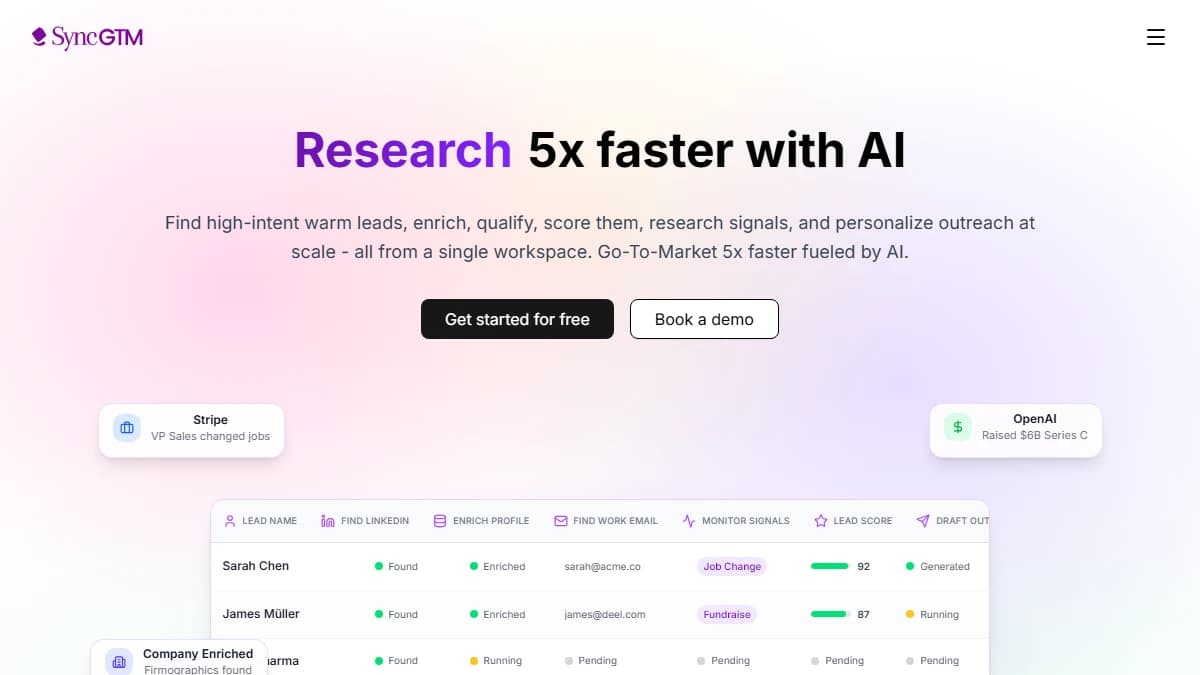
SyncGTM — technographic enrichment, hiring signals, and CRM sync from $49/mo
The reason teams move from TheirStack to SyncGTM is almost always the same: they want the signal — “this company is hiring for Snowflake engineers” — to automatically trigger an outreach sequence in their CRM without building a custom data pipeline. TheirStack surfaces the signal via API. SyncGTM closes the loop.
SyncGTM aggregates technographic data through a 40+ provider waterfall — layering web-crawl data, job-posting inference, third-party data partnerships, and AI research agents to build the most complete tech stack profile available for each target account. It then monitors the accounts continuously: hiring surge detection (volume change, role type shift, department growth velocity), tech stack change events, funding round alerts timed to announcement day, and executive job change tracking. When any of those signals fire, SyncGTM writes the enriched record directly into HubSpot, Salesforce, Pipedrive, or Attio and can trigger an outreach sequence automatically.
For GTM teams that used TheirStack to identify which companies were actively adopting a tool, the question was always “now what?” Export a CSV, clean it, import to the CRM, create a sequence, hope the signal is still fresh. SyncGTM eliminates that latency. The hiring signal and the outreach trigger are connected in the same workflow.
The coverage difference also matters. TheirStack's job-posting engine works on companies with active hiring. SyncGTM's waterfall enrichment works across the full ICP regardless of hiring activity — using web-crawl providers, registry data, and AI research to fill the gaps where job-based inference goes dark.
Pros
- ✓ Technographic enrichment from 40+ provider waterfall — web crawl + job data + AI research
- ✓ Real-time hiring surge detection — volume, role type, and department velocity signals
- ✓ Native CRM sync to HubSpot, Salesforce, Pipedrive, Attio — no custom API build
- ✓ Continuous account monitoring — signals trigger CRM updates and outreach automatically
- ✓ Free tier (200 credits/mo) with CRM integrations active
- ✓ No-code workflow builder for signal-to-outreach automation
- ✓ AI research agents for context beyond structured technographic data
Cons
- ✗ No raw job-posting NLP API — TheirStack's core differentiator for developers building custom data pipelines
- ✗ $99/mo vs TheirStack's lower entry pricing
- ✗ Less granular access to raw job posting data for research use cases
Best for:GTM and revenue operations teams that need technographic enrichment plus automated signal-to-outreach — without building a custom data pipeline between TheirStack's API and their CRM.
Pricing: Free (200 credits/mo), $49/mo Solo, $99/mo Growth, $249/mo Pro, $649/mo Business. See full pricing → Take the product tour →
2. BuiltWith: The Gold Standard for Web-Crawl Technographics
BuiltWith has indexed more technology data across more websites than any other provider. 670M+ websites, 95,000+ technologies tracked, and historical adoption records going back years — making it uniquely valuable for market share analysis, territory planning, and identifying technology adoption trends over time. For any question about frontend technology adoption across a market, BuiltWith is the primary source most analysts reach for first.
Where BuiltWith and TheirStack diverge is methodologically and fundamentally. BuiltWith crawls live websites to identify what's deployed — JavaScript libraries, analytics platforms, CDN providers, CMS systems, payment processors, marketing automation tags. TheirStack parses job postings to infer what companies are building internally. BuiltWith will correctly identify that a company uses Shopify on its storefront; it will not tell you the same company is expanding its Databricks implementation because that inference requires reading job descriptions, not inspecting HTTP headers.
BuiltWith's pricing model starts at $295/mo for its Basic plan, which limits access to two technologies and includes 2,000 lookups. The $995/mo Team plan unlocks broader access and API credits. For most GTM teams, the value concentrates in the BuiltWith Trends product — market share and adoption trend data that is genuinely useful for territory planning and competitive analysis — rather than per-company lookup.
Pros
- ✓ Largest web-crawl technographic database — 670M+ websites, 95K+ technologies
- ✓ Historical adoption trends and market share data (BuiltWith Trends)
- ✓ High accuracy for frontend technologies, analytics, and marketing stack
- ✓ Free website lookup tool for individual domain checks
- ✓ API access on paid plans for developer integrations
Cons
- ✗ No backend or internal tool detection — misses what TheirStack surfaces from job postings
- ✗ No buying signal layer — no hiring surge, funding, or change event detection
- ✗ Expensive for GTM use cases — Basic plan limits to 2 technologies at $295/mo
- ✗ No native CRM integrations — data exports require custom ETL
- ✗ No contact data — technology profiles only, no person-level enrichment
Best for: Product marketing, competitive intelligence, and market research teams that need web-technology market share data and historical adoption trends — not GTM teams running outbound with daily enrichment needs.
Pricing: Basic $295/mo (2 technologies, 2,000 lookups), Team $995/mo (broader access, API credits). Free domain lookup at builtwith.com.
3. Wappalyzer: Free Browser Extension With a Developer-Friendly API
Wappalyzer takes a different approach to the same web-crawl space as BuiltWith: a free browser extension that detects technologies in real time as you browse, and an API that allows programmatic lookups at significantly lower pricing than BuiltWith. With 75,000+ technologies tracked, Wappalyzer has strong coverage of the JavaScript, CMS, e-commerce, and marketing automation layers that characterize most website-visible tech stacks.
For the specific use case TheirStack targets — backend and internal tool detection from job postings — Wappalyzer has the same structural gap as BuiltWith: it only sees what is deployed on the website. A company running Kubernetes internally, using Fivetran for data pipelines, or migrating to Salesforce from a legacy CRM will show none of that in Wappalyzer's output. TheirStack's job-posting NLP would surface all three from the engineering and operations job descriptions the company posts.
Where Wappalyzer wins over TheirStack is access economics. The browser extension is free and detects technologies immediately on any website you visit. The API starts at lower price points than TheirStack's commercial plans. For startups, developers evaluating data quality before committing to a paid plan, or teams that only need frontend technology detection, Wappalyzer is the most accessible entry point in the market.
Pros
- ✓ Free browser extension — real-time technology detection on any website
- ✓ 75K+ technologies tracked — competitive coverage for frontend stack
- ✓ Lower API pricing than BuiltWith — more accessible for smaller teams
- ✓ Bulk lookup via CSV upload for list enrichment workflows
- ✓ Developer-friendly API documentation
Cons
- ✗ No backend or internal tool detection — same limitation as all web-crawl tools
- ✗ No hiring signal or buying intent layer
- ✗ Smaller database than BuiltWith — fewer historical records
- ✗ No native CRM integration on any plan
- ✗ No contact or company enrichment beyond tech stack
Best for: Developers and small teams that need quick, free technology detection via browser extension or low-cost API access — and whose use case is limited to website-visible frontend technologies.
Pricing: Free browser extension. API plans from $99/mo with technology lookups and bulk enrichment.
4. HG Insights: Enterprise Technographic Accuracy at Enterprise Pricing
HG Insights is what TheirStack would look like if it combined every detection method available and priced for enterprise sales cycles. HG Insights uses web crawl, job posting analysis, social signals, vendor partnership data, and proprietary data deals to build the most comprehensive technology intelligence available — with particular strength on enterprise software, IT infrastructure, and the complex internal technology stacks that large enterprises run.
For revenue teams running account-based programs at Fortune 2000 companies — where a single closed deal justifies $50K+ in data infrastructure — HG Insights is the benchmark. Its technology intelligence is used by enterprise software vendors, value-added resellers, and consulting firms to understand exactly what software their prospects are running, when contracts are up for renewal, and where competitive displacement opportunities exist. The accuracy at the enterprise end of the market is materially better than any single-method alternative.
For mid-market SaaS teams or any use case where TheirStack's pricing was appealing, HG Insights is not a realistic alternative on price. Entry contracts typically start around $50K/year. TheirStack serves the same intelligence need at a fraction of that cost for teams whose ICP is smaller companies or mid-market accounts where enterprise-level data fidelity is not the bottleneck.
Pros
- ✓ Highest technographic accuracy for enterprise accounts — multi-signal detection
- ✓ Combines web crawl, job postings, social signals, and proprietary data
- ✓ Technology spend intensity and contract timing intelligence
- ✓ Strong IT infrastructure coverage — on-premise, cloud, and hybrid stacks
- ✓ Integrations with Salesforce, HubSpot, and major CRM platforms
Cons
- ✗ Enterprise pricing only — $50K+/year puts it out of reach for most mid-market teams
- ✗ No self-serve or trial access — sales-led onboarding process
- ✗ Overkill for SMB or mid-market ICP where TheirStack's pricing made sense
- ✗ Complex implementation — not plug-and-play for small RevOps teams
Best for: Enterprise revenue teams running account-based programs targeting Fortune 2000 companies — where technology intelligence accuracy directly determines deal quality and competitive displacement success justifies the cost.
Pricing: Enterprise contracts, typically $50K+/year. No self-serve access.
5. Coresignal: Historical Tech Stack Change Events for Displacement Campaigns
Coresignal addresses a specific gap that TheirStack does not cover directly: what happened to a company's tech stack over time, not just what it is today or what it's hiring for right now. Coresignal tracks technology adoption and abandonment events across 70M+ company profiles, building a historical record of when companies added or removed specific tools from their stack.
That temporal dimension is valuable for competitive displacement campaigns. A company that dropped Marketo 18 months ago and has been running Pardot since is in a different competitive position than a company that adopted Marketo 6 months ago. Coresignal's change event tracking lets GTM teams identify when a tech stack change opened a competitive gap — and how long it has been sitting there.
Coresignal also covers employee count change tracking alongside technographics — monitoring headcount growth and decline signals across company profiles. For teams that use TheirStack's hiring signals to infer technology adoption, Coresignal adds the broader employee growth context that indicates whether a hiring signal reflects genuine expansion or isolated backfill.
Pros
- ✓ Historical tech stack change tracking — adoption and abandonment events over time
- ✓ 70M+ company profiles with technographic and headcount data
- ✓ Near-real-time change event detection for competitive displacement
- ✓ REST API with flexible filtering for developer integration
- ✓ Employee count trend data alongside technographic signals
Cons
- ✗ No job-posting NLP — does not detect backend tool adoption via hiring signals
- ✗ No native CRM integration — requires API development or Zapier for CRM sync
- ✗ No built-in outreach sequencing — data only, no GTM workflow automation
- ✗ Pricing not publicly listed — requires sales conversation for access
Best for:Competitive displacement programs where identifying when a prospect adopted or dropped a competitor's tool — and how long ago — determines outreach timing and message framing.
Pricing: Custom pricing — contact Coresignal sales for packages. Mid-market accessible based on reported user reviews.
6. Apollo.io: All-in-One Prospecting With Technographic Filters
Apollo.io — technographic filters + 275M+ contacts + built-in sequences from $49/mo
Apollo.io approaches technographics as one filter dimension inside a broader contact and company database rather than as the primary product. With 73M+ companies and 275M+ verified contacts, technographic filtering in Apollo means you can find companies using a specific technology and immediately access the decision-makers at those companies — names, titles, verified emails, direct dials — and launch an outreach sequence without leaving the platform.
Apollo uses web crawl and third-party data sourcing for its technographics — not TheirStack's job-posting NLP. The practical difference: Apollo accurately identifies frontend technologies, analytics platforms, and website-visible tools. It will not surface the backend infrastructure adoption signals that TheirStack infers from job descriptions. For teams whose ICP identification depends on backend stack inference — “show me companies actively adopting dbt” — Apollo's technographic coverage is thinner than TheirStack's.
Where Apollo meaningfully outperforms TheirStack is the complete sales workflow. TheirStack tells you who to target. Apollo lets you target, find the right contact, verify their email, and reach out in the same session from $49/mo. For teams that used TheirStack as one step in a longer tool chain, Apollo collapses several steps into one platform at accessible pricing.
Pros
- ✓ 275M+ contacts + 73M+ companies with technographic filters in one platform
- ✓ Built-in email sequencing, power dialer, and AI copywriting
- ✓ Accessible pricing starting at $49/mo — lowest entry cost on this list
- ✓ Native CRM sync to HubSpot, Salesforce, and Pipedrive
- ✓ Buying intent data sourced from Bombora and first-party signals
Cons
- ✗ No job-posting NLP for backend tool adoption inference
- ✗ Technographic coverage thinner on internal and backend tools
- ✗ Data accuracy inconsistencies at volume in some geographies and verticals
- ✗ No raw data API for custom enrichment pipeline builds
Best for: Sales and SDR teams that want technology-filtered prospecting plus contact data and outreach automation in one platform — without the separate data pipeline that TheirStack requires.
Pricing: Free plan (10 email credits/mo), Basic $49/mo, Professional $99/mo, Organization $149/mo per user. See Apollo alternatives →
7. Crustdata: Real-Time Employee Growth Signals From LinkedIn
Crustdata occupies a specific niche adjacent to TheirStack: real-time employee count change tracking from LinkedIn signals, combined with company data API coverage for developer integration. Where TheirStack uses hiring signals to infer technology adoption, Crustdata uses headcount velocity signals to infer growth stage, funding consumption, and organizational expansion — a complement to technology detection rather than a replacement.
For teams that use TheirStack's hiring signal data to identify companies actively expanding a technology practice, Crustdata adds the headcount dimension: not just “they're hiring Kubernetes engineers” but “their total engineering headcount grew 40% in 90 days.” That velocity signal helps differentiate isolated technical hires from genuine team expansion — reducing false positives in signal-triggered outreach.
Crustdata is API-first and developer-focused. There is no no-code workflow builder, no CRM integration layer, and no outreach automation built in. Like TheirStack, it supplies data that then needs to be routed into a GTM workflow through custom engineering or a middleware platform.
Pros
- ✓ Real-time LinkedIn employee count change tracking — daily updates
- ✓ Headcount velocity signals — growth rate, department composition changes
- ✓ Clean REST API with good developer documentation
- ✓ Company financials, funding rounds, and firmographic data included
- ✓ Affordable API access compared to enterprise data providers
Cons
- ✗ No technographic data — does not detect technologies used or hiring for
- ✗ No native CRM integration — API-only, requires custom build
- ✗ No outreach workflow or sequencing built in
- ✗ Coverage limited to LinkedIn-active companies
Best for: Developer teams building custom growth signal pipelines that need real-time employee headcount velocity as a buying signal alongside technology detection from another provider.
Pricing: API access with custom pricing based on call volume. Self-serve onboarding available at crustdata.com.
Side-by-Side Comparison
| Tool | Detection Method | Backend Stack | Buying Signals | CRM Sync | Starting Price |
|---|---|---|---|---|---|
| SyncGTM | Waterfall (40+ providers) | Partial (via job + AI) | Hiring, funding, tech change | Native (HS, SF, PD, Attio) | Free / $49/mo |
| TheirStack | Job-posting NLP | Strong (NLP inference) | Hiring signals only | API only | Free tier / Paid |
| BuiltWith | Web crawl | No | None | API / CSV export | $295/mo |
| Wappalyzer | Web crawl | No | None | None | Free / $99/mo |
| HG Insights | Multi-signal (web + job + proprietary) | Strong (hybrid) | Spend intent, renewal timing | Salesforce, HubSpot | $50K+/yr |
| Coresignal | Web crawl + public data | Partial | Tech stack change events | API only | Custom |
| Apollo.io | Web crawl + 3rd party | Limited | Bombora intent + signals | HubSpot, Salesforce, Pipedrive | $49/mo |
| Crustdata | LinkedIn headcount tracking | No | Headcount velocity only | None | Custom |
How to Choose the Right TheirStack Alternative
Need job-posting NLP for backend stack inference?
TheirStack is still the specialist here. No alternative on this list replicates its raw job-posting NLP API at a similar price point. HG Insights partially covers it but at enterprise pricing. If your use case is specifically “identify companies hiring for [specific technology]” at self-serve pricing, TheirStack's core product has no direct replacement.
Need technographics integrated into CRM without custom development?
SyncGTM is the answer. Waterfall enrichment from 40+ providers with native sync to HubSpot, Salesforce, Pipedrive, and Attio. Buying signals — including hiring surges — trigger outreach automatically. No API build required. Free tier to validate before committing.
Need the broadest web-crawl technographic coverage?
BuiltWith leads on database breadth — 670M+ websites and 95K+ technologies tracked. The right choice for market share analysis, technology adoption trends, and territory planning based on frontend tech stack. Not the right choice for daily outbound prospecting at $295/mo entry.
Need free or low-cost technographic detection?
Wappalyzeris the starting point — free browser extension with real-time detection and API access from $99/mo. Solid for individual lookups and small-team enrichment workflows. Does not replace TheirStack's job-based inference but covers the frontend technology layer at no cost.
Running enterprise ABM targeting Fortune 2000 companies?
HG Insights provides the highest accuracy at the enterprise end — combining web crawl, job analysis, and proprietary data partnerships. At $50K+/year, it is priced for revenue teams where a single closed enterprise deal justifies the data infrastructure cost.
Running competitive displacement campaigns?
Coresignaladds the historical change dimension — when a company adopted or dropped a specific tool — that TheirStack's current-state signals do not capture. Useful for identifying competitive gaps that opened months ago and are still actionable.
Final Verdict
TheirStack's job-posting NLP approach is genuinely distinctive — it surfaces backend infrastructure and internal tool adoption signals that no web-crawl provider can match. If you specifically need raw job-posting technographic inference via API at self-serve pricing, no alternative in this guide fully replicates that capability.
For the GTM teams that consumed TheirStack data primarily to trigger outreach — “company X is hiring for Snowflake, reach out now” — the better workflow is one where that signal detection, CRM enrichment, and outreach trigger are connected in one platform. That is the case for SyncGTM.
For teams whose primary need is frontend technology coverage at scale, BuiltWith leads on database breadth. For free access and developer testing, Wappalyzer is the starting point. For enterprise ABM at Fortune 2000 targets, HG Insights is the accuracy benchmark. For competitive displacement with historical tech stack change context, Coresignal adds the temporal dimension TheirStack does not cover.
Our recommendation:Start with SyncGTM's free tier to validate technographic coverage on your specific ICP before committing to a paid plan. If your use case requires backend stack inference from active job postings specifically, TheirStack's self-serve plan remains the right tool for that step — with SyncGTM or Apollo handling the downstream GTM workflow.
Stop piping TheirStack data into spreadsheets
SyncGTM combines technographic enrichment from 40+ providers with hiring surge detection, funding alerts, and tech stack change monitoring — synced directly to your CRM. From $49/mo with a free tier. No API build required.