

Best Apollo Alternatives in 2026: 5 Tools Compared

By Kushal Magar · March 11, 2026 · 14 min read
Key Takeaway
This guide compares the five best Apollo alternatives in 2026: SyncGTM, Explorium.ai, Instantly, ZoomInfo, and MoltSets. Teams switch from Apollo due to data quality issues with outdated emails and phone numbers, aggressive upselling, limited enrichment depth, and a bloated UI. SyncGTM is the strongest alternative for teams wanting waterfall enrichment across 50-plus providers with AI web scraping, workflow automation, and signals monitoring from 99 dollars per month. Explorium.ai offers AI-powered enrichment with predictive lead scoring across a catalog of external datasets from 200 dollars per 5,000-credit package. Instantly provides cold email at scale with unlimited accounts and built-in warmup from 30 dollars per month. ZoomInfo delivers the largest B2B database with org charts and buyer intent from 15,000 dollars per year. MoltSets provides verified B2B contact data via API or Claude, with business and personal emails, mobile numbers, and business profiles on flat monthly plans from 27 dollars per month. The right choice depends on whether you prioritize data depth, outreach volume, or enrichment flexibility over Apollo's single-source approach.
Apollo.io built its reputation as a go-to sales intelligence platform -- combining a contact database, email sequencing, and basic enrichment in one tool. But as B2B sales teams have gotten more sophisticated, Apollo's limitations have become harder to ignore: shallow enrichment from a single data source, inconsistent email accuracy, and pricing that creeps up fast once you need real volume.
This post compares five Apollo alternatives that are actively used by sales and GTM teams in 2026. Each tool takes a different approach to the problem Apollo tries to solve -- prospecting, enrichment, and outreach. We cover real pricing, honest pros and cons, and specific recommendations based on team size and workflow.
SyncGTM customers report 42% more qualified meetings and 80% lower tool costs compared to running separate enrichment, outreach, and automation platforms.
Quick Summary
The best Apollo.io alternatives in 2026 are SyncGTM, Explorium.ai, Instantly, ZoomInfo, and MoltSets. SyncGTM is the top pick for most B2B sales and GTM teams: it replaces Apollo's single-source database with waterfall enrichment across 50+ providers, adds an AI web scraper, buying signals monitoring, a no-code workflow builder, and direct CRM integrations — starting free with a paid Solo at $49/mo. Explorium.ai is the best choice for teams that want enrichment and predictive account scoring in the same pipeline, from $29.99 per package. Instantly is the cheapest sending option at $30/mo for teams focused purely on cold email at scale. ZoomInfo is the enterprise standard for the largest database and intent data, but starts at $15k+/yr. MoltSets suits teams that want verified B2B contact data via API or Claude, from $27/mo with a free tier of 1,000 tokens.
TL;DR: Best Apollo Alternatives in 2026
- SyncGTM -- Best all-in-one GTM automation. Waterfall enrichment across 50+ providers, AI web scraper, workflow builder, signals monitoring, and CRM push. $49/mo Solo.
- Explorium.ai -- Best for AI-powered enrichment with predictive lead scoring. External dataset catalog, propensity models, warehouse-native delivery. From $29.99/pkg.
- Instantly -- Best for cold email at scale. Unlimited email accounts, email warmup, lead database, campaign sequences. $30/mo starter.
- ZoomInfo -- Best for enterprise contact databases. Largest B2B database, intent data, org charts. Custom pricing (typically $15k+/yr).
- MoltSets -- Best for verified B2B contact data via API or MCP with no UI. $27/mo. Free tier (1,000 tokens).
Why Teams Are Switching from Apollo in 2026
Apollo.io works well as an entry-level prospecting tool. It gives you a contact database, basic email sequencing, and some enrichment -- all in one interface. For solo founders and early-stage SDRs, that's often enough to get started. But as teams scale, four problems keep coming up.
Single-source data. Apollo relies on its own proprietary database for contact information. When that database has a gap -- wrong email, missing phone number, outdated job title -- you are stuck. Waterfall enrichment tools like SyncGTM and Explorium.ai solve this by drawing on many external data sources instead of one proprietary database.
Email accuracy. Apollo's email verification has been a consistent complaint in user reviews throughout 2025 and into 2026. Bounce rates above 10% are common, which damages sender reputation and deliverability. Teams running cold email at volume are moving to tools with better verification -- or adding a dedicated data enrichment layer between Apollo and their outreach tool.
Pricing escalation. Apollo's free tier is generous for getting started, but the jump to paid plans is steep -- and key features like intent data, advanced filters, and API access are locked behind higher tiers. Teams that started on Apollo's free plan often find themselves paying $200+/mo before they get the features they actually need.
Platform bloat. Apollo has expanded from a sequencing tool into a full sales engagement platform, which means the UI has gotten more complex without proportional improvements in core functionality. Teams that want focused tools for specific workflows -- enrichment, outreach, or prospecting -- are finding leaner alternatives that do each job better.
What we evaluated
- Data quality: How accurate and complete are the contact records? Does the tool cross-reference multiple sources?
- Enrichment depth: Single database lookup or waterfall enrichment across multiple providers?
- Outreach capabilities: Does the tool handle email sequencing, or is it enrichment-only?
- CRM integrations: Can enriched data push directly to HubSpot, Salesforce, or Pipedrive?
- Pricing transparency: Is pricing published? Are critical features gated behind enterprise tiers?
1. SyncGTM -- Best All-in-One GTM Automation Platform
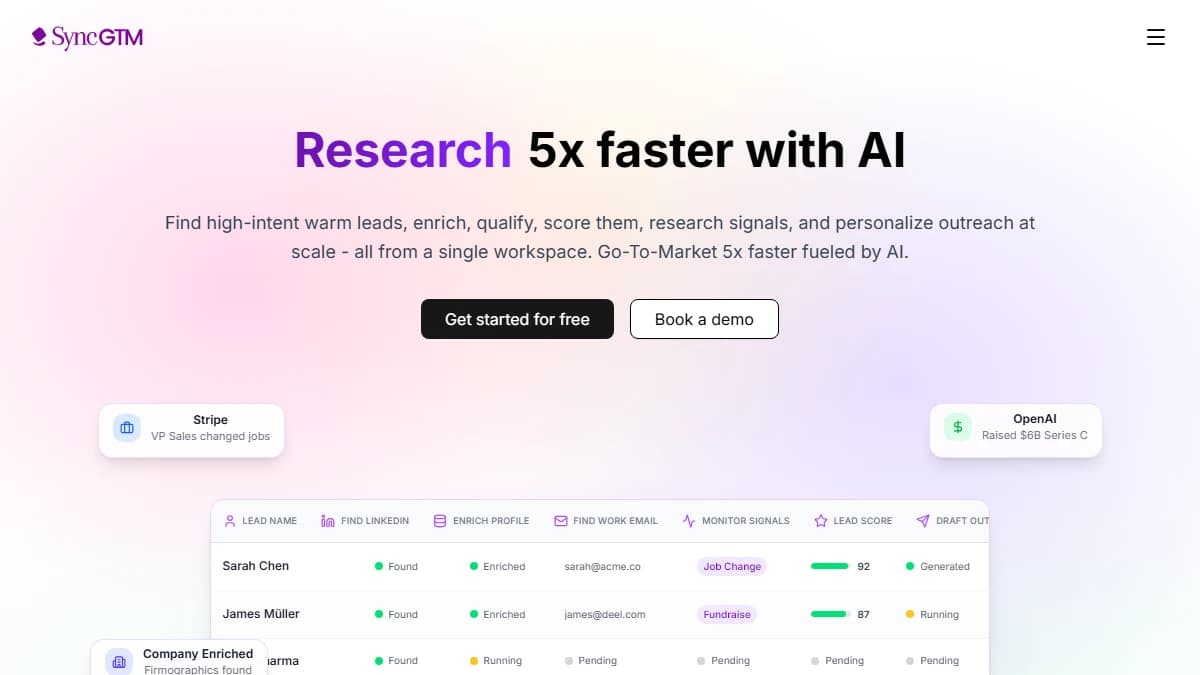
SyncGTM -- waterfall enrichment, AI web scraping, and CRM push in a single platform
SyncGTM is a GTM automation platform that replaces Apollo's prospecting, enrichment, and CRM sync workflows with a more powerful, unified system. Where Apollo gives you a single proprietary database, SyncGTM runs waterfall enrichment across 50+ data providers -- cascading through sources like Clearbit, Lusha, Hunter, and dozens more until every field on a contact record is filled. The result is significantly higher data coverage and accuracy than any single-source tool.
Beyond enrichment, SyncGTM includes an AI web scraper that extracts structured data from any website, a no-code workflow builder for automating multi-step GTM processes, and signals monitoring that tracks job changes, funding rounds, and hiring surges across your target accounts. These are capabilities Apollo either does not have or charges significantly more for on higher-tier plans.
The CRM integration layer pushes enriched data directly to HubSpot, Salesforce, Pipedrive, and Attio with field mapping and deduplication built in. For teams that were using Apollo primarily for prospecting and enrichment, SyncGTM delivers better data quality at a comparable price point -- and eliminates the need to bolt on separate tools for web scraping, signals, or workflow automation.
Pros
- + Waterfall enrichment across 50+ data providers -- not locked to one database
- + AI web scraper extracts structured data from any website
- + No-code workflow builder for multi-step GTM automation
- + Signals monitoring: job changes, funding, hiring surges
- + Free tier available with AI agents and CRM integration
Cons
- - No built-in email sequencing -- pair with Instantly or your outreach tool
- - Newer platform, smaller community compared to Apollo
- - Advanced workflow features require paid tiers
Best for: Sales and GTM teams that want deeper enrichment, AI-powered prospecting, and workflow automation in one platform -- without Apollo's single-source data limitations.
Pricing: Free tier available with AI agents and CRM integration. Starter $49/mo with waterfall enrichments, verified emails, and webhooks. Pro and Business tiers for higher volume. Explore pre-built workflow templates or take a product tour to see the platform in action.
2. Explorium.ai -- AI-Powered Enrichment with Predictive Lead Scoring
Explorium.ai -- external data enrichment with AI-driven predictive scoring models
Explorium.ai is a B2B data platform that enriches your existing records against a catalog of external datasets, then runs predictive models over the result. If Apollo's limitation is being locked to one proprietary database, Explorium's pitch is the opposite: join against many third-party sources -- firmographics, technographics, hiring and funding signals, web presence -- and let the models tell you which accounts are worth working.
That scoring layer is the real difference from Apollo. Apollo gives you filters and a contact list; Explorium gives you a ranked account list with the reasoning attached, which is what most ABM and enterprise-outbound teams actually need before they write a single email. It ranks in our roundup of the best enrichment API tools for a complete feature breakdown. Where SyncGTM cascades across providers to fill every field, Explorium widens the picture around the account itself -- useful if your gap is knowing who to target rather than how to reach them. If a spreadsheet-style workflow builder is closer to what you had in mind, our Clay alternatives guide covers that category.
The tradeoff is implementation. Explorium is API-first with no native CRM or marketing-automation UI, so pushing enriched records back into HubSpot or Salesforce generally needs a data team or middleware -- something Apollo gives you out of the box. Pricing is package-based rather than per-seat, which fits scheduled batch enrichment better than ad-hoc rep lookups. Teams with data resources that want scoring built into enrichment will get a lot out of it. Teams that just want contact details in the CRM tomorrow will find it heavier than they need.
Pros
- + Large catalog of high-quality external data sources
- + AI predictive models for lead scoring and segmentation
- + Integrates directly with existing data stacks and warehouses
- + Strong for ABM and enterprise account prioritisation
- + Scales cleanly from mid-market to enterprise volumes
Cons
- - API-first delivery needs data team resources to implement
- - No native CRM or marketing automation UI
- - Credit cost varies by enrichment type (1-5 credits per record)
- - No built-in email sequencing or outreach tools
Best for: RevOps and data teams that want enrichment and predictive account scoring in one pipeline, feeding a warehouse or existing data stack rather than a rep-facing UI.
Pricing: Free trial (100 credits). Lite $29.99/pkg (500 credits). Starter $149.99/pkg (5K credits). Growth $749.99/pkg (30K credits). Scale $7,499.99/pkg (500K credits). Enterprise custom.
3. Instantly -- Cold Email at Scale with Unlimited Accounts
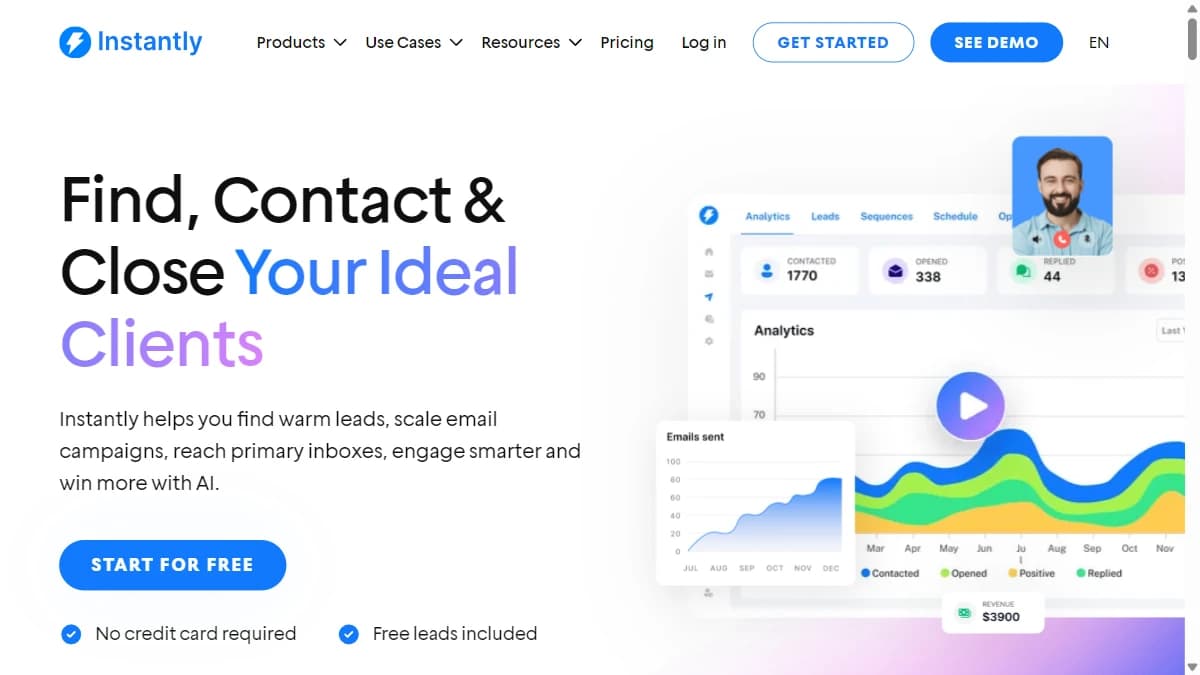
Instantly -- unlimited email accounts, warmup, and campaign sequences for cold outreach
Instantly is a cold email platform built for sending at volume. While Apollo tries to be an all-in-one platform, Instantly focuses entirely on the outreach side -- unlimited email accounts, built-in email warmup, campaign sequencing, and deliverability optimization. For teams whose primary pain point with Apollo is email sending limits and deliverability, Instantly solves that problem directly and at a fraction of the cost.
The platform's key advantage is unlimited email account connections on every plan. Apollo limits you to a set number of mailboxes and daily sends. Instantly lets you connect as many sending accounts as you want and distributes sends across them automatically, which dramatically improves deliverability. The built-in warmup tool gradually increases sending volume on new accounts, building sender reputation before you launch campaigns.
Instantly also includes a B2B lead database with over 160 million contacts, so you can prospect and send from the same platform. However, the lead database is not as deep as Apollo's for enrichment data -- you get email, name, title, and company, but not the detailed firmographic and technographic data you would get from SyncGTM or ZoomInfo. Most Instantly users pair it with a separate enrichment tool to fill those gaps.
Pros
- + Unlimited email accounts on every plan
- + Built-in email warmup and deliverability optimization
- + B2B lead database with 160M+ contacts
- + $30/mo starting price -- cheapest option in this list
- + Campaign analytics with A/B testing
Cons
- - Limited enrichment -- email and basic fields only
- - No waterfall enrichment or multi-provider data
- - Lead database less comprehensive than Apollo's or ZoomInfo's
- - No CRM enrichment features -- outreach-only platform
Best for: SDR teams and agencies running high-volume cold email campaigns who need unlimited sending accounts, reliable deliverability, and low per-seat cost.
Pricing: Growth $30/mo (unlimited accounts, 5,000 emails/mo). Hypergrowth $77.6/mo (25,000 emails/mo). Light Speed $286.3/mo (500,000 emails/mo). Lead database add-on sold separately.
4. ZoomInfo -- The Enterprise Contact Database Standard
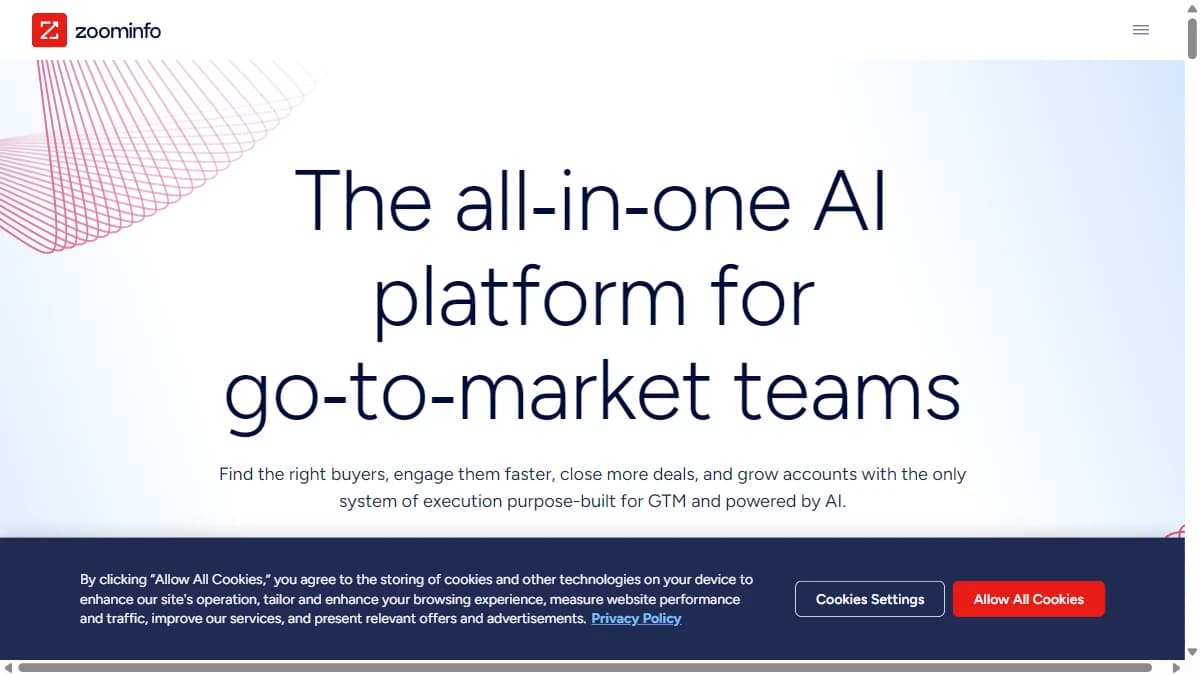
ZoomInfo -- the largest B2B contact database with intent data and org charts
ZoomInfo is the enterprise-grade contact database that Apollo aspires to be. With over 300 million professional profiles and 100 million company records, ZoomInfo has the largest B2B database on the market. For enterprise sales teams with budget, it provides the most comprehensive contact data, org charts, and buyer intent signals available -- capabilities that Apollo and most smaller alternatives simply cannot match at the same depth.
ZoomInfo's buyer intent data, powered by Bombora, identifies companies actively researching topics related to your product (see our full ZoomInfo review). Combined with org charts that map decision-maker hierarchies and direct dial phone numbers, this gives enterprise AE teams the context they need to prioritize accounts and multi-thread into organizations. These are features that Apollo offers in limited form on its highest-tier plans, but ZoomInfo delivers them as core capabilities.
The catch is price. ZoomInfo contracts typically start at $15,000 per year and can run into six figures for larger teams. There is no self-serve signup, no transparent pricing page, and contracts are annual with auto-renewal clauses that are notoriously difficult to cancel. For SMBs and startups, ZoomInfo is almost always overkill. For enterprise teams with 10+ reps who need the deepest possible data, it remains the industry standard -- though teams increasingly use waterfall enrichment platforms to get comparable coverage at a fraction of the cost.
Pros
- + Largest B2B database: 300M+ contacts, 100M+ companies
- + Buyer intent data (Bombora) for account prioritization
- + Org charts and decision-maker mapping
- + Direct dial phone numbers with high accuracy
- + Native integrations with every major CRM and sales tool
Cons
- - $15k+/yr minimum -- not viable for small teams or startups
- - No transparent pricing -- requires sales call
- - Annual contracts with aggressive auto-renewal
- - Credit limits can restrict usage even on paid plans
Best for: Enterprise sales organizations with 10+ reps and budget for premium data who need the deepest contact database, intent signals, and org chart intelligence available.
Pricing: Custom pricing only. Typical contracts start at $15,000/yr for small teams. Mid-market and enterprise plans range from $25,000 to $100,000+/yr depending on seats, credits, and add-ons.
5. MoltSets -- Verified B2B Contact Data via API or Claude
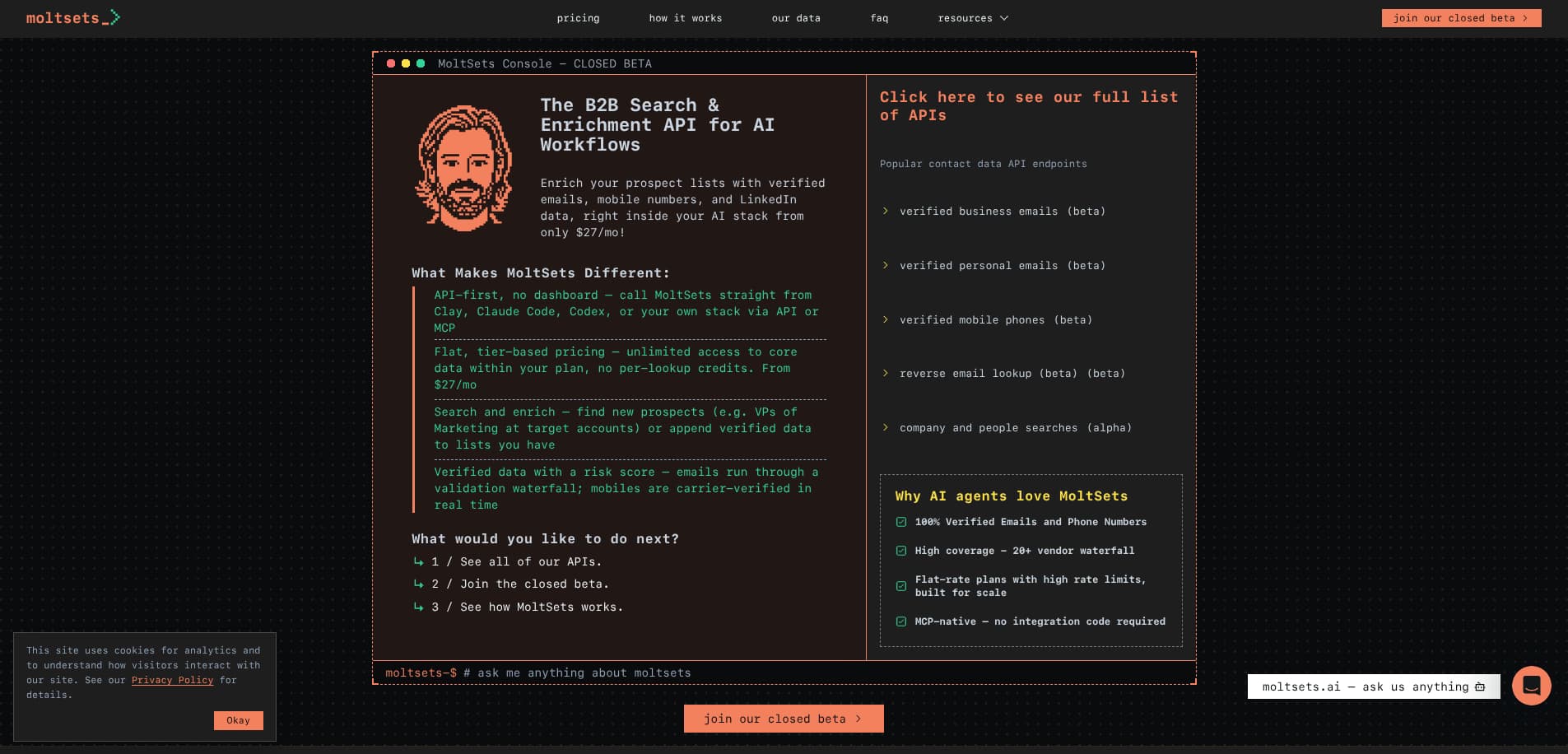
MoltSets -- verified B2B contact data via API or by connecting to Claude
MoltSets gives sales, marketing and RevOps teams a single source of verified contact data for the jobs most teams run every week: building outbound lists, finding and verifying emails before a send, adding mobile numbers, and keeping CRM records complete. From a name and company, a LinkedIn URL, or an email, it returns business and personal emails, mobile numbers, and full business profiles. It also offers people and company search for list building.
Developers can call the API to enrich CRM records, inbound leads or bulk lists on a schedule. Everyone else can connect MoltSets to Claude and ask for what they need in plain English, such as "find the work emails for these 50 VPs" or "enrich this account list with mobile numbers." Plans are flat monthly tiers priced by volume rather than per-credit, so costs stay predictable as usage grows.
Pros
- + Verified business and personal emails, mobile numbers, and full business profiles from a name, LinkedIn URL or email
- + Works for non-technical teams through Claude, and for engineering teams through the API
- + Flat monthly plans priced by volume, with no per-record credit burn on standard enrichment
- + People and company search for building outbound lists
- + Free tier with 1,000 lifetime tokens to test before committing
Cons
- - Newer platform with a smaller community than established players
- - Mobile numbers require a separate phone-token add-on
- - No built-in sequencing or native CRM sync; you pair it with your outreach tool or push records via API
Best for: Verified B2B contact data via API or Claude without a UI.
Pricing: Free tier (1,000 lifetime tokens). Paid plans from $27/mo, flat monthly tiers priced by volume. Mobile numbers need a separate phone-token add-on.
Side-by-Side Comparison: Apollo Alternatives in 2026
| Tool | Best For | Free Tier | Starting Price | Standout Feature |
|---|---|---|---|---|
| SyncGTM | All-in-one GTM automation with waterfall enrichment | Yes | $49/mo | Waterfall enrichment across 50+ providers, AI web scraper, workflow builder, signals monitoring |
| Explorium.ai | AI-powered enrichment with predictive lead scoring | Yes (100 credits) | $29.99/pkg | Predictive models for scoring and segmentation across external datasets |
| Instantly | Cold email at scale with unlimited accounts | No | $30/mo | Unlimited email accounts, built-in warmup, and campaign sequencing |
| ZoomInfo | Enterprise contact databases and intent data | No | $15k+/yr | Largest B2B contact database with org charts and buyer intent signals |
| MoltSets | Verified B2B contact data via API or Claude | Yes (1,000 tokens) | $27/mo | Same verified contact data via API or by connecting to Claude, on flat monthly plans |
How to Choose the Right Apollo Alternative
- If you want better enrichment + workflow automation in one platform -- go with SyncGTM. Waterfall enrichment across 50+ providers, AI web scraper, signals monitoring, and CRM push -- all from $49/mo.
- If you want enrichment and account scoring in one pass -- go with Explorium.ai. A broad external dataset catalog plus predictive models rank accounts before your reps touch them.
- If cold email volume and deliverability are your top priority -- go with Instantly. Unlimited email accounts and built-in warmup at $30/mo make it the best pure sending platform.
- If you need enterprise-grade data and have the budget -- go with ZoomInfo. Largest database, intent data, org charts -- but expect to pay $15k+/yr minimum.
- If you need verified B2B contact data via API or Claude -- go with MoltSets. Flat monthly plans priced by volume keep costs predictable as usage grows.
Many teams combine two tools from this list: one for enrichment (SyncGTM or Explorium.ai) and one for outreach (Instantly). This split approach often delivers better results than Apollo's all-in-one model, because each tool focuses on what it does best instead of trying to be everything. For a broader look at the enrichment landscape, see our guide to the best CRM data enrichment tools.
Final Verdict
Apollo works for teams that want a simple, all-in-one platform and do not need deep enrichment or high-volume sending. But if you have hit Apollo's ceiling -- on data quality, email accuracy, workflow automation, or pricing -- one of these five alternatives will serve you better.
For most B2B sales and GTM teams, the best Apollo replacement is SyncGTM. It solves Apollo's core limitation -- single-source data -- with waterfall enrichment across 50+ providers, adds AI web scraping and signals monitoring that Apollo does not offer, and starts at $49/mo with a free tier available. Pair it with Instantly for cold email sending and you have a stack that outperforms Apollo on both data quality and outreach deliverability.
Ready to switch from Apollo? SyncGTM gives you deeper enrichment, better data, and workflow automation -- starting free. Start free -- no credit card required. Or book a demo to see the enrichment workflow live.
This post was last reviewed in March 2026. Pricing and feature data verified against vendor websites.