

What Sales Intelligence and B2B Prospecting Software Has the Best Customization Options: Side-by-Side for 2026

By Kushal Magar · May 27, 2026 · 13 min read · Last updated: September 28, 2026
Key Takeaway
SyncGTM wins on workflow customization — configurable waterfall enrichment across 50+ providers with custom CRM field mapping. Explorium.ai wins for API-level data access, with 4,000+ signals available to custom agents and workflows. Apollo.io is the best-value customizable option at $49/mo. ZoomInfo leads enterprise custom integrations but costs $15k+/year. Match the tool to how deep your customization actually needs to go.
TL;DR
- SyncGTM — Best workflow customization. Configurable waterfall enrichment across 50+ providers, custom field mapping, CRM push logic. Starts at $99/mo. Free tier available.
- Explorium.ai — Best for custom data access. 146M+ companies, 767M+ profiles, and 4,000+ signals via API, MCP server, and Vibe Prospecting. Free trial (100 credits), then from $29.99 per credit package.
- Apollo.io — Best-value customization. 65+ search filters, sequence branching, A/B testing, CRM field mapping. From $49/mo.
- ZoomInfo — Best enterprise custom integrations. 300+ native connectors, custom Salesforce field mapping, GTM Workspace AI agents. Starts ~$15k/year.
- Cognism — Best compliance-first customization. Intent data segmentation, custom GDPR filters, phone-verified mobile lists. Annual contracts from ~$15k/year.
- Lusha — Solid baseline customization. Custom list segments, team permissions, CRM field push. From $49/mo.
- SalesIntel — Best custom research targeting. Research-on-demand for custom company lists, human-verified contacts. Custom pricing.
Why Customization Matters in Sales Intelligence
Most B2B sales teams don't have generic ICPs. A SaaS company selling to fintech CTOs in Series B companies needs different filters, fields, and enrichment logic than an agency selling to e-commerce CMOs in North America.
Generic tools return generic results. Customization — at the filter, field, workflow, and integration layer — is what turns a database into a targeted prospect list your team can actually work.
According to G2's 2026 Sales Intelligence category data, the top buyer complaints are: too few filter options, inability to map enrichment data to custom CRM fields, and rigid workflows that don't match how the team actually prospects. The seven tools below are ranked on how well they solve exactly those problems.
For broader context, see our comparison of sales intelligence software with the best scalability and our breakdown of which B2B prospecting platforms have the best integrations.
1. SyncGTM
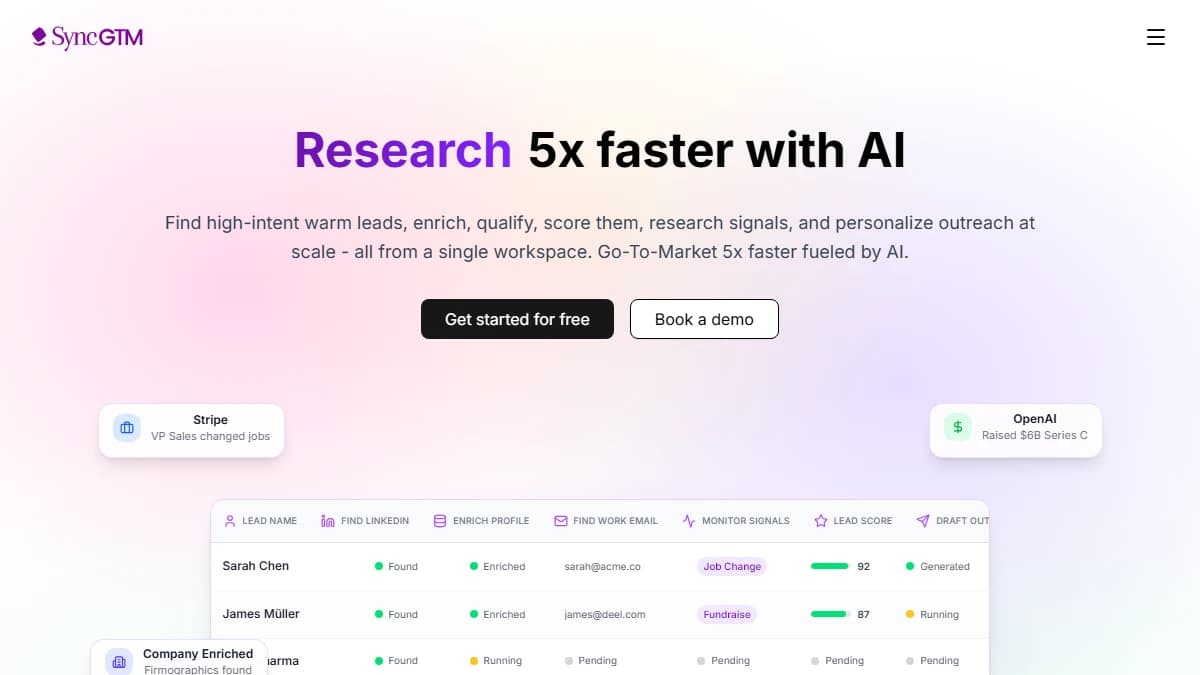
SyncGTM — build custom enrichment workflows across 50+ data providers with no-code field mapping and CRM push logic
SyncGTM is a data-first GTM platform built around a customizable waterfall enrichment engine. Instead of fixed templates, you build your own enrichment sequence — deciding which of 50+ providers to query, in what order, with what fallback conditions, and how each result maps to your CRM fields.
For teams with specific ICP definitions, this depth matters. You can route different contact types through different enrichment paths, trigger CRM updates only when specific fields are populated, and use the AI web scraper to fill custom fields that no database covers. According to SyncGTM's own benchmarks, waterfall enrichment typically achieves 70–85% contact coverage vs. 40–60% from single-source tools.
SyncGTM is not an all-in-one. It does not include built-in email sequencing. It integrates with Outreach, Salesloft, HubSpot, and Salesforce to push enriched data downstream.
Pros
- Fully customizable waterfall enrichment — choose providers, order, and fallback logic per workflow
- Custom field mapping to any CRM object — not limited to standard contact fields
- AI web scraper for real-time custom data extraction from company websites
- Conditional workflow branching — different enrichment paths for different contact segments
- Month-to-month billing — no commitment as your needs evolve
Cons
- No built-in outreach sequences — requires integration with Outreach, Salesloft, or HubSpot
- Steeper initial setup than Apollo or Lusha — workflow builder rewards investment
Best for: RevOps teams, data-first GTM builders, and SDR teams that need precise ICP targeting across multiple enrichment sources.
Pricing: Free tier available. Paid plans from $99/mo. Month-to-month.
2. Explorium.ai
Explorium.ai — company, contact, and signal data through the AgentSource API, a hosted MCP server, and Vibe Prospecting
Explorium.ai is a B2B data platform that gives teams programmatic control over their prospecting data instead of a fixed search screen. Its AgentSource API and hosted MCP server resolve, fetch, enrich, and monitor records across 146M+ companies and 767M+ professional profiles, so you decide which attributes to pull and what logic to run on them.
Explorium.ai's customization sits at the data layer. Want companies that recently raised funding, changed their tech stack, and are hiring, enriched with contacts and passed to your AI agent? You can build that from its 4,000+ signals and company and prospect enrichment, or describe it in plain English in Vibe Prospecting. The trade-off: there is no spreadsheet-style workflow builder, and the deepest customization assumes comfort with an API or MCP setup.
Pros
- API and hosted MCP server — build your own prospecting logic on top of the data
- 4,000+ data signals, including funding, hiring, job changes, and tech changes
- Vibe Prospecting — build and enrich custom lists from plain-English prompts
- Firmographic, technographic, funding, and workforce data for custom segments
Cons
- No spreadsheet-style workflow builder — customization runs through the API, MCP, or prompts
- Enrichments cost 1-5 credits each, and custom CRM integrations require the Enterprise plan
- No built-in email sequencing or dialer — pair it with lemlist, Outreach, or a similar engagement tool
Best for: RevOps engineers and teams building AI agents who want full control over which company, contact, and signal data they pull and how they use it.
Pricing: Free trial (100 credits). Credit packages from $29.99 (500 credits). Enterprise custom.
3. Apollo.io
Apollo.io — 275M+ contact database with 65+ search filters, sequence branching, and custom CRM field mapping
Apollo.io is a sales intelligence and engagement platform that combines a 275M+ contact database with one of the most configurable filter sets in the self-serve market. With 65+ search attributes — from job change alerts and funding rounds to technographics and hiring signals — teams can narrow a 275M database to a few hundred exactly-right contacts.
Customization extends to sequences. Apollo's sequence builder supports A/B testing on subject lines and body copy, conditional branching based on prospect actions, and automatic CRM field updates triggered by email opens or replies. For $49/mo, this is the deepest out-of-the-box customization at any self-serve price point.
Pros
- 65+ search filters — technographic, firmographic, intent, and behavioral signals
- Sequence A/B testing and conditional branching — customize outreach by segment
- CRM field mapping with Salesforce and HubSpot — push enriched data to custom objects
- Saved search templates — reuse custom filter combinations for recurring ICP lookups
- API access on paid plans — build custom enrichment pipelines with Apollo data
Cons
- Phone number accuracy lags Cognism — direct dials sit around 40–50% vs. Cognism's 70%+
- Credit caps limit high-volume customized searches without plan upgrade
Best for: Mid-market teams that want deep filter customization, sequence logic, and CRM integration in one affordable platform.
Pricing: Free tier available. Paid plans from $49/mo per user.
4. ZoomInfo
ZoomInfo — enterprise custom integrations with 300+ connectors, custom Salesforce field mapping, and GTM Workspace AI agents
ZoomInfo is the enterprise default for teams that need custom data pipelines embedded directly into their CRM and engagement stack. Its 300+ native integrations cover everything from Salesforce and HubSpot to Outreach, Salesloft, Marketo, and Gong — with configurable field mapping at each connection.
ZoomInfo's 2026 GTM Workspace AI agents add a new customization layer: AI that analyzes your ICP and automatically identifies matching prospects, segments audiences by intent signals, and triggers CRM workflows based on real-time company changes. For enterprise teams with defined RevOps infrastructure, this is genuinely powerful. For teams under 20 reps, it's expensive infrastructure to maintain.
Pros
- 300+ native integrations — widest pre-built connector library of any platform
- Custom Salesforce and HubSpot field mapping at the object level
- GTM Workspace AI agents — auto-identify prospects matching custom ICP criteria
- Intent data with custom topic tracking — build custom intent segments for your market
- Conversation intelligence (Chorus) — custom call scoring and keyword tracking
Cons
- Starts ~$15,000/year — customization is locked behind enterprise contracts
- Auto-renewal clauses make it hard to downsize after customizing your stack around it
- Custom API access gated and usage-limited — not self-serve
Best for: Enterprise RevOps teams with 20+ reps, mature CRM infrastructure, and budget for deep custom data integrations.
Pricing: Custom quotes only. Starts ~$15,000/year. No free tier.
5. Cognism
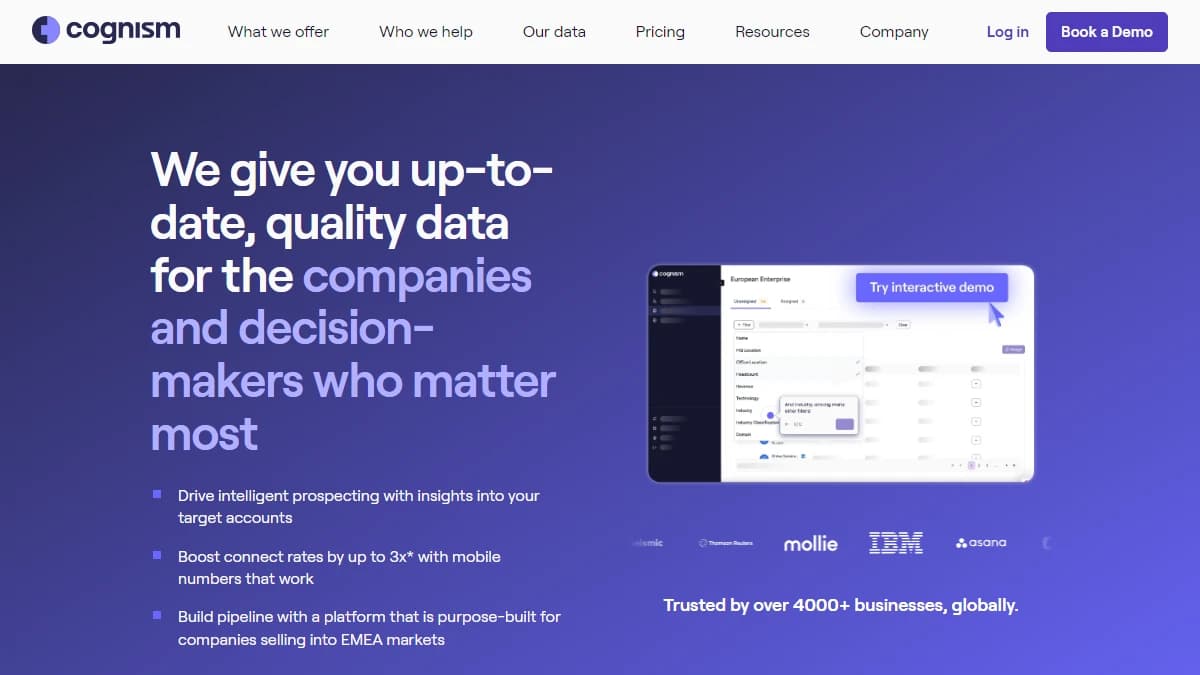
Cognism — customizable intent segments and compliance-first filter logic for European and global enterprise teams
Cognism offers a specific type of customization that most competitors lack: compliance-aware filter logic. You can build custom prospect lists that automatically exclude contacts on DNC registers, apply jurisdiction-specific consent rules, and segment by country-level GDPR status — all within the filter interface rather than in a separate compliance tool.
Intent data customization is also a standout. Cognism's Bombora integration lets teams build custom intent topic clusters — tracking specific combinations of research signals that indicate buying intent for their product. For European enterprise teams, this compliance-first customization combined with phone-verified mobile data (70%+ connect rates) is hard to replicate elsewhere.
Pros
- Custom intent topic tracking via Bombora — build bespoke intent segments
- Compliance-aware filter logic — DNC, GDPR, and consent rules built into search
- Unlimited exports on most plans — no credit limits on custom list sizes
- Custom CRM field mapping for Salesforce and HubSpot sync
Cons
- Annual contracts from ~$15k — no self-serve or monthly option
- Customization depth thins outside European market data
- No built-in sequence builder — customization stops at data, not outreach
Best for: European enterprise teams or global teams where compliance-first custom filtering is a hard requirement.
Pricing: Annual contracts from ~$15,000/year. No free tier.
6. Lusha
Lusha — custom list segments, team-level permission controls, and CRM field mapping for phone-first prospecting teams
Lusha is a contact data platform with 100M+ records that offers solid baseline customization for teams whose primary motion is phone-first outreach. Custom list segments, saved filter sets, and team-level permission controls cover most mid-market customization needs without requiring a heavy setup.
Lusha's customization depth is narrower than SyncGTM or Apollo at the workflow and integration level. But for teams that primarily need configurable contact filters, branded list exports, and a CRM that auto-populates custom contact fields, Lusha delivers those capabilities cleanly at $49/mo.
Pros
- Saved filter sets — reuse custom search configurations across the team
- Team permission controls — segment data access by role or region
- CRM field mapping with Salesforce and HubSpot — push verified phones to custom objects
- Chrome extension — custom enrichment on LinkedIn and company sites
Cons
- Workflow customization is minimal — no multi-step enrichment logic or conditional branching
- Credit model penalizes large custom list builds without Scale plan
- No intent data or AI-generated custom fields
Best for: SMB and mid-market phone-first prospecting teams that need configurable contact filters and CRM mapping without heavy workflow complexity.
Pricing: Free (50 credits/mo). Paid from $49/mo. Scale plan for high-volume custom lists.
7. SalesIntel
SalesIntel — research-on-demand with custom technographic and firmographic filters for human-verified contact targeting
SalesIntel offers a unique form of customization: research-on-demand. If your target list includes companies that aren't well-represented in standard B2B databases, SalesIntel's research team will manually source and verify contacts for those specific accounts. This is custom targeting at the account level — not just filter-level ICP matching.
Its technographic filter depth is also a standout. Teams can build custom segments by specific tech stack combinations — for example, companies running Salesforce + Marketo + AWS that have posted a VP of RevOps role in the last 90 days. For ABM-focused teams with a tight ICP, this precision is valuable. The 22M human-verified contact ceiling limits breadth for large-volume outbound.
Pros
- Research-on-demand — custom contact sourcing for specific target accounts
- Deep technographic filters — build custom segments by tech stack combinations
- Human-verified contacts re-verified every 90 days — 95% accuracy claim
- Custom buyer intent data integration with Bombora
Cons
- 22M human-verified contacts — smaller database limits customization for broad ICPs
- Custom pricing only — no self-serve tier to evaluate customization features before committing
- No built-in outreach or sequence customization
Best for: ABM-focused teams with tight ICPs who need custom account-level research and deep technographic segmentation.
Pricing: Custom quotes. Roughly $5,000–$25,000/year. Unlimited seat model on most tiers.
Side-by-Side Comparison
| Tool | Workflow Builder | Custom Fields | Filter Depth | Integrations | Starting Price |
|---|---|---|---|---|---|
| SyncGTM | Yes — waterfall + conditionals | Full custom mapping | 50+ provider attributes | HubSpot, Salesforce, Outreach, Salesloft | $99/mo |
| Explorium.ai | API + MCP (no visual builder) | Firmographic, technographic, signal attributes | 4,000+ data signals | Salesforce, HubSpot, Claude via MCP | $29.99/pkg |
| Apollo.io | Sequence branching + A/B | CRM object mapping | 65+ search filters | Salesforce, HubSpot, Outreach, API | $49/mo |
| ZoomInfo | GTM AI agents + triggers | Custom Salesforce objects | Enterprise-grade | 300+ native connectors | ~$15k/year |
| Cognism | No built-in workflow | Standard + CRM mapping | GDPR + intent segments | Salesforce, HubSpot, Outreach | ~$15k/year |
| Lusha | No workflow builder | CRM field push | Standard contact filters | Salesforce, HubSpot, Chrome extension | $49/mo |
| SalesIntel | Research-on-demand | Technographic segments | Tech stack combinations | Salesforce, HubSpot, Bombora | ~$5k/year |
How to Choose the Right Customizable Tool
Customization needs vary by team type and motion. Match the tool to the layer where you actually need flexibility:
- Workflow customization (enrichment logic): SyncGTM for waterfall + CRM field routing. Explorium.ai if you want to build your own logic on company, contact, and signal data through an API or MCP server.
- Filter customization (finding the right contacts): Apollo.io for 65+ self-serve filters at $49/mo. ZoomInfo for enterprise-grade intent + technographic filter depth with a budget.
- Compliance-first customization: Cognism, no competition. GDPR-aware filters and DNC exclusion logic are built into the search layer.
- Account-level custom research:SalesIntel's research-on-demand covers accounts that standard databases miss. Best for tight ABM lists.
- Light customization, lowest cost:Lusha at $49/mo covers saved filters, CRM push, and team permissions for teams that don't need workflow depth.
For more on building a customized outbound stack, see our guide to the best waterfall contact providers in 2026 and our breakdown of cost-effective B2B lead generation and sales intelligence pricing models.
Final Verdict
If customization is the primary buying criteria, the answer depends on where in your stack you need it.
SyncGTM wins at the enrichment workflow layer — waterfall logic, conditional routing, and custom CRM field mapping make it the most configurable data pipeline tool at $99/mo. Explorium.ai wins at the data-access layer — an API, a hosted MCP server, and 4,000+ signals let teams build custom prospecting logic and AI agents on top of its data. Apollo.iois the best-value all-in-one — 65+ filters, sequence branching, and CRM mapping at $49/mo covers most teams' customization needs without complexity tax.
Enterprise teams with mature RevOps infrastructure should evaluate ZoomInfo for its 300+ integration depth and AI-driven custom workflow automation. European teams should go to Cognism first for compliance-aware custom filtering. ABM teams with tight target account lists will find SalesIntel's research-on-demand uniquely useful.
For a deeper look at the underlying enrichment architecture, see our post on the best waterfall email finders in 2026 and our guide to B2B lead generation tools with excellent usability.