


What Sales Intelligence, Lead Generation, and B2B Prospecting Software Has the Best Integrations: Expert Picks for 2026

By Kushal Magar · May 22, 2026 · 13 min read
Key Takeaway
Integration quality matters more than database size for most GTM teams. SyncGTM wins on workflow flexibility — it connects enriched data to any CRM, outreach tool, or automation platform via its workflow builder and API. Apollo.io wins on self-serve integration breadth for SMB and mid-market. ZoomInfo wins on enterprise-grade native Salesforce depth. Choose based on your stack, not just the data.
TL;DR
- SyncGTM — Best workflow integration flexibility. Connects enrichment from 50+ providers to CRM, outreach platforms, and automation tools via workflow builder + API. Starts at $49/mo.
- Apollo.io — Best self-serve integration breadth. Native HubSpot, Salesforce, Salesloft, Outreach.io, and Zapier — all on the free plan. $49/mo paid.
- ZoomInfo — Deepest enterprise CRM integration. Bidirectional Salesforce sync, Marketo, and Chorus conversation intelligence. Starts ~$15k/year. Enterprise only.
- Cognism — Best outreach platform integration for EMEA teams. Native Salesloft and Outreach.io with GDPR-compliant data. Annual contracts from ~$15k.
- Lusha — Best one-click CRM push. Chrome extension enriches and syncs to Salesforce or HubSpot without leaving LinkedIn. Free tier (50 credits/mo).
- Hunter.io — Best lightweight API integration. Well-documented REST API, Zapier, Make, and HubSpot — ideal for developers and small teams. Free tier available.
- RocketReach — Solid mid-market integration breadth. Salesforce, HubSpot, Outreach, Salesloft, and Zapier in one platform. From $53/mo.
- TitanX — Best phone intent layer for dialers. Stack-agnostic: sits on top of any data provider, phone system, or sales engagement platform. Custom impact-based pricing.
Why Integration Quality Matters in Sales Intelligence
A sales intelligence tool with a great database but weak integrations creates more work than it saves. SDRs manually export CSVs, data stales before it reaches the CRM, and enrichment never makes it into the outreach sequence.
According to G2's 2026 Sales Intelligence category data, CRM integration quality is the top buyer evaluation criterion — ahead of database size and pricing. Teams that run tight sales stacks lose hours per week when enrichment data doesn't flow automatically to where reps actually work. According to Salesforce's State of Sales report, sales reps spend 72% of their time on non-selling activities — manual data entry and tool-switching being the top two time sinks.
The tools below are ranked specifically on integration quality across three dimensions: CRM integrations (Salesforce, HubSpot, Pipedrive), outreach platform integrations (Salesloft, Outreach.io, Instantly), and workflow/automation integrations (Zapier, Make, native API).
For broader context, see our guide to B2B sales prospecting tools and our breakdown of what waterfall enrichment is and how it works.
1. SyncGTM
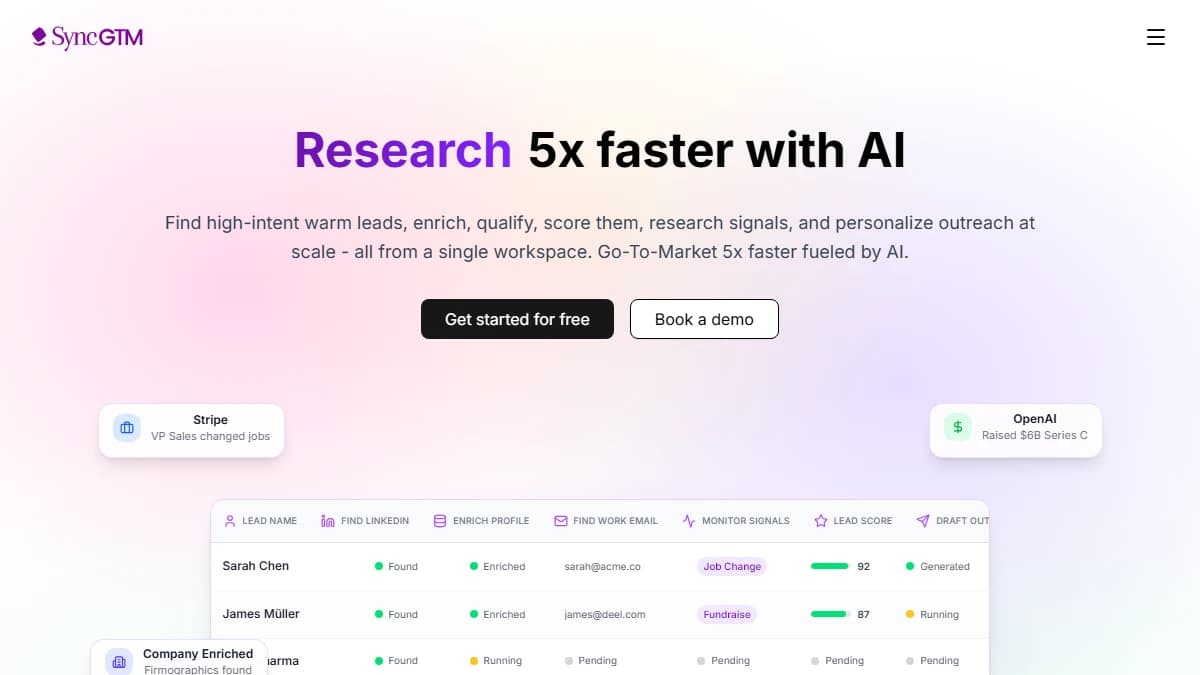
SyncGTM — workflow builder connects waterfall enrichment to CRM, outreach, and automation platforms automatically
SyncGTM is a data-first GTM platform built around waterfall enrichment and workflow automation. Where most enrichment tools stop at exporting a CSV, SyncGTM's workflow builder pushes verified contact and company data directly to your CRM, outreach platform, and Slack — triggered automatically on import, enrichment completion, or scoring threshold.
The integration architecture is the real differentiator. SyncGTM connects to Salesforce and HubSpot natively, supports Outreach.io and Salesloft via webhook push, and exposes a full REST API for teams that want custom integrations. For RevOps teams running multi-step enrichment workflows, this eliminates the manual handoff that breaks most prospecting pipelines.
Pros
- Workflow builder with native CRM push — enrichment flows to Salesforce or HubSpot without manual steps
- Full REST API with self-serve docs — no enterprise contract needed for API access
- Webhook support for any downstream tool — Outreach, Salesloft, Instantly, Slack, or custom endpoints
- Zapier and Make compatible — integrate with 6,000+ apps without code
- Pay-per-verified-result model — CRM records only receive data when enrichment succeeds
Cons
- No built-in email sequencing — requires connecting to a separate outreach platform
- Workflow setup has a learning curve for non-technical users
Best for: RevOps teams and data-first GTM teams that want enrichment to flow automatically into every tool in their stack.
Pricing: Starts at $99/mo. Free tier available. Month-to-month billing.
2. Apollo.io
Apollo.io — 275M+ contact database with the broadest self-serve integration stack at SMB pricing
Apollo.io has the widest self-serve integration breadth of any B2B prospecting platform. Native connections to Salesforce, HubSpot, Pipedrive, Outreach.io, Salesloft, and Zapier are all available on the free plan — no upgrade required to connect your stack. For SMB and mid-market teams, this makes Apollo the most practical choice when integration setup speed matters.
Apollo's CRM sync is bidirectional — contact, company, and activity data flow both ways. Sequences trigger from CRM deal stage changes. Enrichment can run automatically on new CRM contacts. The platform also has a Salesforce Chrome extension that surfaces Apollo data inline on CRM records without leaving Salesforce.
Pros
- Native HubSpot, Salesforce, Pipedrive, Outreach.io, and Salesloft — all available on the free plan
- Bidirectional CRM sync — sequences trigger from deal stage, contact status syncs back
- Zapier integration for custom workflows without engineering
- Salesforce Chrome extension — Apollo data visible inline on Salesforce records
- API access on paid plans — supports custom enrichment pipelines
Cons
- CRM sync can be inconsistent with complex Salesforce field mappings — G2 reviews note occasional duplicate contact issues
- Outreach and Salesloft integrations lack the depth of native connections compared to ZoomInfo
Best for: SMB and mid-market teams that want the broadest integration coverage without a multi-year contract.
Pricing: Free tier with full integrations. Paid plans from $49/mo per user.
3. ZoomInfo
ZoomInfo — enterprise-grade CRM integration with Salesforce, HubSpot, Marketo, and Chorus conversation intelligence
ZoomInfo has the deepest native CRM integration of any sales intelligence platform. Its Salesforce connector supports bidirectional sync, custom field mapping, opportunity enrichment, account scoring pushes, and real-time intent alerts triggered directly in Salesforce. HubSpot integration mirrors the same depth — including company hierarchy enrichment and Chorus call recordings synced to deal timelines.
ZoomInfo also integrates with marketing automation platforms — Marketo, Pardot, and Eloqua — making it the only prospecting tool that bridges sales intelligence and demand generation data in a single platform. For enterprise teams running account-based programs, that breadth is hard to replicate with point solutions.
Pros
- Deepest native Salesforce integration — field mapping, custom objects, intent push, and opportunity enrichment
- HubSpot, Marketo, Pardot, and Eloqua integrations — bridges sales and marketing data
- Chorus conversation intelligence syncs call recordings and transcripts to CRM timelines
- Real-time intent alerts push to Salesforce tasks and HubSpot workflows automatically
Cons
- Enterprise contract only — minimum ~$15,000/year. No self-serve or monthly billing.
- Integration setup requires professional services for complex Salesforce orgs — additional cost
- No Zapier support — custom integrations require ZoomInfo's own API, which is locked behind enterprise agreements
Best for: Enterprise sales teams with 20+ reps that need the deepest possible CRM integration and marketing automation bridging.
Pricing: Custom quotes only. Starts ~$15,000/year. No free tier.
4. Cognism
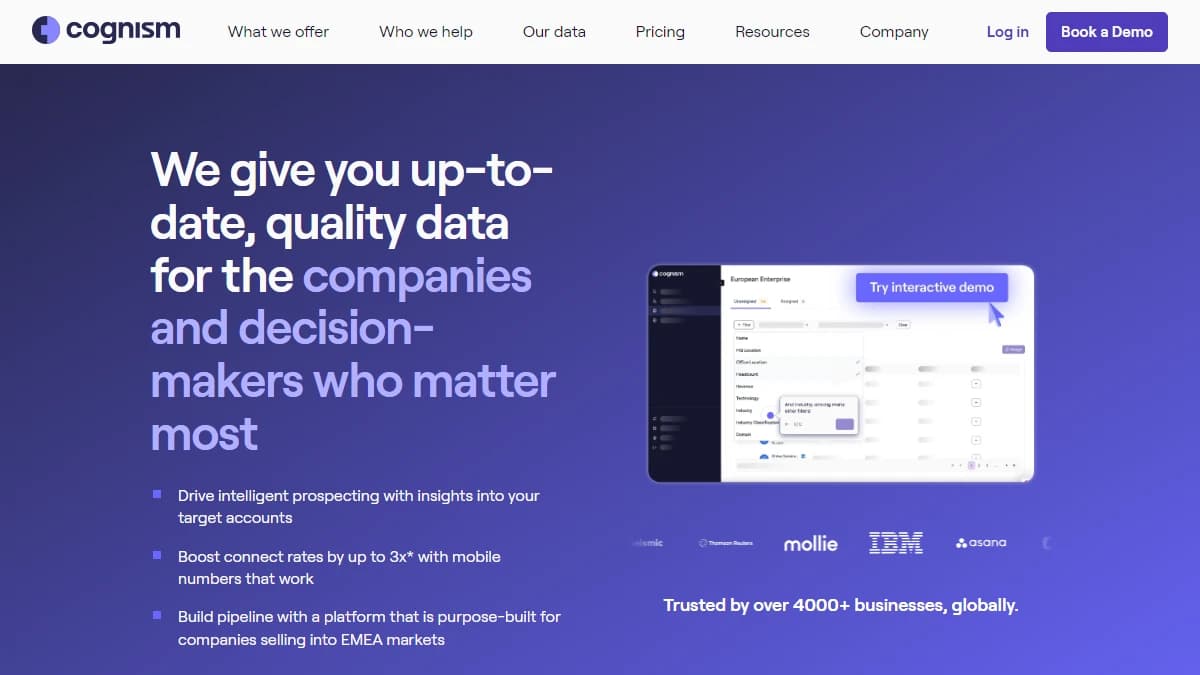
Cognism — native Salesforce, HubSpot, Outreach.io, and Salesloft integrations with GDPR compliance built into the data layer
Cognism offers a clean integration suite built for enterprise outbound teams. Native connectors exist for Salesforce, HubSpot, Outreach.io, Salesloft, and SalesLoft Dialer — with the key differentiator that all synced data carries Cognism's GDPR and CCPA compliance metadata. When a contact is synced to Salesforce, the lawful basis for processing travels with the record.
This compliance-aware integration model matters for European enterprise teams. Most CRM integrations push raw contact data and leave the legal team to figure out the rest. Cognism pushes data that's already been screened against Do Not Call registries and GDPR legitimate interest criteria before it hits your CRM.
Pros
- Native Salesforce, HubSpot, Outreach.io, and Salesloft integrations with GDPR compliance metadata
- DNC registry screening happens before data reaches your CRM — not after
- Chrome extension surfaces Cognism data inline on LinkedIn, company websites, and Salesforce
- Strong Salesloft and Outreach sequence triggering — contacts push directly into active cadences
Cons
- No Zapier integration — custom automation requires direct API or professional services
- Annual contracts from ~$15k — no self-serve monthly option
- API access is limited on lower tiers — full programmatic access requires enterprise contract
Best for: European enterprise teams that need compliance-aware CRM and outreach platform integration.
Pricing: Annual contracts from ~$15,000/year.
5. Lusha
Lusha — one-click Salesforce and HubSpot push from LinkedIn or company websites via Chrome extension
Lusha takes a different integration approach than the platforms above. Its Chrome extension lets reps push a single contact to Salesforce or HubSpot in one click — directly from LinkedIn, company websites, or Gmail. There's no separate prospecting session required. SDRs work where they already work, and data lands in the CRM automatically.
This simplicity is the integration story. Lusha doesn't have deep API access or complex bidirectional sync — it optimizes for friction reduction in the individual prospecting workflow. For teams where reps do their own prospecting, this is often more useful than a sophisticated server-side integration that requires RevOps to maintain.
Pros
- One-click Salesforce and HubSpot push from Chrome extension — no CSV export required
- Free tier (50 credits/mo) includes CRM integration — no paywall on the core value
- Zapier integration available for automating enrichment into other tools
- Works inline on LinkedIn, company websites, and Google Contacts
Cons
- No native Outreach.io or Salesloft integration — outreach platform users need to go through CRM or CSV
- No bidirectional CRM sync — Lusha pushes to CRM but doesn't pull CRM data back for enrichment
- API is limited and not suitable for high-volume programmatic enrichment
Best for: Sales teams where individual reps do their own prospecting and need a frictionless CRM push without leaving their browser.
Pricing: Free (50 credits/mo). Paid plans from $49/mo.
6. Hunter.io
Hunter.io — well-documented REST API and Zapier integration make it the best lightweight email finding layer for custom stacks
Hunter.io is the most integration-friendly email finding tool for developers and small technical teams. Its REST API is clean, well-documented, and free to use on the free plan — 25 requests/month without a credit card. Paid plans unlock rate limits without changing the API surface, making Hunter a reliable enrichment layer you can build on top of.
Native integrations include HubSpot, Salesforce (via Zapier), Make, and n8n. Hunter also has a Chrome extension that surfaces email patterns and verified addresses inline on any website or LinkedIn profile. For teams building lightweight lead gen pipelines, Hunter often serves as the enrichment step between a scraper and a CRM.
Pros
- Clean REST API with free tier — no contract required for API access
- Native HubSpot integration — syncs found emails directly to contacts
- Zapier, Make, and n8n support — connects to 6,000+ apps without code
- Bulk verification endpoint — verify email lists programmatically before they reach your CRM
Cons
- Email-only — no phone numbers, firmographics, or intent data
- No native Salesforce integration (requires Zapier or API workaround)
- No native Outreach.io or Salesloft integration
Best for: Technical teams and developers building custom lead gen pipelines that need a reliable, well-documented email enrichment API.
Pricing: Free (25 searches/mo). Paid plans from $49/mo.
7. RocketReach
RocketReach — solid mid-market integration breadth across Salesforce, HubSpot, Outreach, Salesloft, and Zapier
RocketReach covers the mid-market integration gap between Apollo's budget positioning and ZoomInfo's enterprise pricing. Native integrations exist for Salesforce, HubSpot, Outreach, Salesloft, Bullhorn, and Zapier — enough to connect RocketReach to most mid-market GTM stacks without custom development.
RocketReach's Chrome extension works across LinkedIn, AngelList, CrunchBase, and company websites — pushing found contacts to CRM with one click. The Salesforce and HubSpot integrations support field mapping and deduplication, which is the minimum required for reliable CRM hygiene at team scale.
Pros
- Native Salesforce, HubSpot, Outreach, Salesloft, and Bullhorn integrations — solid mid-market breadth
- Chrome extension works on LinkedIn, CrunchBase, and AngelList with one-click CRM push
- Zapier support for custom automation workflows
- Field mapping and deduplication in Salesforce and HubSpot connectors
Cons
- Integration depth is shallower than ZoomInfo — no bidirectional intent data sync or marketing automation support
- API is available but less well-documented than Hunter.io or Apollo
- Data accuracy for phone numbers lags Cognism and Lusha in European markets
Best for: Mid-market sales teams that need a broad integration layer without enterprise pricing.
Pricing: Starts at $53/mo per user.
8. TitanX
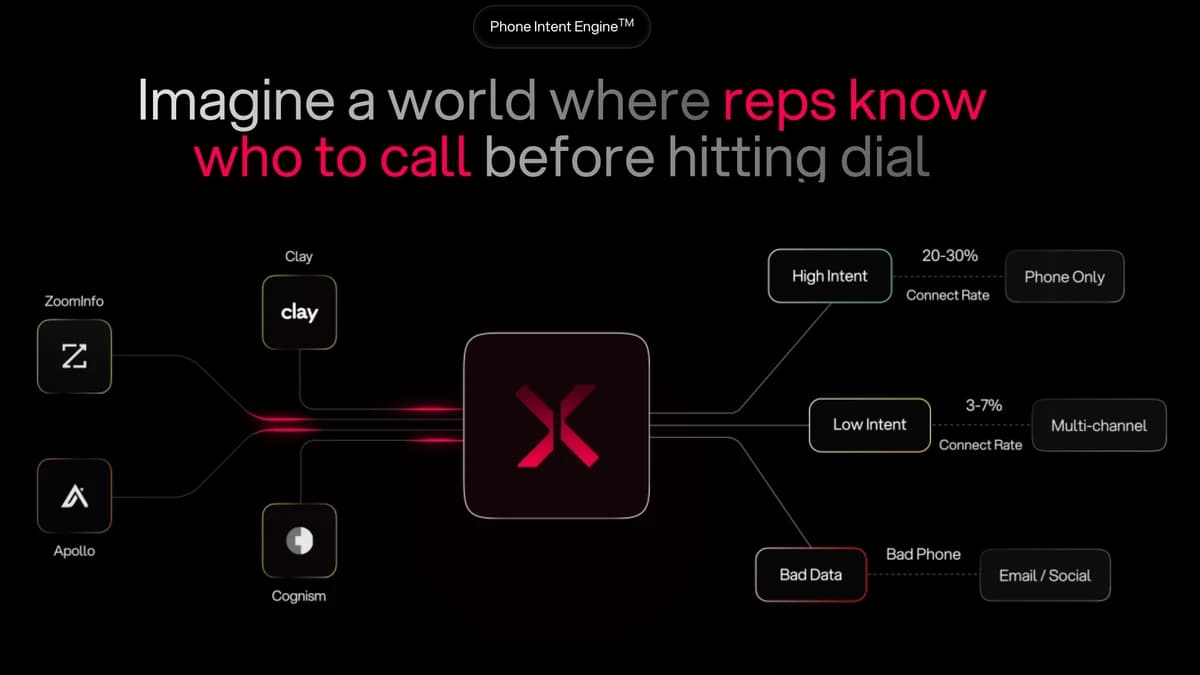
TitanX — Phone Intent Engine identifies active prospects to maximize dial-to-conversation ratios
TitanX is a specialized outbound intelligence platform built for the "Precision Era" of sales. Unlike tools that optimize for dial volume, TitanX focuses on conversation density by identifying which prospects are actually likely to answer. Its Phone Intent Engine™ analyzes behavioral patterns across 100 million+ phone numbers to surface the 20% of contacts who are active and reachable.
From an integration standpoint, TitanX is designed to be a "plug and play" layer that sits atop your existing GTM stack. It works natively with all major data providers, phone systems, and sales engagement platforms. By syncing directly with your dialer, it ensures reps only spend time on "at-bats" that have a high probability of connecting, effectively tripling connect rates without increasing headcount or burn.
Pros
- Stack-agnostic integration — works with any data provider, dialer, or sales engagement platform
- Immediate ROI — customers frequently report 3x to 5x increases in connect rates within the first week
- Reductions in "dead air" — prevents the caller reputation damage and spam flagging caused by parallel dialers
- Behavioral intelligence — identifies the 20% answer rate pattern to prioritize outreach
Cons
- Phone-focused — does not include multi-channel sequence builders or email automation features
- Dependent on existing stack — requires an active dialer and data source to realize Phone Intent value
Best for:Sales teams and SDR managers who want to maximize conversation density and stop "burning" accounts with high-volume, low-precision dialing.
Pricing:Impact-based pricing (not seat-based). Offers a 30-day pilot with a "3X connect rate or $10,000" guarantee.
Integration Comparison Table
| Tool | Salesforce | HubSpot | Outreach / Salesloft | Zapier / Make | API | Starting Price |
|---|---|---|---|---|---|---|
| SyncGTM | Native (bidirectional) | Native (bidirectional) | Webhook push | Yes / Yes | Full REST, self-serve | $49/mo |
| Apollo.io | Native (bidirectional) | Native (bidirectional) | Native both | Yes / No | Paid plans | $49/mo |
| ZoomInfo | Native (deepest) | Native (deep) | Native both | No / No | Enterprise only | ~$15k/year |
| Cognism | Native | Native | Native both | No / No | Enterprise tiers | ~$15k/year |
| Lusha | One-click push | One-click push | No native | Yes / No | Limited | $49/mo |
| Hunter.io | Via Zapier | Native | No native | Yes / Yes | Full REST, free tier | $49/mo |
| RocketReach | Native | Native | Native both | Yes / No | Available | $53/mo |
| TitanX | Via connected data provider | Via connected data provider | Native (all major SEPs) | Not published | Dialer + phone system sync | Custom (impact-based) |
How to Choose Based on Your Integration Needs
Integration requirements differ by team size, stack complexity, and technical resources. According to Gartner's B2B Buying Journey research, the average B2B sales team uses 10+ tools in their GTM stack — making native integrations a deciding factor for 67% of enterprise buyers. Five decision filters:
- You run Salesforce enterprise with Outreach or Salesloft: ZoomInfo or Cognism. Both have the deepest native connectors for this stack combination. ZoomInfo for North American teams; Cognism for European.
- You run HubSpot with sequences in Apollo or Instantly: Apollo.io. Native HubSpot bidirectional sync and built-in sequences eliminate the need for a separate outreach platform entirely.
- You need enrichment to flow into multiple tools automatically: SyncGTM. The workflow builder connects enrichment output to CRM, outreach platform, Slack, and custom endpoints in one automated flow. No manual steps.
- Your team does individual prospecting from LinkedIn: Lusha or Apollo. Both Chrome extensions push contacts to CRM without leaving the browser.
- You're building a custom lead gen pipeline as a developer: Hunter.io or SyncGTM API. Hunter for lightweight email finding. SyncGTM for multi-provider waterfall enrichment with CRM push built in.
- Your reps dial all day and nobody picks up: TitanX. It layers phone intent on top of whatever data provider, dialer, and sales engagement platform you already run — no stack migration required.
For teams evaluating the full prospecting stack, our post on good sales intelligence and lead generation platforms covers the full category landscape. Our waterfall contact provider comparison is worth reading if contact hit rate is the primary constraint.
See also: the sign-up enrichment workflow — a concrete example of how SyncGTM connects enrichment to CRM automatically.
Final Verdict
Integration quality is a better buying signal than database size for most teams. A platform with 500M contacts that requires manual CSV exports creates more ops burden than one with 100M contacts that pushes verified data to your CRM automatically.
Pick SyncGTM if you want enrichment to flow automatically into every downstream tool — CRM, outreach platform, Slack, and beyond — without engineering support. The workflow builder handles the routing; the waterfall enrichment handles the coverage.
Pick Apollo.ioif you're on a tight budget and want the broadest self-serve integration layer for a standard SMB stack (HubSpot + Salesforce + sequences in one place).
Pick ZoomInfoif you're an enterprise team that needs the deepest possible Salesforce and marketing automation integration, and you have the contract budget to match.
For more on building a connected outbound stack, see our guide to B2B sales prospecting tools and our breakdown of which B2B lead generation and sales intelligence companies are the best.