

Best Company Email List Databases for B2B Prospecting in 2026 (Ranked and Compared)

By Kushal Magar · April 27, 2026 · 14 min read
Key Takeaway
Single-source email databases miss 20–40% of records. Waterfall enrichment — stacking 50+ providers — lifts coverage to 90%+ at the same or lower cost per valid record. SyncGTM is the strongest option for GTM teams that need accuracy and flexibility. Apollo is the best all-in-one for SMBs. ZoomInfo wins on sheer database size for enterprise. Cognism leads for GDPR-compliant EU/UK prospecting.
TL;DR
| Tool | Best For | Starting Price | Verdict |
|---|---|---|---|
| SyncGTM | Teams needing waterfall coverage + signals | Free tier available | Best overall for GTM teams |
| Apollo.io | SMBs wanting database + sequencer in one | $49/mo | Best all-in-one for SMBs |
| ZoomInfo | Enterprise teams needing the largest database | ~$15,000/yr | Best raw coverage, highest cost |
| Cognism | EU/UK GDPR-compliant prospecting | ~$12,750/yr | Best for European markets |
| UpLead | Mid-market teams wanting verified credits | $99/mo | Best accuracy guarantee |
| Hunter.io | Founders doing domain-based email finding | $34/mo | Best for domain lookups |
| Lusha | LinkedIn-focused prospecting with phone | $29/mo | Best for LinkedIn + mobile |
| RocketReach | Individual contributors needing quick lookups | $53/mo | Solid mid-tier option |
B2B prospecting lives and dies on data quality. A stale email list means bounce rates above 10%, domain blacklists, and wasted rep hours chasing contacts who left their company six months ago.
This guide ranks the 8 best company email list databases for B2B prospecting in 2026 — evaluated on accuracy, pricing, integrations, and which audience each tool actually serves best.
Why Database Quality Matters for B2B Prospecting
According to Gartner, B2B contact data decays at roughly 25–30% per year. A list that was 85% accurate when you bought it will be 60% accurate 18 months later.
That decay rate means three things for outbound teams. First, bounce rates climb past the 5% threshold that triggers spam filters. Second, reps waste time on bad dials and undeliverable emails. Third, pipeline velocity slows because coverage gaps leave in-market accounts unreached.
The best databases in 2026 solve this with continuous refresh cycles, real-time verification at export, and waterfall enrichment that queries multiple sources to fill gaps no single provider covers. We evaluated all eight platforms on these criteria.
Want to understand how waterfall enrichment works before diving in? Read our guide on what waterfall enrichment is and how B2B teams use it.
1. SyncGTM
SyncGTM is a signal-driven GTM platform that solves the core problem with every other database on this list: single-source coverage gaps. Instead of pulling from one proprietary dataset, SyncGTM runs waterfall enrichment across 50+ underlying providers — including Apollo, Hunter, RocketReach, FindyMail, Datagma, and Dropcontact — and returns the first verified result.
For B2B prospecting teams, that means email coverage above 90% on most ICPs compared to 65–75% from any single source. SyncGTM also layers buying signals — job change alerts, hiring spikes, website traffic growth, recent funding — so you can prioritize in-market accounts rather than blasting static lists.
Pros
- Waterfall enrichment across 50+ providers lifts email hit rate to 90%+
- Built-in buying signals: hiring growth, job changes, funding events, tech installs
- Integrates with HubSpot, Salesforce, Pipedrive, Attio, Instantly, Smartlead, HeyReach, and 40+ more
- Only charges credits when a valid result is returned — no pay-for-misses
- API access for custom enrichment workflows
Cons
- Newer platform — smaller brand recognition than ZoomInfo or Apollo
- Proprietary database is smaller than Apollo or ZoomInfo; relies on waterfall to compensate
Best for: GTM teams that run outbound at scale and need the highest possible email coverage without enterprise pricing.
Pricing: Free tier available. Paid plans from $49/mo. Credits only consumed on successful enrichments.
SyncGTM is also the backbone for teams building automated outbound enrichment workflows that feed directly into their sequencers.
2. Apollo.io
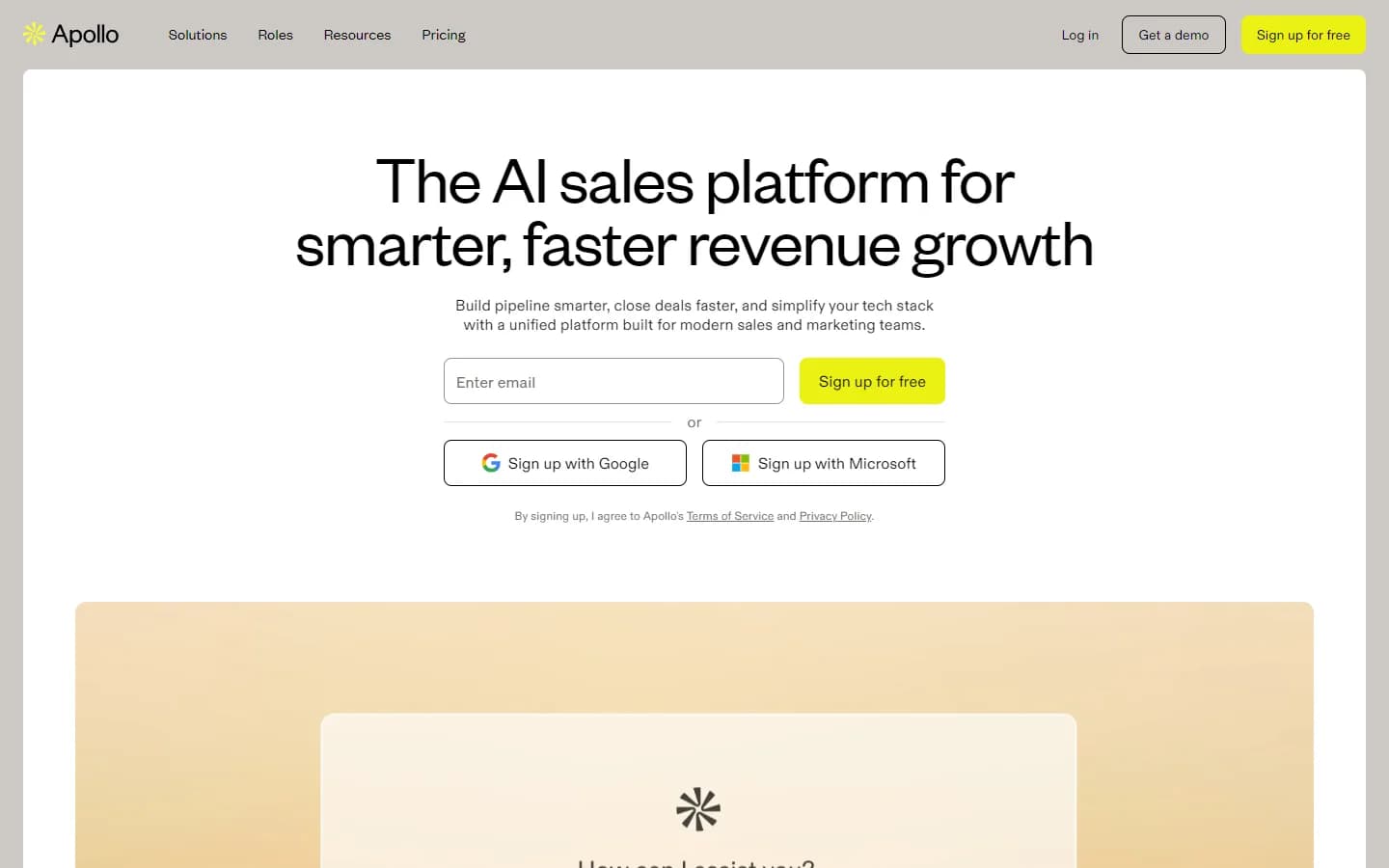
Apollo.io is the most popular all-in-one B2B prospecting platform for SMBs and growth-stage teams. Its database covers 260M+ contacts across 70M+ companies, paired with built-in email sequencing, AI lead scoring, and a Chrome extension for LinkedIn prospecting.
The appeal is obvious: one platform for finding and contacting prospects. The catch is coverage. Apollo's single-source database typically returns verified emails on 65–75% of records. Teams with niche ICPs or international targets often hit 50–60% coverage before needing a supplementary enrichment layer.
Pros
- 260M+ contacts — one of the largest B2B databases available
- Built-in email sequencer eliminates need for a separate tool
- AI lead scoring and intent signals on paid plans
- Chrome extension for LinkedIn and website prospecting
- Strong free tier (50 email credits/mo)
Cons
- Single-source coverage gaps — 25–35% of records return no valid email
- Data quality drops on non-US and non-enterprise contacts
- 5-seat annual pricing ($395/mo) adds up fast for small teams
- Sequencer has lower deliverability ceiling than dedicated cold email tools
Best for: SMBs and growth-stage teams that want database + outreach in one subscription.
Pricing: Free (50 credits/mo). Paid from $49/user/mo (annual). 5-seat bundle ~$395/mo.
See our full Apollo.io review for a detailed breakdown of hit rates, pricing tiers, and how it compares to alternatives.
3. ZoomInfo
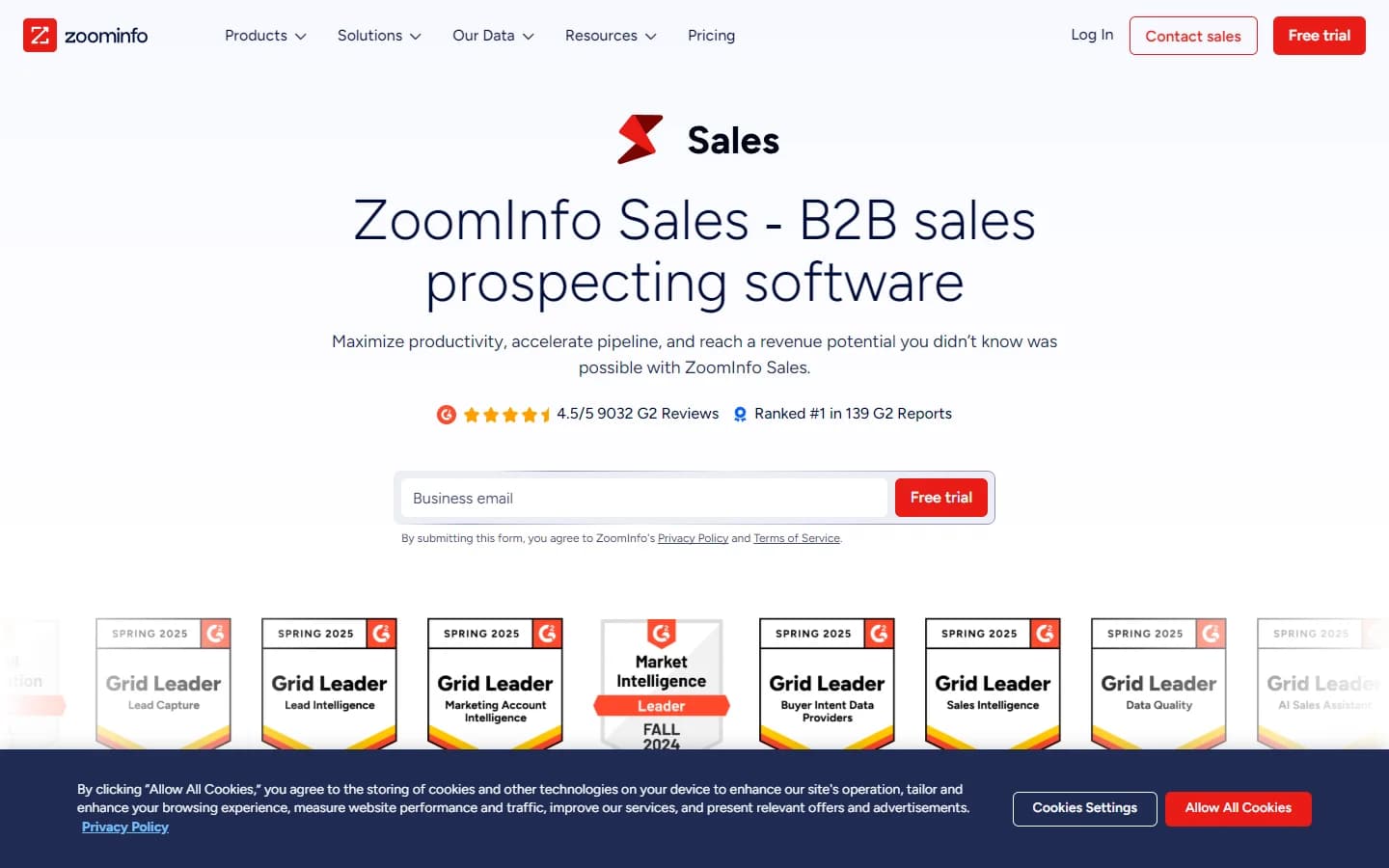
ZoomInfo is the market-leading enterprise B2B data platform with 100M+ verified business contacts and 35M+ company profiles. It combines contact data with buyer intent signals, technographic overlays, org charts, and deep CRM integrations — all in one platform.
ZoomInfo is overkill for most SMBs. It's designed for enterprise sales teams running account-based programs at scale. Entry pricing starts at approximately $14,995/year — and most real deployments with 5+ seats run $25,000–$35,000/year. For large teams working named-account lists, the depth of org chart data and buyer intent signals justifies the cost.
Pros
- 100M+ contacts — the largest verified B2B database on the market
- Org chart data: identify the right contact inside a target account
- Buyer intent signals: see which companies are actively researching your category
- Technographic data: filter by tech stack for precision ICP targeting
- Deep Salesforce and HubSpot integrations with bi-directional sync
Cons
- ~$15,000/year minimum — prohibitive for startups and small teams
- Annual or multi-year contracts with limited flexibility
- Data quality outside the US and UK drops noticeably
- Onboarding is complex; teams often under-use the platform in year one
Best for: Enterprise sales teams running ABM programs against large named-account lists in North America.
Pricing: Approximately $14,995/year for entry tier. 5–10 seats typically $25,000–$35,000/year.
4. Cognism
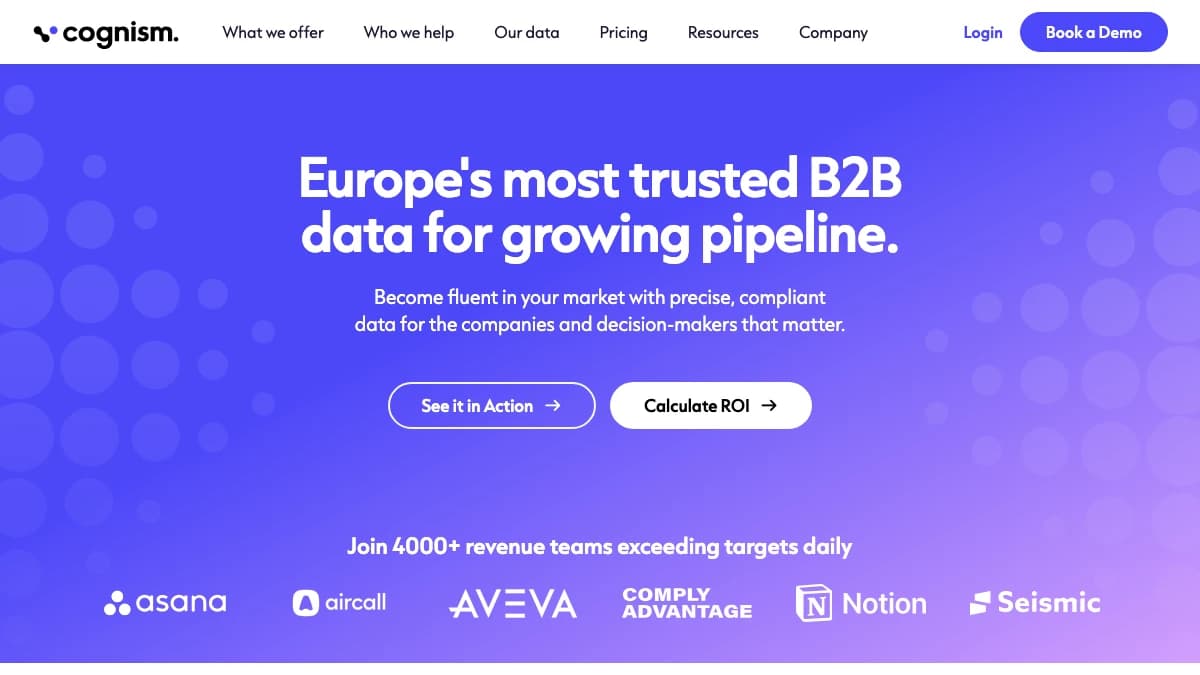
Cognism is the leading B2B contact database for teams prospecting into Europe, the UK, and EMEA markets. It covers 500M+ business profiles and 100M+ companies, with a critical differentiator: its Diamond Data tier uses human verification and opt-out suppression to maintain GDPR compliance at the data level.
For EU and UK outbound, Cognism is the safest enterprise choice. Its notified-state dataset means contacts have been notified their data is held in a B2B database — reducing GDPR exposure vs. scrape-based alternatives. The trade-off is cost: plans start around $12,750/year with five seats included.
Pros
- Notified-state GDPR compliance — safest option for EU/UK outbound
- Diamond Data: human-verified mobile numbers with high connect rates
- 500M+ profiles with continuous refresh cycles
- Buyer intent signals and account-level insights on higher tiers
- Strong EMEA and UK-specific data depth
Cons
- $12,750/year minimum — not viable for early-stage companies
- US data depth is weaker than ZoomInfo or Apollo
- Mobile coverage varies by country — strongest in UK, thinner in Southern Europe
Best for: B2B teams with significant EU/UK outbound that need defensible GDPR compliance baked into their data source.
Pricing: Standard ~$12,750/year. Pro ~$17,000/year. Both include five seats.
5. UpLead
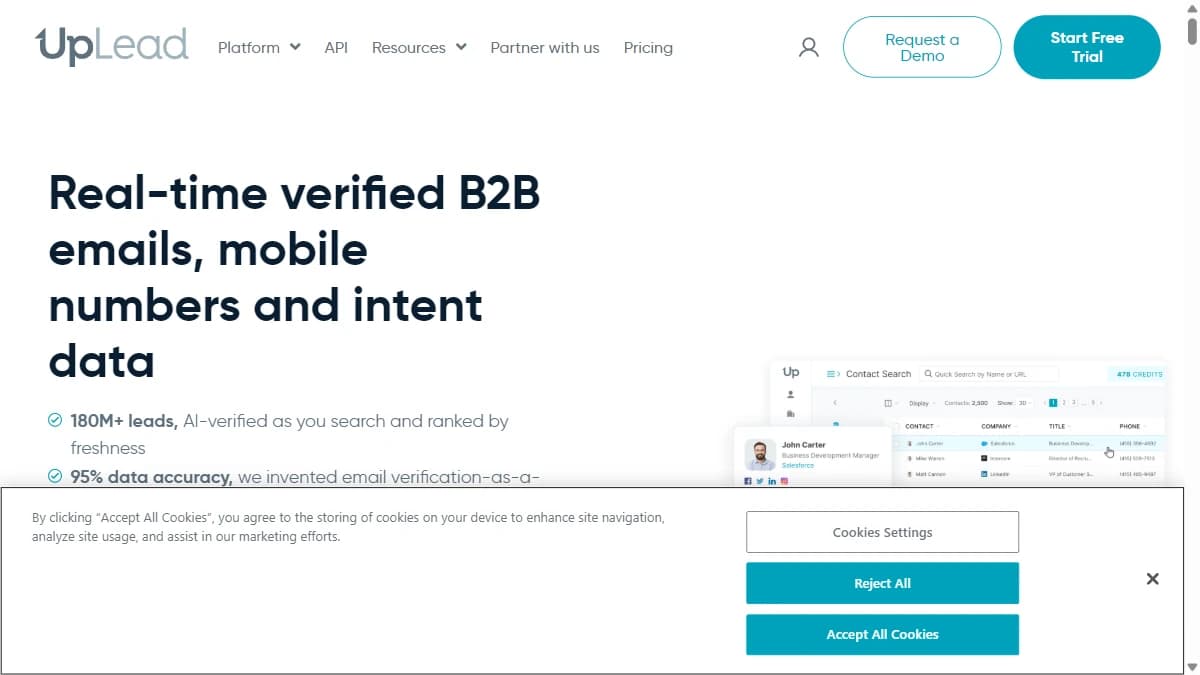
UpLead is a mid-market B2B contact database that backs its data with a 95% accuracy guarantee — and refunds credits for any bounced email. That guarantee is meaningful: it shows UpLead's confidence in real-time verification at the point of export, not just at ingestion.
UpLead's database is smaller than ZoomInfo or Apollo (roughly 155M verified contacts), but the accuracy-per-credit is consistently higher than most competitors at similar price points. Teams with focused ICPs in North America and Western Europe get clean data without enterprise minimums.
Pros
- 95% accuracy guarantee with credit refunds for bounces
- Real-time email verification at export — not just at ingestion
- Technographic filters: prospect by tech stack installed
- No annual contract required on entry plans
- Clean UI with fast list-building workflow
Cons
- Smaller database than Apollo or ZoomInfo — coverage thins outside US/Europe
- Phone number coverage is limited compared to Lusha or Cognism
- No built-in sequencer — need a separate cold email tool
Best for: Mid-market teams prioritizing verified email accuracy over raw database size, particularly in North America.
Pricing: Essentials at $99/mo (170 credits). Plus at $199/mo (400 credits). Professional at $399/mo (900 credits).
6. Hunter.io
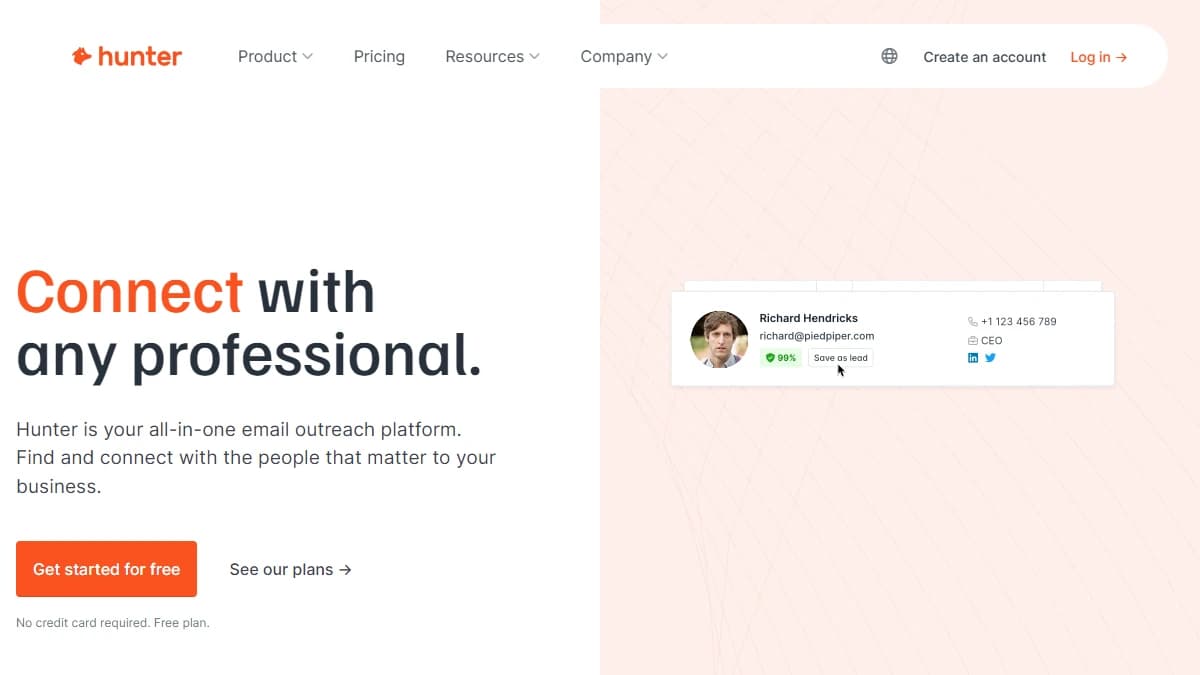
Hunter.io is the go-to tool for domain-based email finding. Enter a company domain and Hunter returns every email address it has indexed for that domain, plus a confidence score for each. Its Email Verifier checks deliverability in real time before you send.
Hunter is not a full B2B database. It doesn't have contact records with job titles, phone numbers, or intent signals. It's a specialist tool: best for founders and SDRs who already have a target company list and need to find the right email pattern quickly.
Pros
- Best-in-class domain search — finds company email patterns instantly
- Real-time email verification with deliverability confidence scores
- Generous free tier (25 searches/mo)
- Simple API for bulk domain lookups
- Email campaign tool included on paid plans
Cons
- Not a contact database — no job titles, phone numbers, or firmographics
- Coverage limited to indexed domains; private or small companies often missed
- No intent signals or account-level data
Best for: Founders and SDRs doing targeted domain-based prospecting on a defined company list.
Pricing: Free (25 searches/mo). Starter at $34/mo (500 searches). Growth at $104/mo (5,000 searches, annual billing).
7. Lusha
Lusha is a B2B sales intelligence platform with a 45M+ business profile database, best known for its LinkedIn Chrome extension and mobile number coverage. When you land on a LinkedIn profile, Lusha surfaces the contact's direct mobile, work email, and key firmographics without leaving the page.
Lusha is a strong fit for field sales teams and SDRs who prioritize phone outreach. Its mobile hit rates are among the highest for a self-serve platform. The database isn't as deep as Apollo or ZoomInfo, but Lusha's credit model (buy what you need) makes it accessible for small teams that don't want enterprise contracts.
Pros
- Strong mobile number coverage — best for teams prioritizing phone outreach
- LinkedIn Chrome extension makes prospect enrichment frictionless
- AI-based buyer intent signals on higher tiers
- Credit-based pricing — no annual minimums on entry plans
- SOC 2 Type II and GDPR compliant
Cons
- 45M profiles — smaller coverage than Apollo or ZoomInfo
- Credits expire monthly on base plans — unused credits don't roll over
- Bulk export limits on lower tiers
Best for: SDRs and field reps who prospect heavily via LinkedIn and need direct mobile numbers.
Pricing: Free (5 credits/mo). Pro at $29/user/mo (annual, 40 credits). Premium at $51/user/mo (annual, 80 credits).
8. RocketReach
RocketReach is a solid mid-tier B2B contact database with 700M+ professional profiles across 35M+ companies. It's one of the broadest by raw contact count, though its data refresh cadence and verification processes are less rigorous than UpLead or Cognism.
RocketReach is a reasonable choice for individual contributors who need quick ad-hoc lookups without an enterprise commitment. Teams doing high-volume outbound typically find accuracy inconsistent enough to warrant a more specialized or waterfall-based solution.
Pros
- 700M+ profiles — one of the broadest raw databases available
- Chrome extension for quick LinkedIn lookups
- API access on all paid plans
- No annual contract required on lower tiers
Cons
- Verification less rigorous than UpLead — bounce rates can be higher
- Limited firmographic depth compared to ZoomInfo or Apollo
- No built-in sequencer or intent signals
Best for: Individual contributors needing fast, affordable ad-hoc contact lookups without a full platform commitment.
Pricing: Essentials at $53/mo (annual, 80 lookups). Pro at $83/mo (annual, 150 lookups). Ultimate at $207/mo (annual, 300 lookups).
Side-by-Side Comparison
| Tool | Database Size | Email Accuracy | GDPR | Sequencer | Starting Price |
|---|---|---|---|---|---|
| SyncGTM | 50+ providers (waterfall) | 90%+ (waterfall) | Yes | Via integrations | Free / $49/mo |
| Apollo.io | 260M+ contacts | ~70–75% | Partial | Built-in | $49/user/mo |
| ZoomInfo | 100M+ contacts | ~80–85% | Partial | Via integrations | ~$15,000/yr |
| Cognism | 500M+ profiles | ~80–90% (Diamond) | Yes (notified-state) | Via integrations | ~$12,750/yr |
| UpLead | 155M+ contacts | 95% guaranteed | Yes | No | $99/mo |
| Hunter.io | Domain-based | Variable | Yes | Basic campaign tool | $34/mo |
| Lusha | 45M profiles | ~75–80% | Yes | No | $29/user/mo |
| RocketReach | 700M+ profiles | ~65–75% | Partial | No | $53/mo |
How to Choose the Right B2B Email Database
Five questions narrow the field quickly:
- What's your coverage expectation? If you need 85%+ email hit rates, only waterfall platforms (SyncGTM) or verified-first databases (UpLead with 95% guarantee) reliably get there. Single-source platforms average 65–75%.
- What geography are you targeting? EU/UK outbound mandates GDPR-compliant sourcing. Cognism is the only enterprise option with notified-state compliance. SyncGTM routes through GDPR-compliant sources as part of its waterfall.
- Do you need phone numbers? Lusha leads for mobile coverage among self-serve tools. Cognism Diamond Data is the enterprise benchmark for verified direct dials.
- Do you need a built-in sequencer? Apollo is the only major database that bundles prospecting and outreach in one platform. Everyone else requires a separate cold email tool. SyncGTM integrates natively with Instantly, Smartlead, and HeyReach.
- What's your budget? Under $100/mo: Hunter.io or Lusha for targeted use cases; SyncGTM for waterfall coverage. $100–$500/mo: UpLead or Apollo. Enterprise: ZoomInfo or Cognism.
For most outbound-focused B2B teams in 2026, pairing SyncGTM's waterfall enrichment with a dedicated sequencer gives the best combination of coverage, accuracy, and cost. Teams that want an all-in-one should start with Apollo and layer waterfall enrichment when coverage gaps appear.
See how waterfall enrichment fits into a complete prospecting workflow in our guide to enrichment tools for outbound sales teams. Or compare data providers directly in our top B2B data providers ranked for 2026.
Looking for region-specific coverage? We've tested databases across every major market: North America B2B databases, Europe B2B databases, and APAC B2B databases.