

Global Database Review 2026: B2B Data Coverage, Pricing & Alternatives

By Kushal Magar · June 2, 2026 · 12 min read · Last updated: September 30, 2026
Key Takeaway
Global Database is a procurement-grade B2B intelligence platform with genuine strength in emerging markets and a credible $19 business credit report — but hidden pricing, $5K–$25K annual contracts, and conflicting database claims (80M to 600M depending on which page you read) make it a poor fit for most modern sales teams. It is strongest for supplier verification, credit risk, and emerging-market prospecting; US and EU SMB outbound teams will get better hit rates from other tools.
Global Database is a UK-based B2B intelligence platform with strong emerging-market coverage, $19 business credit reports, and hidden pricing that runs $5K–$25K per year on 12-month contracts. Database claims swing from 80M to 600M depending on the page. Our rating: 3.6/5.
The case for Global Database is regional and procurement-driven. UK-headquartered with deep coverage across Africa, Southeast Asia, Latin America, and the Middle East — markets where ZoomInfo and Apollo are thin.
The case against it is structural. Hidden pricing, mandatory annual contracts, conflicting database-size claims, and Trustpilot reviews reporting contact success rates under 5% on Western lists.
Global Database is also data-first. The platform is built for procurement, supplier verification, and credit risk — not for modern signal-driven sales outbound where hiring surges and funding rounds drive timing.
This Global Database review compares to peers like D&B Hoovers and covers what the prospecting platform actually delivers, the real cost of a 12-month contract, the regional accuracy split, and a direct comparison with ZoomInfo and D&B Hoovers for teams evaluating B2B enrichment in 2026.
What Is Global Database?
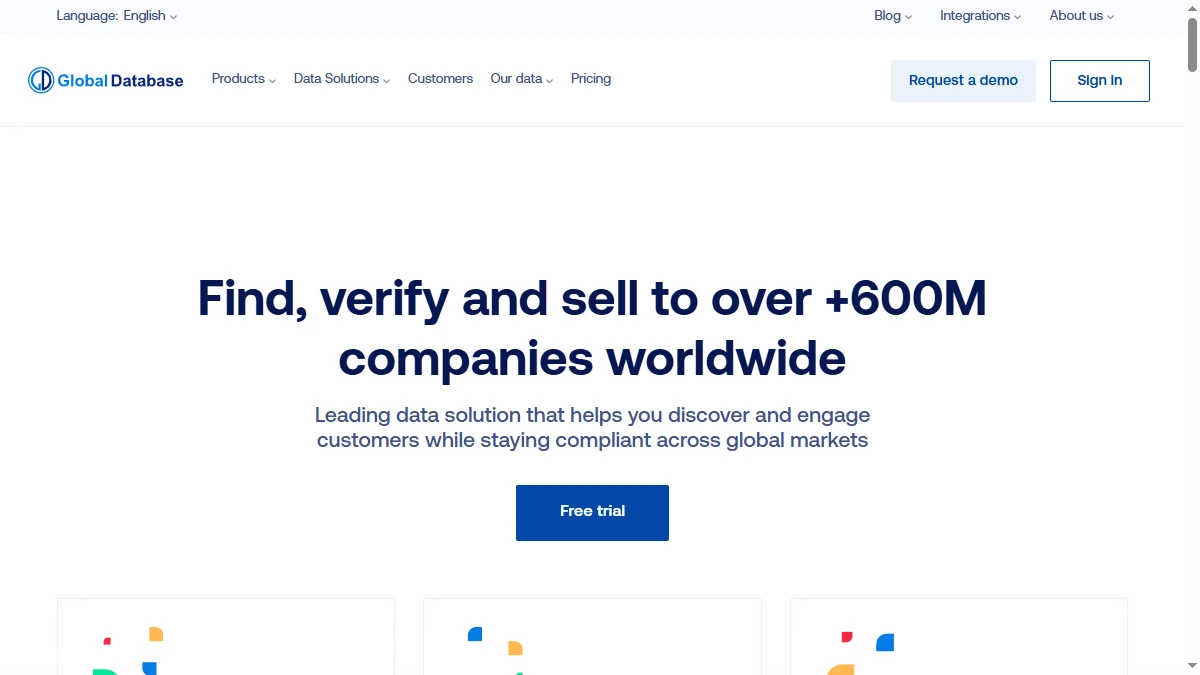
Global Database — UK-headquartered B2B intelligence platform with company data, credit reports, and supplier monitoring across 200+ countries.
Global Database is a B2B intelligence platform that bundles three things into one annual subscription: a sales prospecting database, a business credit reporting product, and supplier monitoring with risk alerts. The company is headquartered in the UK and has been operating since 2014.
The target user is split. On one side, procurement and credit teams use Global Database to vet suppliers and pull credit reports. On the other, sales and marketing teams use the prospecting platform to build contact lists for outbound.
Global Database's structural bet is geographic breadth plus credit data. By indexing company records across 200+ countries — including many emerging markets where US-first platforms are thin — it covers a global supplier and prospect base that competitors do not match at the same depth.
As of September 2026, the homepage leans further into compliance than sales. It leads with KYB business verification against 400+ government registries, beneficial ownership (UBO) discovery, PEPs and sanctions screening, and portfolio monitoring, alongside sales prospecting, an API, bulk data feeds, and Regis AI, a conversational interface to registry data. Global Database also states GDPR, CCPA, and ISO 27001 compliance with EU hosting, which matters for procurement reviews.
| Capability | What Global Database Provides | Notable Gaps |
|---|---|---|
| Company Database | Claimed 600M+ companies (homepage); 80M–100M verified contacts cited elsewhere | Conflicting size claims with no methodology document |
| Country Coverage | 200+ countries; strong in Africa, SEA, LATAM, Middle East | US/EU coverage thinner than Western specialists in independent testing |
| Business Credit Reports | $19 per report — financials, risk scores, ownership, payment behavior | Separate product, not included in prospecting subscription |
| Search Filters | 100+ filters with daily data updates | Filter logic limited compared to Apollo's boolean builder |
| Buying Signals | None published | No hiring, funding, tech stack, or intent signals |
| Outreach | Email campaigns module available as add-on | Not a primary product; most teams pair with Outreach or Salesloft |
Global Database Pricing: Plans, Contracts & What You Actually Pay
Global Database does not publish prospecting platform pricing publicly. The only hard public number is $19 per business credit report — and that is a separate product from the subscription.
Independent research, reseller estimates, and customer reports converge on a three-factor pricing model: number of users, number of data exports, and number of countries you need access to.
| Team Profile | Users | Country Scope | Estimated Annual Spend |
|---|---|---|---|
| Small team | 1–3 | 1–2 countries | $5,000–$10,000 |
| Mid-market | 4–10 | Multi-region | $10,000–$18,000 |
| Enterprise | 10+ | Global access | $15,000–$25,000+ |
| Credit reports (à la carte) | n/a | n/a | $19 per report |
The real cost math
Headline cost-per-user looks reasonable at first glance. A mid-market team at $14,000/year for 6 users works out to roughly $194 per user per month — comparable to ZoomInfo and below Cognism.
Three structural costs change the math. First, the 12-month commitment means you absorb the full annual spend even if hit rates fall short of your ICP. Second, credit reports are billed separately and most procurement teams need them — budget another $200–$500/month at $19 per pull.
Third, multiple Trustpilot reviewers report renewal price increases of 15–30% without written warning, and at least one user described an unauthorized recurring charge they classified as fraudulent. Procurement teams should insist on written renewal terms before signing.
Before signing, ask for a written quote that spells out seats, export limits, country access, and renewal terms, and use the free trial to test hit rates on your own ICP. If you only need contact data rather than credit reports, benchmark the quote against monthly waterfall contact providers before committing to a 12-month term.
Global Database Data Coverage: Claims vs Reality
Global Database publishes database stats that range from 80M contacts to 600M companies depending on the page. The real coverage quality varies dramatically by region.
The claims problem
Database size statements diverge sharply across Global Database's own surfaces. The homepage cites "600M+ companies worldwide." The G2 profile says "80M+ business profiles." The Datarade listing claims "450M direct contacts and 400M company profiles."
A 7.5x spread between the lowest and highest published number is not a rounding error. Procurement teams that require defensible vendor claims should ask for a written methodology before signing a contract.
What works: emerging markets and supplier data
Where Global Database is genuinely best-in-class is emerging markets. Coverage across Africa, Southeast Asia, Latin America, and the Middle East is deeper and more current than ZoomInfo, Apollo, or Cognism.
G2's 4.7/5 rating tracks closely with this user base — procurement, supplier verification, and emerging-market sales teams praise contact accuracy and company depth in those regions.
What does not work: US and EU SMB
Trustpilot's 2.9/5 reflects a different user base — Western SMB and mid-market sales teams. Reviewers report contact success rates under 5% on US and UK lists, with outdated records and phone numbers that fail to connect.
That hit rate is too low for cold email or cold call at scale without damaging sender reputation and rep productivity, so test Global Database against dedicated waterfall email finders on a sample of your own records before committing.
| Region / Segment | Global Database Coverage | Real-World Verdict |
|---|---|---|
| Africa | Strong | Best-in-class at this price; beats every Western tool |
| Latin America | Strong | Solid Brazil, Mexico, Argentina coverage; thinner SMB |
| Middle East | Strong | Good UAE, Saudi, Israel coverage; useful for cross-region |
| Southeast Asia | Strong | Solid mid-market and enterprise; competitive on price |
| United Kingdom / EU | Moderate | Decent on enterprise; weak on SMB contact data |
| United States / Canada | Weak | Falls behind ZoomInfo, Apollo, and waterfall tools |
The takeaway is geographic. If your ICP concentrates in emerging markets or your buying motion is procurement and supplier verification, Global Database is a defensible primary database. If your ICP is US or EU SMB, you need a different primary tool, and Global Database is better kept as a supplementary source for emerging-market accounts.
Global Database Key Features
Global Database's feature set is wider than most pure-play databases. It bundles prospecting, credit reporting, supplier monitoring, and an email campaigns add-on into a single subscription.
Sales Prospecting
Build targeted contact lists using 100+ firmographic and personal filters — industry, headcount, revenue, technology, geography, title, seniority. Results export to CSV, XLSX, or push to CRM.
Filter logic is fixed and form-based rather than custom-buildable. You cannot combine arbitrary boolean conditions the way Apollo's search builder allows.
Business Credit Reports
$19 per report — financials, payment behavior, risk score, recommended credit limit, ownership structure. The cheapest credible alternative to D&B credit reports for procurement and AR teams.
Coverage strongest on UK, EU, and emerging-market companies. Weaker on private US SMBs where D&B's century of credit-bureau history is hard to displace.
Supplier Verification & Monitoring
Vet new suppliers with company verification, financial health checks, and ownership transparency. Set alerts on portfolio companies for risk score changes, leadership changes, or litigation events.
This is the strongest non-sales use case for Global Database — and where the regional depth genuinely pays off. Procurement teams with global supplier bases get more value here than equivalent Western tools.
Chrome Extension
Surfaces company info on LinkedIn, company sites, and Sales Navigator. Verifies a business in one click — useful for supplier due diligence and prospect research.
UX is functional but less polished than Apollo or AroundDeal extensions. Reviewers cite a learning curve.
Integrations
Native connectors for Salesforce, HubSpot, Microsoft Dynamics, Pipedrive, Marketo, Salesloft, and Outreach. Tenders and grants database access for government and public-sector bids. API access available for custom integrations.
Real-time CRM enrichment on contact creation requires API setup — most teams default to batch sync or manual push from Global Database's app.
Global Database Pros: What It Does Well
- ✓Best-in-class emerging-markets coverage. Genuine depth across Africa, SEA, LATAM, and Middle East. Beats ZoomInfo, Apollo, and Cognism on these regions — a real differentiator for global enterprise.
- ✓$19 business credit reports. The cheapest credible alternative to D&B at roughly one-third the per-report price. Strong value for procurement, AR, and supplier vetting.
- ✓Tenders and grants database. Built-in access to public-sector bids — useful for government and B2G sales teams that most pure B2B tools do not serve.
- ✓Wide capability bundle. Prospecting, credit reports, supplier monitoring, tenders, and an email campaigns add-on under one contract. Compelling for buyers who want to consolidate vendors.
- ✓Daily data updates. Published refresh cadence across the company database. Stronger update commitment than databases that refresh quarterly or only on customer request.
Global Database Cons: Where It Falls Short
- Hidden pricing with mandatory annual contracts. Prospecting platform requires a sales call to get a quote and a 12-month commitment to sign. Effective entry point is $5,000+/year. No month-to-month option exists; the homepage offers a free trial, but testing the platform at scale requires committing the full annual spend up front.
- Conflicting database size claims. Homepage says 600M+ companies, G2 says 80M+, internal comparisons reference 100M verified contacts, Datarade lists 450M. A 7.5x spread with no methodology document — a real transparency red flag for procurement.
- Trustpilot 2.9/5 vs G2 4.7/5 — sharp divergence. G2 reviewers (often emerging-market users) praise accuracy. Trustpilot reviewers (often US/EU users) report contact success rates under 5% and unresponsive support. The right rating depends entirely on where your ICP lives.
- Post-sale support widely criticized. Multiple Trustpilot reviews cite responsive pre-sale outreach followed by minimal account-management contact after the contract is signed. Some reviewers reported deleted accounts and unprocessed refund requests.
- Hidden upsells on credit reports. Business credit reports are billed separately at $19+ each — they are not included in the prospecting subscription. Teams expecting credit data in the base contract are commonly surprised at renewal.
- Steep learning curve. Reviewers consistently flag the interface as "not intuitive" with limited in-app guidance. Onboarding requires real training time that competing tools do not demand.
- No published buying signals. Hiring surges, funding rounds, tech stack changes, and intent data are not part of the published feature set. Procurement-grade firmographic data only — not a modern signal-driven outbound platform.
- Single-source architecture. When Global Database does not have a record, it returns nothing. There is no waterfall fallback to other providers — a structural limitation when running enrichment at scale across ICPs the platform covers thinly.
Global Database vs ZoomInfo vs D&B Hoovers
Three ways to solve B2B data: emerging-markets specialist + credit reports (Global Database), US-first enterprise data warehouse (ZoomInfo), and the legacy credit-bureau standard (D&B Hoovers).
| Feature | Global Database | ZoomInfo | D&B Hoovers |
|---|---|---|---|
| Starting Price | $5,000+/yr (annual only) | $15K+/yr | $10K+/yr |
| Pricing Transparency | Hidden — sales call required | Hidden | Hidden |
| Database Size (claimed) | 100M–600M (conflicting) | 600M+ contacts | 523M+ companies |
| Country Coverage | 200+ countries | Strong US, weaker outside | Global |
| Emerging Markets Coverage | Strong (Africa, SEA, LATAM) | Weak outside US/EU | Strong (legacy advantage) |
| Buying Signals | None published | Intent + scoops | Risk + credit signals |
| Native Outreach | Email campaigns add-on | Engage add-on | None |
| Contract Length | 12-month minimum | 12-month minimum | 12-month minimum |
The honest take on each option
Global Database wins on emerging markets and $19 credit reports. Right choice if your ICP is global enterprise, you need supplier verification across regions, or you pull credit reports regularly.
ZoomInfo is the US enterprise default. Deepest North American coverage and most mature intent/scoops, but starts at $15K+/year with hidden pricing and weak emerging-market data. Only worth it if your ICP is US and you have the budget.
D&B Hoovers is the legacy credit-bureau standard. Best for procurement, credit, and AR teams where century-of-history risk data matters. Less useful for modern outbound.
For deeper context, see our D&B Hoovers review and our Cognism alternatives roundup.
Who Should Use Global Database?
Global Database is the right tool in a narrow but real scenario: your business spans emerging markets, you need supplier verification or credit reports, and you can absorb a $5K+ 12-month commitment.
Use Global Database if:
- Your ICP concentrates in Africa, Southeast Asia, Latin America, or the Middle East — and regional depth matters more than US breadth.
- You are a procurement, AR, or compliance team that needs supplier verification, credit risk scoring, and global financial data in one place.
- You regularly pull business credit reports and $19/report saves meaningful money versus D&B at $60+.
- You sell into government or public sector and need tenders and grants data alongside company intelligence.
Do not use Global Database if:
- Your primary ICP is US or EU SMB — Trustpilot reviewers report contact success rates under 5% on Western lists.
- You need buying signals like hiring surges, funding rounds, or tech stack changes. Global Database does not publish them.
- You want data, signals, and outreach in one platform. The email campaigns module is an add-on, and most teams still pair Global Database with a dedicated sequencer.
- You cannot commit to a 12-month annual contract or need transparent published pricing before purchase.
- You need waterfall fallback when a record is missing — single-source databases like Global Database simply return nothing.
If Global Database's quote-only pricing with a 12-month minimum is a dealbreaker, SyncGTM is one alternative worth a look: it is free to start and runs waterfall enrichment across 50+ data providers for verified emails, phone numbers, and firmographics.