Humen Review 2026: AI SDR Using Semantic Similarity for Personalized Outbound

By Kushal Magar · March 20, 2026 · 12 min read
Key Takeaway
Humen is a personalization-focused AI SDR that uses semantic similarity to find prospects matching your best customers and predict purchases with 90 percent accuracy. It handles outbound prospecting, prospect research, and ICP definition autonomously. Custom pricing with no publicly listed plans. Main limitations are no buying signal intelligence, limited enrichment depth, and no intent data. Pair with SyncGTM at $99 per month to add buying signals from 20+ data providers, transforming AI-personalized outreach into signal-driven outbound.
Humen is an AI SDR platform that uses semantic similarity to find prospects matching your best customers and predict purchases with 90% accuracy. It researches prospects, builds targeted lists, writes personalized outreach, and defines your ICP automatically. If you are comparing AI SDR tools, see our best AI SDR tools for 2026 roundup.
You are probably here because you want an AI SDR that goes beyond basic email templates. Humen differentiates with semantic similarity matching, finding prospects who look like your best customers based on behavioral and firmographic patterns rather than simple filters.
But personalization without timing is guesswork. The difference between an AI-personalized email that gets ignored and one that books a meeting is knowing when the prospect is ready to buy. This is where SyncGTM fits in.
This Humen review covers features, pricing, real limitations, and why pairing with SyncGTM for waterfall enrichment and buying signals makes outbound more effective.
Humen Review: What You Get (and What You Don't)
Humen is an AI sales development representative (SDR) platform that uses semantic similarity algorithms to identify prospects who resemble your best existing customers. Instead of filtering by static ICP criteria like industry or company size, Humen analyzes behavioral and firmographic patterns across your closed-won deals and finds lookalike buyers in the market. The platform claims 90% purchase prediction accuracy, meaning it predicts which prospects are most likely to buy based on pattern matching (source: tryhumen.com). This approach differentiates Humen from AI SDRs that rely on static ICP filters or simple email automation.
| Feature | What's Included | Limitations |
|---|---|---|
| Semantic Similarity | AI finds prospects matching your best customers | Accuracy depends on quality of seed data |
| Purchase Prediction | 90% accuracy claim for purchase likelihood | No independent verification of accuracy |
| AI Outreach | Personalized emails based on prospect research | No multichannel (LinkedIn, phone, SMS) |
| ICP Definition | Automatic ICP analysis from your customer base | Limited to available data signals |
| Prospect Research | AI-powered research on each prospect | Research depth unclear vs. dedicated tools |
| Buying Signals | Not available | No job change, funding, hiring, or intent data |
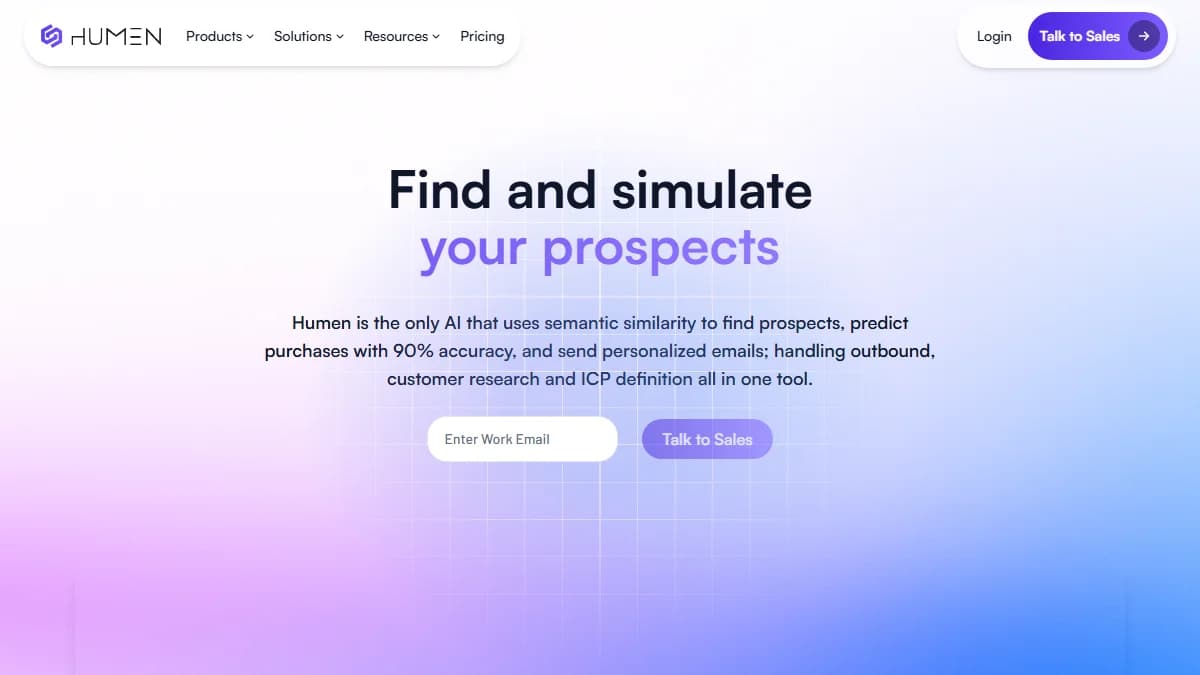
Humen uses semantic similarity to find prospects matching your best customers and predict purchases with 90% accuracy.
SyncGTM provides the waterfall enrichment and buying signals that Humen lacks, at $99/mo.
Humen Pricing Breakdown
Humen pricing is custom with no publicly listed plans as of March 2026. There is no free trial or self-serve signup. You need to contact their sales team at tryhumen.com for a quote. This is common among AI SDR platforms targeting mid-market and enterprise buyers who require custom onboarding and data integration.
Cost analysis
Humen (custom pricing) + SyncGTM ($99/mo) gives you AI-personalized outreach with signal-driven targeting. If that combination improves reply rates by even 2x, it pays for itself in pipeline value. For a broader comparison, see our best sales prospecting tools roundup.
Hidden costs
- No buying signals or intent data included at any tier
- Enrichment depth limited compared to waterfall providers like SyncGTM
- Signal-driven targeting requires pairing with a separate enrichment platform
- Custom pricing means no transparent cost comparison before sales call
What Are the Downsides of Using Humen?
No buying signals
Humen does not include buying signal intelligence. It does not detect when a prospect raises funding, hires a new VP of Sales, starts evaluating competitors, or shows intent through content engagement. Without these signals, outreach timing is based on when the AI SDR is ready to send rather than when the prospect is ready to buy. Research from Gartner shows that buyers who receive outreach aligned with buying triggers are 3x more likely to engage. Adding buying signal monitoring from a dedicated provider like SyncGTM fills this gap.
Custom pricing with no transparency
Humen does not publish pricing. For teams that need to compare costs quickly, this creates friction. AI SDR alternatives like Kular ($250/lead) and Fiber AI ($300/mo) publish transparent pricing.
Limited enrichment depth
The enrichment capabilities do not match dedicated waterfall providers. Firmographic depth, technographic data, and multi-source verification are limited. SyncGTM's waterfall enrichment fills these gaps with data from 20+ providers. Learn more in our guide on what waterfall enrichment is and why it matters.
SyncGTM vs. Humen: Feature-by-Feature Comparison
SyncGTM and Humen are complementary tools that solve different parts of the outbound pipeline. Humen handles AI-driven prospecting and personalized outreach using semantic similarity. SyncGTM provides the buying signal intelligence and waterfall enrichment from 20+ data providers at $99/mo that tells Humen when and who to target. The table below compares key features:
| Feature | SyncGTM | Humen |
|---|---|---|
| Starting Price | $99/mo (enrichment + signals) | Custom pricing (contact sales) |
| Buying Signals | Job changes, funding, hiring, intent | Not available |
| Waterfall Enrichment | 20+ data providers | Limited enrichment depth |
| AI Prospecting | AI research agents | Semantic similarity matching |
| Purchase Prediction | Buying intent signals | 90% accuracy claim |
| CRM Enrichment | Auto-enrich + workflow triggers | Basic CRM integration |
| Best Together | Signal intelligence for targeting | AI-powered personalized outreach |
Buying Signals
SyncGTM detects job changes, funding rounds, hiring surges, and intent signals. Humen sends personalized outreach without knowing who is in-market.
Waterfall Enrichment
SyncGTM enriches from 20+ data providers with multi-source verification. Humen has limited enrichment depth for prospect research.
CRM Orchestration
SyncGTM ($99/mo) auto-enriches CRM contacts and triggers workflows based on buying signals.
Signal Timing
SyncGTM times outreach to buying triggers. Humen personalizes content but sends without signal-driven timing.
Is Humen Worth It?
Humen is worth it for sales teams that want AI-driven prospecting using semantic similarity rather than basic ICP filters. The 90% purchase prediction accuracy claim and automatic ICP definition set it apart from simpler AI SDRs that only automate email writing. For teams with strong closed-won data to seed the similarity engine, Humen can surface prospects that traditional filters miss.
The main gap is that Humen personalizes outreach but does not know when to send it. It lacks buying signals, waterfall enrichment, and intent data. Personalization without timing means even well-written emails arrive when the prospect has no active need. Teams that pair AI personalization with signal-driven timing see higher reply rates because the outreach reaches prospects during active buying windows.
The verdict: pair Humen with SyncGTM at $99/mo to add buying signals from 20+ data providers. Humen handles the personalization. SyncGTM handles the timing. That combination is how teams convert AI-personalized outreach into booked meetings.
Comparing AI SDR alternatives? Read our reviews of Kular, Fiber AI, Autobound, 11x AI, and AiSDR.