

Fiber AI Review 2026: Live B2B Data API Pricing and Verdict

By Kushal Magar · March 20, 2026 · 12 min read · Last updated: September 30, 2026
Key Takeaway
Fiber AI is an agent-native B2B data platform with live APIs for people and company search, contact reveal, live LinkedIn fetch, and Trackers that watch 40+ company and people signals. As of September 2026, plans start at $300 per month for 15,000 credits, with a work email costing 2 credits and a phone number 3. It suits teams building AI sales agents or technical GTM workflows, but it delivers data rather than outreach, so you still need your own CRM, sequencer, or agent to act on it.
Fiber AI is an agent-native B2B data platform: live APIs for finding companies and people, enriching profiles, and revealing work emails and phone numbers, built for AI sales and recruiting agents as well as GTM teams. You use it through a REST API, an MCP server, or a first-party plugin, and pay with credits. Pricing starts at $300/mo.
This Fiber AI review covers what the platform actually includes, how credits get spent, what each plan costs, where it falls short, and who it fits. Looking at the broader landscape of AI-driven outbound? See our best AI SDR tools for 2026 roundup.
Fiber AI Review: What You Get (and What You Don't)
Fiber AI sells data access, not a finished outbound workflow. Its homepage pitches "live data APIs for AI sales agents," and every self-serve plan includes the complete API: people and company search, contact enrichment and reveal, live LinkedIn profile fetch, reverse email lookup, audiences, and trackers. What you do not get is a sequencer or a rep-facing CRM. Fiber AI supplies the data, and your agent, CRM, or outreach tool acts on it.
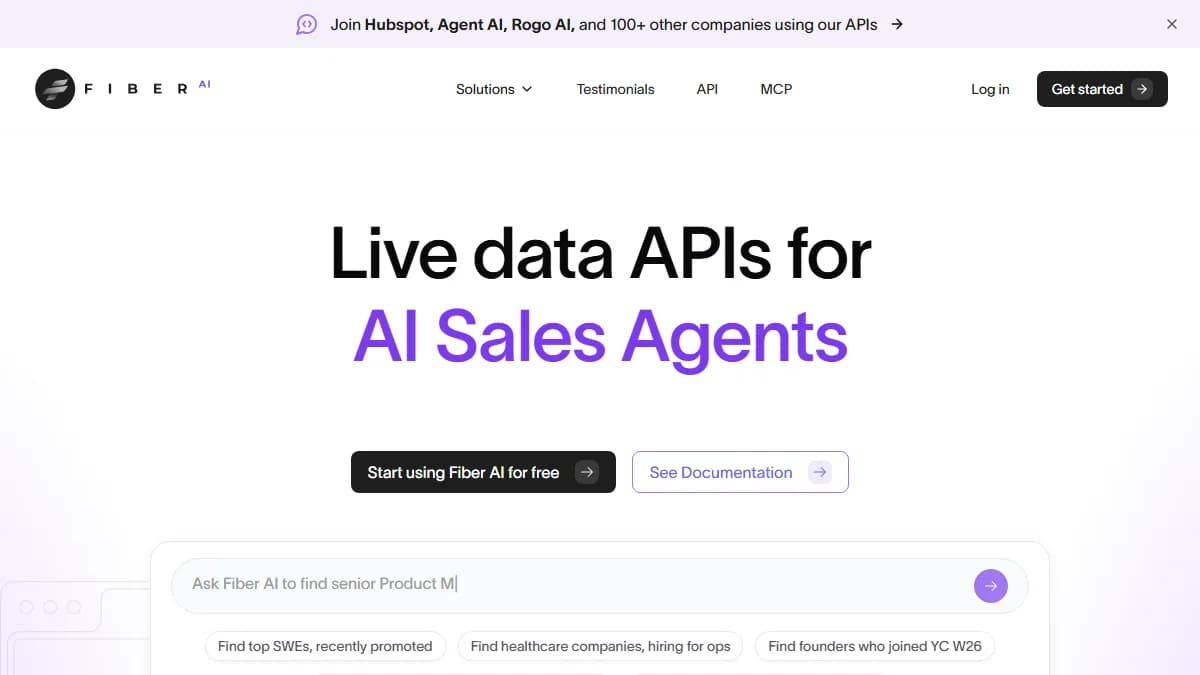
Fiber AI's homepage pitches live data APIs for AI sales agents, with a natural-language search box for finding people and companies.
| Capability | What's Included | Limitations |
|---|---|---|
| People and company search | Plain-English or filtered search, 1 credit per result | Every result costs a credit, so broad searches add up |
| Contact reveal | Work email (2 credits), personal email (2), phone (3), all contacts (5) | Homepage and pricing page don't publish match or bounce rates |
| Live LinkedIn fetch | Live profile snapshots and full profile payloads on self-serve keys | Arrives as API data; you build the workflow around it |
| Trackers | 40+ company and people signal types | Billed per entity on every refresh run |
| Access | REST API, MCP server, first-party plugin | Homepage doesn't list native CRM connectors or a sequencer |
How Fiber AI Works: From Search to Signals
Fiber AI makes more sense once you see how a typical workflow spends credits. Here is the order of operations for a prospecting use case, whether a person or an AI agent is making the calls.
- Define the audience. Search people and companies in plain English (the homepage examples include "healthcare companies, hiring for ops") or with structured filters, then save the results as an audience. Each search result costs 1 credit.
- Reveal contacts selectively. Request a work email (2 credits), personal email (2), phone number (3), or all contacts (5) only for the people you actually plan to reach. Reverse email lookup, which turns an email address into a profile, costs 2 credits per successful match.
- Refresh with live data. Pull a live LinkedIn snapshot when you need a current title or employer rather than a cached record, which matters most right before outreach.
- Track changes. Add companies or people to Trackers, which cover 24+ company signals (headcount changes, funding rounds and stage changes, new investors, hiring and job postings, news, posts, profile and HQ changes, technology additions) and 19+ people signals (job changes, promotions, title and headline changes, "open to work," posts and keywords, new certifications and skills, network milestones).
- Plug it into your stack. Call the API from your own code, connect an AI assistant or agent through the MCP server, and route results into your CRM, Slack, or internal pipelines through your own integration.
The credit math is the main planning job. Trackers are billed per entity per refresh run: 2 credits on the standard tier (monthly or weekly runs), 1 credit on the Silver tier for high-volume or daily tracking, and 0.5 credits on the Gold tier for large lists refreshed daily. Tracking 1,000 people weekly at the standard rate uses about 8,000 credits a month, more than half of the Prospector plan's 15,000 credits before a single contact is revealed. Decide which records deserve a full reveal and how often each tracker list really needs a refresh before you pick a plan.
How Much Does Fiber AI Cost?
As of September 2026, Fiber AI sells three self-serve API plans on its pricing page, each with the complete API:
- Prospector: $300/mo, or $250/mo billed annually ($3,000/yr), for 15,000 credits per month
- Growth: $900/mo, or $750/mo billed annually ($9,000/yr), for 50,000 credits per month, plus priority Slack support and 2x standard rate limits
- Enterprise: $2,400/mo, or $2,000/mo billed annually ($24,000/yr), for 150,000 credits per month, plus priority support, custom rate limits, and custom API endpoints
One credit is worth $0.02. A search result costs 1 credit, a work or personal email 2, a phone number 3, and all contacts for a person 5. Separate bulk search plans (from 500,000 search credits a month, starting at $1,000) and weekly-refreshed datasets (from $1,000) serve high-volume buyers. There is a 7-day free trial with full product access, but it requires a payment method at signup and billing starts on day 8. For a broader look at prospecting tools and their pricing, see our best sales prospecting tools for B2B teams guide.
Hidden costs
- Every search result costs a credit, not just the contacts you reveal
- Phone numbers cost 3 credits and a full contact reveal costs 5
- Trackers bill per entity on every refresh run
- The free trial requires a payment method, and billing starts on day 8
What Are the Downsides of Using Fiber AI?
Built for developers and agents
Fiber AI is an API and MCP product first. There is no built-in sequencer, and the homepage doesn't list native CRM connectors, so turning data into outreach means wiring it into your own CRM, sequencer, or AI agent. Sales teams without an engineer or an agent setup will get more out of a finished prospecting app.
Credit burn is easy to underestimate
Searches, reveals, and tracker runs all draw from one credit pool. A broad search that returns thousands of results, a habit of revealing all contacts at 5 credits each, or a large tracker list on a weekly refresh can drain a Prospector plan well before month end.
A $300/mo floor with no free plan
The entry plan costs $300 per month ($250 billed annually), and the only free option is a 7-day trial that needs a payment method. That is a real commitment for a small team that only needs a few hundred contacts a month.
Accuracy is yours to verify
Fiber AI's homepage and pricing page don't publish email match or bounce rates. Run the trial against a sample of contacts you already know, and if coverage matters most, compare the results with multi-provider tools; our guide to waterfall enrichment explains how those cascade across providers.
Is Fiber AI Worth It?
Fiber AI is worth considering for teams building AI sales or recruiting agents, and for technical GTM teams that want fresh people, company, and job-change data through an API instead of a seat-based database. The credit model is transparent, Trackers cover 40+ signal types, and live LinkedIn fetch is available on self-serve keys. The main limitations are the $300/mo floor, credit burn across searches, reveals, and trackers, and the engineering work needed to turn API payloads into outreach.
The verdict: Fiber AI is a capable data layer for agent-driven prospecting, rated 3.8 out of 5. Start the 7-day trial with a fixed test, such as a known list of contacts to reveal and a small tracker list, and check hit rates and credit use before committing to a plan. Want more options? See our Fiber AI alternatives roundup.
Comparing AI outbound tools? Read our reviews of Kular, Humen, Autobound, 11x AI, AiSDR, and FirstQuadrant.
If wiring Fiber AI's API output into your CRM yourself is a dealbreaker, SyncGTM is one alternative worth a look: it pairs waterfall enrichment across 50+ data providers with native Salesforce, HubSpot, and Pipedrive integrations.