

Kular Review 2026: AI Lead Gen at $250 Per Lead

By Kushal Magar · March 20, 2026 · 14 min read · Last updated: September 30, 2026
Key Takeaway
Kular is a Y Combinator-backed AI lead generation platform with pay-per-lead pricing at $250 per interested lead and $375 per scheduled meeting. AI voice cloning for LinkedIn voice notes and automated email campaigns. First lead free, no monthly subscription. The pay-per-result model removes upfront risk, but outside its separate Website Visitors product Kular lacks buying signal intelligence, meaning outreach timing is random rather than strategic. According to Gartner's 2025 B2B Buyer Survey, 75% of B2B buyers prefer a rep-free experience until ready to buy, making timing more important than outreach volume. Costs also scale linearly with every lead, so Kular fits high-ACV offers far better than low-margin, high-volume products.
Kular is a Y Combinator-backed AI lead generation platform that charges $250 per interested lead and $375 per scheduled meeting. Instead of a monthly subscription, you pay only for results. The platform uses AI voice cloning to send LinkedIn voice notes that sound like you, alongside automated email campaigns. Your first lead is free.
That pricing model sounds appealing. But the question every revenue leader should ask is: does Kular know who to reach and when?
According to Gartner's 2025 B2B Buyer Survey, 75% of B2B buyers prefer a rep-free sales experience until they are ready to buy. Reaching the right prospect at the right moment matters more than the volume of leads generated.
This Kular review covers the platform's features, pay-per-lead pricing breakdown, AI voice cloning, real limitations, and which teams the pricing model actually suits. For a broader comparison, see our best AI SDR tools guide.
What Is Kular?
Kular is an AI-powered lead generation platform backed by Y Combinator that automates prospecting, outreach, and meeting scheduling using a pay-per-result pricing model. The platform identifies prospects matching your ideal customer profile, generates personalized outreach using AI, and charges only when a prospect shows interest or books a meeting.
Founded as part of Y Combinator's accelerator program (source: YC Company Directory), Kular differentiates itself with AI voice cloning for LinkedIn outreach and a pricing model that eliminates the risk of paying for outbound that does not convert.
According to that YC profile, Kular was founded in 2021, went through the Winter 2022 batch, is based in London with a team of 12, and runs outreach over email and LinkedIn for more than 1,000 companies. It has since launched Kular Website Visitors, a separate product that identifies visitors to your website, researches them, and where appropriate engages them by email, priced pay-as-you-go at $0.30 per identified visitor with no minimum.
Kular Review: What You Get (and What You Don't)
Kular handles the full outbound cycle: identifying prospects, researching them, writing personalized outreach, and scheduling meetings. Here is what is included and what is missing.
| Feature | What's Included | Limitations |
|---|---|---|
| AI Prospecting | AI identifies prospects matching your ICP | No real-time buying signal detection |
| AI Voice Cloning | LinkedIn voice notes generated with your cloned voice | Voice note deliverability varies by industry |
| Email Campaigns | Automated personalized email sequences | Personalization lacks signal context and timing |
| Meeting Booking | Automated scheduling from positive replies | $375 per meeting on top of per-lead cost |
| Buying Signals | Website visitor identification (separate product) | No job change, funding, or hiring signals |
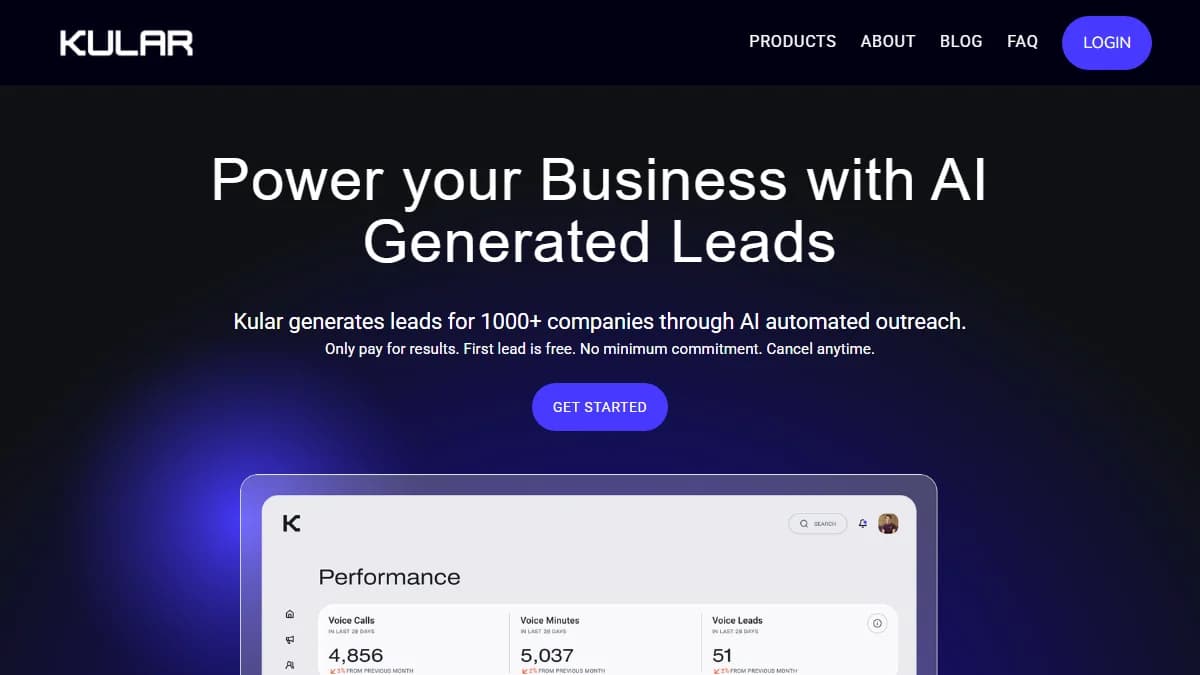
Kular's platform offers AI-powered lead generation with pay-per-lead pricing starting at $250 per interested lead and $375 per meeting.
The takeaway: Kular handles outreach mechanics well and removes upfront financial risk. What it does not tell you is who to reach and when; that still depends on the ICP you define and your own targeting.
AI Voice Cloning: How Kular's LinkedIn Outreach Works
Kular's standout feature is AI voice cloning for LinkedIn outreach. The platform clones your voice and generates LinkedIn voice notes that sound like you, adding a personal touch that text-based outreach cannot match.
The voice cloning pipeline works in three steps. First, you provide voice samples so the AI can learn your speech patterns. Second, Kular generates personalized voice messages for each prospect. Third, those messages are delivered through LinkedIn alongside email follow-ups.
Where voice cloning works well
Voice notes stand out in a LinkedIn inbox full of text connection requests. For industries where personal relationships matter (consulting, enterprise sales, recruiting), a voice message creates a different first impression than another cold email. The AI handles volume while maintaining a personal feel.
Where it falls short
Voice cloning does not solve the targeting problem. A well-crafted voice note sent to a prospect who is not in-market is still poorly timed outreach. Without buying signals indicating that a prospect recently raised funding, changed roles, or started evaluating solutions, the voice note reaches people at random points in their buying journey.
There is also a perception risk. Some buyers welcome a voice note; others react badly once they realize the voice is synthetic. Test voice notes on a small segment and compare reply sentiment against text-only outreach before rolling them out to your whole list.
Kular Pricing Breakdown
Kular uses a pay-per-result model instead of monthly subscriptions. For current pricing details, visit Kular's website. For a broader look at prospecting tool pricing, see our best sales prospecting tools for B2B teams guide.
- --Per interested lead: $250 per lead who responds with interest
- --Per scheduled meeting: $375 per meeting booked through the platform
- --First lead free: No cost for your first interested lead
- --No monthly subscription: You pay only for results
What you actually pay at scale
At $250 per lead, 20 interested leads per month costs $5,000. Add 5 meetings at $375 each and the total reaches $6,875/mo. Whether that is expensive depends entirely on deal size. If one of those meetings closes a $50,000 contract, the month paid for itself many times over. If your average deal is $3,000, the same spend needs more than two closed deals just to break even.
Hidden costs to watch
- No buying signals or intent data included in the per-lead price
- Enrichment depth limited compared to dedicated multi-provider waterfall tools
- Signal-driven targeting requires adding a separate signal or intent tool
- Costs scale linearly with volume, no bulk discounts publicly listed
What Are the Downsides of Using Kular?
No buying signals
Outside its separate Website Visitors product, Kular does not include buying signal intelligence. It does not know if a prospect just raised funding, hired a new VP, or started evaluating competitors. Without signals, outreach timing is random rather than strategic. You pay $250 per lead regardless of whether that lead was in-market or not. Learn how waterfall enrichment solves this data gap.
Limited enrichment depth
Kular's enrichment capabilities do not match dedicated waterfall providers. Firmographic depth, technographic data, and multi-source verification are limited. Teams that need complete records usually run leads through a separate multi-provider waterfall tool before or after Kular hands them over.
Early-stage platform risk
As a Y Combinator startup with a team of 12, Kular is still building its track record, even with more than 1,000 companies served according to its YC profile. It is smaller than established prospecting vendors like Apollo or ZoomInfo. For teams that need a proven, stable platform with consistent deliverability and support, the early-stage risk should factor into the decision.
Linear cost scaling
Pay-per-lead pricing means costs grow with every lead. A team generating 50 interested leads per month pays $12,500 before meeting costs. No bulk discounts are publicly listed, so budgeting is harder than with a flat-rate subscription whose cost stays the same regardless of volume.
Who Should Use Kular (and Who Shouldn't)
Kular's pricing turns the fit question into a math question. Because you pay per interested lead and per meeting rather than per seat or per month, the right buyer is the one whose deal value comfortably absorbs those fees.
Good fit
- High-ACV B2B offers. If an average closed deal is worth tens of thousands of dollars, $250 for an interested lead and $375 for a meeting is small relative to the revenue at stake. Even a modest close rate can justify the spend.
- Founders and busy operators without an SDR. Kular positions itself as a lead generator for busy professionals and business owners. If nobody on the team has time to prospect, paying per result is simpler than hiring.
- Relationship-driven markets. Consulting, enterprise services, and recruiting are where a LinkedIn voice note that sounds like you is most likely to stand out.
- Teams testing a new segment. The free first lead and the lack of a subscription make Kular a low-risk way to see whether a new ICP responds before committing budget to a full outbound stack.
Poor fit
- Low-ACV or high-volume products. When a deal is worth a few hundred or a few thousand dollars, $250 per interested lead can consume most of the margin before a single meeting happens.
- Teams that need predictable budgets. Spend rises with every lead and meeting, and no bulk discounts are publicly listed, so forecasting monthly cost is harder than with a flat subscription.
- Signal-led outbound teams. If your playbook depends on reaching accounts right after a funding round, leadership change, or hiring spike, Kular does not supply those triggers.
- Brands wary of synthetic voice. Cloned voice notes are the headline feature. If your buyers would react badly to AI-generated audio, a large part of Kular's differentiation goes unused.
A quick break-even check helps before you start. Divide the per-lead fee by your expected lead-to-close rate: if one in ten interested leads closes, each new customer costs about $2,500 in lead fees, plus $375 for every meeting booked along the way. That is trivial against a $50,000 contract and prohibitive against a $2,000 one.
Is Kular Worth It?
Kular is worth trying if you want to test AI-powered outbound without committing to a monthly subscription. The pay-per-lead model eliminates upfront risk: you pay nothing until someone shows interest. The AI voice cloning feature adds a personal channel that most competitors lack. And the first lead is free.
Kular is not enough for teams that need precision over volume. Without buying signal intelligence, you are paying $250 per lead for prospects who may or may not be in-market. A VP of Sales who just switched companies last week is a far better target than one who has been settled for three years, but Kular treats both the same.
The verdict: promising Y Combinator-backed technology with a fair pay-per-result model. But AI lead generation without buying signals is just automated cold outreach at $250 a pop. Use the free first lead to test reply quality on your own ICP, run the break-even math against your average deal size, and scale only if the interested leads turn into meetings that close.
Evaluating other AI sales platforms? Read our reviews of Fiber AI, Humen, Autobound, 11x AI, and AiSDR to see how they compare.
If Kular's signal-blind outreach timing is a dealbreaker, SyncGTM is one alternative worth a look: it tracks real-time buying signals such as job changes, funding, and hiring, and scores leads against your ICP.