


Autobound Review 2026: AI Email Writer Pricing, Pros, Cons

By Kushal Magar · March 20, 2026 · 12 min read · Last updated: September 30, 2026
Key Takeaway
Autobound is an AI sales personalization and signal intelligence platform rated 4.9/5 on G2 across 240+ reviews. It built its name on an AI email writer that personalizes from real-time buyer signals, with teams reporting 60 to 120x faster email generation. As of September 2026 it leads with a Signal Database, REST API, and MCP server covering 700+ signals across 35 feeds, sold as one-time credit packs from $19 with 1,000 free credits on signup. Main limitations: acting on signals requires your own workflow, and its pricing lists no email or phone lookups.
Autobound is an AI-powered sales personalization tool that writes outbound emails from real-time buyer signals. It is rated 4.9 out of 5 on G2 across 240+ reviews. The platform pulls from SEC filings, funding rounds, hiring surges, and technographic data to generate emails that reference specific events at a prospect's company. As of September 2026, it also sells that signal data directly through an API and MCP server.
This Autobound review covers the email writer, the signal data behind it, credit-based pricing, real limitations, and which teams each fits. See how it compares in our best AI SDR tools for 2026 roundup.
Autobound Review: What You Get (and What You Don't)
What is Autobound?
Autobound is an AI sales email writing platform that generates personalized outbound emails by analyzing real-time buyer signals. According to G2 reviewer data, the platform holds a 4.9 out of 5 rating across 240+ verified reviews, making it one of the highest-rated AI email writers in the category. Teams report 60x to 120x faster email generation compared to manual research and writing.
Key features
Autobound pulls from SEC filings, news articles, job postings, and technographic data to craft messages that reference real events at a prospect's company. The Chrome extension integrates with LinkedIn and Gmail for one-click email generation.
Autobound personalizes emails from 400+ real-time buyer signals including SEC filings and funding rounds.
That is the email writer as most reviewers know it. As of September 2026, Autobound's website leads with the signal data behind it, which is now sold on its own and covered in the next section.
Autobound Signal Coverage: What the Data Includes
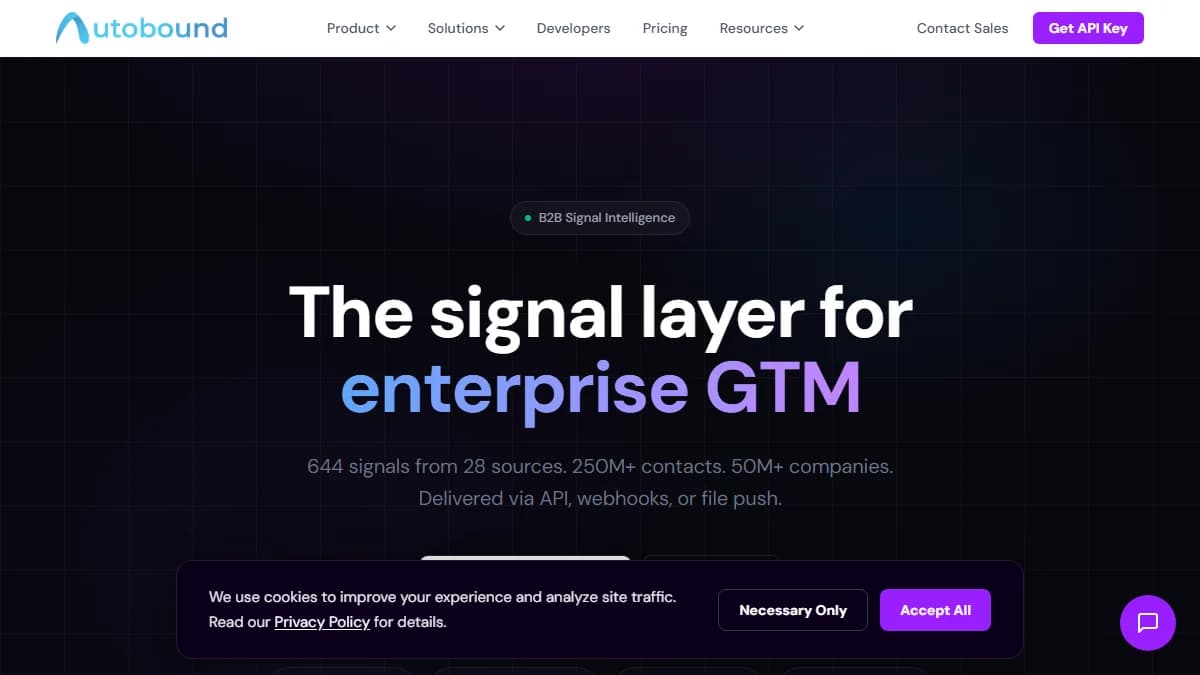
The signals that power Autobound's personalization are now a product in their own right. As of September 2026, Autobound describes itself as B2B signal intelligence infrastructure, with 700+ signals across 35 feeds covering 250M+ contacts and 80M+ companies. The feeds fall into five groups:
- Financial: SEC filings (10-K, 10-Q, 8-K, 20-F, and 6-K), earnings transcripts, financial fundamentals, and Form D private funding.
- Social: LinkedIn posts and comments, Reddit, Glassdoor, GitHub, X, YouTube, podcasts, and conference appearances.
- Workforce: hiring trends, employee growth, job changes, and organizational shifts.
- Market: news events, website traffic, patents, Product Hunt launches, federal contracts, and business registrations.
- Intent: company- and contact-level buyer intent, which Autobound says draws on 6B+ daily behavioral signals across 43,000+ topics.
How the data is delivered
There are three ways to consume it. The REST API serves real-time lookups (Autobound claims sub-200ms responses), file delivery ships daily to weekly exports in JSONL, Parquet, or CSV, and OEM licensing lets other software vendors white-label the data. An MCP server lets AI assistants such as Claude and Cursor query signals directly, and signals refresh daily.
What this means for sales teams
The depth is real: the 10-K feed alone tracks 84 event types. For an SDR, that breadth is what lets a first line reference a specific filing, funding round, or hiring surge instead of a job title. The trade-off is that Autobound is now built with technical buyers in mind. Getting value from the API or file delivery takes someone who can wire signals into a CRM, an outreach tool, or an internal data pipeline.
Autobound Pricing Breakdown
As of September 2026, Autobound's pricing page lists one-time credit packs rather than per-seat plans. Every pack includes the same features: 35+ signal sources, REST API and MCP server access, and buyer intent data. New accounts get 1,000 free credits on signup with no credit card required, credits never expire, and requests that return zero results are free. For current pricing, visitAutobound's website, check G2 reviews, or browse Capterra.
| Pack | Price | Credits | Cost per credit | Best for |
|---|---|---|---|---|
| Starter | $19 | 2,000 | $0.0095 | Testing and proofs of concept |
| Growth | $49 | 5,444 | $0.009 | Production workloads |
| Scale | $149 | 19,867 | $0.0075 | High-volume teams |
| Pro | $499 | 83,167 | $0.006 | Enterprise integrations |
| Business | $1,299 | 288,667 | $0.0045 | Enterprise scale |
| Enterprise | $4,999 | 1,249,750 | $0.004 | Maximum volume |
What a credit buys
Searches cost 2 credits per result, signal enrichment costs 2 credits per signal, and buyer intent costs 1 credit per contact. Exports cost 50 credits plus 5 per topic, with unlimited rows. In practice, the $19 Starter pack covers about 1,000 search results or enriched signals, or 2,000 buyer intent lookups. Beyond 11.5M credits, Autobound offers custom volume with an SLA, SSO, and dedicated infrastructure, plus flat-file licensing covering 80M+ companies with a weekly refresh.
Hidden costs to consider
- Usage-based billing: each search result and each enriched signal costs 2 credits
- Exports cost 50 credits plus 5 per topic
- No email or phone lookups among the listed credit costs
- API, file delivery, and MCP access need technical setup to reach your CRM or outreach tools
What Are the Downsides of Using Autobound?
Autobound has clear strengths in personalization and signal breadth, but its shift to API-first signal infrastructure brings trade-offs. Here is a summary of the pros and cons based on our testing and Autobound's current pricing page.
Pros
- +4.9/5 on G2 across 240+ verified reviews
- +700+ signals across 35 feeds, including buyer intent
- +60x to 120x faster email generation
- +1,000 free credits on signup, no credit card required
- +Credits never expire; zero-result requests are free
Cons
- Signals need your own workflow to trigger outreach
- No email or phone lookups on the pricing page
- Usage-based credits make monthly costs variable
- API-first setup needs RevOps or engineering time
- Email writer seats no longer listed on the pricing page
Signals still need a workflow
Autobound can tell you that a prospect filed a 10-K, raised funding, or started hiring, but it is infrastructure, not an outreach platform. Signals refresh daily and arrive by API, file export, or MCP. Turning a signal into a timely email or CRM task depends on the workflow you build around it, so teams without RevOps or engineering support may struggle to act on the data quickly.
Contact data is not on the price list
Autobound's credit costs cover signal search, signal enrichment, buyer intent, and exports. Verified work emails and phone numbers do not appear among them, so check whether you will need a separate contact data source before budgeting. If you are weighing that side of the stack, our guide to what waterfall enrichment is and why it matters explains how multi-provider contact lookups work.
Is Autobound Worth It?
If your SDR team spends hours researching prospects before writing emails, Autobound's signal-based personalization cuts that to seconds. The 1,000 free credits let you test signal quality on accounts you already know before paying, and credit packs start at $19 as of September 2026. The main gap is that Autobound tells you what changed at an account but leaves it to you to act on it.
The verdict: Autobound is worth it for teams that want deep, timely account context and have the RevOps or engineering capacity to plug a signal API into their stack. If you only need a plug-and-play email writer, confirm what the Chrome extension includes today before buying credits.
Exploring alternatives? Read our reviews of Kular, Fiber AI, Humen, and Lavender.
If building your own workflow to act on Autobound's signals is a dealbreaker, SyncGTM is one alternative worth a look: it pairs real-time buying signals such as job changes and funding with native Salesforce, HubSpot, and Pipedrive integrations.