

ListKit Review 2026: B2B Data Coverage, Pricing & Alternatives

By Kushal Magar · June 6, 2026 · 12 min read · Last updated: September 30, 2026
Key Takeaway
ListKit is a solid list-building tool for cold email teams that prioritize triple-verified deliverability, now sold as an all-in-one Full Cold Email Stack from $597/mo (as of September 2026). The gaps — no free trial, unreliable intent data, a single-database architecture, and expiring credits on the older credit plans — matter at scale.
ListKit is a B2B lead generation platform with 977M+ contacts, an AI-powered company search engine, and triple email verification built in. As of September 2026, its public pricing lists one all-in-one plan, the Full Cold Email Stack, from $597/mo. ListKit cites a 4.8/5 G2 rating. Our rating: 3.8/5.
The pitch is straightforward: describe your target company in plain English, get matching contacts, export with verified emails. ListKit's triple-verification claims ~98% deliverability — and for US enterprise cold email, that claim is largely backed by user data.
The cracks show at scale. On the credit-based plans we first reviewed, credits expired monthly with no rollover. There is no free trial. Intent data is widely reported as inconsistent. And when a contact isn't in ListKit's database, there is no cascade to secondary providers — you simply get no result.
This review covers the pricing math at every plan, data coverage by region and use case, what the triple-verification engine actually delivers, where ListKit falls short, and a direct comparison with Apollo and ZoomInfo for teams deciding on their 2026 data stack.
What Is ListKit?
ListKit is a B2B lead generation and sales intelligence platform built around three core capabilities: an AI company search engine, a 977M+ contact database (as of September 2026), and a triple-verification engine that checks email deliverability before you export.
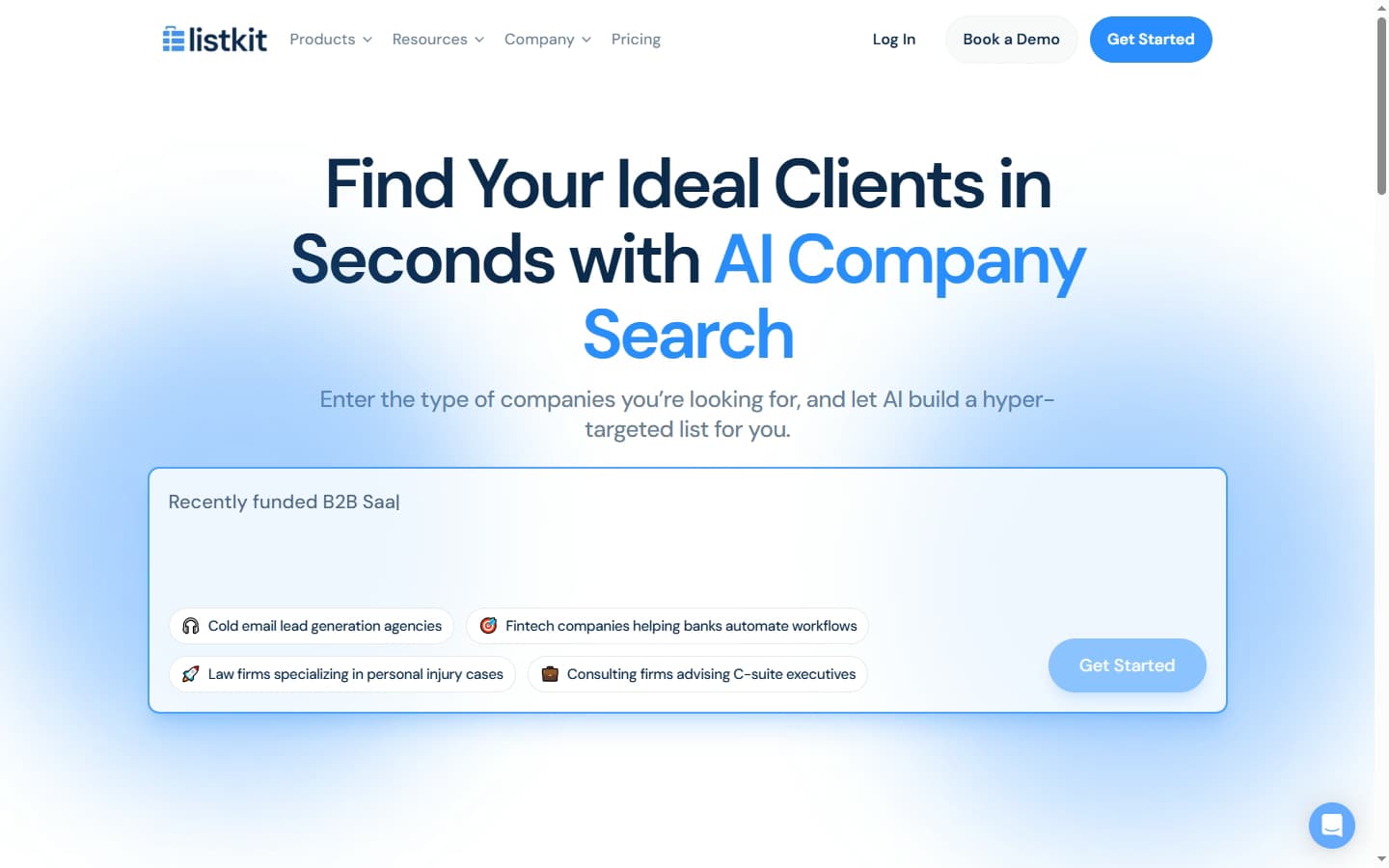
ListKit homepage — AI company search with triple-verified B2B contacts
The AI search is the differentiator on paper. Instead of manually filtering by industry, employee count, and location, you type something like "funded fintech companies with 100+ employees in the US" and ListKit interprets the prompt into structured filters. You then browse matching companies, select contacts, and export with email verification run at point-of-export.
The target user is a founder, SDR, or cold email agency running high-volume outbound — particularly one who needs clean lists without a separate email validation tool in the stack. ListKit positions the verification layer as the reason you can skip ZeroBounce or Bouncer.
| Capability | What ListKit Provides | Notable Gaps |
|---|---|---|
| Contact Database | 977M+ contacts — companies + people | Single database; no cascade if contact missing |
| Email Verification | Triple-verified before export; ~98% claim | Bounce rates still non-zero per user reports |
| AI Company Search | Plain-English prompts converted to filters | Results quality varies; geographic drift reported |
| Intent Data | Intent signals on Scale+ plans | Widely reported as unreliable / inconsistent |
| Mobile Numbers | 5 credits per number on credit-based plans | Expensive relative to email; accuracy varies |
| CRM Integrations | HubSpot, Close, Instantly, Salesforge | No real-time CRM enrichment; manual export flow |
| Buying Signals | Intent data (add-on) | No hiring, funding, or tech-stack signals |
ListKit Pricing: Plans, Credits & What You Actually Pay
As of September 2026, ListKit's public pricing page lists one plan: the Full Cold Email Stack at $597/month for 1,000 cold emails per day, with a slider for 2k, 3k, 5k, and 10k emails per day. It bundles triple-verified leads from AI Search, an email engine with sequences and inbox warmup, managed inboxes, domains (ListKit covers registration), an AI script-writing agent, a cold email course, and a concierge onboarding call.
That is a different model from the one we first reviewed. In June 2026, ListKit sold credit-based plans where different data points cost different amounts, which created a significant gap between the headline credit count and the number of contacts you could actually export. The pricing page no longer lists those plans, so if you only need data, ask sales whether a data-only option still exists.
ListKit's earlier credit-based plans, as reviewed in June 2026
| Plan | Monthly Price | Annual Price | Monthly Credits | Effective Leads (email only) |
|---|---|---|---|---|
| Professional | $97/mo | $83/mo ($996/yr) | 2,000 | 2,000 |
| Scale | $297/mo | $253/mo ($3,036/yr) | 10,000 | 10,000 |
| Ultimate | $597/mo | $508/mo ($6,096/yr) | 50,000 | 50,000 |
| Enterprise | Custom | Custom | Custom | Custom |
The credit math that matters
On those credit plans, the headline credit counts assume email-only exports at 1 credit per lead. Real-world usage is different. Here's what happens when you add data points:
- Business email only: 1 credit per lead. 2,000 credits = 2,000 leads.
- Email + LinkedIn URL: 2 credits per lead. 2,000 credits = 1,000 leads.
- Email + intent signal: 3 credits per lead. 2,000 credits = 666 leads.
- Full enrichment with mobile: 8–10 credits per lead. 2,000 credits = 200–250 leads.
At the Professional plan ($97/mo), fully enriched contacts with mobile numbers cost roughly $0.39–$0.49 each. That is 3–5x the effective cost of email-only exports. Teams building phone-first outbound sequences will burn through credits faster than expected.
The most critical detail on the credit plans: credits did not roll over. Unused credits expired at the end of each billing cycle, so a slow month in your outbound calendar translated directly to wasted spend. The flat $597/mo bundle has the same effect in a different form: you pay for the full stack whether or not you send.
If your volume swings month to month, favor tools whose credits carry over, and compare ListKit against waterfall enrichment platforms before committing.
ListKit Key Features
AI Company Search
ListKit's most distinctive feature is the ability to search for companies using plain-English prompts. Instead of building Boolean filters, you describe your ICP: industry, funding stage, headcount, geography, and tech stack. ListKit converts this into structured database queries.
The practical result is faster list building for non-technical users. A founder or SDR without RevOps support can build targeted company lists in minutes rather than hours of filter configuration. The limitation is accuracy — some users report geographic drift where companies outside the target region appear in results.
Triple-Verification Engine
Every email exported through ListKit goes through three verification checks before leaving the platform. ListKit claims this produces ~98% deliverability at scale — meaning less than 2% of exported emails should bounce.
In practice, G2 reviewers consistently confirm that ListKit lists need little additional cleaning before loading into outreach tools like Instantly or Smartlead. The verification layer is the most credible differentiator in the product. However, "98% deliverability" assumes the email is syntactically valid — it does not guarantee the contact is the right person, still at the company, or responsive to cold outreach.
Phone Numbers & Intent Data
On the credit-based plans we reviewed, mobile phone numbers cost 5 credits per number, and intent data — signals indicating which companies are actively researching solutions — was included on Scale and above. ListKit now markets intent signals across its 977M+ contacts.
Both are useful in theory. In practice, the intent data is where ListKit reviews diverge most sharply from marketing claims. Multiple independent sources — G2 reviewers, Trustpilot, and Reddit threads — describe the intent signals as inconsistent, triggering on companies with no clear purchase intent. This undermines the value of what was the Scale plan's primary differentiator.
CRM & Outreach Integrations
ListKit connects natively to HubSpot, Close, Instantly, Salesforge, and Smartlead. The Email Engine — a cold email sending layer with sequences and inbox warmup — was a separate add-on on the credit plans; as of September 2026 it is bundled into the Full Cold Email Stack along with managed inboxes and domains. Exports can also be done via CSV for any tool not natively supported.
The integration depth is adequate for most outbound stacks. The limitation is flow: ListKit is a list-building tool, not a real-time enrichment layer. You build a list, export it, then load it into your sequencer. There is no continuous CRM enrichment that automatically updates contact records as data changes.
ListKit Pros: What It Does Well
- ✓Triple-verified email deliverability. The verification layer is real. G2 users consistently report low bounce rates without additional cleaning. For cold email teams focused on inbox placement, this removes a step from the workflow.
- ✓Unlimited users on all plans. Unlike Apollo or ZoomInfo which charge per seat, ListKit allows unlimited team members on any plan tier. A 10-person SDR team pays the same as a solo founder. This is a structural cost advantage for growing teams.
- ✓AI search speeds up list building. Plain-English company search is faster than manual filter configuration for non-technical users. Founders and SDRs without RevOps support can build targeted lists without learning a complex filtering UI.
- ✓Strong US enterprise coverage. With 977M+ contacts, ListKit has dense coverage for US enterprise targets. For ICPs concentrated in US tech, finance, and professional services, hit rates are competitive with single-source databases.
- ✓Responsive onboarding support. Multiple G2 reviewers highlight personalized onboarding calls and strategy sessions. For teams new to cold email, the guided setup reduces time-to-first-campaign.
ListKit Cons: Where It Falls Short
- Entry price jumped. As of September 2026, the public pricing page lists only the $597/mo Full Cold Email Stack — about six times the $97/mo entry plan ListKit sold when we reviewed it — so data-only buyers now pay for sending infrastructure too.
- Credits expired monthly with no rollover on the credit-based plans. Unused credits were lost at the end of each billing cycle, so a slow outbound month meant paying for nothing.
- No free trial. Unlike Apollo, ListKit requires a paid commitment before you can test data quality against your specific ICP.
- Intent data is unreliable. Multiple G2 reviewers and Reddit users describe ListKit's intent signals as inconsistent — firing on companies that show no actual buying behavior.
- Cancellation friction. Users must attend an 'onboarding meeting' to cancel. Support goes quiet if no convenient meeting time exists, leading to ongoing charges.
- Mobile numbers are expensive. At 5 credits per number on the credit-based plans, phone enrichment depletes plans 5x faster than email-only exports. A 2,000-credit plan yields just 400 mobile numbers.
- Single-database architecture limits hit rates. ListKit queries one proprietary database. Contacts not in that database return no result — there is no cascade to secondary providers. Multi-provider waterfall tools cover those gaps.
- No buying signals worth acting on. Hiring surges, funding rounds, and tech stack change monitoring — the signals that indicate when a company is ready to buy — are not reliable in ListKit.
The architectural limitation is worth expanding. ListKit queries one proprietary database. If a contact is not indexed there, ListKit returns nothing — no fallback, no secondary source, no cascade. This is the core trade-off against waterfall enrichment tools, which route the same input through multiple providers sequentially to maximize coverage. For niche industries, SMB targets, and non-US markets, the gap between single-database and waterfall hit rates can be meaningful.
ListKit vs Apollo vs ZoomInfo
The B2B data category has three dominant architectures in 2026: single-database tools (ListKit, Apollo, ZoomInfo), waterfall enrichment platforms (such as FullEnrich), and open-orchestration layers (Clay). Here is how ListKit compares across the dimensions that matter most for outbound teams.
| Feature | ListKit | Apollo | ZoomInfo |
|---|---|---|---|
| Starting Price | $597/mo (Full Cold Email Stack) | $59/mo (Basic) | ~$15,000/yr (min) |
| Database Size | 977M+ contacts | 275M+ contacts | 260M+ professionals |
| Enrichment Method | Single DB + triple-verification | Single proprietary DB | Single proprietary DB |
| Email Hit Rate (US Enterprise) | ~85% (triple-verified) | 60–75% (own DB) | 70–80% (own DB) |
| Mobile Phone Coverage | 5 credits per number (credit plans) | Limited direct dials | Strong (premium tier) |
| Buying Signals | Intent data (unreliable per users) | Basic intent (Bombora) | Intent + scoops |
| Native Outreach | Email engine bundled in Full Cold Email Stack | Yes — sequences included | Yes (Engage add-on) |
| Credit Rollover | No on credit plans (expired monthly) | Yes (annual plans) | N/A (seat-based) |
| Free Trial | No | Yes (limited free tier) | Demo only |
| Seat Fees | None (unlimited users) | Per seat | Per seat |
The honest take on each option
ListKit wins for teams that need verified email lists fast, value unlimited users, and do most outbound to US enterprise contacts. The AI search is genuinely useful for non-technical users. The ceiling hits when you need mobile-heavy enrichment, reliable signals such as hiring surges, funding rounds, and tech stack changes, or contacts outside ListKit's database coverage.
Apollo combines a proprietary database with built-in sequencing. Data quality is competitive with ListKit for US enterprise, and the sequencer eliminates the need for a separate outreach tool. Apollo charges per seat, which adds up for larger teams. Enrichment hit rate on edge cases (niche industries, SMBs) is lower than waterfall tools.
ZoomInfo has the deepest enterprise coverage and the strongest intent data in the category — but starts at ~$15,000/year with long annual contracts. It is overkill for most teams under 20 SDRs and out of reach for startups and agencies.
Who Should Use ListKit?
ListKit is the right tool in a specific scenario: your ICP is US enterprise or mid-market, your primary channel is cold email, you need verified lists without a separate cleaning step, and your team is large enough that per-seat pricing from Apollo or ZoomInfo is becoming expensive.
Use ListKit if:
- You send 5,000+ emails per month to US enterprise targets and inbox placement is your primary concern.
- You have 3+ people doing outbound and need unlimited users without per-seat fees.
- You want triple-verified leads, sending, inboxes, and domains bundled into a single plan rather than managed separately.
- Non-technical SDRs need to build lists without RevOps support — the AI search removes the filter-configuration barrier.
Do not use ListKit if:
- Your ICP includes significant APAC, LATAM, or niche industry targets where single-database coverage thins out.
- Reliable buying signals (hiring surges, funding alerts) are part of your outbound strategy — ListKit's intent data consistently underdelivers.
- You need mobile-heavy enrichment — at 5 credits per number on the credit plans, the effective cost per contact becomes prohibitive.
- Your outbound volume varies month to month — a flat $597/mo bundle (and, on the older credit plans, expiring credits) means slow months are pure waste.
- You already run Instantly, Smartlead, or Salesforge and only need data — the current bundle charges for sending infrastructure you already have.
- You want to enrich your existing CRM records in real time. ListKit is a list-builder, not a continuous enrichment engine.
Teams in two or more of these categories should evaluate waterfall enrichment tools such as FullEnrich, which route the same input through multiple providers to cover contacts that fall outside a single database's reach.
If ListKit returning nothing for contacts outside its single database is a dealbreaker, SyncGTM is one alternative worth a look: it runs waterfall enrichment across 50+ data providers for verified emails, phone numbers, and firmographics.