

RB2B Review 2026: Person-Level Visitor ID, Plans and Pricing

By Kushal Magar · April 8, 2026 · 12 min read · Last updated: September 30, 2026
Key Takeaway
RB2B is a person-level website visitor identification tool that matches US-based visitors to LinkedIn profiles and pushes real-time alerts to Slack or Teams. As of September 2026, the free plan gives 150 company-level resolutions per month, Starter is $79/mo (300 resolutions, LinkedIn URLs), Pro starts at $149/mo (600 to 2,500 resolutions, business emails, all integrations), and Pro+ starts at $199/mo (premium resolution), with a 7-day full-featured trial. RB2B claims 35-45% contact-level identification of US visitors on paid plans. Main limitations: US-only person-level coverage, credit-based pricing that burns fast on high-traffic sites, overage fees, and no built-in outreach or outside buying signals.
RB2B identifies individual website visitors — not just companies — by matching US-based visitors to LinkedIn profiles and pushing real-time Slack alerts. A rep gets notified the moment a prospect hits your pricing page: name, title, company, LinkedIn URL, and every page they viewed in that session. The free plan gives 150 credits/month with company-level data only; person-level identification starts at $79/mo (Starter).
The core question: is person-level visitor identification worth paying for when most of your traffic stays anonymous anyway, and when US-only coverage excludes every international visitor from person-level matching?
RB2B Review: What You Get (and What You Don't)
RB2B uses a tracking pixel to identify individual website visitors and match them to LinkedIn profiles. Unlike company-level tools such as Leadfeeder that only show you which companies visited, RB2B aims to show you the actual person. Check how users rate it on G2.
| Feature | What's Included | Limitations |
|---|---|---|
| Person-Level ID | LinkedIn profile matching for US visitors | US-only — international visitors not identified at person level |
| Match Rate | RB2B claims 35-45% of US visitors at contact level, 15-20% globally at company level | Vendor figures; even at best, most traffic stays anonymous |
| Slack Alerts | Real-time visitor notifications with LinkedIn URL | Email addresses only on Pro plan and above |
| Credit System | 150 to 2.5 million monthly resolutions depending on plan | Credits burn fast on high-traffic sites; overages cost 25-45 cents each |
| Intent and Prioritization | Hot Pages tag high-intent pages; Hot Leads filter visitors by ICP | No outside buying signals such as funding or hiring data |
| Integrations | Slack, Teams, HubSpot, Salesforce, Clay, Apollo, Zapier, webhooks, CSV | Everything beyond Slack and Teams requires Pro or above |
The takeaway: RB2B tells you who visited your website and which pages they cared about. What it does not do is tell you whether the visitor's company is in-market based on outside signals, or run the outreach for you.
RB2B Visitor Identification: How Person-Level Matching Works
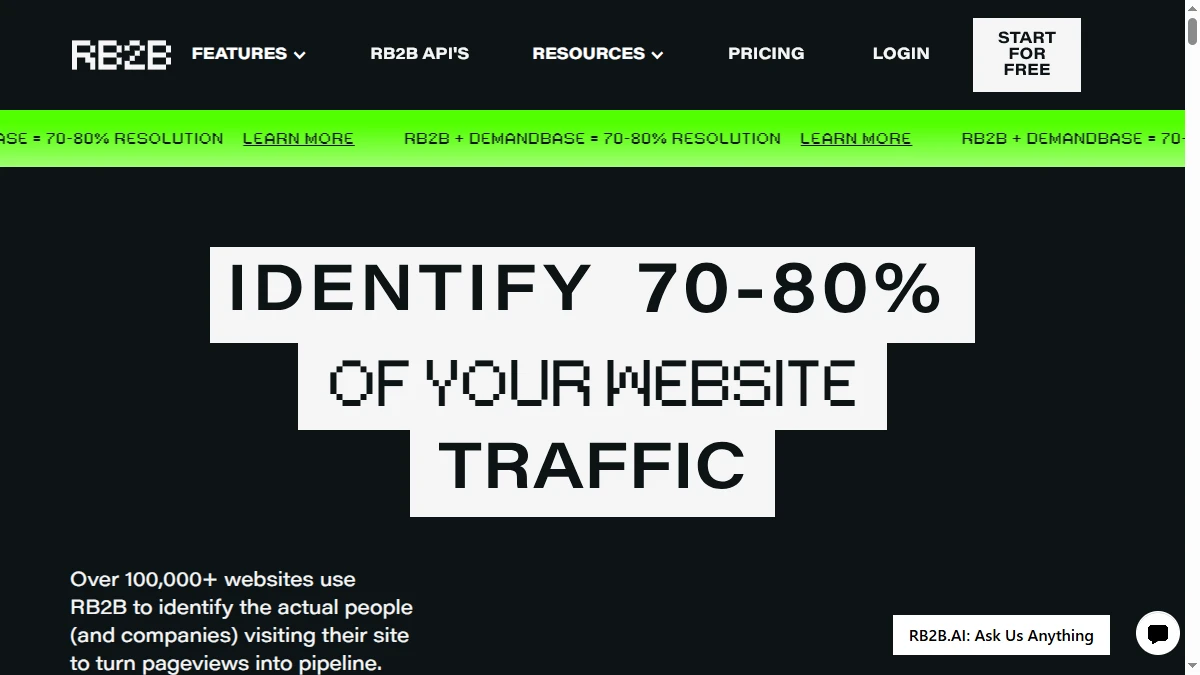
You install a lightweight JavaScript pixel on your website. When a US-based visitor lands on any page, RB2B attempts to match them against its database using browser signals, cookies, and identity graph data. If matched, you get a Slack notification with their name, LinkedIn profile URL, company, job title, and the pages they viewed.
The Pro plan adds business email addresses to the notification. Pro+ uses a premium resolution engine that claims higher match rates. On the free plan, you get company-level data only — no person-level identification.
What works well
Setup takes under 5 minutes. The Slack integration is genuinely useful — your sales team gets notified the moment a prospect hits your pricing page, case study, or comparison page. The LinkedIn profile link means your reps can immediately check the person's background before reaching out. For teams running ABM campaigns, knowing that a specific decision-maker visited your site is actionable intel.
Where it falls short
RB2B identifies the visitor and flags high-intent pages and ICP matches, but it stops short of outside signals: there is nothing to tell you whether that visitor's company is hiring, recently funded, or researching competitors elsewhere. There is no built-in outreach either — your rep still has to craft a connection request or email, or push the visitor to a sequencer through one of the Pro-tier integrations.
RB2B Pricing Breakdown
RB2B publishes pricing on their pricing page (plans below as of September 2026). All paid plans billed annually:
- •Free ($0/mo): 150 resolutions (credits)/month, company-level identification only, Slack or Teams alerts, no person-level data, no email addresses
- •Starter ($79/mo): 300 resolutions/month, person-level identification, LinkedIn URLs pushed to Slack or Teams, no email addresses, no other integrations, 45¢ per resolution in overage
- •Pro (from $149/mo): 600 to 2,500 resolutions/month (tiered), business email addresses included, all integrations, full person-level data, 25¢ per resolution in overage
- •Pro+ (from $199/mo): Premium resolution engine, tiers from 600 up to 2.5 million resolutions/month, everything in Pro, 25¢ per resolution in overage
A 7-day full-featured trial is available, and paid plans include Hot Pages, Hot Leads, exclusions, and reporting on net-new versus repeat visitors.
What you actually pay
A B2B SaaS site getting 10,000 monthly visitors will burn through 600 Pro credits in the first week if traffic is concentrated. At that point you either stop identifying visitors mid-month, pay overages, or upgrade. At list price, Starter works out to about 26 cents per resolution and Pro to about 25 cents at its entry tier, and overages cost 45 cents per resolution on Starter and 25 cents on Pro and Pro+.
Hidden costs to watch
- Credits burn fast — high-traffic sites exhaust monthly allotments within days
- Free plan is company-level only — person-level data requires paid plans
- Email addresses locked behind Pro at $149/mo — Starter only gives LinkedIn URLs
- No built-in outreach — identified visitors have to be pushed to other tools, and integrations beyond Slack and Teams start at Pro
- US-only — international teams need a completely separate person-level visitor ID solution
- Overages — 45 cents per resolution on Starter, 25 cents on Pro and Pro+
What Are the Downsides of Using RB2B?
US-only coverage kills it for global teams
RB2B's person-level identification database is US-only. If your website traffic comes from Europe, APAC, or LATAM, you get company-level data at best — and often nothing at all. Teams selling internationally cannot rely on RB2B as their primary visitor identification tool.
Credit-based pricing punishes growth
The more website traffic you drive, the faster you burn credits. A successful blog post or ad campaign that doubles your traffic also doubles your RB2B costs. Users on Reddit report running out of credits mid-month and having to choose between upgrading or going blind for two weeks.
No enrichment or outreach layer
RB2B tells you a name, a LinkedIn URL, a business email on Pro, and which high-intent pages they viewed. It does not tell you if that person's company just raised a Series B, hired 3 SDRs last month, or is actively evaluating competitors. You get identification without context. Read our best buying intent data tools guide for the signal layer RB2B is missing.
Most traffic still stays anonymous
RB2B says its paid plans identify 35-45% of US visitors at the contact level (as of September 2026). Even taking that at face value, more than half of your US traffic stays anonymous, and international visitors are never identified at the person level. For a site with 5,000 monthly US visitors, RB2B's own rates imply roughly 1,750-2,250 identified people, well above Pro's entry tier of 600 resolutions. Measure your real rate during the trial before you choose a tier.
How to Get the Most Out of RB2B
RB2B is quick to install, but the difference between a noisy Slack channel and real pipeline comes down to setup. Here is a practical rollout, using the features RB2B lists on its pricing page as of September 2026.
- Start with the trial, not the free plan. The free plan only resolves visitors at the company level. The 7-day full-featured trial shows person-level matches on your real traffic, which is the number that decides whether a paid tier pays off.
- Install the pixel and set exclusions. RB2B lets you exclude traffic you do not want to resolve, which keeps your monthly resolutions focused on prospects.
- Tag Hot Pages. Mark pricing, comparison, and case study pages as high intent so alerts surface the visits that matter instead of every blog read.
- Define Hot Leads. Use the ICP filters so alerts focus on the titles, company sizes, and industries you actually sell to.
- Route alerts where reps work. Starter pushes LinkedIn URLs to Slack or Teams. Pro and above add business emails plus integrations with HubSpot, Salesforce, Clay, Apollo, Zapier, webhooks, and CSV export, so identified visitors can land in your CRM or sequencer automatically.
- Watch the reporting and your resolution count. Net-new versus repeat visitors, pageview history, and top pages show which content brings buyers back. Keep an eye on monthly resolutions too: overages cost 45 cents each on Starter and 25 cents on Pro and Pro+.
Done well, RB2B becomes a real-time trigger for warm outreach: a named visitor on your pricing page, matched to your ICP, landing in a rep's queue while the visit is still fresh. Done carelessly, it becomes another alert channel people mute.
Is RB2B Worth It?
RB2B is worth it for US-focused B2B sales teams that want to know exactly who is browsing their website. The free plan at 150 credits/month is enough to validate whether person-level identification changes how your team works. The Slack integration is genuinely useful for real-time sales reactions.
RB2B is not enough for teams that need global coverage, enrichment, or built-in automated follow-up. Visitor identification is one piece of the pipeline puzzle. Knowing that Jane from Acme Corp visited your pricing page is useless if you do not know whether Acme is actually in-market and cannot route that signal into a workflow.
The verdict: strong person-level identification for US traffic, with useful intent tagging and integrations on Pro, but no outreach, no outside buying signals, and no person-level coverage outside the US. Run the 7-day trial on your own traffic before picking a tier.
Comparing visitor identification tools? Read our reviews of Leadfeeder, Warmly, and our roundup of best buying intent data tools for 2026.
If RB2B's lack of company-level buying signals is a dealbreaker, SyncGTM is one alternative worth a look: it tracks funding, hiring, headcount growth, and job changes, and uses AI to score leads against your ICP.