4 Best Contact Leads in 2026 (Ranked and Compared)

By Kushal Magar · April 21, 2026 · 14 min read
Most B2B teams buy contact leads from the same two or three vendors, then wonder why outbound performance is flat. The problem is not outbound — it is data quality.
A single data provider returns valid information for 40–60% of your list. That means nearly half your pipeline never reaches an inbox or a phone.
B2B prospecting platforms vary dramatically in coverage, verification depth, integration options, and cost. ZoomInfo charges enterprise prices for data your team might not need. Apollo is affordable but accuracy clusters around 65–80% on independent tests. Lusha is fast for individual reps but does not scale to bulk enrichment pipelines.
This guide ranks the 4 best contact leads platforms in 2026 on the metrics that actually matter: data accuracy, coverage depth, integration with your GTM stack, and cost per valid record. No fluff. No vendor-paid rankings.
TL;DR
- SyncGTM (#1) — Best for GTM teams that need waterfall enrichment, real-time buying signals, and CRM automation in one platform. Starts at $99/mo.
- Apollo.io (#2) — Best for outbound teams that want a contact database plus built-in email sequencing. Free tier available; paid from $49/user/mo.
- ZoomInfo (#3) — Best for enterprise sales teams that need org charts, intent data, and the deepest US company database. Annual contracts from ~$15k/year.
- Lusha (#4) — Best for individual reps who prospect on LinkedIn and need quick contact lookups without a full platform. Starts at $36/mo.
What Are Contact Leads?
Contact leads are individual prospects — people at companies matching your ICP — paired with verified contact information. This includes work email addresses, direct phone numbers, LinkedIn URLs, job titles, and sometimes mobile numbers.
High-quality contact leads combine personal data with firmographic context: company size, industry, revenue, tech stack, and buying signals. A prospect record without context is just a name and email. A verified contact with context tells you who to reach, when to reach out, and what to say.
What a high-quality contact lead contains
- Personal: Full name, job title, seniority level, LinkedIn URL
- Contact: Verified work email, direct dial, mobile number
- Company: Name, industry, headcount, revenue range, location
- Signals: Recent job change, hiring intent, tech stack changes, funding events
According to Gartner, B2B contact data decays at roughly 2% per month. A contact list that was accurate six months ago is already 12% stale. This is why contact leads tools that verify data in real time or cascade across multiple sources dramatically outperform static databases.
The best B2B prospecting platforms in 2026 do more than store names and emails. They enrich records continuously, layer in buying signals, and push verified data directly into your CRM and outreach tools — removing the export/import bottleneck that kills sales lead automation workflows.
How We Ranked These Tools
We evaluated each tool on four dimensions. These map directly to the questions GTM teams ask when choosing a contact leads platform.
- Data quality (30% weight) — Email deliverability, mobile hit rate, and freshness of records. We weight verified deliverability, not just “email found.”
- Coverage depth (25% weight) — Total database size, global vs. US-only coverage, and how many underlying providers or sources the platform aggregates.
- Integration depth (25% weight) — Native CRM integrations, API access, workflow automation, and how easily contact leads flow into your existing sales stack.
- Pricing and ROI (20% weight) — Actual cost per verified contact, not headline credit pricing. A cheaper plan with a 50% hit rate costs more per valid record than a pricier plan with 90% coverage.
All four tools ranked here solve the core problem of finding and verifying B2B contacts for outbound. The differences are in how they do it — and which motions they support best.
Side-by-Side Comparison
Here is how the 4 top B2B prospecting platforms compare on the metrics that matter for GTM teams in 2026.
| Feature | SyncGTM | Apollo.io | ZoomInfo | Lusha |
|---|---|---|---|---|
| Database Size | 50+ provider waterfall | 275M+ contacts | 260M+ professionals | 100M+ profiles |
| Email Accuracy | 80–95% (waterfall) | 65–80% (single-source) | ~85% (claimed) | ~81% (direct dials) |
| Phone Numbers | Mobile + direct dial waterfall | Direct dials included | Direct dials + mobile | Strong mobile/direct dials |
| Buying Signals | 20+ native signals | Intent data (add-on) | Scoops + intent data | Job change alerts |
| CRM Integration | Native push + API | Native (SF, HubSpot) | Native (SF, HubSpot, more) | Extension + API |
| Outreach Built In | No (integrates with Instantly, Smartlead, HeyReach) | Yes — email sequences + dialer | Yes — Engage module | No |
| Starting Price | $99/mo | Free / $49/user/mo | ~$15k/year | $36/mo |
| Contract Type | Month-to-month | Monthly or annual | Annual only | Monthly or annual |
| Best For | GTM engineers and signal-led outbound | Email-led outbound at scale | Enterprise sales with large budgets | Individual reps on LinkedIn |
1. SyncGTM — Best Contact Leads Platform for GTM Teams
SyncGTM is a GTM automation platform best suited for B2B sales and RevOps teams that need high-coverage contact enrichment paired with real-time buying signals, starting at $99/mo with no annual contract. Instead of maintaining its own proprietary database, SyncGTM cascades contact lookups across 50+ data providers in a single workflow step — achieving 80–95% email coverage where single-source tools cap out at 40–60%.
The result: email coverage of 80–95% on B2B contacts — far higher than any single-source provider. You only pay when a valid contact is returned, so wasted credits on misses are eliminated.
SyncGTM also layers in 20+ real-time buying signals — job changes, funding events, hiring spikes, tech stack updates, website traffic growth — so you can prioritize contact leads based on who is actively in-market rather than cold-calling a static list.
Pros
- Waterfall enrichment across 50+ providers pushes email hit rate to 80–95%, beating every single-source competitor
- 20+ native buying signals layer intent and timing data directly onto contact leads
- Native integrations with Salesforce, HubSpot, Instantly, Smartlead, and HeyReach eliminate manual exports
- No annual contract — month-to-month pricing from $99/mo
- Pay-only-on-valid-result credit model means zero wasted spend on misses
Cons
- No built-in email sequencing — you need a separate outreach tool like Instantly or Smartlead
- Steeper learning curve than Lusha for individual reps who want quick point-and-click lookups
- Waterfall enrichment adds a small latency vs. single-source providers (typically under 30 seconds per batch)
Best for
GTM engineers and RevOps teams running signal-led outbound at scale, or any team tired of single-source contact data that misses 40% of their list.
Pricing
Starts at $99/mo. No annual contract. Enrichment credits are billed only on valid results returned.
2. Apollo.io — Best Contact Leads Tool for Outbound Email Teams
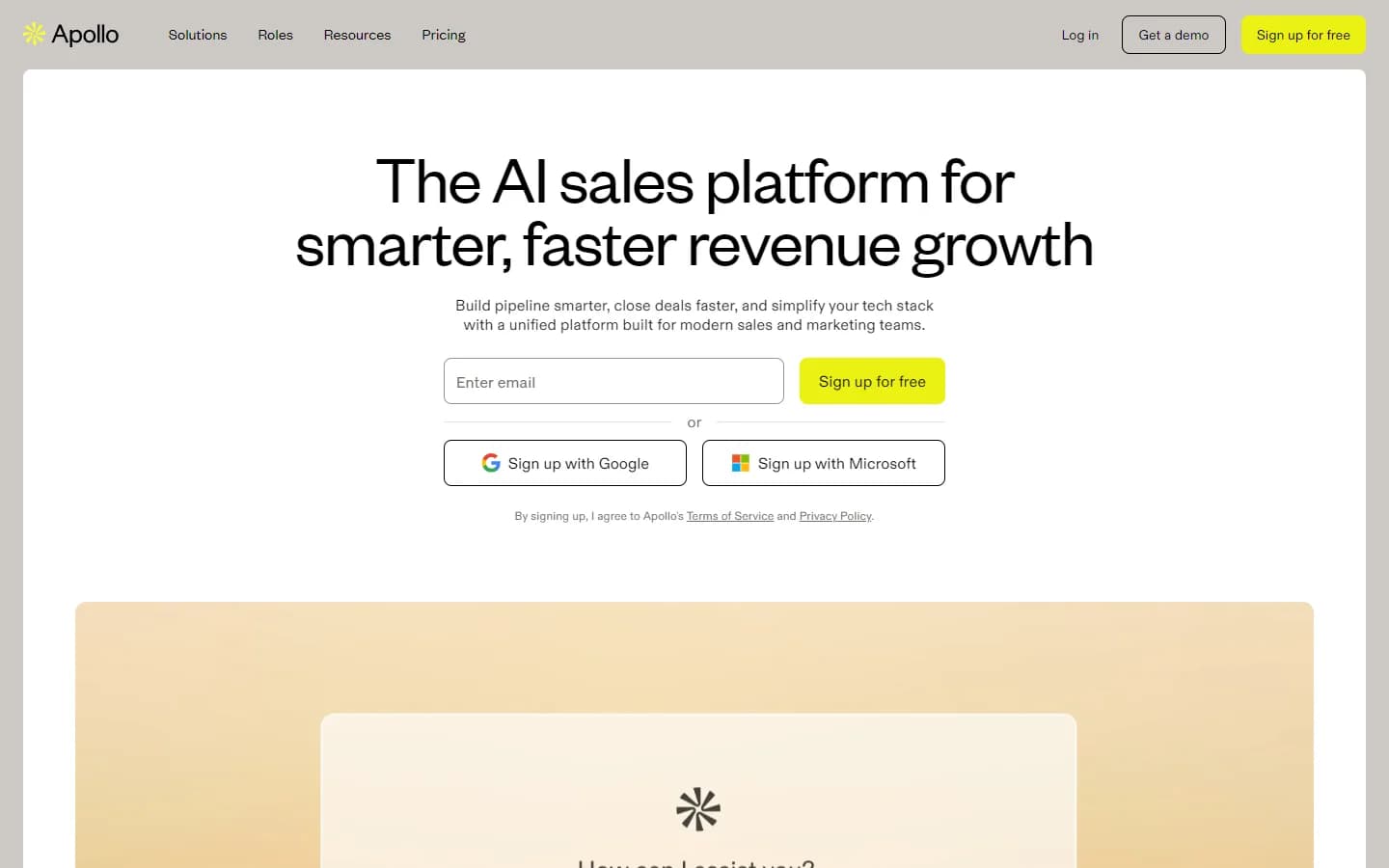
Apollo.io — 275M+ contact database with built-in email sequencing and dialer
Apollo.io is an all-in-one sales prospecting and outreach platform best suited for outbound email teams that want a large contact database and built-in sequencing in one tool, starting free with paid plans from $49/user/mo. It combines a 275M+ contact database with built-in email sequences, a power dialer, and intent data — all in one subscription.
Apollo is the strongest option on this list for teams running email-led outbound at scale. According to G2, Apollo has 7,000+ reviews with a 4.8/5 rating, making it one of the most-reviewed sales intelligence platforms on the market. You can build targeted contact lists, verify emails, and launch sequences without switching tools or exporting data.
Data accuracy clusters around 65–80% on independent deliverability tests — lower than claimed but still competitive for the price point. For teams on the Apollo free tier or basic paid plans, the database is the primary value. Intent data and advanced enrichment require higher-tier plans.
Pros
- 275M+ contact database — one of the largest accessible at this price point
- Built-in email sequences and power dialer eliminate the need for a separate outreach tool
- Free tier with 50 contact exports per month — usable for small teams testing the platform
- Advanced filters for building hyper-targeted prospect lists (title, seniority, tech stack, funding stage)
- 4.8/5 on G2 across 7,000+ reviews — highest-rated sales intelligence tool at its price tier
Cons
- Email accuracy of 65–80% lags behind waterfall platforms — expect higher bounce rates at scale
- Credit limits on lower tiers restrict bulk list building for high-volume outbound teams
- Intent data and advanced enrichment gated behind $79/user/mo+ plans
- European contact coverage weaker than US — not ideal for EMEA-focused teams
Best for
Outbound sales teams that want contact data and email sequencing in one platform. Strong for US-focused teams at early to growth stage.
Pricing
Free tier (50 exports/mo). Paid plans from $49/user/mo (Basic). Professional at $79/user/mo adds intent data and advanced enrichment.
See our full Apollo.io review for a deeper breakdown of features, pricing, and accuracy benchmarks.
3. ZoomInfo — Best Contact Leads Tool for Enterprise Sales Teams
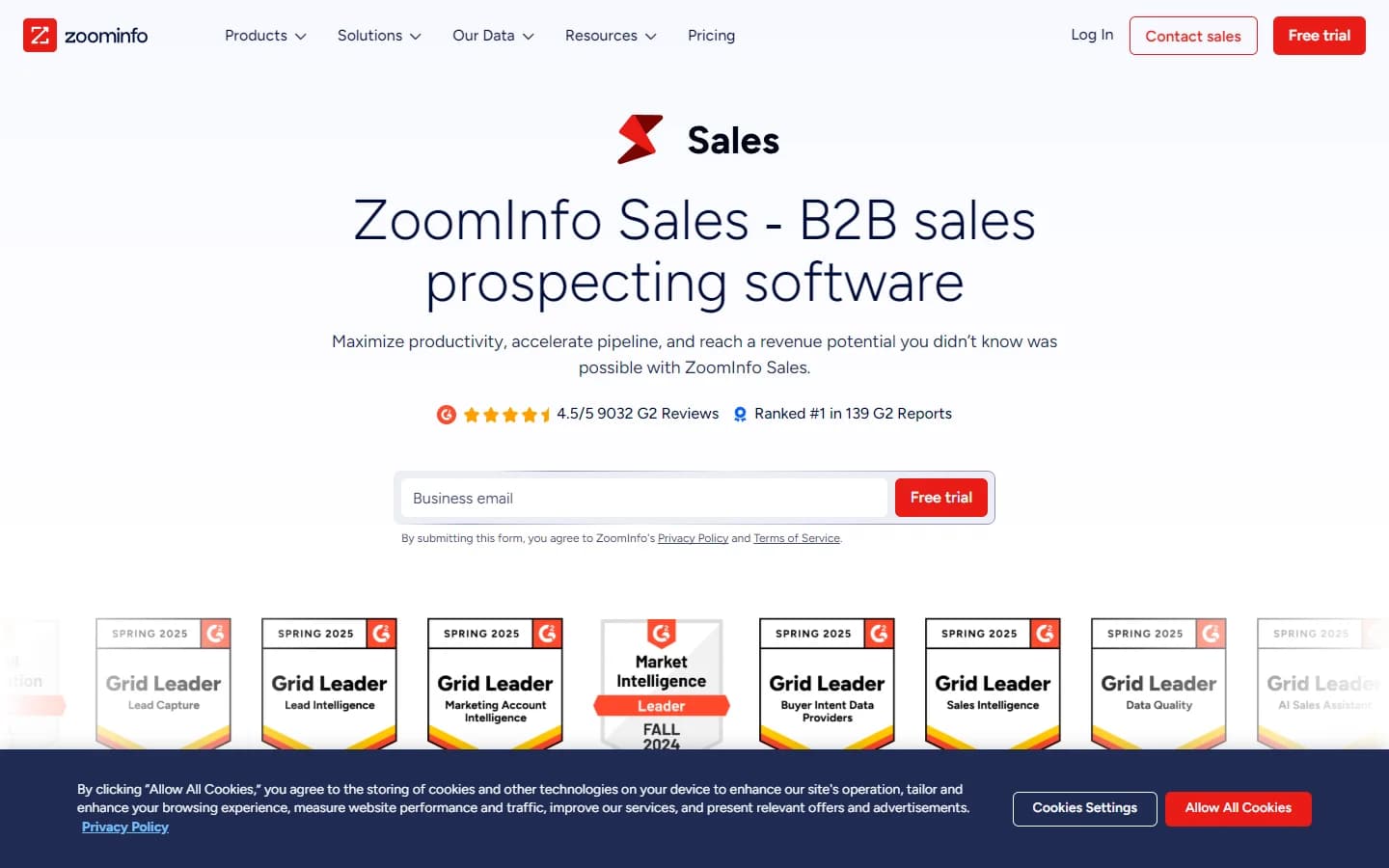
ZoomInfo — enterprise B2B contact database with org charts, Scoops, and intent data
ZoomInfo is a B2B intelligence platform best suited for enterprise sales teams running account-based programs, offering the deepest US contact database and org chart data at annual contracts from ~$15,000/year. Its database covers 260M+ professionals across 100M+ companies, with particular depth in US enterprise accounts.
ZoomInfo earns its premium pricing through features smaller tools cannot match: org charts that map decision-maker hierarchies, Scoops (proprietary intelligence on business triggers), Chorus AI for conversation intelligence, and Engage for multichannel outreach. For enterprise sales teams running account-based motions, this ecosystem is hard to replicate.
The catch is cost. ZoomInfo requires annual contracts that typically start at $15,000/year for small teams and scale to $50,000+ at mid-market. Startups and early-stage companies almost always find better ROI with Apollo or SyncGTM.
Pros
- 260M+ professional profiles — largest proprietary B2B contact database on the market
- Org charts map full decision-maker hierarchies for enterprise account-based selling
- Scoops surface business triggers (leadership changes, expansions, new initiatives) before competitors see them
- Deep integrations with Salesforce, HubSpot, Marketo, and most enterprise sales stacks
- Intent data from Bombora partnership flags accounts actively researching your category
Cons
- Annual contracts from ~$15k/year make it inaccessible for most startups and SMBs
- Contact accuracy claims (~85%) exceed independent test results in some categories — verify with a trial batch before committing
- International coverage thins outside North America — European and APAC contact leads weaker than US
- Complex pricing with add-on modules means the base price rarely reflects what you actually pay
Best for
Enterprise sales teams with 50+ rep organizations running account-based programs where org chart depth and Scoops intelligence justify the budget.
Pricing
Annual contracts only. Entry-level for small teams starts around $15,000/year. Most mid-market deployments run $30,000–$50,000/year depending on seat count and modules.
See our full ZoomInfo review or compare the best ZoomInfo alternatives if the pricing is out of range.
4. Lusha — Best Contact Leads Tool for Individual LinkedIn Prospectors
Lusha — Chrome extension for instant contact data on LinkedIn profiles and company pages
Lusha is a B2B contact data platform best suited for individual sales reps who prospect on LinkedIn, offering instant email and phone lookup via a Chrome extension starting at $36/mo. Its extension overlays direct dial numbers and work emails directly on LinkedIn profile pages with one click.
Lusha's strength is speed and simplicity. You do not need a data engineering background or a complex workflow to get contact leads — hover over a profile and the data appears. For SDRs and account executives running manual LinkedIn prospecting, this frictionless UX beats every other option on this list.
Coverage for US direct dials is strong. Mobile hit rates are above industry average for individual lookups. However, Lusha is not built for bulk enrichment pipelines or programmatic contact leads workflows — it scales with humans, not automation.
Pros
- Chrome extension makes LinkedIn contact lookup instant — no exports, no copy-paste
- Strong US direct dial accuracy — above-average mobile hit rate for individual lookups
- Free tier with 5 credits/month for testing data quality before committing
- GDPR and CCPA compliant data collection — relevant for US and European outbound teams
- Intent signals and job change alerts available on higher-tier plans
Cons
- Not designed for bulk enrichment — scales with manual LinkedIn activity, not programmatic workflows
- Credit limits on entry plans restrict high-volume prospecting teams
- International coverage thinner than Apollo or ZoomInfo outside the US and UK
- No built-in sequencing — requires integration with a separate outreach tool
Best for
Individual SDRs and AEs who prospect manually on LinkedIn and need fast contact data without a complex platform setup.
Pricing
Free tier (5 credits/mo). Pro plan from $36/mo (480 credits/year). Premium from $59/mo. Scale plans for teams available on request.
See our full Lusha review or explore Lusha alternatives if you need bulk enrichment or better global coverage.
How to Choose the Right Contact Leads Tool
The best contact leads tool for your team depends on three factors: whether you need bulk enrichment or individual lookups, whether you want outreach built in, and how much budget you have. Use this decision framework to match your motion to the right platform.
- You run a signal-led outbound motion and care about coverage: SyncGTM. Waterfall enrichment across 50+ providers gives you the highest contact lead hit rate, and 20+ native signals tell you when to reach out.
- You want contact data and email sequencing in one tool: Apollo.io. Best price-to-feature ratio for email-led outbound, especially for US-focused teams.
- You run enterprise ABM and need org chart depth: ZoomInfo. No other platform matches its US enterprise database and business intelligence depth — if the budget is available.
- You prospect manually on LinkedIn and want instant lookup: Lusha. The Chrome extension UX is unmatched for individual rep workflows.
- You are budget-constrained and want to test before committing: Apollo.io free tier or Lusha free tier. Both let you validate contact data quality before paying.
One final consideration: data decay. According to HubSpot research, the average B2B contact list decays by up to 22% per year. Platforms that re-verify data in real time — or cascade multiple sources — outperform static databases as your list ages. This is the core advantage of waterfall-first platforms like SyncGTM over single-source tools for teams that run outbound at volume.
If you are currently using a single-source provider and seeing bounce rates above 5%, it is worth running a sample list through a waterfall contact provider to measure the coverage uplift.
Final Verdict: Which Contact Leads Tool Should You Use?
SyncGTM is the strongest contact leads platform for GTM teams in 2026. Waterfall enrichment across 50+ providers solves the coverage problem that makes single-source tools underperform. Built-in buying signals mean you can prioritize outreach to contacts who are actively in-market — not just anyone on a list.
Apollo.io is the right pick if you want everything in one tool — contact data, email sequencing, and a dialer — at a price that scales with your team size. The data accuracy gap vs. waterfall platforms is a real trade-off, but for teams that care more about workflow consolidation than marginal coverage gains, Apollo wins.
ZoomInfo is worth the price if you are running enterprise account-based programs where org chart depth and Scoops intelligence generate pipeline that justifies the $15k+ annual commitment. For everyone else, the ROI math is hard to defend against newer alternatives.
Lusha delivers the best experience for individual LinkedIn-first prospecting. The Chrome extension is the fastest path from LinkedIn profile to phone number, and the pricing is accessible for small teams. It is not built for bulk enrichment or automated pipelines.
If you are unsure, start with a free trial on Apollo or SyncGTM, run the same 100-contact list through both, and measure bounce rate and coverage before committing to a paid plan. Data quality differences are visible within a single test batch.
For deeper context on building a full contact data stack, see our guides on contact enrichment tools and B2B contact databases.
This post was last reviewed in April 2026. Pricing and features are subject to change — verify current plans on each provider's website before purchasing.