

ZoomInfo 2026 Review: Is the Premium Pricing Actually Worth It?

By Kushal Magar · March 16, 2026 · 14 min read · Last updated: September 30, 2026
You are probably here because your team is evaluating ZoomInfo and the pricing made you pause. A $15,000 starting price. Annual contracts only. Credits that expire every month. You want to know if the data is good enough to justify the spend.
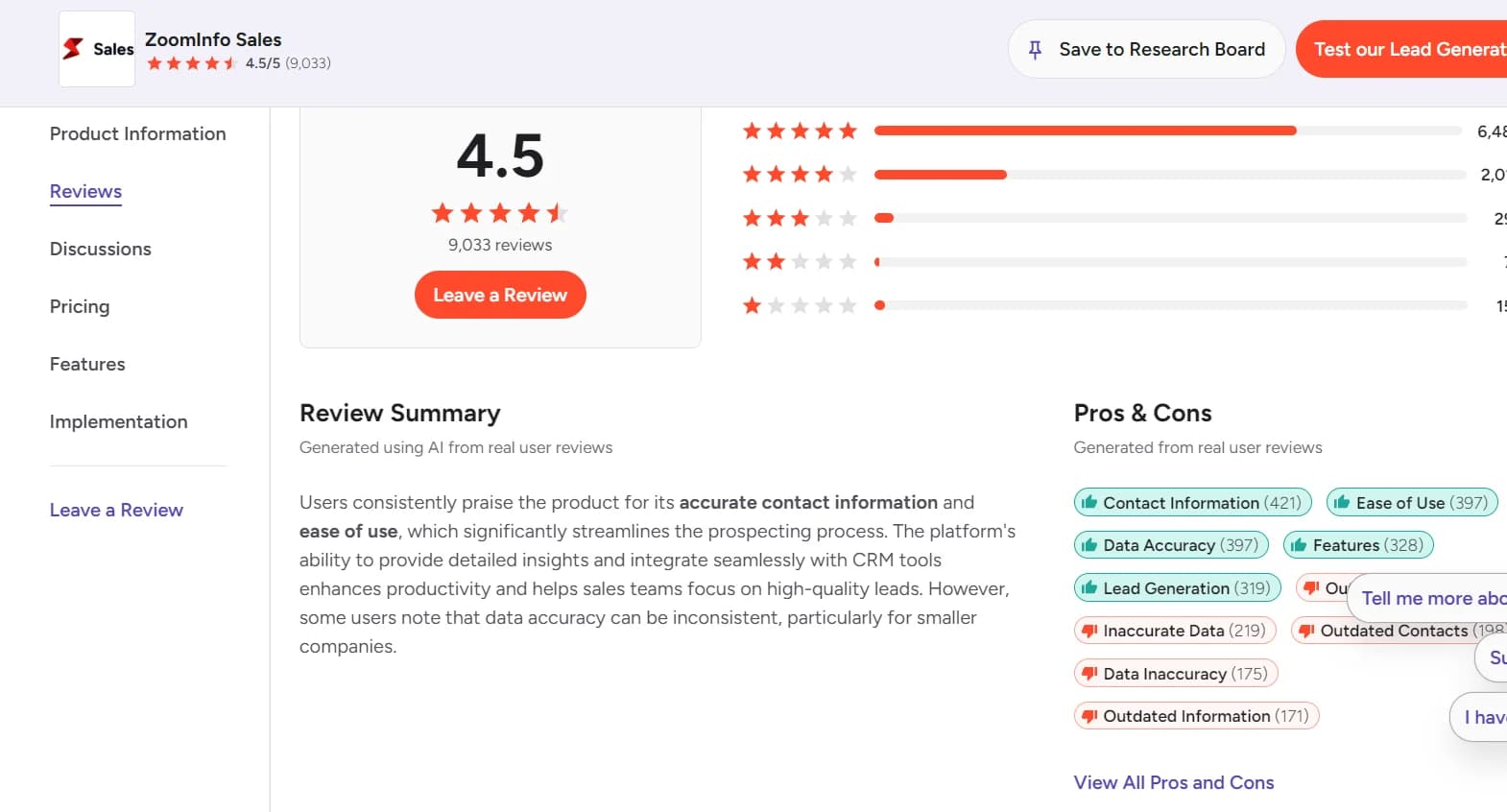
This ZoomInfo review answers that question directly. ZoomInfo is the 800-pound gorilla of B2B sales intelligence. It has 420M+ contacts, 145M+ company profiles, and intent data that enterprise teams swear by. It earns its 4.5-star rating on G2 across 9,000+ reviews.
But the ZoomInfo that works for a 200-person sales org with a $60K data budget is not the same product for a 10-person startup trying to build pipeline. The data is real. The cost is also real. This review covers both sides so you can decide whether ZoomInfo is the right investment for your team — or whether a ZoomInfo alternative gets you further for less.
ZoomInfo Review: What You Get (and What You Don't)
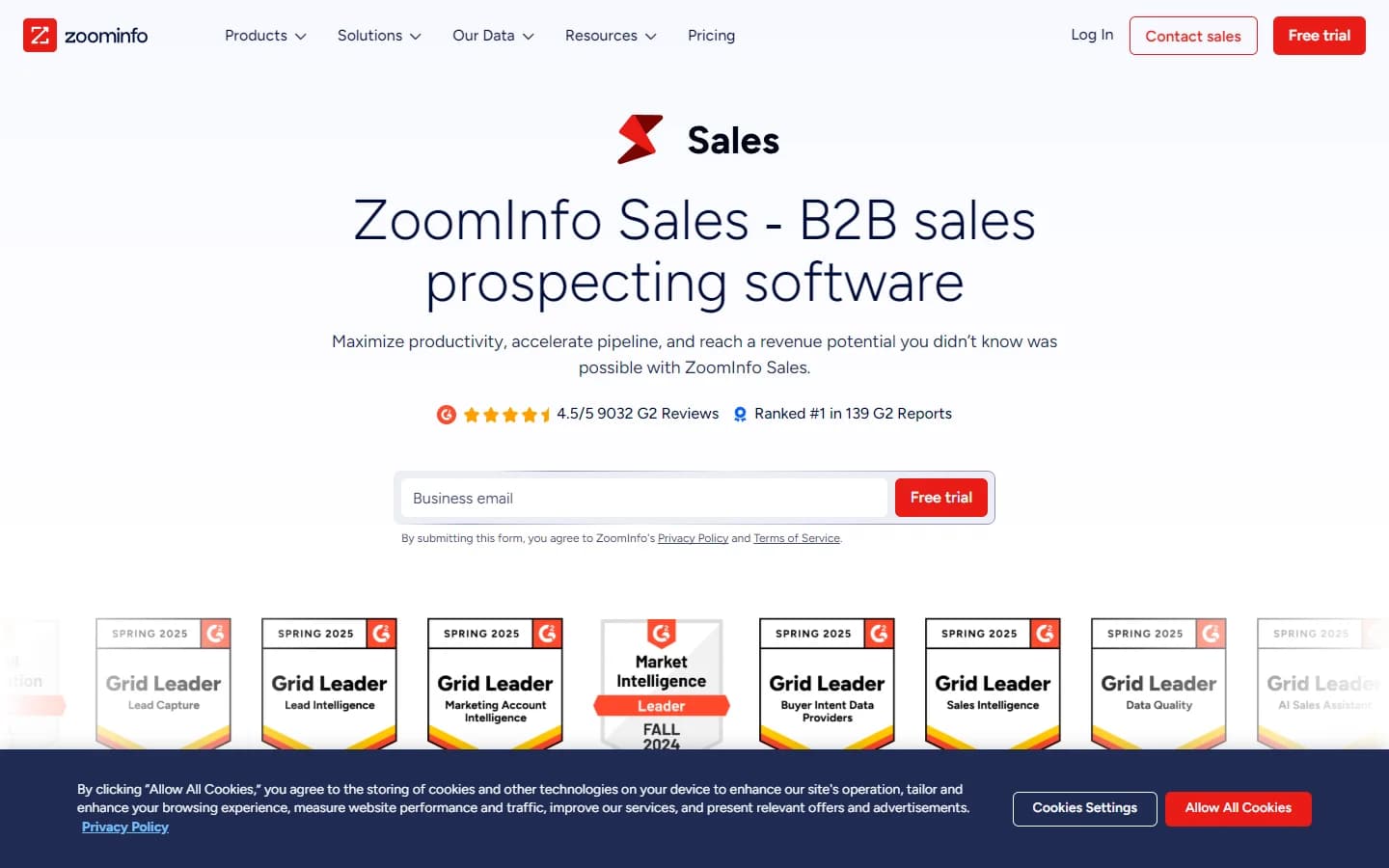
ZoomInfo is a B2B sales intelligence platform. It gives you a massive contact and company database, buyer intent signals, sales engagement tools, conversation intelligence, and workflow automation. The platform is designed for enterprise sales teams running account-based motions against large target lists.
Here is a quick-reference table of what is included and where the gaps are:
| Feature | What's Included | Limitations |
|---|---|---|
| Contact Database | 420M+ contacts, 120M+ direct dials, 174M+ verified emails | Accuracy drops outside North America; credit-gated access |
| Company Profiles | 145M+ companies with 300+ filtering attributes | SMB and startup coverage is thinner than enterprise |
| Buyer Intent | Content consumption signals, website visitor ID (WebSights) | Intent data is an add-on at additional cost on most plans |
| Sales Engagement | Dialer, email, multi-touch cadences, CRM export | Engagement tools locked behind higher tiers |
| Conversation Intelligence | Call recording, deal tracking, forecasting (Chorus) | Separate add-on; not included in base package |
| AI Copilot | AI-powered account prioritization and email drafting | New feature; limited track record and user feedback |
The takeaway: ZoomInfo gives you the widest B2B database on the market. But the features that make it powerful — intent data, engagement tools, conversation intelligence — are often add-ons that push the real cost well past the starting price.
ZoomInfo Data Quality: How Accurate Is It Really?
ZoomInfo claims a 95% accuracy guarantee on its contact data. For North American enterprise contacts, that number holds up. Direct dials connect. Emails deliver. Job titles are current. If your ICP is VP-level and above at US companies with 500+ employees, ZoomInfo's data quality is the best in the market. For European contacts, however, Cognism often delivers stronger results thanks to its Diamond Data verified mobiles.
Where the data falls short
The accuracy story changes outside that sweet spot. Multiple Capterra reviewers report that 5–10% of contacts are no longer at the listed company. International data — especially in APAC and LATAM — has noticeably lower coverage and accuracy. SMB and startup contacts are sparse compared to enterprise records.
This is the core limitation of a single-source database. No matter how large the dataset, one provider cannot maintain perfect accuracy across every region and company size. That is why some teams supplement ZoomInfo with waterfall enrichment — querying multiple data providers in sequence — to fill the gaps in regions and segments where its coverage is thinner.
Data freshness and update cadence
ZoomInfo uses a combination of machine learning, web scraping, and a contributor network (users who share their contacts in exchange for access) to keep records current. Updates happen continuously, but the refresh rate varies by record. High-profile enterprise contacts get updated frequently. Mid-market and SMB records can go months without a refresh.
For teams prospecting into the mid-market, stale data means wasted credits. You burn a credit to pull a contact, only to find the person left the company three months ago. ZoomInfo does not refund credits for outdated records.
ZoomInfo Sales product page — March 2026
ZoomInfo Intent Data: The Feature Nobody Reviews Properly
ZoomInfo intent data tracks content consumption patterns across a B2B publisher cooperative network, identifies companies researching topics relevant to your product, and scores them based on signal strength. It is available as a paid add-on on most plans starting around $5,000–$10,000 per year on top of the base contract. Most ZoomInfo reviews gloss over intent data with a sentence or two. That is a mistake — intent signals are the reason enterprise teams pay premium prices.
What ZoomInfo intent data actually tracks
- Content consumption across a B2B publisher cooperative network
- Website visitor identification (WebSights) — de-anonymizes company-level traffic
- Technology adoption signals — tracks when companies install or remove tech
- Job posting patterns — hiring signals that indicate team expansion
- Funding and firmographic changes — new rounds, leadership changes
The intent data trade-off
ZoomInfo's intent data is company-level, not contact-level. You know that Acme Corp is researching "CRM migration," but you do not know which person at Acme Corp is doing the research. You still need to guess (or buy more credits to find) the right contact.
The bigger issue: intent data is a paid add-on on most ZoomInfo plans. It is not included in the base $14,995/yr package. Teams that sign up for ZoomInfo expecting intent signals out of the box often discover they need to negotiate a separate line item. That pushes the total annual cost toward $25,000–$40,000 for a team of 5–10 users.
If intent is the main reason you are evaluating ZoomInfo, price the add-on against dedicated buying intent data tools before you negotiate, and make sure someone owns the workflows that turn intent scores into outreach.
ZoomInfo Integrations: CRM, Outreach, and Beyond
ZoomInfo integrates with every major CRM — Salesforce, HubSpot, Microsoft Dynamics, Pipedrive — plus outreach platforms like Salesloft, Outreach, and Gong. The integration marketplace is extensive. This is one of ZoomInfo's genuine strengths.
Does ZoomInfo integrate with HubSpot?
Yes. ZoomInfo's HubSpot integration syncs contacts, companies, and deal data bi-directionally. You can push enriched records from ZoomInfo into HubSpot and pull HubSpot data back for segmentation. The integration works, but configuring it properly takes time. Multiple users report needing 1–2 weeks of setup to get the field mapping and sync cadence right.
Integration complexity adds hidden cost
The integrations exist, but they are not plug-and-play. ZoomInfo's data model is complex. Mapping ZoomInfo fields to your CRM fields, setting up enrichment rules, configuring deduplication logic, and building workflows around intent signals requires a RevOps professional or a ZoomInfo-certified admin. For teams without dedicated ops resources, this is a real barrier.
Before you sign, list the fields you actually need synced and name the person who will own the integration. If nobody on the team has that capacity, compare lighter CRM enrichment options that need less configuration.
ZoomInfo Pricing: What You Actually Pay
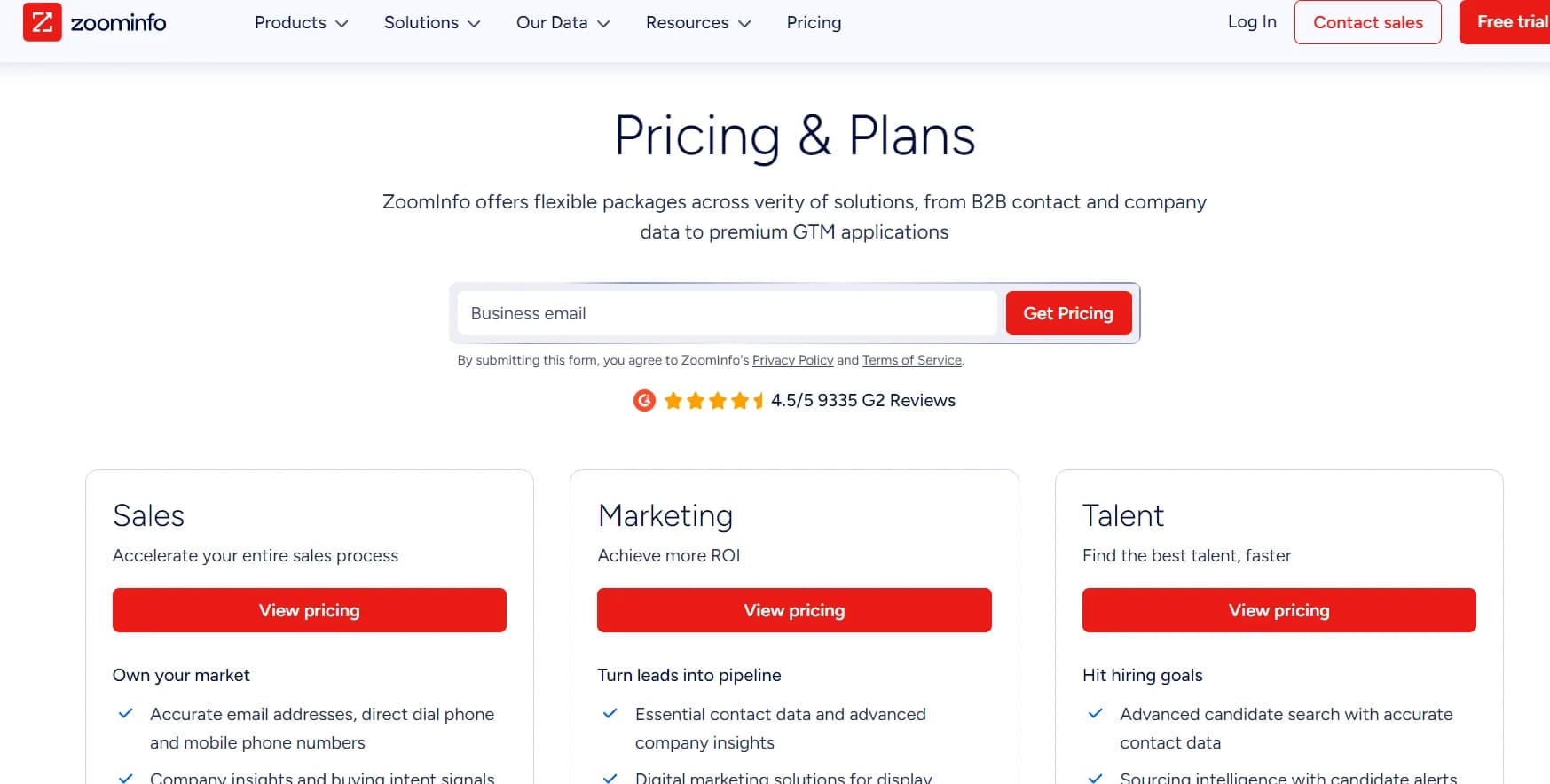
ZoomInfo pricing starts at $14,995 per year for SalesOS Professional, $24,995 per year for Advanced (with intent data), and $39,995+ per year for Elite. All plans require annual contracts with no monthly billing option. Most teams pay $25,000–$60,000 per year once they add seats, credits, and intent data add-ons. The company does not publish pricing on its website — here is what we know from verified user reports, G2 reviews, and published analyses.
- –SalesOS Professional ($14,995/yr): Base plan. 5,000 bulk credits, 10,000 export credits per year. Limited to core database access and basic search filters. No intent data.
- –SalesOS Advanced ($24,995/yr): Adds intent signals, website visitor tracking (WebSights), and advanced filtering. 10,000 bulk credits. This is where most mid-market teams land.
- –SalesOS Elite ($39,995+/yr): Everything in Advanced plus Chorus conversation intelligence, advanced AI features, and higher credit limits. Enterprise-only pricing that often exceeds $60K/yr with add-ons.
ZoomInfo pricing page — no public pricing displayed, sales contact required
What you actually pay: a real scenario
Here is a realistic scenario. A team of 5 SDRs running outbound prospecting:
- Each SDR pulls 200 contacts per month = 1,000 contacts/mo = 12,000 contacts/yr
- Professional plan gives you 5,000 bulk credits — you burn through them in 2.5 months
- You need Advanced ($24,995/yr) for the credit ceiling and intent data
- Add 2 extra seats beyond the included minimum: +$3,000–$5,000
- Intent data add-on if not included: +$5,000–$10,000
- Realistic annual cost: $30,000–$40,000
- Cost per lead: $2.50–$3.33 per contact pulled
Hidden costs to watch
- Auto-renewal with price increases: ZoomInfo contracts auto-renew with 15–20% annual price increases. Multiple G2 reviewers report surprise renewal charges after missing the cancellation window.
- Credit expiration: Unused bulk and export credits do not roll over. If you do not use your annual allotment, you lose them.
- Seat minimums: Most plans require 3–5 seats minimum, even if only 1–2 people use the platform actively.
- Add-on stacking: Intent data, Chorus, engagement tools, and advanced API access are separate line items that compound the base price.
- Cancellation difficulty: 60–90 day cancellation notice required before renewal date. Miss it and you are locked in for another year.
What Are the Downsides of Using ZoomInfo?
ZoomInfo's biggest downsides are its enterprise-only pricing that locks out startups, rigid annual contracts with aggressive auto-renewal, credit systems that burn through faster than expected, data accuracy issues outside North America, and a complex onboarding process that delays time-to-value by 2–4 weeks.
The pricing locks out startups and mid-market teams
At $14,995/yr as a starting price with no monthly option, ZoomInfo is out of reach for most startups. A seed-stage company spending $15K–$40K on a data tool before proving product-market fit is burning runway. The pricing model assumes you have a large enough sales team and deal size to justify the investment. If your average deal is under $10K ACV, the math does not work.
Annual contracts with auto-renewal traps
Every ZoomInfo contract is annual with auto-renewal. The cancellation window is 60–90 days before your renewal date. Miss it by one day and you are locked in for another 12 months. G2 reviewers consistently flag this as a pain point. One paraphrased complaint: "We wanted to cancel but missed the window by two weeks. Now we are paying $25K for a tool half the team stopped using."
The auto-renewal also comes with built-in price increases. Multiple users report 15–20% annual bumps with no negotiation. Your $25K contract becomes $30K in year two and $36K in year three.
Credits deplete faster than you expect
ZoomInfo uses a credit system for contact lookups and data exports. Each plan includes a set number of bulk and export credits per year. The problem: credits burn faster than teams plan for. Every contact view, every export, every list build consumes credits. A 5-person SDR team doing daily prospecting can exhaust a Professional plan's credits in 2–3 months, leaving 9 months of the contract with restricted access or overage charges.
International data accuracy is inconsistent
ZoomInfo's database strength is North America. Outside the US and Canada, coverage drops and accuracy decreases. European data is better than APAC or LATAM, but still lags behind US records. For teams selling globally, this means supplementing ZoomInfo with regional data providers — adding more cost on top of the annual contract.
Onboarding takes weeks, not hours
ZoomInfo is not a sign-up-and-start platform. Configuring CRM integrations, setting up enrichment rules, training the team on search and list building, and optimizing intent signal workflows takes 2–4 weeks. For teams used to modern tools that deliver value on day one, this is a significant friction point.
ZoomInfo user reviews on G2 — 4.5/5 across 9,000+ reviews
How to Buy ZoomInfo Without Overpaying
ZoomInfo does not publish prices, so every contract is negotiated. That works in your favor if you arrive prepared. These steps target the pain points reviewers raise most often.
- Model your credit burn first. Multiply reps by contacts pulled per month, as in the scenario above. If a Professional-tier credit allotment would run out in the first quarter, negotiate a higher credit ceiling up front instead of paying overages or upgrading mid-contract.
- Test data quality on your own ICP. Ask for a sample pull against your target accounts, including any regions outside North America and any SMB segments, and check how many contacts are still at the listed company before you sign.
- Decide on intent before the call. Intent data and WebSights usually sit in a higher tier or an add-on. If you will not build workflows around them in the first 90 days, leave them out of year one.
- Right-size seats. Most plans come with 3–5 seat minimums. Only pay for extra seats that will be used every week, and ask what access options exist for occasional users.
- Fix the renewal terms in writing. Ask for a cap on renewal price increases, a shorter cancellation notice period than the typical 60–90 days, and removal of automatic renewal if possible. Whatever you agree, put the notice deadline in your calendar the day you sign.
- Budget for onboarding. Plan for 2–4 weeks of setup and a named owner for the CRM integration, field mapping, and enrichment rules, or the first month of the contract will go largely unused.
These steps target the most common surprises in ZoomInfo reviews: credits that run out early, add-ons nobody uses, and renewals that arrive before anyone has decided whether to keep the tool.
Is ZoomInfo Worth It?
ZoomInfo is worth it for enterprise sales teams with $30K+ annual data budgets, dedicated RevOps resources, and an ICP focused on North American mid-market and enterprise accounts. The database depth, intent data network, and integration ecosystem are genuinely best-in-class. If you are running a 50-person sales org with $50K+ ACV deals, ZoomInfo earns its keep.
ZoomInfo is not worth it for startups, early-stage teams, or companies with lean budgets. The annual contract requirement, credit expiration, seat minimums, and $15K+ starting price create too much financial risk for teams still finding product-market fit. Lower-cost alternatives like Apollo.io and Lusha offer smaller databases at a fraction of the price, while Clay provides custom waterfall workflows for technical teams.
The verdict: ZoomInfo is the best single-source B2B database money can buy. The problem is how much money it takes to buy it. If your team has the budget, ZoomInfo delivers. If it does not, compare the ZoomInfo alternatives before you commit to an annual contract.
If ZoomInfo's annual contract is a dealbreaker, SyncGTM is one alternative worth a look: it is free to start and combines waterfall enrichment across 50+ data providers with real-time buying signals and native Salesforce and HubSpot integrations.