

Best Sales Emails Personal: Ranked for 2026

By Kushal Magar · May 24, 2026 · 14 min read
Key Takeaway
The best personal sales email tool for your team depends on where the bottleneck lives. If you're losing replies because emails feel generic, you need better personalization data — not a fancier sequencing platform. Start with verified, signal-enriched contact data, then layer on the sequencing and AI-writing tools that match your team size and outreach volume.
Personal sales emails convert. Generic blasts don't. The difference between a 3% reply rate and a 20% reply rate is almost always the same thing: how well the email proves the sender actually knows the prospect.
This guide ranks the 7 best tools for sending personal sales emails in 2026 — covering features, pricing, data quality, and integrations. It pays close attention to where SyncGTM fits as a data-first alternative for teams who want genuine personalization, not just merge-field theatre.
TL;DR
- SyncGTM — Best for teams who want verified contact data plus buying signals to make every personal email genuinely relevant. Data-first, not feature-first.
- Lemlist — Best for reply lift through video and image personalization. Strong multichannel sequences.
- Apollo.io — Best all-in-one for SMB and mid-market. Contact data + email sequencing in one platform.
- Outreach — Best for enterprise sales teams that need deep CRM integration and manager-level coaching analytics.
- Salesloft — Best for teams that prioritize call coaching and conversation intelligence alongside email.
- Lavender — Best AI email writing coach for reps who compose their own emails and want real-time feedback.
- Instantly — Best for high-volume cold outreach. Aggressive deliverability tools, straightforward pricing.
2026 benchmark: average cold outbound reply rate is 8.5%. Sequences with 4–6 well-spaced touchpoints generate 2x more replies than single-touch sends.
What Makes the Best Personal Sales Email Tool Worth Using
Most tools in this category market themselves around sequencing and automation. The best ones are actually about data — because personalization without accurate contact data is just educated guessing.
A personal sales email tool earns its place in your stack by delivering on four things: verified contact data (so emails land), genuine personalization (buying signals, not just first-name merge fields), proven email templates and frameworks, and deliverability infrastructure (domain health, inbox placement, warm-up). Tools that tick all four consistently outperform tools that only tick two or three.
According to McKinsey's personalization research, personalization drives a 10–15% revenue boost and significantly higher conversion rates compared to generic outreach. The tooling you choose determines whether your team can deliver that personalization at scale.
1. SyncGTM

SyncGTM is a B2B data enrichment and go-to-market intelligence platform. It provides the verified contact data and buying signals that make personal sales emails genuinely personal — not just name-and-company tokens dropped into a template.
The core feature is waterfall enrichment: when you upload a prospect list, SyncGTM cascades through multiple data providers to find verified email (85–95% coverage), direct phone, LinkedIn URL, company firmographics, tech stack, and buying signals like hiring surges and funding events. A single provider gives you 40–60% coverage. Waterfall gives you 85–95%.
That coverage gap is the difference between reaching most of your prospect list and reaching nearly all of it. For teams running personalized outreach at scale, this directly translates to more replies from fewer sends.
Pros
- 85–95% email coverage via multi-provider waterfall — highest in the category
- Buying signals (hiring, funding, tech installs) create genuinely timely personalization hooks
- Integrates with Apollo, Outreach, Salesloft, HubSpot, and Salesforce — enriched data flows into your existing sequencing tool
- Team pricing (not per-seat) keeps costs predictable as headcount grows
- Sign-up enrichment workflow automatically enriches inbound leads the moment they enter your CRM
Cons
- Does not replace a sequencing platform — you still need Apollo, Outreach, or similar for multi-step email sequences
- Best suited for B2B outbound; not designed for B2C or high-volume consumer email campaigns
Best for: B2B sales teams who want verified contact data and real buying signals to write personal sales emails that reference something genuinely relevant to each prospect.
Pricing: Team pricing from $99/mo — not per seat.
2. Lemlist

Lemlist is a cold email and multichannel outreach platform known for its personalization depth. Beyond standard text variables, Lemlist lets reps embed personalized images (screenshots of the prospect's website, LinkedIn profile, or a custom graphic with their name) and short video thumbnails directly in email bodies.
Image personalization alone has been shown to lift reply rates by 10–25% compared to plain-text alternatives. For reps who want to stand out in a crowded inbox, this is Lemlist's core differentiator.
Pros
- Image and video personalization out of the box — no extra tools required
- Built-in email warm-up (Lemwarm) for new domains
- Multichannel sequences: email + LinkedIn + voice notes in one workflow
- Strong template library covering cold outreach, follow-up, and re-engagement
Cons
- Contact database is shallower than dedicated enrichment tools — verify with a waterfall tool before uploading
- Interface can feel cluttered when managing large campaigns across multiple inboxes
- Email warm-up is included but still requires manual configuration per inbox
Best for: SDRs and founders who send personal sales emails manually and want every email to visually stand out. High-touch outreach to ICPs with visual personalization.
Pricing: From $39/mo per user (Email Pro). Multichannel from $69/mo.
3. Apollo.io
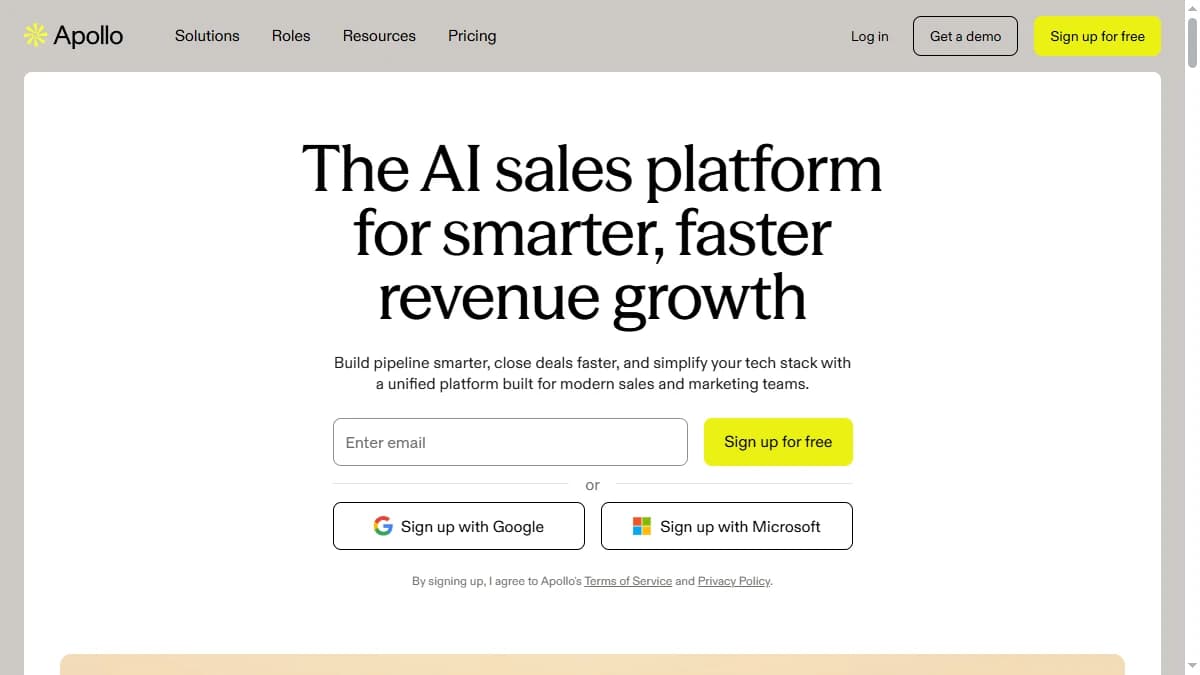
Apollo.io combines a 220 million contact database with email sequencing, LinkedIn automation, phone dialing, and AI-assisted email writing in one platform. For small-to-mid-market teams, it is often the first all-in-one tool they reach for.
Apollo's contact coverage (around 60–70% verified email rate on a single-provider basis) works well for most use cases. Teams running high-volume outreach to specific ICPs often supplement Apollo with waterfall enrichment to push coverage above 85%. The email sequencing is solid — A/B testing, multi-step flows, reply detection, and CRM sync with Salesforce and HubSpot.
Pros
- 220M+ contact database — find and sequence from one platform
- AI email writing assistant generates personalized drafts from contact data
- Free tier with limited credits — useful for testing before committing
- Native integrations with Salesforce, HubSpot, Outreach, and Salesloft
Cons
- Single-provider contact data: 60–70% email coverage versus 85–95% with waterfall enrichment
- Enterprise features (Salesforce sync depth, custom reporting) require higher-tier plans
- AI writing is functional but not as coaching-focused as dedicated tools like Lavender
Best for: SMB and mid-market teams who want contact data and email sequencing in a single tool without managing separate platforms.
Pricing: Free tier available. Paid plans from $49/user/mo (Basic) to $119/user/mo (Professional).
4. Outreach

Outreach is an enterprise sales engagement platform designed for teams that need deep CRM integration, sophisticated sequence management, and manager-level analytics. It does not provide contact data — it executes against the enriched data your team already has.
Pairing Outreach with SyncGTM enrichment is one of the most common enterprise stacks: SyncGTM populates verified contact data into Salesforce, Outreach pulls that data and executes personalized sequences, and managers use Outreach's analytics to coach reps on what's working. The combination covers both the data layer and the execution layer.
Pros
- Best-in-class sequence management: A/B testing, conditional branching, trigger-based enrollment
- Deep Salesforce and HubSpot bidirectional sync — activities logged automatically
- Manager coaching tools: rep activity dashboards, sequence performance analytics, rep coaching notes
- AI-powered deal health scoring and pipeline forecasting
Cons
- No contact database — requires an enrichment tool (SyncGTM, ZoomInfo, or Apollo) to populate prospect data
- Pricing starts at $100+/user/mo — high cost of entry for teams under 10 reps
- Implementation takes 2–4 weeks; not a fast-start platform
Best for: Enterprise sales teams with 10+ reps who need deep CRM integration, sophisticated analytics, and a platform their managers can coach from.
Pricing: $100+/user/mo — pricing by quote.
5. Salesloft

Salesloft combines email sequencing with call coaching and conversation intelligence. Where Outreach competes on CRM depth, Salesloft competes on the call side: call recording, AI-powered transcript analysis, and coaching recommendations based on what reps say during calls.
For teams where phone outreach is as important as email, Salesloft's unified approach — personal sales emails and calls managed in the same platform — reduces context-switching and gives managers a full picture of rep activity across channels.
Pros
- Conversation intelligence built in — no separate tool needed for call recording and analysis
- Unified inbox for email, calls, LinkedIn, and SMS in one workflow
- Strong AI coaching: rep performance analysis based on actual conversation data
- Good integration with enterprise revenue stacks — Salesforce, Microsoft Dynamics, HubSpot
Cons
- No native contact database — same dependency on enrichment tools as Outreach
- Premium pricing comparable to Outreach — not suited to small teams
- Conversation intelligence features add cost on top of base sequencing plans
Best for: Teams where phone + email multichannel outreach is the core motion and managers want to coach from call recordings alongside email metrics.
Pricing: $75–$150+/user/mo — pricing by quote.
6. Lavender

Lavender is an AI email writing coach that sits inside Gmail, Outlook, and major sequencing platforms as a browser extension. It scores your email in real time (0–100) against factors that predict reply rate — length, subject line, reading level, CTA clarity, personalization depth — and suggests specific fixes before you hit send.
Lavender does not replace your sequencing tool. It makes the emails your reps write in that tool significantly better. For teams using Outreach or Salesloft who want to lift reply rates without changing their core stack, Lavender is a low-friction add-on with measurable impact. Teams using Lavender report 20%+ improvement in reply rates after implementation.
Pros
- Real-time email scoring with specific, actionable feedback — not generic writing tips
- Works inside Gmail, Outlook, Outreach, Salesloft, Apollo, and HubSpot
- Prospect research panel pulls LinkedIn data and news for personalization hooks
- AI-generated subject line and opening line suggestions with predicted reply lift
Cons
- Browser extension only — no standalone sequencing or contact database
- Value depends on reps consistently using the scoring before sending; adoption varies by team
- Research panel is useful but not a substitute for deep enrichment data
Best for: Individual reps and teams who compose personal sales emails manually and want AI feedback to improve every email before sending.
Pricing: Free tier (10 emails/mo). Pro from $27/user/mo. Unlimited from $45/user/mo.
7. Instantly

Instantly is built for high-volume cold email outreach. Its core value proposition: unlimited sending accounts on all paid plans, built-in email warm-up for every account, and straightforward flat pricing that does not scale with send volume.
For teams running 1,000+ cold emails per day across multiple domains, Instantly's infrastructure approach solves the deliverability problem that kills most high-volume campaigns. Pair it with SyncGTM for verified contact data and buying signals, and the combination covers both volume and personalization. Read more about writing clear and concise personalized sales emails that perform at volume.
Pros
- Unlimited sending accounts on all paid plans — scale without per-seat penalties
- Built-in warm-up for every connected inbox — deliverability maintained automatically
- Simple, predictable flat pricing — no per-email or per-contact fees
- A/B testing, subsequence branching, and reply detection on all plans
Cons
- No contact database — you bring your own lists (which need verification before uploading)
- Less suited to highly personalized, low-volume account-based outreach — better for volume-first motions
- Reporting is functional but not as deep as Outreach or Salesloft for team management
Best for: Growth-stage teams running high-volume cold outreach across multiple domains who need aggressive deliverability tools at a flat monthly rate.
Pricing: Growth from $37/mo. Hypergrowth from $77/mo. Both include unlimited sending accounts.
Side-by-Side Comparison
| Tool | Best For | Contact Data | Personalization | Starting Price |
|---|---|---|---|---|
| SyncGTM | Data-first enrichment + buying signals | 85–95% waterfall coverage | Signal-based (hiring, funding, tech) | $99/mo (team) |
| Lemlist | Image & video personalization | Limited — supplement needed | Image, video, text variables | $39/user/mo |
| Apollo.io | SMB all-in-one (data + sequences) | 60–70% (single provider) | AI drafts + merge variables | Free / $49/user/mo |
| Outreach | Enterprise sequences + analytics | None — bring your own | Templates + CRM data merge | $100+/user/mo |
| Salesloft | Email + call coaching combined | None — bring your own | Templates + CRM data merge | $75+/user/mo |
| Lavender | AI email writing coach | LinkedIn pull (light) | Real-time scoring + suggestions | Free / $27/user/mo |
| Instantly | High-volume deliverability | None — bring your own | Variables + AI writing | $37/mo (flat) |
How to Choose the Right Tool
Start with your bottleneck — not the feature list. Most teams that underperform on personal sales email have a data problem, not a sequencing problem. Before evaluating platforms, read our B2B sales prospecting tools guide to understand where your stack gaps live.
- Low reply rates despite good copy? Your contact data is stale or unverified. Start with SyncGTM waterfall enrichment before changing your sequence tool.
- Good data but generic emails? Add Lavender for real-time coaching or Lemlist for image and video personalization. Both lift reply rates without rebuilding your stack.
- Small team (under 5 reps), limited budget? Apollo free tier + SyncGTM. Covers data and sequencing at under $200/mo total.
- Enterprise team with Salesforce? SyncGTM for enrichment + Outreach or Salesloft for execution. Deep CRM sync, manager analytics, and coaching workflows are worth the investment at 10+ reps.
- High-volume cold outreach (1,000+ emails/day)? Instantly for deliverability infrastructure + SyncGTM for verified contact data. Flat pricing scales predictably.
The best stack for most B2B teams is two layers: a data layer (SyncGTM) and an execution layer (Apollo, Outreach, Salesloft, or Instantly depending on team size). See our full guide on personalized sales email samples to see what high-converting copy looks like once you have the data in place. Also, see how to handle follow-up emails when prospects go silent— a critical part of any personal outreach sequence.
For buyers researching sales engagement platforms on G2, Outreach and Salesloft consistently rank highest for enterprise teams, while Apollo and Instantly lead for SMB. SyncGTM fills the data gap that all four of those tools leave.