

What Are the Best Sales Development Representative Tools for Prospecting: 2026 Comparison Guide

By Kushal Magar · June 2, 2026 · 14 min read · Last updated: September 28, 2026
Key Takeaway
The best sales development representative tools for prospecting combine high contact accuracy, CRM integration, and multi-channel outreach. SyncGTM leads for data-first teams. Apollo.io wins for all-in-one simplicity. Cognism is the top pick for GDPR-compliant EU prospecting. The right choice depends on your motion, geography, and budget.
TL;DR
| Tool | Best For | Starting Price | Data Accuracy |
|---|---|---|---|
| SyncGTM | Waterfall enrichment + multi-channel outreach | Free tier available | 70–85% (waterfall) |
| Apollo.io | All-in-one prospecting and sequencing | $49/user/mo | 55–65% |
| Cognism | GDPR-compliant EU/UK prospecting | Custom (enterprise) | 70–80% (phone-verified) |
| LinkedIn Sales Navigator | Social selling and account research | $99/user/mo | N/A (no email data) |
| ZoomInfo | Enterprise-scale contact data | ~$15,000/yr | 60–75% |
| Explorium.ai | Prospect data and signals for AI SDR agents | $29.99/pkg | 97.8%+ company match (self-reported) |
| Lusha | Quick LinkedIn enrichment for individual SDRs | Free tier; $29/user/mo | 55–65% |
| LeadIQ | LinkedIn capture and instant CRM sync | Free tier; $39/user/mo | 55–65% |
Why Sales Development Representative Tools for Prospecting Matter in 2026
The best sales development representative tools for prospecting exist for one reason: SDRs spend an average of 21% of their time on manual data research — time that produces zero meetings. ZoomInfo's 2026 pipeline research shows teams using dedicated prospecting tools book 3x more meetings per rep than those relying on manual list-building.
The right B2B sales prospecting tools collapse research, enrichment, and outreach into a repeatable workflow. The wrong stack creates data debt, broken integrations, and reps who spend more time in spreadsheets than on calls.
This guide ranks the 8 best sales development representative tools for prospecting by four dimensions SDRs actually care about: data accuracy, pricing, integrations, and SDR-specific features. According to Salesforce's 2026 state of sales report, teams that add intent signals and waterfall enrichment to their stack see 20–35% higher meeting rates.G2's 2026 sales intelligence category data shows the average SDR team now evaluates 4.2 tools before committing to a stack — making head-to-head comparisons essential before purchase.
1. SyncGTM

SyncGTM — waterfall enrichment and multi-channel outreach in one platform.
SyncGTM is a data-first prospecting platform built specifically for outbound SDR teams. It runs waterfall enrichment across multiple providers — pulling verified emails and mobile numbers from Apollo, Hunter, Lusha, and others in sequence — achieving 70–85% contact coverage on a single ICP list.
Unlike tools that lock you into one data source, SyncGTM lets you enrich contacts, launch multi-channel sequences (email, LinkedIn, phone), and track intent signals from a single dashboard. It eliminates the three-tool stack most SDRs operate today.
Pros
- Waterfall enrichment hits 70–85% coverage versus 40–60% from any single provider
- Multi-channel sequencing (email, LinkedIn, phone) built in — no separate engagement platform needed
- Real-time buying intent signals surface accounts already researching your category
- Native CRM sync to HubSpot and Salesforce with bi-directional field mapping
- Free tier available — SDRs can start testing before committing budget
Cons
- Smaller brand recognition than ZoomInfo or Apollo — fewer third-party integrations in marketplace
- EU phone-verified data coverage narrower than Cognism for GDPR-heavy regions
Best for: SDR teams that need high contact coverage without managing three separate tools and their integration overhead.
Pricing: Free tier available. Paid plans from affordable per-seat pricing — see SyncGTM pricing.
2. Apollo.io
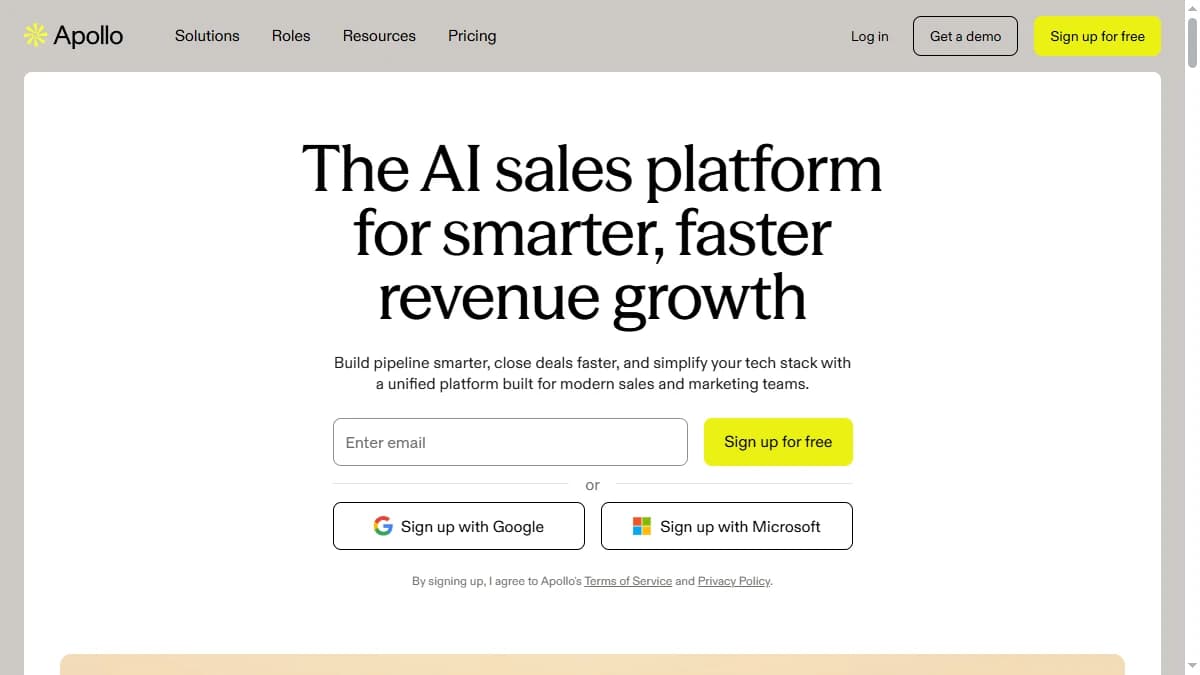
Apollo.io — all-in-one SDR platform with 275M+ contact database and built-in sequencing.
Apollo.io is the most widely used all-in-one SDR prospecting platform in 2026. Its 275M+ contact database covers most ICP profiles SDRs target, and its built-in email sequencing means many teams never need a separate engagement tool.
Apollo's strength is its breadth. One platform handles list building, email finding, sequence execution, and basic analytics. The tradeoff: email accuracy averages 55–65% — usable but meaningfully below what waterfall enrichment achieves.
Pros
- 275M+ contacts with firmographic, technographic, and intent filters
- Built-in sequences — no need for a separate engagement platform at lower volumes
- $49/user/month makes it accessible to early-stage SDR teams
- Chrome extension captures contacts directly from LinkedIn
- Large integration marketplace: HubSpot, Salesforce, Slack, Outreach, and 50+ others
Cons
- Email accuracy 55–65% — higher bounce rates than phone-verified or waterfall providers
- Database skews heavily US/English-speaking markets; EMEA and APAC coverage thinner
- Sequencing features lack the depth of dedicated platforms like Outreach or Salesloft
Best for: SMB and mid-market SDR teams running US-focused outbound who want one tool for data and outreach.
Pricing: Free tier. Basic from $49/user/month. Professional from $99/user/month.
3. Cognism

Cognism — GDPR-compliant, phone-verified contact data for EU/UK SDR teams.
Cognism is the leading choice for SDR teams that prospect into EMEA markets and can't afford compliance risk. Its Diamond Data tier is phone-verified by a human caller — not just algorithmically validated — giving it one of the highest mobile accuracy rates of any provider at 70–80%.
Cognism doesn't try to be an engagement platform. It's a data layer that feeds into your CRM and sequencing tools through deep integrations with Outreach, Salesloft, HubSpot, and Salesforce.
Pros
- Human phone-verified mobile numbers — 70–80% connect rate on mobile dials
- GDPR, CCPA, and TCPA compliant by default — DNC registry scrubbing built in
- Intent data via Bombora partnership — surfaces accounts in active buying mode
- Chrome extension for LinkedIn enrichment
- Deep integrations with every major CRM and engagement platform
Cons
- Enterprise-only pricing — no self-serve plan, requires sales call
- Annual contracts from ~$15,000–$30,000+ make it inaccessible for small teams
- US contact coverage weaker than ZoomInfo or Apollo
Best for: Mid-market and enterprise SDR teams running phone-first outbound into European markets.
Pricing: Custom enterprise pricing. Annual contracts required. Contact sales for a quote.
4. LinkedIn Sales Navigator
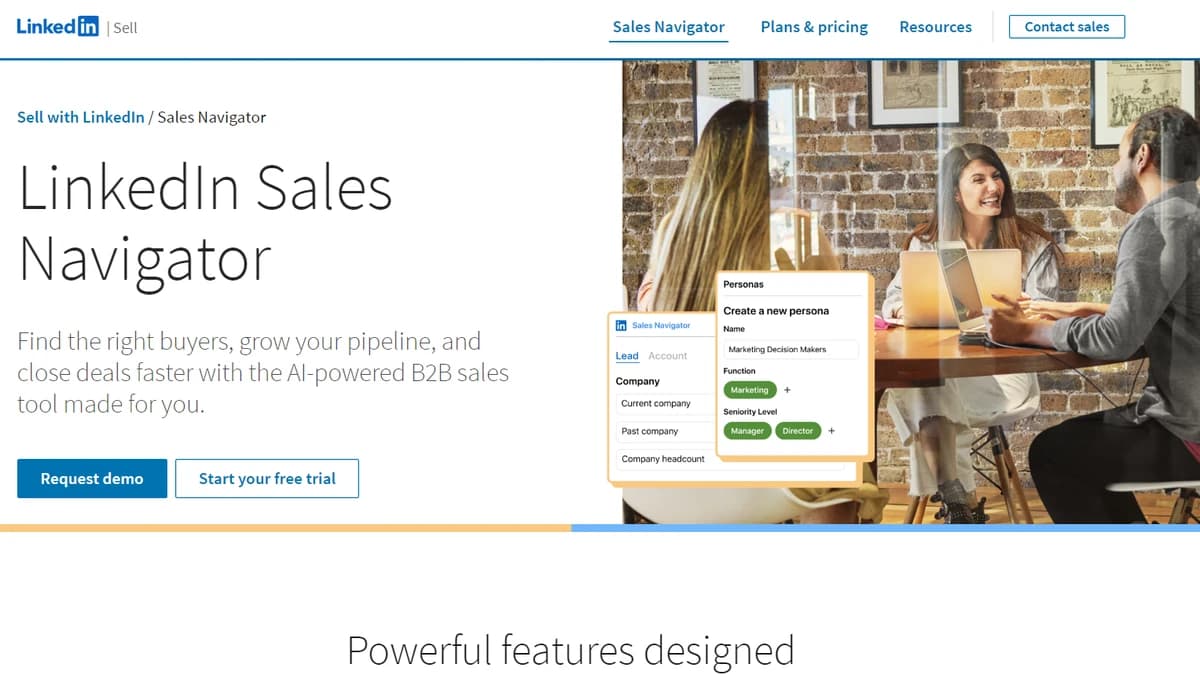
LinkedIn Sales Navigator — the gold standard for social selling and account research.
LinkedIn Sales Navigator is the essential social prospecting layer for any SDR running account-based outreach. Its advanced search filters — job title, seniority, company headcount, recent job changes, posted content — let SDRs build hyper-targeted lists directly from LinkedIn's 1B+ member network.
Sales Navigator doesn't give you email addresses or phone numbers. It's a research and social engagement tool that works best when paired with an enrichment platform like SyncGTM, Apollo, or Lusha to convert LinkedIn profiles into contact records.
Pros
- Access to LinkedIn's full 1B+ member database with 30+ advanced filters
- Job change alerts — surface warm signals when a champion moves to a new company
- InMail credits for direct outreach outside your network
- Account lists with real-time news and stakeholder mapping
- TeamLink shows mutual connections for warm introductions
Cons
- No email or phone data — must be paired with an enrichment tool
- $99/user/month is expensive as a standalone investment
- InMail response rates declining as SDR usage saturates the channel
- LinkedIn API restrictions limit export to third-party enrichment tools
Best for: SDRs doing account-based prospecting and social selling where warm signals and relationship mapping matter.
Pricing: Core at $99/user/month. Advanced at $169/user/month. Annual billing saves ~20%.
5. ZoomInfo

ZoomInfo — the enterprise standard for B2B contact data depth and intent intelligence.
ZoomInfo is the largest B2B contact and company database on the market. Its 260M+ professional profiles, 100M+ verified business emails, and deep technographic and intent data make it the go-to for enterprise SDR teams with complex ICP targeting needs.
The tradeoff is cost. ZoomInfo typically requires annual contracts starting around $15,000/year — prohibitive for smaller teams. Data accuracy runs 60–75% on email; its Websights and intent features are what justify the premium for enterprise buyers.
Pros
- 260M+ contacts with firmographic, technographic, and org chart data
- Intent data from Websights identifies anonymous website visitors by company
- Chorus.ai conversation intelligence built in for enterprise plans
- Strongest US enterprise data coverage of any provider
- Deep integrations with Salesforce, HubSpot, Outreach, Salesloft, and Marketo
Cons
- Annual contracts from ~$15,000/year — not viable for individual SDRs or small teams
- Email accuracy 60–75% — high bounce rates without additional validation
- Onboarding and implementation require significant time investment
- EMEA data quality lags behind Cognism for EU/UK markets
Best for: Enterprise SDR teams with large quotas, complex accounts, and budget to match the data depth they need.
Pricing: Annual contracts from ~$15,000/year. Custom enterprise pricing based on seat count and data modules.
6. Explorium.ai
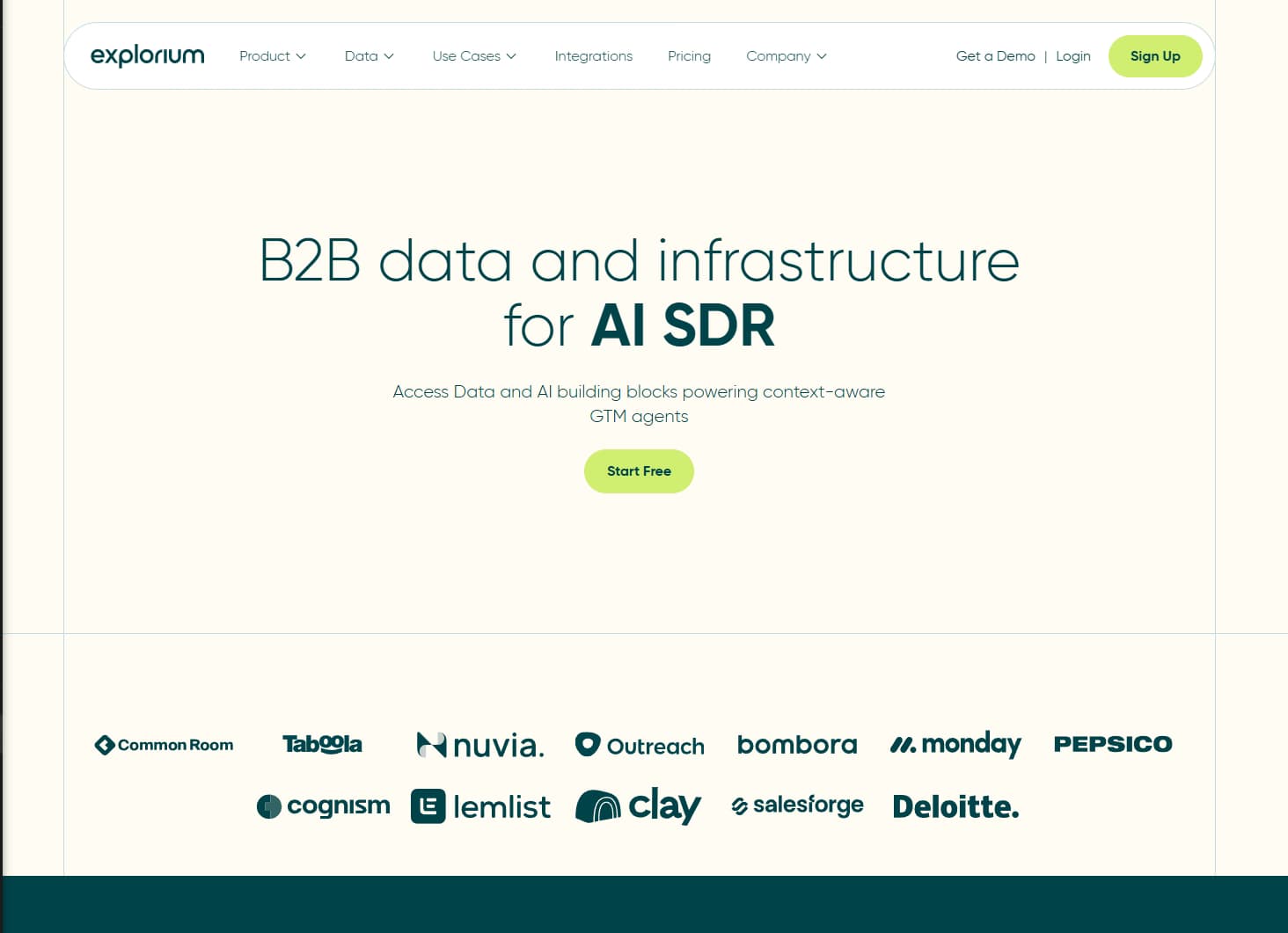
Explorium.ai — B2B prospect data and real-time signals for SDRs and AI SDR agents, via API, MCP server, or plain-English prompts.
Explorium.ai is a B2B data platform that feeds SDR teams and AI SDR agents with company, contact, and signal data from 146M+ companies and 767M+ professional profiles. It's not a sequencer — it's a data layer that finds and enriches prospects through the AgentSource API, a hosted MCP server, or Vibe Prospecting's plain-English prompts in Claude and ChatGPT.
Credit packages start at $29.99 for 500 credits after a free 100-credit trial, so SDR teams can test it before committing. Enrichments cost 1 to 5 credits each. The API path requires more technical setup than Apollo or SyncGTM.
Pros
- 146M+ companies and 767M+ professional profiles with work emails, phone numbers, and professional history
- Real-time prospect events — funding rounds, job changes, hiring, and tech changes — to time SDR outreach
- Vibe Prospecting builds prospect lists from plain-English prompts inside Claude or ChatGPT
- AgentSource API and hosted MCP server plug straight into AI SDR agents
- Integrations with Salesforce and HubSpot
Cons
- No built-in sequencing — still need a separate engagement tool
- Not a waterfall across named providers — data comes from Explorium's own aggregated dataset
- API and MCP paths require technical setup
- Credit cost varies by enrichment type (1–5 credits per enrichment)
Best for: SDR teams and AI SDR builders who want prospect data and buying signals piped into agents or custom workflows, with a separate engagement tool for sending.
Pricing: Free trial (100 credits). Lite $29.99 for 500 credits. Starter $149.99 for 5,000. Growth $749.99 for 30,000.
7. Lusha

Lusha — quick LinkedIn enrichment for SDRs who need contact data without a complex setup.
Lusha is a contact enrichment tool built for individual SDRs who need fast access to emails and direct dials from LinkedIn profiles. Its Chrome extension surfaces contact data in one click on any LinkedIn profile, and its 50M+ business profile database covers most US and EU markets.
Lusha is not a sequencing or database platform. It's a point enrichment tool — great as part of a stack, limited as a standalone solution for high-volume prospecting.
Pros
- Chrome extension delivers contact data from LinkedIn in under 3 seconds
- Free tier with 5 credits/month — zero-risk trial for individual SDRs
- GDPR and CCPA compliant
- Integrates directly with HubSpot, Salesforce, and Pipedrive for one-click CRM push
- Intent data add-on available for teams on Team/Enterprise plans
Cons
- Email accuracy 55–65% — lower than waterfall providers
- Credit limits restrict high-volume SDR workflows without costly upgrades
- No built-in sequencing or outreach features
- US data stronger than EMEA — limited phone coverage outside US
Best for: Individual SDRs doing LinkedIn-based prospecting who need a fast, lightweight enrichment tool with CRM sync.
Pricing: Free (5 credits/month). Pro from $29/user/month. Team from $51/user/month.
8. LeadIQ

LeadIQ — LinkedIn prospecting and instant CRM sync designed for SDR workflows.
LeadIQ sits between Lusha and Apollo in the SDR prospecting stack. Its Chrome extension captures contact data from LinkedIn Sales Navigator and pushes it directly into your CRM or sequencing tool — including Outreach and Salesloft — without manual data entry.
LeadIQ's "Scribe" feature uses AI to generate personalized first lines based on a prospect's LinkedIn activity and recent news, reducing the time SDRs spend personalizing outreach by an estimated 40%.
Pros
- One-click capture from LinkedIn Sales Navigator into CRM or sequencing tool
- Scribe AI generates personalized first lines — reduces manual personalization time by ~40%
- Job change tracking alerts SDRs when champions move to new accounts
- Real-time email verification before data enters your CRM
- Native integrations with Outreach, Salesloft, HubSpot, Salesforce, and Gong
Cons
- Email accuracy 55–65% — standard single-provider ceiling
- Limited as a standalone database — works best with LinkedIn Sales Navigator
- Scribe AI personalization quality varies; SDRs still need to review outputs
- Free tier is very limited (20 verified work emails/month)
Best for: SDRs already using LinkedIn Sales Navigator who want to cut manual data entry and automate CRM population.
Pricing: Free (20 verified emails/month). Essential from $39/user/month. Pro from $79/user/month.
Side-by-Side Comparison: Best SDR Prospecting Tools 2026
| Tool | Data Accuracy | Sequencing Built In | Waterfall Enrichment | CRM Integrations | Starting Price | Best For |
|---|---|---|---|---|---|---|
| SyncGTM | 70–85% | Yes | Yes | HubSpot, Salesforce | Free tier | Data-first outbound teams |
| Apollo.io | 55–65% | Yes | No | HubSpot, Salesforce, 50+ | $49/user/mo | All-in-one SMB teams |
| Cognism | 70–80% (phone) | No | No | HubSpot, Salesforce, Outreach | Custom | GDPR/EU phone-first teams |
| LinkedIn Sales Navigator | N/A | Limited (InMail) | No | Salesforce, HubSpot, CRM sync | $99/user/mo | Social selling and research |
| ZoomInfo | 60–75% | Yes (engage) | No | Salesforce, HubSpot, Marketo | ~$15,000/yr | Enterprise data depth |
| Explorium.ai | 97.8%+ company match (self-reported) | No | No | Salesforce, HubSpot | $29.99/pkg | AI SDR data and signals |
| Lusha | 55–65% | No | No | HubSpot, Salesforce, Pipedrive | $29/user/mo | LinkedIn point enrichment |
| LeadIQ | 55–65% | No | No | HubSpot, Salesforce, Outreach | $39/user/mo | LinkedIn capture + CRM push |
How to Choose the Right SDR Prospecting Tool
No single tool wins every category. The right choice depends on four variables specific to your team.
1. Your primary prospecting motion
Email-first teams need high deliverability — prioritize waterfall enrichment (such as SyncGTM) over single-source tools. Phone-first teams in Europe need Cognism's verified mobiles. LinkedIn-first teams need Sales Navigator plus an enrichment layer.
2. Your geography
US-focused teams: Apollo.io and ZoomInfo have the strongest US coverage. EU/UK teams: Cognism is the only provider with phone-verified GDPR-compliant data at scale. Global teams: SyncGTM's waterfall approach pulls from multiple providers to maximize coverage regardless of market.
3. Your volume
Individual SDRs prospecting 50–100 contacts/week: Lusha or LeadIQ are cost-effective. Teams running 500–5,000 contacts/week: Apollo or SyncGTM. Enterprise teams with complex ICP targeting: ZoomInfo or Cognism. See how your daily SDR activity targets should shape your tool choice.
4. Your stack complexity
If you already have Outreach or Salesloft, you need a data layer — not another sequencing tool. Pick a provider (Cognism, ZoomInfo, SyncGTM) that integrates cleanly with your existing engagement platform. If you're starting from scratch, Apollo.io or SyncGTM give you everything in one place.
5. Your budget
Under $100/user/month: Apollo.io, Lusha, or LeadIQ. $100–$200/user/month: LinkedIn Sales Navigator + an enrichment layer. Enterprise budget: ZoomInfo or Cognism. Teams that want maximum coverage at mid-market pricing: SyncGTM.
For a deeper look at building a complete SDR tech stack, read our guide to sales development representative software categories.
Final Verdict
The best sales development representative tools for prospecting in 2026 aren't the ones with the biggest databases — they're the ones that get your reps in front of the right prospects with verified contact data and minimal workflow friction.
SyncGTM is the strongest all-round pick for teams that need high contact coverage without stitching together a three-tool stack. Its waterfall enrichment, multi-channel sequencing, and intent signals cover what most SDR teams buy three separate subscriptions to achieve.
Apollo.io wins on simplicity and price for US-focused teams starting out.Cognism is non-negotiable if your team dials into European markets.LinkedIn Sales Navigator remains essential for account-based motions — but pair it with an enrichment tool.
For a broader look at the prospecting software landscape, read our guide to B2B sales prospecting tools or explore our ranked list of the best waterfall contact providers.
What role SDRs play in your pipeline also shapes which tools matter most — see our full breakdown of what a sales development representative actually does.