

Enrow Review 2026: B2B Data Coverage, Pricing & Hit Rate

By Kushal Magar · May 26, 2026 · 12 min read · Last updated: September 30, 2026
Key Takeaway
Enrow delivers the lowest bounce rate in the 2026 Dropcontact benchmark — 2.3% on 20,000 contacts — and charges only for valid emails, with plans from $17/month for 1,000 credits. The ceiling is single-source data: a 40.9% hit rate beats budget tools but trails multi-provider FullEnrich (48.3%) on the same list. Use Enrow for low-volume, deliverability-sensitive lookups when you already have a list source and a sender.
TL;DR: Enrow Review 2026 Verdict
Enrow is a French-built B2B email finder that charges only for valid, verified emails, with plans from $17/month. Independent Dropcontact testing across 20,000 contacts placed it 3rd of 15 tools with a 40.9% effective hit rate and the lowest hard bounce rate in the cohort at 2.3%. The deterministic catch-all verifier is a real differentiator. The ceiling is single-source data, a 5.8% wrong-domain rate, and no signals or outreach layer. Our rating: 4.0/5.
The case for Enrow is deliverability. A 2.3% bounce rate is better than FullEnrich (3.6%), Datagma (10.6%), and most of the email finder market. Combined with pay-per-valid-email pricing, low-volume buyers get a near-zero deliverability tax.
The case against it is ceiling. Single-source data caps hit rate below 41% on independent testing. No buying signals means you can't time outreach to a real trigger. No native sender means you still need Instantly or Smartlead to ship the campaign. For sustained outbound at 1,000+ contacts/month, the architecture stops scaling.
This review covers the real Enrow pricing math, the Dropcontact benchmark numbers, what the catch-all verifier actually solves, integrations and missing features, and a direct comparison with FullEnrich and Datagma for teams evaluating their B2B data stack in 2026.
What Is Enrow?
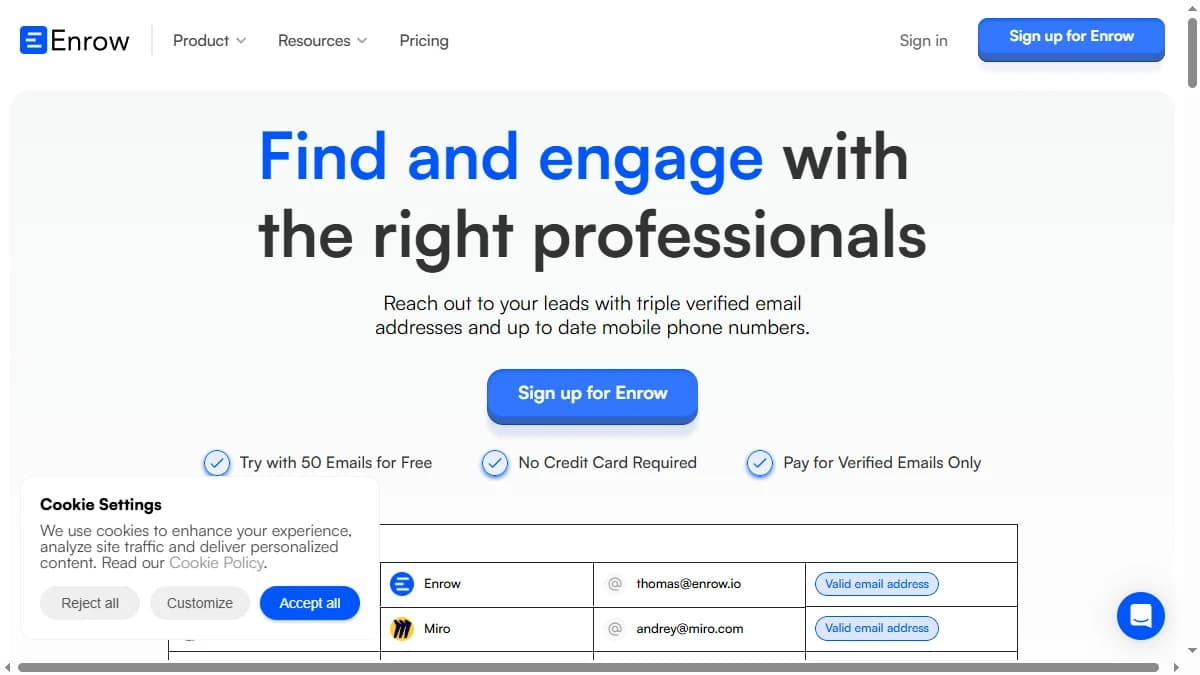
Enrow is a French-built B2B email finder and verifier launched to compete with Apollo, Hunter, and Dropcontact on a single, opinionated promise: pay only for emails the platform can verify as deliverable. Failed lookups cost nothing.
The product surface is narrow by design. Email Finder (lookup by name + company), Email Verifier (validate addresses from any source), Mobile Phone API (verified direct dials), plus a Chrome extension, a REST API, and integrations with HubSpot, Salesforce, Pipedrive, and Clay. There is no Prospector-style searchable database and no native cold email sender.
The signature technical bet is the deterministic catch-all verifier. Most email finders flag catch-all domains as "unknown" and push the risk back to the buyer; Enrow runs additional signals to confirm deliverability on catch-all domains before charging a credit. The result shows up in the independent benchmark numbers: Enrow posted the lowest hard bounce rate in Dropcontact's 2026 test of 15 tools across 20,000 contacts.
| Capability | What Enrow Provides | Notable Gaps |
|---|---|---|
| Database | Single-source proprietary index; lookup by name + company or name + domain. | No waterfall — missing records are dead ends, no fallback. |
| Catch-All Handling | Deterministic verification; doesn't bill if not confirmed deliverable. | Best-in-class on this dimension — no notable gap. |
| Mobile Direct Dial | Available at 40 credits each (about $0.68 on the Start plan). | Coverage thinner than dedicated mobile-data tools. |
| Searchable Database | Not available. | Bring your own list — Apollo or Clay let you discover net-new. |
| Buying Signals | Not available. | No hiring, funding, tech changes, or job-change tracking. |
| Outreach Sender | Not available. | Bring your own — Instantly, Smartlead, Apollo, Lemlist. |
| Integrations | HubSpot, Salesforce, Pipedrive, Clay, Chrome extension, REST API with webhooks, MCP server. | No built-in sequencer — outreach still runs in a separate tool. |
Enrow Pricing: Pay Only for Valid Emails
As of September 2026, Enrow runs three self-serve plans plus a Custom tier that opens at $1,000/month. The structural difference from most email finders: you only spend a credit when Enrow returns a result it can verify. A miss costs nothing.
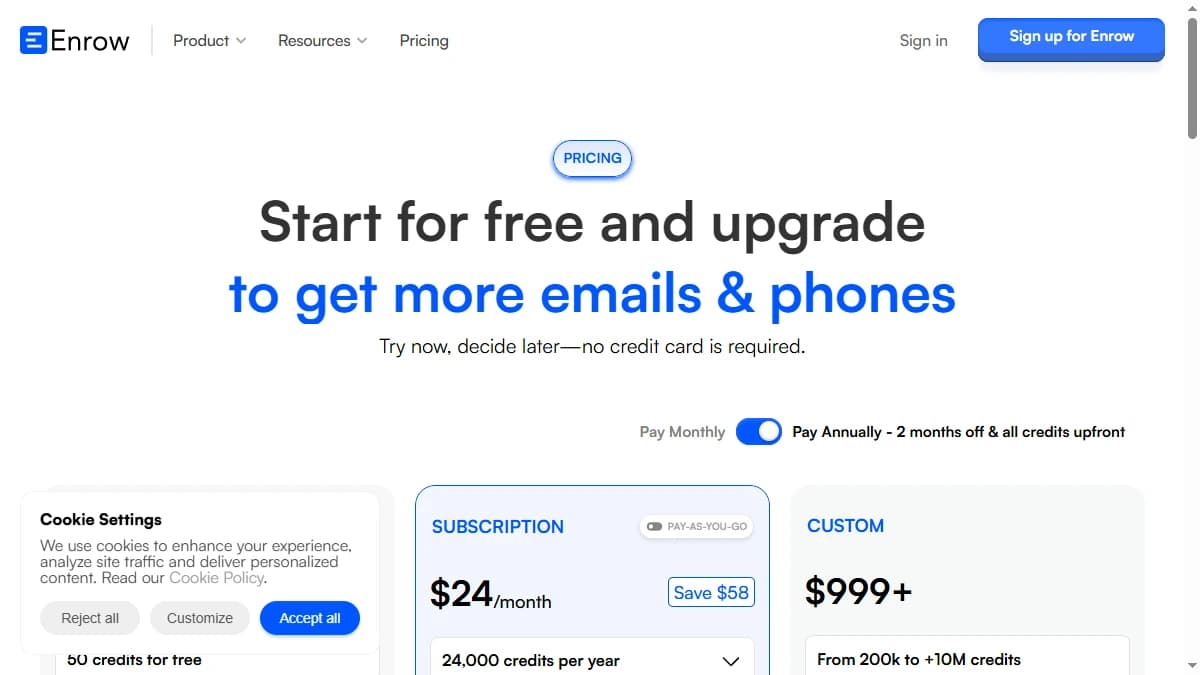
| Plan | Price (monthly billing) | Credits / Month | Per Valid Email |
|---|---|---|---|
| Start | $17/month | 1,000 | ~$0.017 |
| Pro | $87/month | 10,000 | ~$0.009 |
| Scale | $397/month | 50,000 | ~$0.008 |
| Custom | From $1,000/month | Unlimited (via demo) | Custom |
New accounts get 50 free credits with no card. Phone numbers cost 40 credits each, email verifications cost 0.25 credit each, and catch-all verification is included. Annual billing is discounted further. Unused credits roll over — up to 3x the plan on Start and 6x on Pro and Scale with monthly billing, or for 12 months on annual plans — a structural advantage over most credit-based tools.
The real cost math
At Start, the unit economics are clean: about $0.017 per valid email, no charge for misses, credits roll over. For a solo SDR pulling 500–1,000 contacts/month with mixed monthly volume, the cost structure is genuinely friendly. The same dollar spent on a search-based tool (where every lookup costs a credit whether it returns or not) would deliver fewer usable emails per dollar.
Scale brings the list price below $0.008 per valid email at 50,000 credits a month — competitive with the cheapest waterfall providers on a per-record basis. But you're still buying one dimension: no signals, no native sender, and no searchable database for discovering net-new contacts. If coverage matters more than cost per record, the best waterfall email finders roundup covers the multi-provider alternatives.
Enrow Data Coverage: Email, Mobile, Catch-All Verification
Enrow does not publish a headcount the way BookYourData (250M) or ZoomInfo (320M+) do. The product is built around the lookup model: bring a name and a company, get a verified email back if Enrow's index has it.
Coverage in practice is regionally uneven. The database is strongest in US and EU mid-market and weaker in APAC, LATAM, MENA, and SMB long-tail — the same pattern as most single-source tools. Catch-all verification is where Enrow genuinely differentiates: on catch-all domains (where typical email finders return "unknown" and shift the bounce risk to the buyer), Enrow runs a deterministic verification pipeline and either confirms deliverability or returns nothing.
| Region / Segment | Coverage Quality | Notes |
|---|---|---|
| US Mid-Market | Strong | Highest hit rates; densest sourcing pipeline. |
| France / Western Europe | Strong | French roots show up in better-than-average FR/BENELUX coverage. |
| US Enterprise (500+ emp) | Solid | Catch-all verification helps on enterprise domains. |
| US SMB (<50 emp) | Mixed | Single-source ceiling shows; waterfall tools find more. |
| APAC | Weak | Japan/Korea/SEA inconsistent. Use a multi-provider tool. |
| LATAM / MENA / Africa | Weak | Pay-per-valid model softens the cost of misses here. |
One structural advantage of pay-per-valid pricing: weak regions don't bleed your budget. A 5%-hit-rate territory on a credit-based tool burns 95% of your credits on nothing. On Enrow, you only pay for the 5% that came back. The deliverability tax is built into the pricing model — which is the cleanest defense of the model. See what waterfall enrichment is for the alternative architecture that solves coverage with cascade rather than pricing.
Enrow Accuracy: 40.9% Hit Rate Benchmark Tested
The independent reference is Dropcontact's 2026 email finder benchmark: 15 tools tested on the same 20,000-contact list. Enrow ranked 3rd overall with these numbers:
- Effective enrichment rate: 40.9% — emails found and verified as deliverable.
- Hard bounce rate: 2.3% — the lowest of all 15 tools tested.
- Domain error rate: 5.8% — emails delivered to the right name at the wrong company.
- Overall error rate: 8.1% — combined hard bounces and wrong-domain.
- Cost per 1,000 usable emails: €8.72 — second cheapest in the cohort.
The bounce rate is genuinely impressive. For comparison from the same benchmark: FullEnrich landed 3.6% bounces, Datagma 10.6%, and LeadMagic 10.6%. Enrow is in a different category on deliverability. The catch-all verifier delivers what it promises.
The 5.8% domain error rate is the offsetting concern. These are emails where the syntax is valid and the inbox is reachable, but it's the wrong person — the message lands at, say, "john. smith@otherco.com" when you intended to reach John Smith at TargetCo. Reputationally worse than a hard bounce because someone actually reads it.
A multi-provider cascade is not an automatic fix for either number. In the same benchmark, FullEnrich's waterfall found more emails (48.3%) but posted a higher bounce rate (3.6%) and roughly double Enrow's domain error rate (11.7%). LeadMagic kept domain errors slightly lower (5.4%) but found just over half as many emails. Enrow's balance of low bounces and moderate domain errors helps explain why it ranked third overall.
| Tool | Hit Rate | Hard Bounce | Domain Error | €/1K Usable |
|---|---|---|---|---|
| Enrow | 40.9% | 2.3% | 5.8% | €8.72 |
| FullEnrich | 48.3% | 3.6% | 11.7% | €58.89 |
| Datagma | 37.4% | 10.6% | 12.8% | €9.24 |
| LeadMagic | 22.6% | 10.6% | 5.4% | €10.51 |
Source: Dropcontact 2026 email finder benchmark on 20,000 contacts across 15 tools.
Key Features: Email Finder, Verifier, Mobile API
Email Finder
The headline product. Provide a name + company name or name + domain; receive a verified professional email. Bulk CSV upload handles list jobs up to credit allocation, and the REST API supports asynchronous lookups via webhooks for high-volume workflows.
The model only charges when the email is verified as deliverable. On catch-all domains, the deterministic verifier runs additional signal checks — not the typical "return unknown and bill anyway" behavior of older finders.
Email Verifier
Standalone endpoint for validating addresses pulled from elsewhere — old CRM dumps, webinar registrations, scraped lists. 0.25 credit per check. Triple email verification pipeline runs syntax + MX + SMTP + catch-all logic before returning a verdict.
Mobile Phone API
Mobile direct-dial enrichment at 40 credits per number found (about $0.68 on the Start plan). Coverage is thinner than dedicated mobile-data tools like Lusha or Kaspr, but the pay-per- valid model again softens misses. For occasional direct-dial needs, it's a reasonable add-on inside an existing Enrow subscription.
Chrome Extension + API
A Chrome extension lets you trigger lookups directly from LinkedIn and company websites. The REST API supports synchronous and async (webhook) modes, which is what production workflows need. Zapier handles no-code automation for simpler stacks, and as of September 2026 Enrow also lists integrations with HubSpot, Salesforce, Pipedrive, and Clay, plus an MCP server for AI assistants.
What's missing
No searchable Prospector — Enrow is purely a lookup tool, so you still need Apollo, Clay, or Sales Navigator to discover net-new contacts. No buying signals, no intent data, and no native cold email sender. Enrow is intentionally narrow — a verifier, not a workflow platform.
Enrow Pros: What It Does Well
- ✓Best-in-class bounce rate. Independent Dropcontact benchmark on 20,000 contacts placed Enrow at 2.3% hard bounces — the lowest of 15 tools tested. Lower than FullEnrich (3.6%), Datagma (10.6%), and LeadMagic (10.6%) on the identical input list. Deliverability matters more than raw hit rate for sender reputation.
- ✓Pay-per-valid-email pricing. You only spend a credit when Enrow can actually verify the email. Failed lookups cost nothing — which structurally protects budget on weaker territories (APAC, LATAM, SMB long-tail) where most tools burn credits on misses.
- ✓Deterministic catch-all verification. Most email finders flag catch-all domains as "unknown" and push bounce risk back to the buyer. Enrow runs additional signals to confirm deliverability before billing — a genuine technical differentiator that shows up in benchmark results.
- ✓Credits roll over month to month. Unused credits don't expire at the end of the billing cycle: monthly plans carry up to 3x (Start) or 6x (Pro and Scale) the plan's credits, and annual plans keep them for 12 months. For seasonal, project-based, or uneven outbound motions, that's a structural cost advantage over tools like FindThatLead and most credit-based competitors.
- ✓Cost-efficient on a per-record basis. €8.72 per 1,000 usable emails in the Dropcontact benchmark — second-cheapest in the cohort, and roughly 7x cheaper than FullEnrich (€58.89) per usable record. List price drops below $0.008 per valid email on the Scale plan.
- ✓Free trial with no card. 50 free credits, no credit card required — enough for a small test against your own ICP before committing.
Enrow Cons: Where It Falls Short
- Single-source database. When the prospect isn't in Enrow's index, you get nothing — no fallback, no cascade. Multi-provider FullEnrich found more emails (48.3% vs 40.9%) on the same Dropcontact benchmark list.
- 5.8% wrong-domain error rate. Independent Dropcontact testing showed nearly 1 in 17 emails delivered to a correctly-named recipient at the wrong company. Reputationally worse than a hard bounce because the message lands.
- No buying signals, no intent data. There are no hiring-surge alerts, funding round triggers, tech-stack change notifications, or job-change tracking — so you can't time outreach to a real moment.
- No native outreach sender. Enrow finds emails, full stop. You need a separate cold email tool (Instantly, Smartlead, Apollo) to actually send — adding a second vendor, a second bill, and a CSV bridge between them.
- Phone data is expensive. Each number costs 40 credits (about $0.68 on the Start plan), and coverage is thinner than dedicated mobile-data tools like Lusha or Kaspr.
- No searchable contact database. Enrow is a lookup tool — give it a name and company, it returns an email. There is no Prospector-style ICP filter to discover net-new contacts the way Apollo or Clay allow.
- Limited track record. Enrow launched recently and has a thin G2 footprint compared to established vendors. For risk-averse buyers, that's a real consideration on multi-year commitments.
Enrow vs FullEnrich vs Datagma
The B2B contact data market in 2026 splits into a few clean categories: single-source verifiers (Enrow, Datagma), multi- provider waterfall platforms (FullEnrich), all-in-one outbound suites (Apollo), and domain-first finders (Hunter.io). Here's how Enrow stacks against representatives from the adjacent categories on the dimensions that actually move pipeline.
| Feature | Enrow | FullEnrich | Datagma |
|---|---|---|---|
| Pricing Model | Pay-per-valid-email | Credit-based subscription | Credit-based subscription |
| Entry Price | $17/mo (Start, monthly billing) | $59/mo | $49/mo |
| Cost Per Valid Email | ~$0.017 (Start) · under $0.008 (Scale) | $0.06 average | $0.009 – $0.012 |
| Benchmark Hit Rate | 40.9% (Dropcontact 20K test) | 48.3% | 37.4% |
| Hard Bounce Rate | 2.3% | 3.6% | 10.6% |
| Data Architecture | Single-source + catch-all verifier | Waterfall (15+ providers) | Single-source |
| Catch-All Handling | Deterministic verification | Provider-dependent | Standard SMTP |
| Mobile Direct Dial | Available · 40 credits each | Available | Limited |
| CRM Integrations | HubSpot, Salesforce, Pipedrive, Clay + API | Via Zapier/API | Via Zapier/API |
| Credit Rollover | Yes — up to 3–6x plan (monthly) or 12 months (annual) | Monthly only | Monthly only |
| Best For | Low-volume email-only lookups | Mid-market enrichment buyers | Budget-conscious solo SDRs |
The honest take on each option
Enrow wins on deliverability-per-dollar at low volume. 2.3% bounce rate, about $0.017 per valid email on Start, no charge for misses, credits roll over. The cleanest fit for a solo SDR or small team that needs verified emails for a sequence already running on Instantly or Smartlead.
FullEnrich ranked 5th in the same Dropcontact benchmark with a higher hit rate (48.3%) than Enrow but worse bounce (3.6%) and a much higher cost per usable record (€58.89). Multi-provider cascade on the back end. Best for mid-market enrichment buyers who need higher raw coverage and can absorb the price. See our FullEnrich review for the details.
Datagma is the budget single-source option — similar per-record price to Enrow but 4x the bounce rate (10.6%) and a thinner overall feature surface. Reasonable for budget- conscious solo SDRs willing to pay a deliverability tax in exchange for low entry pricing. See the full Datagma review for the deeper trade-offs.
Who Should Use Enrow?
Enrow is the right tool in one specific scenario: you already have a sourcing motion that produces names, you already have a sender running, and you need verified emails as the bridge between them — with the lowest possible bounce risk. It is genuinely best-in- class for that workflow.
Use Enrow if:
- You're running cold email on Instantly, Smartlead, or Lemlist and need a clean upstream verifier with the lowest bounce rate available — your sender reputation depends on this.
- Your monthly volume is uneven or seasonal — the pay-per-valid model and rollover credits both protect budget against unused capacity.
- Your ICP sits primarily in US, France, and Western Europe at mid-market or larger — Enrow's strongest coverage bands.
- You already have a Prospector or list-source (Apollo, Clay, Sales Nav, scraping tool) feeding Enrow — and you don't need another searchable database.
- You want one narrow, well-built tool and you're fine stitching it into your existing stack via its integrations or API.
Do not use Enrow if:
- You're running sustained outbound at 1,000+ contacts/month and need maximum hit rate — single-source 40.9% trails multi-provider FullEnrich (48.3%) on the same benchmark list.
- You need buying signals (hiring, funding, tech stack changes, job changes) to time outreach to a real moment — Enrow is signal-free.
- You want one bundled vendor for finding + sequencing instead of two — Enrow doesn't send.
- Your ICP is heavily APAC, LATAM, MENA, or Africa — coverage gaps are still real even with pay-per-valid pricing.
- You need automated continuous CRM enrichment that keeps records fresh without manual re-runs — Enrow is built around on-demand lookups, so confirm its CRM integrations cover your refresh workflow first.
- You need a searchable database to discover net-new contacts — Enrow only enriches names you bring.
Conclusion: Is Enrow Worth It in 2026?
Enrow is the best deliverability-focused single-purpose email finder we tested for 2026. The 2.3% bounce rate is genuinely best-in-class against an independent 20,000-contact benchmark, the pay-per-valid-email pricing is buyer-friendly, the rollover credits punish nothing, and the catch-all verifier delivers on its technical promise.
The structural ceiling is single-source data and product surface. A 40.9% hit rate beats budget tools but trails multi-provider waterfall platforms such as FullEnrich (48.3%) on the same benchmark list. The 5.8% wrong-domain rate is the offsetting concern against the great bounce number. No buying signals, no native sender, and no searchable database mean Enrow lives inside someone else's stack rather than running the workflow itself.
Our recommendation:Start with the 50 free credits (no card) and test against your real ICP. If you're a solo SDR or small team running cold email elsewhere and you need a clean, deliverability-first verifier as the bridge — Enrow Start at $17/mo (or Pro at $87/mo for 10,000 credits) is a defensible choice. If you're running outbound at scale and need maximum coverage, look at one of the 6 best waterfall email finders for a structurally better fit. External benchmarks worth reading before deciding: Dropcontact 2026 benchmark, Salesforge directory, and G2 reviews.
If Enrow's single-source data ceiling is a dealbreaker, SyncGTM is one alternative worth a look: it runs waterfall enrichment across 50+ data providers to return verified emails, phone numbers, and firmographics.