

Fetcher Review 2026: Data Coverage, Pricing & Alternatives

By Kushal Magar · June 7, 2026 · 11 min read · Last updated: September 30, 2026
Key Takeaway
Fetcher is an AI recruiting platform, not a B2B sales tool. Self-serve starts at $115/month (30% less billed annually) with a cap of 500 Fetcher-sourced candidates a year; enterprise contracts run $8K–$26K/year. It suits in-house TA teams that want vetted candidate batches and automated email outreach; sales teams need a dedicated prospecting platform instead.
Fetcher is an AI-powered recruiting and candidate sourcing platform that searches 500M+ professional profiles to automate talent acquisition. Pricing starts at $115/month self-serve with annual caps of 500 sourced candidates. It is purpose-built for recruiting — not B2B sales prospecting. Our rating: 3.8/5 for TA teams; 1.5/5 for sales teams.
Most teams land on Fetcher reviews from two different angles. Recruiting teams want to know if the AI sourcing, automated email outreach, and ATS integrations are worth the price. B2B sales teams sometimes evaluate Fetcher while searching for B2B sales prospecting tools — and quickly find it is built for an entirely different workflow.
This review covers both angles. For TA teams: what Fetcher actually delivers, where it earns its price, and where it frustrates. For sales teams: why Fetcher is the wrong fit, starting with the waterfall enrichment and buying signal use cases it does not address.
Key facts upfront: Fetcher has no free tier. Annual sourcing caps apply at every plan level. Email is the only native outreach channel — LinkedIn messaging requires workarounds. For B2B outbound sales, it simply is not the right tool.
What Is Fetcher?
Fetcher is an AI-powered recruiting automation platform headquartered in New York. It operates on a source-engage-track model: the AI continuously identifies and vets candidates from a 500M+ profile database, delivers curated batches to the recruiter's inbox, and automates personalized email outreach sequences to move candidates through the funnel.
The target user is an in-house recruiter or TA team at a venture-backed startup or mid-market company that needs a steady pipeline of qualified candidates without building a large sourcing team from scratch. Fetcher handles the search-and-vet loop — the recruiter reviews the delivered profiles and approves outreach.
The platform covers roles across engineering, finance, product, operations, marketing, sales, and customer success. Diversity sourcing filters let teams build inclusive pipelines with specific demographic criteria. ATS integrations via Merge connect to 20+ ATS platforms including Greenhouse, Lever, Workable, and BambooHR.
Fetcher claims 23 seconds of average candidate vetting time per profile, 17 hours saved per role filled, and a 40% average response rate from automated outreach sequences — figures that put it meaningfully ahead of manual sourcing for teams doing high-volume hiring.
| Capability | What Fetcher Provides | Notable Gaps |
|---|---|---|
| Candidate Sourcing | AI-vetted profiles from 500M+ database delivered to inbox. 23-second average vetting time. | Annual caps: 500–2,000+ sourced candidates/year by plan. APAC and LATAM coverage thinner. |
| Email Outreach | Automated, personalized email sequences. 40% average response rate claimed. | Email only. No native LinkedIn messaging or SMS. LinkedIn requires Chrome extension workaround. |
| Diversity Sourcing | Dedicated DEI filters. Diversity pipeline analytics available across all plans. | No diversity analytics on Self-serve tier. Full reporting requires Growth or Amplify. |
| ATS Integrations | 20+ ATS via Merge: Greenhouse, Lever, Workable, BambooHR, iCIMS, Jobvite. | CRM integrations for sales teams are not available. No HubSpot or Salesforce enrichment workflow. |
| Buying Signals | Hiring activity visible as a signal for TA teams. | No funding alerts, tech stack changes, or job change detection for B2B sales teams. |
| B2B Sales Workflow | Not available. | No contact enrichment waterfall, no sales sequences, no CRM enrichment automation for revenue teams. |
Fetcher Pricing: Plans, Costs, and What You Actually Pay
Fetcher publishes pricing for its first three tiers. Annual billing saves 30% on every tier (as of September 2026). No free tier exists — and no self-serve trial. All plans require connecting your work email and ATS before sourcing begins.
| Plan | Price (Monthly / Annual Billing) | Sourced Candidates/Year | Seats | Key Inclusions |
|---|---|---|---|---|
| Self-serve | $115/mo (monthly) / $80.50/mo (annual) | Up to 500/year | 1 | 300 leads/mo, 2,500 inbound applicant reviews/year, email outreach, ATS integrations, LinkedIn plugin |
| Growth | $379/mo (monthly) / $265.30/mo (annual) | Up to 1,000/year | 1 | 5,000 leads/year, 5,000 inbound applicant reviews/year, US-based success team, single sign-on (SSO) |
| Amplify | $649/mo (monthly) / $454.30/mo (annual) | 2,000+/year | 2 | 10,000+ inbound applicant reviews/year, dedicated sourcer covering ~4–6 roles, dedicated success team |
| Enterprise | Custom (contact sales) | Custom | 3+ | 10,000+ leads, volume pricing for large companies and agencies |
Real-world contract data from Vendr shows median annual Fetcher contracts landing around $11,000, with negotiated deals ranging from $8,402 to $26,000. Average negotiated discount is approximately 24% off list price. Enterprise buyers consistently get more sourcing volume and additional seats bundled into custom agreements.
The most significant hidden cost is the annual sourcing cap. Growth at $379/month allows 1,000 sourced candidates per year — roughly 83 per month. Teams hiring for multiple roles simultaneously burn through that allocation quickly. Moving to Amplify or Enterprise adds significant cost without a self-serve upgrade path.
Single sign-on is not available on Self-serve; it starts on Growth (as of September 2026), so smaller teams with SSO requirements pay more than triple the entry price to get it. Fetcher also displays a SOC 2 Type 2 certification on its website.
Fetcher Key Features
AI Candidate Sourcing
Fetcher's core feature is continuous AI-driven candidate discovery. After configuring a role brief, the AI runs searches across the 500M+ profile database and delivers vetted candidate batches to the recruiter's inbox or ATS queue. Recruiters review and approve profiles — they do not manually search or filter.
The vetting layer is what differentiates Fetcher from raw sourcing databases. The AI checks candidates against role criteria before surfacing them, which reduces time spent on clearly unqualified profiles. The 23-second average vetting claim reflects this pre-screening, not total recruiter time per hire.
Automated Email Outreach
Fetcher generates personalized email sequences for each candidate batch. Recruiters can customize templates and timing. Sequences run automatically from the recruiter's email address, maintaining a human-from address while automating follow-up.
Email is the only native channel. LinkedIn outreach requires the Fetcher Chrome extension — it is not automated end-to-end within the platform. Teams that rely on LinkedIn InMail as a primary sourcing channel will need a separate workflow or tool.
Diversity Sourcing and Analytics
Fetcher includes dedicated DEI filters that let recruiters set diversity criteria within role briefs. The platform surfaces candidates matching those criteria alongside standard sourcing results. Diversity funnel analytics track pipeline representation at each hiring stage.
This is one of Fetcher's genuine differentiators versus generic job boards. Teams with explicit DEI hiring mandates get structured tooling — not just a bolt-on filter.
ATS Integrations and Analytics
Fetcher integrates with 20+ ATS platforms via Merge, including Greenhouse, Lever, Workable, BambooHR, iCIMS, and Jobvite. Candidate profiles sourced in Fetcher flow directly into the ATS without manual data entry. Recruiting analytics track sourcing volume, engagement rates, and pipeline conversion by role.
Amplify plan buyers get a dedicated sourcer who covers 4–6 active roles simultaneously — essentially a fractional sourcing specialist embedded in the Fetcher platform.
LinkedIn Chrome Extension
The Fetcher Chrome extension allows recruiters to add LinkedIn profiles directly to sourcing queues and trigger email outreach from within LinkedIn. This bridges the gap between LinkedIn sourcing and Fetcher's email automation — though it requires manual profile-by-profile action rather than automated LinkedIn messaging.
How Fetcher Works: From Role Brief to Interviews
Fetcher makes more sense once you see the order of operations. Here is how a typical search runs, and where plan limits show up along the way.
- Connect email and ATS. Every plan starts by connecting your work email and ATS, so outreach sends from your own address and approved candidates sync without manual data entry.
- Write the role brief. Define the title, seniority, location, and must-have experience, and add diversity goals to the search if you have them. Be specific: users report that some AI-sourced candidates miss on seniority or role fit, and a precise brief is your main lever against that.
- Review vetted batches. Candidates arrive in batches that have already been checked against the brief, and you approve or reject each profile. Fetcher puts the average review at 23 seconds per candidate. Fetcher-sourced candidates count toward an annual cap: up to 500 on Self-serve, 1,000 on Growth, and 2,000+ on Amplify.
- Let the sequence run. Approved candidates enter a templatized email sequence sent from your mailbox, with automated follow-ups. Fetcher reports a 40% average response rate on these sequences.
- Add your own sources. The LinkedIn sourcing plugin, unlimited spreadsheet imports, and inbound applicant reviews (up to 2,500 a year on Self-serve and 5,000 on Growth) bring candidates you found yourself into the same workflow.
- Track the funnel. Analytics show sourcing volume, engagement rates, and conversion by role, which is where you spot a brief that needs tightening before the cap runs out.
The main cost lever is brief quality. Because the caps count sourced candidates rather than hires, a tight brief that yields fewer, better-matched profiles stretches the annual allocation much further than a broad one. Teams hiring for many roles at once should model their yearly volume against the caps before choosing a tier: each step up the plan ladder adds roughly $265–$270 a month at monthly rates (as of September 2026), and moving past Amplify means an Enterprise negotiation.
Fetcher Pros: What It Does Well
- Hands-off sourcing model.Fetcher delivers vetted candidate batches to the recruiter's inbox without requiring manual Boolean searches or database sifting. For teams without dedicated sourcers, this is the core value — the platform does the search-and-filter work automatically.
- 40% claimed outreach response rates.Automated, personalized email sequences achieve higher response rates than generic cold outreach. The personalization layer tailors messaging to each candidate's background before sequences run.
- Strong diversity sourcing tooling. DEI filters and pipeline analytics are native to the platform. Teams with active diversity hiring mandates get structured tooling rather than manual workarounds.
- 20+ ATS integrations via Merge. Greenhouse, Lever, Workable, BambooHR, and 16+ more connect without custom API work. Candidate data flows into the ATS automatically post-approval.
- Transparent base pricing. Three published tiers with clear candidate caps and seat counts. Monthly billing available without annual lock-in on Self-serve and Growth plans. Vendr data confirms 24% average negotiated discounts are achievable.
- 17 hours saved per role filled.The platform's own performance benchmark — backed by customer reporting — reflects meaningful recruiter time savings on sourcing and outreach management for teams filling multiple roles simultaneously.
Fetcher Cons: Where It Falls Short
- Annual sourcing caps limit high-volume use. Self-serve allows just 500 sourced candidates/year; Growth tops out at 1,000; Amplify at 2,000+. Teams hiring aggressively or running large-scale sourcing campaigns hit these ceilings quickly and must negotiate enterprise terms.
- Email-only native outreach. Fetcher sends automated email sequences but has no native LinkedIn messaging or SMS capability. Reaching candidates on LinkedIn — the primary sourcing channel in 2026 — requires a separate tool or the Fetcher Chrome extension workflow.
- No B2B sales workflow. Fetcher is built for recruiting. Account-level buying signals, CRM enrichment, and sales sequences are not on the roadmap. B2B sales teams evaluating Fetcher for prospecting are choosing the wrong product.
- No free tier or trial. Fetcher offers a demo but no self-serve trial. Testing the platform requires a paid subscription starting at $115/month. Competitors like Apollo offer free tiers that let teams validate data quality before committing.
- No SSO on the entry plan. Single sign-on starts on Growth ($379/month, or $265.30/month billed annually, as of September 2026), so Self-serve teams with security requirements pay more than triple the entry price to get it.
- AI matching occasionally misses on seniority and role fit. Users report that a portion of AI-sourced candidates fall outside target criteria — over-qualified or under-qualified relative to the role brief. Human review of every batch is still recommended.
- Limited direct dial phone coverage. Fetcher surfaces candidate contact data but does not specialize in verified mobile numbers. Teams needing direct dial phone enrichment for call-based recruiting need a supplementary data source.
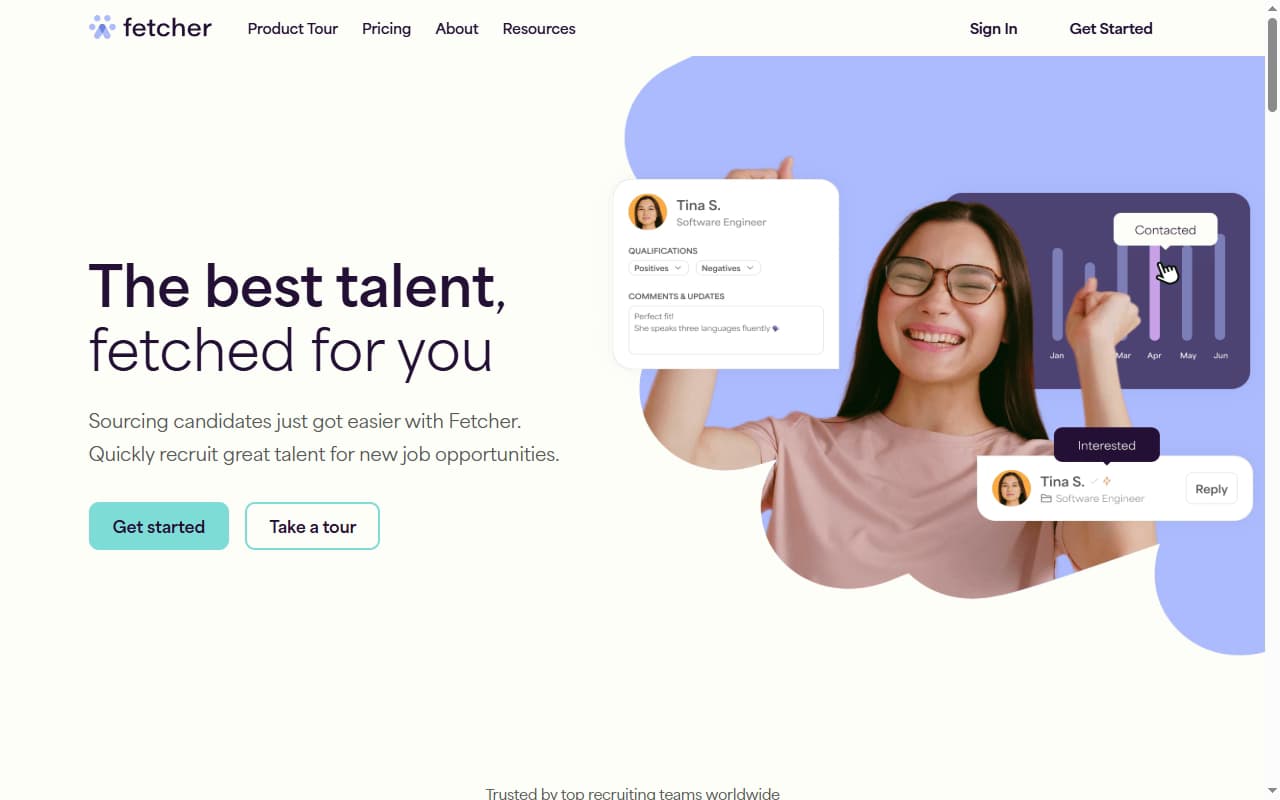
Fetcher homepage — AI-powered recruiting automation for mid-market and growth-stage companies.
Fetcher vs hireEZ vs Apollo
The comparison below covers Fetcher against hireEZ (its closest AI recruiting competitor) and Apollo (the B2B sales prospecting tool sales teams should evaluate instead). These are the most common tools teams evaluate when assessing the Fetcher category.
| Feature | Fetcher | Apollo | hireEZ |
|---|---|---|---|
| Starting Price | $115/mo (Self-serve, 1 seat) | $59/mo (Basic) | $379/mo (Growth) |
| Pricing Transparency | Self-serve, Growth, Amplify published; Enterprise — sales call | Published | Published |
| Database Size | 500M+ candidate profiles | 275M+ contacts | 800M+ professional profiles |
| Primary Use Case | AI recruiting & candidate sourcing | B2B sales prospecting & outreach | AI sourcing at scale |
| Email + Phone Accuracy | Moderate — email-only outreach, no direct dials native | 60–75% (own DB) | Varies — aggregated open web |
| Buying Signals | Hiring signals only (TA focus) | Basic intent via Bombora | No |
| Native Outreach | Email sequences (candidate-focused) | Yes — sequences included | Email only |
| Sourcing Caps | 500–2,000+ sourced candidates/year by plan | Contact export limits by plan | Varies by plan |
| ATS Integrations | 20+ via Merge (Greenhouse, Lever, Workable) | HubSpot, Salesforce native | Greenhouse, Lever, Workday |
| B2B Sales Workflow | None — built for recruiters, not AEs | Full sales workflow | None — TA focus |
| Contract Terms | Monthly available; annual ~30% cheaper | Monthly or annual | Annual minimum on team plans |
Fetcher vs hireEZ
hireEZ (formerly Hiretual) is Fetcher's closest direct competitor. hireEZ claims an 800M+ profile database versus Fetcher's 500M+, and includes LinkedIn integration more deeply into its sourcing workflow. Fetcher's advantage is its cleaner hands-off UX and the Amplify plan's dedicated sourcer option. For teams that want maximum database size and LinkedIn-first sourcing, hireEZ has the edge. For teams that want the most automation with human review of pre-vetted batches, Fetcher is stronger.
Fetcher vs Apollo for Sales Teams
Apollo is the appropriate comparison for B2B sales teams who mistakenly evaluate Fetcher. Apollo has 275M+ contacts, a free tier, built-in sales sequences, CRM native integrations, and buyer intent data via Bombora. Sales teams that need higher contact hit rates than a single database delivers typically add a waterfall enrichment provider on top. Fetcher does none of these things — it is not a competitor for B2B sales use cases.
Who Should Use Fetcher?
Fetcher is the right fit for:
- Venture-backed startups and mid-market companies hiring for engineering, operations, product, and marketing roles at volume without a large in-house sourcing team.
- TA teams with active DEI mandates that need structured diversity filters and pipeline analytics baked into the sourcing workflow — not added as an afterthought.
- Recruiters who want hands-off sourcing.If the goal is to review pre-vetted candidate batches rather than manually searching databases, Fetcher's inbox-delivery model fits that preference directly.
- Teams already on Greenhouse, Lever, or Workable where ATS integration eliminates manual candidate data entry.
Fetcher is not the right fit for:
- B2B sales teams. No waterfall enrichment, no buying signals, no CRM enrichment automation, no sales sequences. The wrong tool category entirely.
- High-volume sourcing operations that exceed 1,000–2,000 candidates per year without moving to Enterprise pricing.
- Teams needing LinkedIn-automated outreach. Email only is a hard constraint. LinkedIn requires manual Chrome extension use.
- Small businesses or solo recruiters on tight budgets. No free tier, and $115/month entry without a trial period is a meaningful commitment for a tool that cannot be tested before payment.
- Teams needing SSO on a limited budget. Single sign-on starts on Growth, so it is not available at the $115/month entry price.
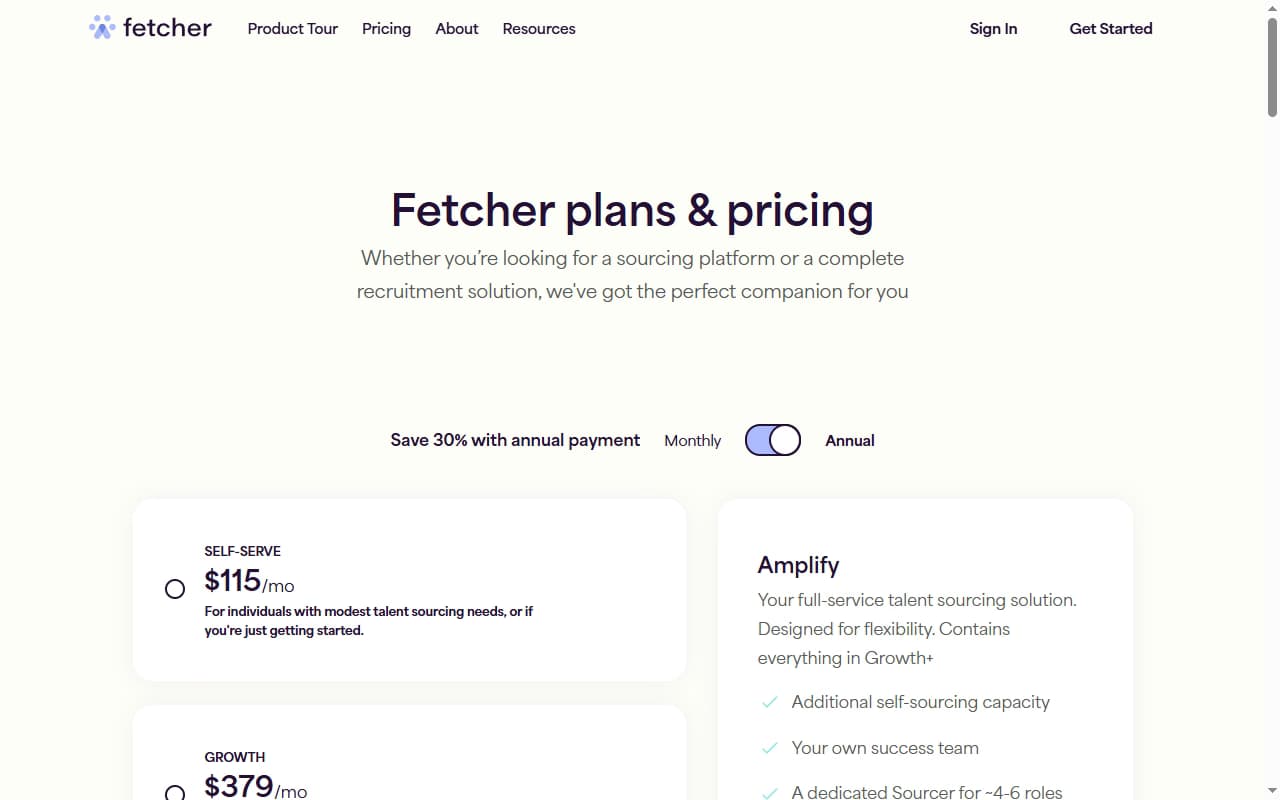
Fetcher pricing 2026 — three published tiers from $115/month to $649/month, plus custom Enterprise.
Is Fetcher Worth It? Final Verdict
For in-house TA teams, Fetcher earns its 3.8/5. The hands-off sourcing model, vetted batches, automated email sequences, and ATS sync remove most of the manual work from filling mid-market roles, and Fetcher reports 17 hours saved per role. Annual billing takes 30% off every tier, which makes Growth ($265.30/month billed annually, as of September 2026) the practical starting point for teams that need SSO or more than 500 sourced candidates a year.
The caps are the deciding factor. Model your yearly hiring volume against the 500, 1,000, and 2,000+ limits before you buy, and check whether LinkedIn-first outreach matters to your team, since email is the only automated channel. Recruiters who want a larger database and deeper LinkedIn workflows should evaluate hireEZ alongside it.
Bottom line: Fetcher is worth a demo for recruiting teams hiring steadily across several roles. Teams researching B2B sales prospecting tools should skip it: it has no contact enrichment, account-level buying signals, or sales sequencing.
If Fetcher's recruiting-only workflow, with no contact enrichment or buying signals for sales, is a dealbreaker, SyncGTM is one alternative worth a look: it pairs waterfall enrichment across 50+ data providers with real-time buying signals such as funding and hiring.