

Firecrawl Review 2026: Pricing, B2B Data Coverage & Alternatives

By Kushal Magar · July 3, 2026 · 12 min read · Last updated: September 30, 2026
Key Takeaway
Firecrawl is the best web scraping API for AI developers who need LLM-ready output. It is not a B2B contact enrichment tool: it cannot find verified emails or mobile numbers, so outbound teams will need a dedicated enrichment tool alongside it.
Firecrawl is a managed web scraping API that converts any URL into clean, LLM-ready markdown or structured JSON. Starting at $16/mo, it handles JavaScript rendering, anti-bot bypass, and proxy rotation automatically. With 40,000+ GitHub stars and 150,000+ companies using the platform, it is the default web scraping layer for AI builders in 2026. Our rating: 4.0/5 — excellent for web scraping, not built for B2B contact enrichment.
B2B sales and GTM teams often discover Firecrawl while looking for a way to extract data from company websites. The tool does this well. What it cannot do is find the verified work email or mobile number of a specific person at that company — that requires a contact enrichment platform, not a web scraper.
This review covers what Firecrawl actually does, what it costs at each plan tier, where it succeeds and fails on web scraping benchmarks, and a direct comparison with Apify and Clay for teams evaluating web data infrastructure in 2026.
If your goal is outbound prospecting with verified B2B contact data, skip to the comparison section. If you are evaluating Firecrawl for AI research or RAG pipelines, the full review below covers what you need to know.
What Is Firecrawl?
Firecrawl — web data infrastructure for AI builders
Firecrawl is a managed web scraping API built by Mendable.ai. Founded on a single architectural bet — that AI applications need clean, structured web data without HTML parsing overhead — Firecrawl returns 93% fewer input tokens than raw HTML by converting page content directly into LLM-ready markdown or schema-validated JSON.
The target user is an AI engineer or developer building research agents, RAG pipelines, competitive intelligence tools, or data extraction workflows. It is not a B2B prospecting database. For a review of tools actually designed for web crawling in AI lead gen, we cover the category in detail elsewhere.
Firecrawl covers approximately 96% of the web with anti-bot bypass, handles JavaScript-rendered pages, and supports browser actions (clicking, typing, scrolling) for dynamic content extraction. The open-source core on GitHub has 40,000+ stars, signaling real developer adoption, not marketing traction.
| Capability | What Firecrawl Provides | Notable Gaps |
|---|---|---|
| Web Scraping | Single URL → LLM-ready markdown or JSON. 67% success rate across 12 benchmarked sites. | LinkedIn, Twitter, Instagram: 0% success. Scrapfly outperforms at 97%. |
| Full-Site Crawl | Crawls all pages on a domain. Returns content with webhook callbacks for async jobs. | No built-in scheduling. Rate limits apply per plan. |
| Web Search | Search the web and return full page content (2 credits/10 results). | Not a news or real-time data API. Search freshness varies. |
| Browser Automation | Click, type, scroll, and fill forms before extraction. 2 credits per browser minute. | FIRE-1 agent billed even on failed runs. |
| B2B Contact Enrichment | Not available. | Cannot find verified emails, mobile numbers, or LinkedIn profiles. Needs a separate tool. |
| Buying Signals | Not available. | No hiring, funding, tech change, or intent signals of any kind. |
Firecrawl Pricing: Plans, Credits, and What You Actually Pay
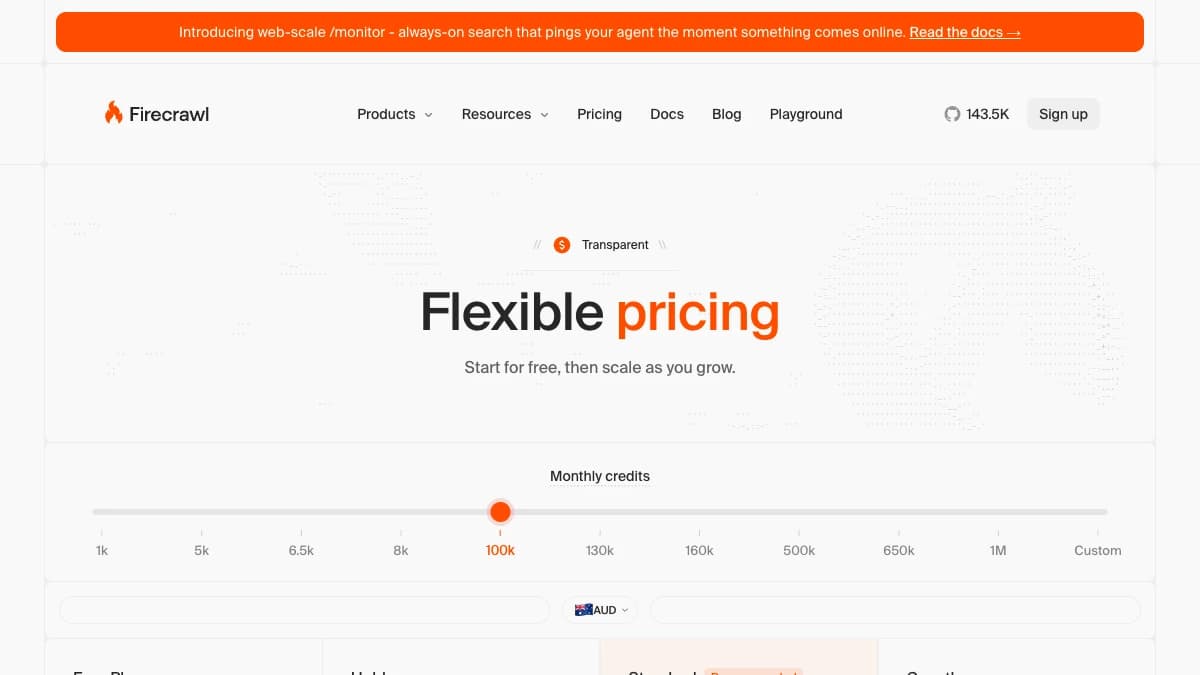
Firecrawl pricing page — plans range from free to $599/mo
Firecrawl uses a credit-based model. The base rate is 1 credit per page for standard scraping. The catch: enabling premium features multiplies that cost significantly — and credits do not roll over on standard plans.
| Plan | Monthly Price (yearly) | Credits/Month | Concurrent Requests | Cost/1k Credits |
|---|---|---|---|---|
| Free | $0 | 1,000 | 2 | — |
| Hobby | $16/mo | 5,000 | 5 | $3.20 |
| Standard | $83/mo | 100,000 | 25 | $0.83 |
| Growth | $333/mo | 500,000 | 50 | $0.67 |
| Scale | $599/mo | 1,000,000 | 100 | $0.60 |
| Enterprise | Custom | Custom | Custom | Custom + ZDR + SSO + SLA |
Prices above assume annual billing. Billed month to month (as of September 2026), Hobby is $19, Standard $99, and Growth $399; Scale is billed annually only and is the first tier where unused credits carry over, for one month.
The real cost math
The Hobby plan at $16/mo looks cheap. At 1 credit per page, that is 5,000 pages per month. But add JSON extraction (+4 credits/page) and Enhanced Mode (+4 credits/page) — both common for structured data extraction — and you are spending 9 credits per page. The effective page count drops to 555 pages per month for fully featured extraction, raising the real cost to $0.029 per page.
Stealth Mode (for heavily protected sites) costs 5× the base rate. The FIRE-1 autonomous agent is billed even on failed runs, and a page that returns an error such as a 403 or 404 still costs 1 credit. Independent benchmarks place Firecrawl at $6.84 per 1,000 requests in real-world conditions — versus Scrapfly at $3.97 and WebScrapingAPI at $2.49. Annual billing saves two months across all tiers.
Firecrawl Key Features
Scrape API
The core endpoint. Send a URL, receive clean markdown or structured JSON. Firecrawl handles JavaScript rendering, waits for dynamic content to load, and strips navigation, ads, and boilerplate. The output drops directly into a prompt or a vector database without additional parsing. This is the primary reason 1.25 million developers use the platform.
Crawl and Map
Crawl recurses through all pages on a domain, returning content for each URL in a single async job with webhook callbacks. Map returns all URLs on a site without scraping content — useful for understanding site structure before deciding what to crawl. Both are essential for building comprehensive knowledge bases from target company websites.
Structured Extraction (JSON Schema)
Define a JSON schema and Firecrawl returns data structured to your spec. Want a list of job titles from a careers page, or product prices from a competitor page? Define the schema once and the API extracts it consistently across runs. This is where Firecrawl genuinely earns its reputation for AI-workflow compatibility.
MCP Server and AI Framework Integrations
Firecrawl ships with native integrations for LangChain, LlamaIndex, CrewAI, and an MCP server for Claude Code and other AI agents. This is the feature set that separates Firecrawl from generic scraping APIs — it is purpose-built for the AI developer stack, not for traditional data pipelines.
Firecrawl Pros: What It Does Well
- ✓Best LLM-ready output in the category. Firecrawl returns 93% fewer tokens than raw HTML by pre-processing page content into clean markdown. No custom parsing layer needed before feeding content to an LLM. This alone justifies the tool for AI research agents.
- ✓Open-source core with real developer adoption. 40,000+ GitHub stars and 1.25 million active developers signal genuine utility, not marketing. The open-source core means you can self-host the scraping layer — albeit without Fire-engine (the anti-bot bypass layer), which is cloud-only.
- ✓Native AI framework integrations. LangChain, LlamaIndex, CrewAI, and MCP server support are baked in. For teams building AI agents, Firecrawl requires zero integration work to connect to the most common AI orchestration frameworks.
- ✓Generous free tier for prototyping. 1,000 credits per month at $0, no credit card required. Sufficient to evaluate the API, build a prototype, and validate a use case before committing to a paid plan.
- ✓Strong e-commerce and public web coverage. 95%+ success rates on Amazon, Etsy, and StockX. For teams building competitive intelligence on public websites — product pricing, job postings, press releases — Firecrawl delivers reliable extraction.
Firecrawl Cons: Where It Falls Short
- Not a B2B contact database. Firecrawl scrapes public websites but cannot find verified work emails, mobile numbers, or LinkedIn profiles. For outbound prospecting, you still need a dedicated enrichment tool.
- 67% overall success rate — ranked third in independent benchmarks. Scrapfly (97%) and WebScrapingAPI (74%) outperform Firecrawl on raw scraping success rate, though LLM-optimized output partially offsets this.
- Credits do not roll over on most plans. Unused credits expire at the end of each billing cycle on Hobby, Standard, and Growth; only Scale (one month) and Enterprise carry credits over, as of September 2026. Teams with uneven usage patterns will lose credits they paid for.
- Hidden credit multipliers. Enabling JSON extraction (+4 credits/page), Enhanced Mode (+4 credits/page), and Stealth Mode (5× total) means real-world costs can be 9× higher than the base rate advertised on the pricing page.
- No buying signals of any kind. Firecrawl is a web scraping tool — it has no concept of hiring surges, funding rounds, tech stack changes, or other B2B intent signals. If your outbound motion depends on timing, you need a separate signal layer.
- LinkedIn, Twitter, and Instagram return 0% success. The three highest-value social platforms for B2B prospecting are effectively blocked, limiting Firecrawl's utility for social-first lead research.
- No native CRM integration. There is no direct connection to HubSpot, Salesforce, or Pipedrive. Integrating Firecrawl into a CRM workflow requires custom API work or Zapier automation.
Firecrawl vs Apify vs Clay
Firecrawl, Apify, and Clay all touch web data, but they solve different problems. The table below makes the differences clear. Understanding them saves teams from buying the wrong tool for their actual use case.
| Feature | Firecrawl | Apify | Clay |
|---|---|---|---|
| Starting Price | $16/mo (Hobby, yearly) | $49/mo | $167/mo (Launch) |
| Core Use Case | Web scraping & crawling for AI | Web scraping & data pipelines | GTM data orchestration |
| B2B Contact Data | None — scrapes websites, not databases | None — scrapes websites, not databases | Waterfall across 150+ data providers |
| LLM-Ready Output | Yes — markdown, JSON, screenshots | Yes — markdown via Website Content Crawler | No |
| Open Source Core | Yes (GitHub, 40k+ stars) | Partial (Crawlee open source) | No |
| Success Rate | 67% overall (independent benchmark) | Higher on targeted site Actors | Depends on provider |
| Credits Rollover | Scale (one month) and Enterprise only | Partial | Limited |
| CRM Integration | None native | Via Zapier/API | Native CRM sync from Growth ($446/mo) |
The honest take on each option
Firecrawl wins on LLM-ready web scraping output. If you are building AI agents that need to read and process company websites, it is the cleanest API for that job. It is not a B2B contact database and should not be evaluated as one.
Apify wins on targeted site extraction with its 6,000+ pre-built Actors. If your use case requires scraping LinkedIn profiles, Google Maps listings, or job boards at scale, Apify has pre-built scrapers that Firecrawl does not. For finding work emails, neither Apify nor Firecrawl is the right answer — you need a purpose-built enrichment tool.
Clay wins on GTM workflow orchestration if your team already knows how to build Clay tables. At $167/mo+ for paid plans (as of September 2026), it is significantly more expensive for web scraping use cases than Firecrawl, but it combines enrichment provider routing with outreach sequencing in a single workflow.
Pairing Firecrawl with a contact enrichment tool
A strong outbound research workflow uses two tools in sequence. Firecrawl scrapes the target company's website to extract context — recent blog posts, product updates, job listings, technology signals. A dedicated enrichment tool then finds the verified email and mobile number for the specific person you want to reach. Firecrawl gives the context for personalization; the enrichment tool gives the contact data to act on it. Our best waterfall contact providers comparison covers the full enrichment landscape. See our FullEnrich review for a comparison of pure-waterfall enrichment options if contact data is your primary need.
Who Should Use Firecrawl?
Firecrawl is the right tool when you need to turn websites into structured data for AI applications, competitive intelligence, or research workflows — and you want the output formatted specifically for LLM consumption without a parsing layer.
Use Firecrawl if:
- You are building AI agents, RAG pipelines, or research automation that ingests website content as LLM context.
- You need structured extraction from public websites using a JSON schema — product prices, job listings, press releases.
- You want LangChain, LlamaIndex, or CrewAI integration out of the box without custom connector work.
- You want to prototype a web data workflow for free before spending money on a paid plan.
- Your target sites are public web pages (e-commerce, company websites, news) rather than LinkedIn or gated social platforms.
Do not use Firecrawl if:
- Your goal is finding verified work emails or mobile numbers for B2B prospects. Firecrawl is a web scraper, not a contact database. Use a dedicated contact enrichment tool instead.
- You need to scrape LinkedIn, Twitter, or Instagram at scale — Firecrawl returns 0% success on all three.
- You need pre-built scrapers for specific platforms rather than a generic crawling API — Apify's 6,000+ Actors are stronger for that use case.
- You need buying signals (hiring surges, funding rounds, tech stack changes) to time your outreach — Firecrawl has no signal layer of any kind.
- Budget sensitivity is a concern and your extraction workflow uses Enhanced Mode + JSON schema — actual costs can run 9× the advertised base rate.
If Firecrawl's inability to find verified work emails or mobile numbers is a dealbreaker, SyncGTM is one alternative worth a look: it runs waterfall enrichment across 50+ data providers for verified emails, phone numbers, and firmographics.