Import.io Review 2026: B2B Data Coverage, Pricing & SyncGTM Comparison

By Kushal Magar · June 9, 2026 · 11 min read
Key Takeaway
Import.io is a managed web scraping platform — not a B2B contact tool. Basic starts at $299/month, with custom enterprise pricing (median ~$36k/year per Vendr). It extracts raw, structured page data well, but provides no verified emails, no phone numbers, no buying signals, and no sales workflow. The billing charges for queries whether you use them or not, with a 4-week cancellation notice. For B2B sales teams needing waterfall enrichment across 50+ providers, buying signals, and outbound sequences, SyncGTM is the purpose-built alternative from $99/mo with no seat fees.
This Import.io review covers a managed web data extraction platform that turns websites into structured, tabular data through a no-code interface. Basic starts at $299/month. Above that, pricing is custom — Vendr's benchmark median is roughly $36,000/year. Import.io extracts raw page data well, but provides no verified B2B contacts, no buying signals, and no sales workflow. Our rating: 3.8/5 for enterprise web scraping; 1.5/5 for B2B sales prospecting.
Most people land on an Import.io review from one of two angles. Data and enterprise teams want to know if the managed, hands-off scraping model is worth the price step-up over DIY tools. B2B sales teams sometimes evaluate Import.io while searching for B2B sales prospecting tools — and quickly discover it scrapes web pages rather than delivering verified prospect data.
This review covers both angles honestly. For data teams: what Import.io actually delivers, where it earns its price, and where it frustrates. For sales teams: why Import.io is the wrong fit and what to use instead — including how SyncGTM handles the waterfall enrichment and buying signal use cases that Import.io does not address.
Key facts upfront: Import.io is a genuinely strong tool for governed, large-scale web scraping. The $299/month Basic plan prices out most SMBs and is unaffordable for single users. Above Basic, you negotiate a custom quote, and you pay for query volume whether you use it or not. There is no verified contact database behind it. For B2B outbound sales, Import.io is simply not the right tool.
What Is Import.io?
Import.io is a managed web data extraction platform. It converts websites into structured, tabular data through a point-and-click no-code interface — no REGEX, XPath, or coding required. The company builds and maintains your extractors, handles break/fix when sites change, and delivers the resulting data via API or cloud. The pitch is hands-off, governed scraping at scale.
The core differentiator is the managed model. Instead of running your own proxies, writing your own scrapers, and babysitting them every time a target site changes its layout, Import.io owns that maintenance burden. For enterprises running dozens of extractors, the managed approach can pencil out cheaper than hiring a dedicated scraping engineer — that is the value proposition Import.io sells against DIY tools and in-house builds.
Import.io handles authenticated and JavaScript-rendered sites, which is where simpler scrapers break. It is used for price monitoring, competitive intelligence, market research, and large-scale web data collection. On Capterra, Import.io holds a 3.7/5 rating across 17 reviews, with users praising reliable, predictable structured output and flagging cost and cancellation terms as the main pain points.
The critical thing to understand for this review: Import.io is a data extraction tool, not a data enrichment tool. It scrapes whatever is on the page. It does not maintain a verified B2B contact database, it does not validate emails or phones, and it has no firmographic or intent layer. That distinction decides whether Import.io is right for you.
| Capability | What Import.io Provides | Notable Gaps |
|---|---|---|
| Web Data Extraction | No-code point-and-click extractors, structured tabular output, JS-rendered and authenticated site support. | Output is page-dependent and unverified. Still needs cleaning, deduplication, and validation. |
| Managed Maintenance | Import.io builds and maintains extractors, handles break/fix, runs proxies, and owns QA. | Managed service is priced for enterprise. Overkill and overpriced for small teams. |
| Data Delivery | API and cloud delivery, scheduling, alerts, dashboards, and historical/trend reporting. | No native CRM sync. Integration into a sales stack is DIY via API. |
| Verified B2B Contacts | Not available. | No verified email/phone database, no waterfall cascade, no accuracy guarantee. |
| Buying Signals | Not available. | No funding, hiring, tech-change, or job-change detection. |
| B2B Sales Workflow | Not available. | No sequences, no enrichment automation, nothing for revenue teams to act on. |
Import.io Pricing: Plans, Costs, and What You Actually Pay
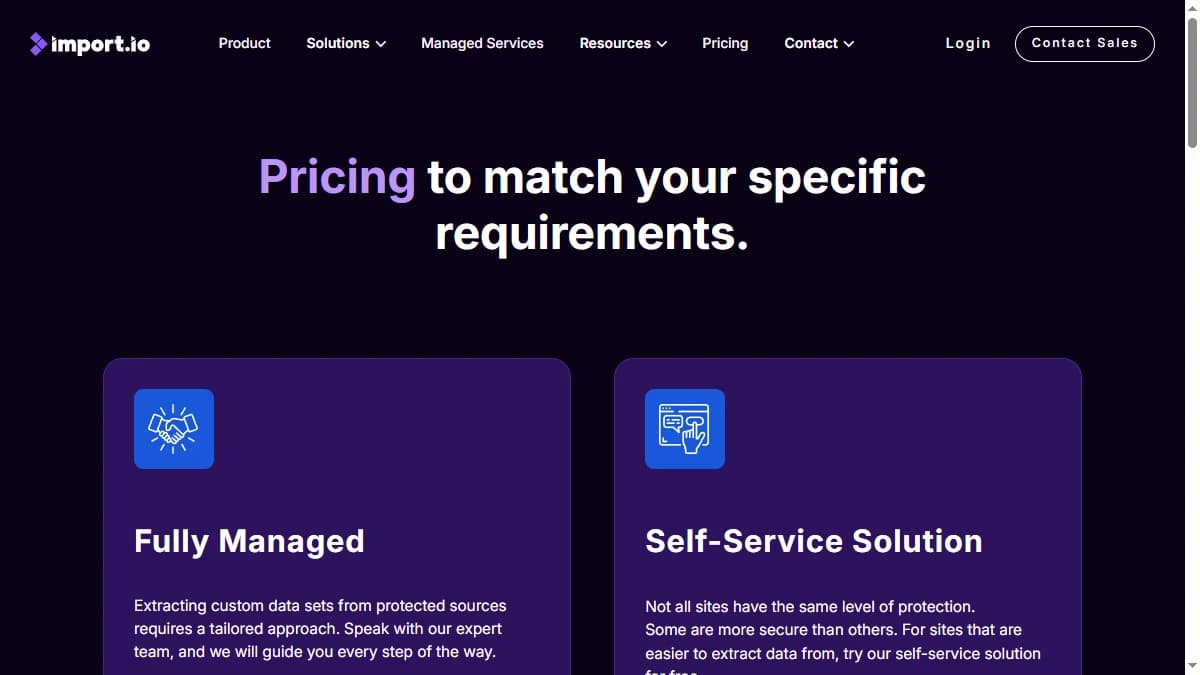
Import.io publishes one number: Basic at $299/month, billed monthly, with a free trial. Everything above Basic is “tailored to your requirements” — vendor language for a custom quote you only get after a sales call. The variables are query volume, proxy needs, and contract length.
| Plan | Price | Best For | Key Inclusions |
|---|---|---|---|
| Free Trial | $0 (time-limited) | Evaluation | Trial access to test extraction before committing. No free desktop app (discontinued). |
| Basic | $299/mo (published) | Small data teams | No-code extractors, structured output, API/cloud delivery, scheduling, alerts, dashboards |
| Enterprise | Custom (median ~$36k/yr per Vendr) | High-volume scraping | Everything in Basic + managed extractor maintenance, higher query volume, dedicated support, governance |
The most important pricing reality: Import.io charges for your query allotment whether you use it or not, and there is no option to pause an account in a low-volume month. Reviewers describe the structure as designed to push you toward larger commitments. If your scraping needs are seasonal or spiky, you pay for the peak every month.
The custom-pricing range is wide. Vendr's benchmark data puts the median Import.io buyer at roughly $36,000/year, with deals stretching from about $9,750 on the low end to over $272,000 for the largest query volumes. That spread tells you Import.io is built and priced for enterprise data operations, not individual users or small teams.
Cancellation is also worth flagging. Reviewers report a 4-week notice requirement to cancel. Combined with the no-pause billing model, Import.io is a heavier commitment than usage-based scraping competitors where you can scale spend down — or off — whenever you want.
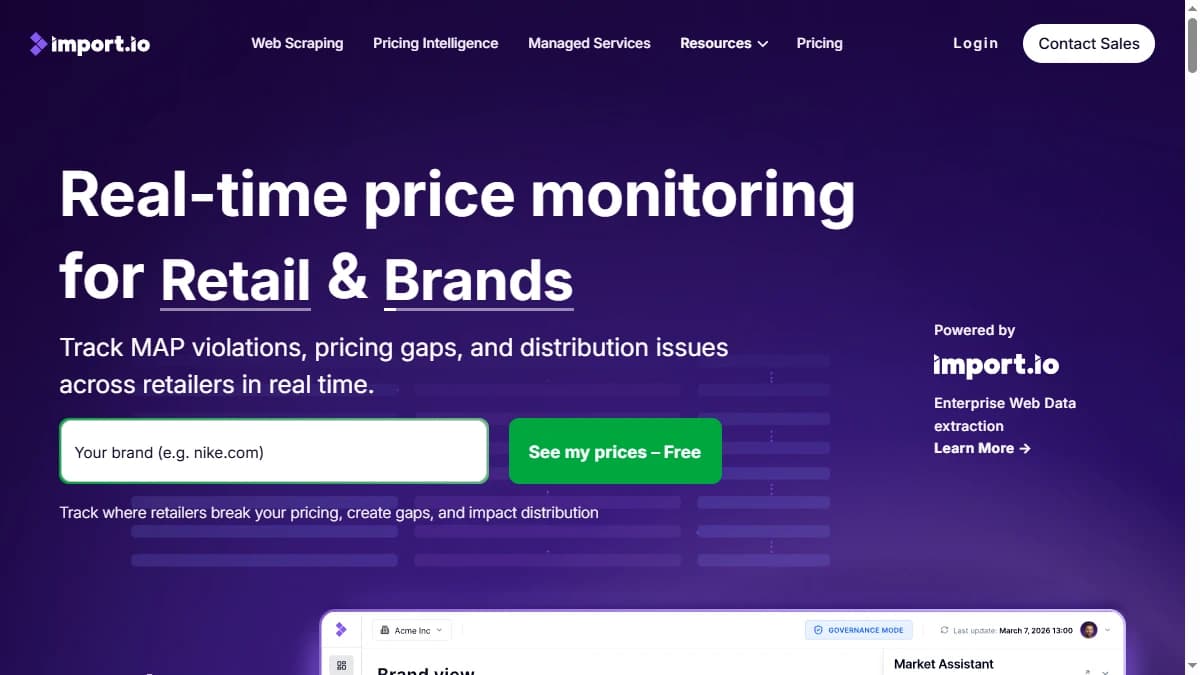
Import.io homepage — a managed web scraping and data extraction platform for enterprise data teams.
Import.io Key Features
No-Code Point-and-Click Extraction
Import.io's headline feature is no-code extraction. You point at a web page, click the data fields you want, and the platform turns messy HTML into clean, structured, tabular output — no REGEX or XPath required. For non-technical teams, this is a genuine time-saver and the reason many users choose Import.io over developer-first scraping tools.
The structured output is the payoff. Reviewers consistently describe the results as predictable and trustworthy — clean tables delivered reliably without constant babysitting. For repeatable data collection at scale, that reliability is the core selling point.
Managed Extractor Maintenance
Import.io builds and maintains your extractors. When a target site changes its layout and breaks a scraper, Import.io fixes it — you do not. The platform also runs the proxies and handles QA. This managed model removes the maintenance burden that makes in-house scraping expensive and fragile.
For enterprises running dozens of extractors, this is where the cost can justify itself. The managed service can be cheaper than hiring and retaining a dedicated scraping engineer to keep brittle pipelines alive.
JS-Rendered and Authenticated Site Support
Import.io handles JavaScript-rendered pages and sites behind logins — the cases where simpler scrapers fail. Dynamic content and authenticated areas are exactly where DIY tools tend to break, so this is a meaningful capability for teams scraping modern web applications.
API, Scheduling, and Delivery
Extracted data is delivered via API or cloud, with task scheduling, workflow automation, alerts, and notifications. You can run extractions on a schedule and pipe the results into downstream systems programmatically — useful for keeping datasets fresh without manual re-runs.
Dashboards and Historical Reporting
Import.io includes customizable dashboards and reports, plus historical reporting and trend analysis. For use cases like price monitoring and competitive intelligence, tracking how scraped values change over time is often the whole point — and Import.io supports that natively.
What Import.io Does Not Do
It is worth naming the gaps explicitly. Import.io has no verified B2B contact database, no email or phone validation, no waterfall enrichment, no buying-signal detection, and no outbound sales sequencing. If those are the features you came looking for, Import.io is the wrong product category.
Import.io Pros: What It Does Well
- No-code extraction with clean output. The point-and-click interface turns messy web pages into structured tabular data without writing code — a real time-saver for non-technical data teams who would otherwise need a developer.
- Managed maintenance removes the worst part of scraping. Import.io builds and maintains extractors, fixes them when sites change, and runs the proxies. For teams running many extractors, this offloads the fragile, time-consuming maintenance that sinks in-house scraping.
- Handles hard targets. JS-rendered pages and authenticated sites — where simpler scrapers break — are supported. That reliability on dynamic and gated content is a genuine technical advantage.
- Predictable, trustworthy results. Reviewers repeatedly describe Import.io output as reliable and hands-off — clean data delivered at scale without constant attention, freeing up engineering time for repeatable collection jobs.
- Enterprise-grade delivery and reporting. API and cloud delivery, scheduling, alerts, dashboards, and historical trend reporting make it a complete platform for governed, large-scale data pipelines — not just a scraper.
- Can be cheaper than building in-house. For enterprises that would otherwise hire a dedicated scraping engineer and manage their own proxy infrastructure, the managed model can pencil out as the lower total cost.
Import.io Cons: Where It Falls Short
- Expensive for anything below enterprise scale. The $299/month Basic floor is steep for SMBs, and reviewers repeatedly call Import.io unaffordable for single users. Above Basic, pricing is custom — Vendr's benchmark median is roughly $36,000/year, which prices out most small teams entirely.
- You pay for queries whether you use them or not. Multiple reviewers flag that the billing model charges for your allotted query volume regardless of actual usage, and there is no option to pause an account in a low-volume month. The pricing structure pushes you toward larger commitments.
- No verified B2B contact data. Import.io extracts whatever is on the page — it is not an enrichment tool. There is no verified email/phone database, no waterfall cascade, and no accuracy guarantee. Sales teams expecting clean prospect data get raw, unvalidated page output that still needs heavy cleanup.
- No buying signals or sales workflow. There is no firmographic intent layer, no job-change or funding detection, and no outbound sequencing. Import.io collects data; it does nothing to help you act on it for revenue. B2B sales teams evaluating it for prospecting are in the wrong product category.
- Restrictive cancellation terms. Reviewers report a 4-week cancellation notice requirement. Combined with the no-pause billing model, this makes Import.io a heavier commitment than usage-based scraping competitors that let you scale spend down freely.
- The free desktop browser version is gone. Import.io discontinued its free desktop app, removing the low-cost entry path that earlier users relied on. The only no-cost option now is a time-limited free trial before the $299/month Basic plan.
- Customer service complaints. While many reviewers praise reliability, a recurring minority report negative support experiences — slow responses and friction around billing and cancellation. For a managed, support-dependent product, service quality is a meaningful risk factor.
Import.io pricing 2026 — Basic from $299/month, with custom enterprise pricing (median ~$36k/year per Vendr benchmarks).
Import.io Review: vs SyncGTM vs Alternatives
This Import.io review compares it against SyncGTM (B2B sales enrichment), Octoparse (no-code scraping), and Apify (developer scraping). These are the tools teams most often weigh when evaluating the Import.io category — one from the sales side, two from the scraping side.
| Feature | Import.io | SyncGTM | Octoparse | Apify |
|---|---|---|---|---|
| Starting Price | $299/mo (Basic, published) | $99/mo (no seat fees) | $99/mo (Standard) | $49/mo (Starter) |
| Pricing Transparency | Basic published; enterprise — sales call | Published on website | Published | Published, usage-based |
| Primary Use Case | Managed web scraping & data extraction | B2B sales prospecting & enrichment | No-code web scraping | Developer scraping & automation |
| Verified B2B Contacts | No — raw page data only | Yes — 50+ provider waterfall | No — raw page data only | No — raw page data only |
| Email + Phone Accuracy | N/A — scrapes whatever is on the page | 75–90% (waterfall cascades 50+ providers) | N/A — page-dependent | N/A — page-dependent |
| Buying Signals | None — no firmographic or intent layer | Hiring, funding, tech changes, job changes | None | None (DIY via custom actors) |
| Native Outreach | None | Yes — sales sequencing built-in | None | None |
| Free Tier | Free trial only (no free desktop app) | Free trial available | Yes — limited free plan | Yes — $5 monthly usage credit |
| CRM Integrations | API + cloud delivery; no native CRM sync | HubSpot, Salesforce native | Via API / Zapier | Via API / integrations |
| B2B Sales Workflow | None — built for data extraction, not sales | Full GTM workflow: enrich → signal → outreach | None | None |
| Contract Terms | Monthly billed; 4-week cancellation notice | Monthly or annual, cancel anytime | Monthly or annual | Pay-as-you-go or monthly |
Import.io vs SyncGTM
Import.io and SyncGTM address completely different problems. Import.io extracts raw, structured data from web pages and hands you the output. SyncGTM runs waterfall enrichment across 50+ providers to maximize B2B contact data hit rates, detects buying signals like hiring surges and funding rounds, and executes outbound sales sequences.
B2B sales teams that land on Import.io while researching prospecting tools are solving a different problem. SyncGTM starts at $99/month with no seat fees, no custom contract, and no no-pause billing trap. Import.io starts at $299/month for Basic — but with no verified contacts, no buying signals, no CRM enrichment, and no sales sequencing. For SDR tooling and sales prospecting, Import.io is not the right choice.
Import.io vs Octoparse
Octoparse is the closest no-code alternative for teams that want web scraping without Import.io's price tag. Both offer point-and-click extraction, but Octoparse starts at $99/month and includes a limited free plan, where Import.io's floor is $299/month with no free tier. The trade-off is the managed service — Import.io maintains your extractors for you, while Octoparse leans more self-serve. For teams that want to own their scraping at a lower cost, Octoparse is the value pick. For fully governed, hands-off pipelines, Import.io's managed model is the differentiator.
Import.io vs Apify
Apify is the developer-focused alternative. Its usage-based pricing starts at $49/month with a small free monthly credit, and it offers a marketplace of pre-built scrapers (actors) plus the flexibility to write custom ones. Apify suits technical teams that want control and pay-as-you-go billing; Import.io suits non-technical teams that want a managed, no-code service and will pay a premium for it. Neither tool, however, gives you verified B2B contacts — like other scraping tools, both leave you with raw page data to clean and verify yourself.
Who Should Use Import.io?
Import.io is the right fit for:
- Enterprises with a $30k+/year data budget that need governed, large-scale web extraction and can absorb custom enterprise pricing without flinching.
- Teams that want hands-off, managed scraping. If you want the vendor to own extractor maintenance, proxies, and break/fix rather than building and babysitting scrapers in-house, the managed model is the whole point.
- Price monitoring and competitive intelligence use cases. Repeatable, scheduled extraction of pricing or product data at scale, with historical trend reporting, is exactly what Import.io is built for.
- Non-technical teams scraping hard targets. JS-rendered and authenticated sites without writing code — Import.io handles the cases that break simpler tools, with no developer required.
Import.io is not the right fit for:
- B2B sales teams. No verified contacts, no buying signals, no CRM enrichment, no sales sequences. The wrong tool category entirely. See Import.io alternatives if you need B2B data enrichment.
- SMBs and single users. The $299/month floor and custom enterprise pricing price out small teams. Reviewers explicitly call it unaffordable for individuals.
- Teams with seasonal or spiky needs. You pay for query volume whether you use it or not, with no pause option. If your scraping demand fluctuates, the billing model works against you.
- Anyone who needs verified, ready-to-use contact data. Import.io scrapes raw page data that still needs cleaning, deduplication, and validation. For verified emails and phones out of the box, you need an enrichment tool, not a scraper.
The B2B Sales Alternative: SyncGTM Waterfall Enrichment
If you arrived at this Import.io review while researching B2B sales prospecting tools, Import.io is not the product you need. Scraping a page gives you raw text; it does not give you a verified decision-maker to email. Here is what the right tool looks like for outbound sales teams:
- Waterfall enrichment across 50+ providers — not raw page scraping. SyncGTM cascades through 50+ data sources to achieve 75–90% email and phone hit rates on B2B contact records. Import.io has no equivalent for verified contact data.
- Buying signals that time outreach. SyncGTM detects hiring surges, funding rounds, tech stack changes, and job changes at target accounts in real time. Import.io detects none of these.
- Sales-native CRM enrichment. SyncGTM pushes enrichment directly into HubSpot and Salesforce records automatically. Import.io delivers raw data via API with no native CRM sync.
- No no-pause billing or custom contracts. SyncGTM pricing is transparent and starts from $99/month — no per-seat charges, no enterprise sales conversation, and no 4-week cancellation notice.
The bottom line: Import.io solves a web data extraction problem. SyncGTM solves a B2B pipeline problem. They are not substitutes for each other — and if prospect data is what you came for, you want the waterfall enrichment approach, not a scraper.