

Outscraper Review 2026: B2B Data Coverage, Pricing & Alternatives

By Kushal Magar · June 8, 2026 · 11 min read · Last updated: September 30, 2026
Key Takeaway
Outscraper is a low-cost, no-code Google Maps and web-scraping platform — not a verified B2B contact database. Maps scraping starts free for 500 records, then $3/1k, with no monthly fees. But costs stack across separate tasks (scrape, find email, verify, enrich), pushing a full lead profile to ~$14/1k. There is no published accuracy benchmark, no buying signals, and no outreach, and its CRM integrations cover HubSpot, Pipedrive, and Zoho CRM but not Salesforce. It fits agencies, researchers, and developers who need raw local-business data cheaply; outbound sales teams will need verification and sequencing tools on top.
Outscraper is a business data and web-scraping platform built around Google Maps. Maps scraping is free for the first 500 records, then $3 per 1,000, with no monthly fees and credits that never expire. The headline price is cheap — but a usable B2B lead stacks three or four billed tasks, pushing the real cost of a full profile to roughly $14 per 1,000. Our rating: 4.0/5 for no-code scraping; 2.5/5 for B2B sales prospecting.
This Outscraper review covers what the platform actually delivers in 2026. Most people land here from one of two angles. Marketers and local agencies want to know if Outscraper is the cheapest way to pull business listings at scale. B2B sales teams evaluate it while searching for B2B sales prospecting tools — and discover it is a data-sourcing layer, not a full outbound stack.
We tested both angles honestly. For scraping use cases: where Outscraper earns its low price and where the per-task billing adds up. For sales teams: why scraped data alone is not enough, and which verification and waterfall enrichment steps a scraped list needs before it is ready for outreach.
Key facts upfront: Outscraper covers 100M+ business listings across 249 countries and 5,490 Google Maps categories. Its free tier is genuinely useful at 500 records per service. The $3/1k headline rate only covers raw listings — email finding, verification, and enrichment are separate paid tasks. CRM options stop at integrations such as HubSpot, Pipedrive, and Zoho CRM, and there are no buying signals and no outreach. For outbound sales prospecting, scraped data is the start of the workflow, not the whole thing.
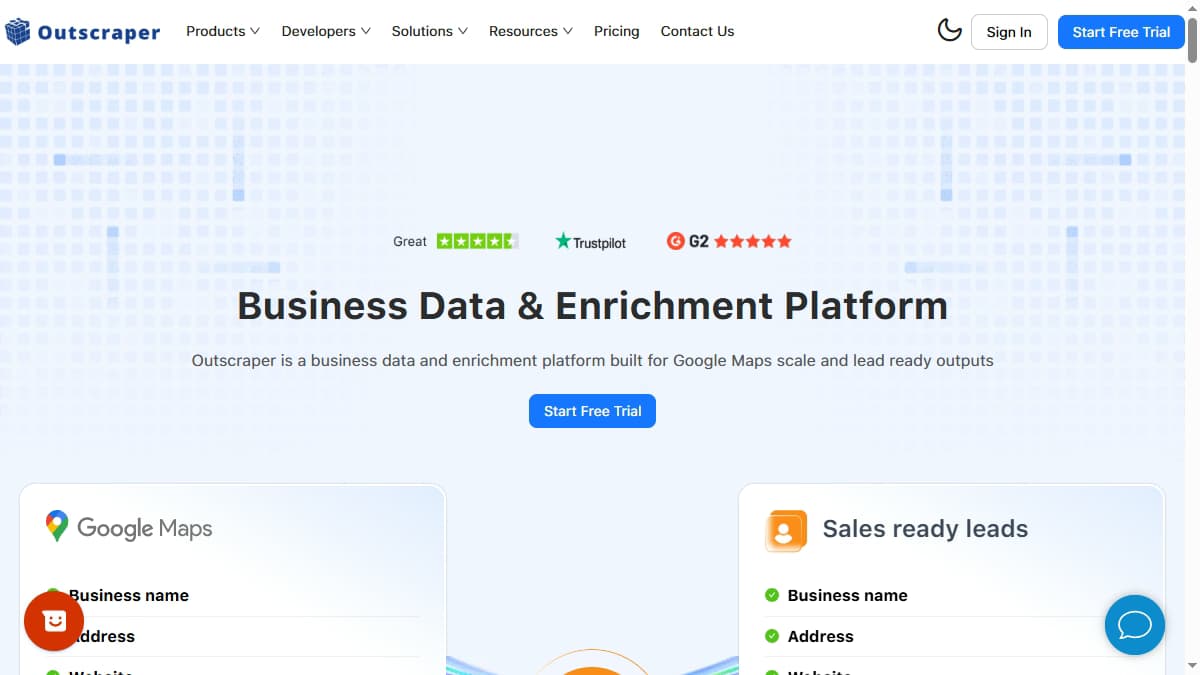
Outscraper homepage — a business data and enrichment platform built for Google Maps scale and lead-ready outputs.
What Is Outscraper?
Outscraper is a business data and web-scraping platform built primarily around Google Maps. It extracts business listings, place details, reviews, photos, emails, and phone numbers from public sources — delivered through both a no-code dashboard and a documented REST API. The pitch is simple: pull business data at scale without writing or maintaining your own scrapers.
The data footprint is large. Outscraper covers 100M+ business records across 249 countries and recognizes 5,490 Google Maps categories. For anyone who needs raw business listings — local agencies building lead lists, market researchers mapping a category, or developers feeding Maps data into their own product — it is genuinely hard to beat on coverage and price for the base scrape.
Outscraper holds a 4.7/5 rating across 250 reviews on Trustpilot and positive ratings on G2. Reviewers consistently praise how fast scrapes finish, how easy the dashboard is, and how responsive support is. The recurring complaint — almost universally — is billing: costs that look cheap per task add up quickly across the endpoints needed to produce a usable lead.
| Capability | What Outscraper Provides | Notable Gaps |
|---|---|---|
| Google Maps Scraping | 100M+ listings, 249 countries, 5,490 categories. Name, address, website, phone, reviews, photos. | No firmographic/technographic filtering for precise ICP targeting. |
| Email + Contact Enrichment | Email and contact scraping from domains; phone lookup. | Separate paid tasks. Scraped, not verified. No published accuracy benchmark. |
| API + Automation | Clean REST endpoints, async job processing, clear docs. Broadest API surface in Maps scraping. | Output is raw CSV/JSON — requires post-processing before use. |
| CRM Integration | CSV/XLSX export, API, webhooks, and integrations with HubSpot, Pipedrive, Zoho CRM, Zapier, Make, and n8n (as of September 2026). | No Salesforce integration listed; scraped records still need cleanup before they are sales-ready. |
| Buying Signals + Outreach | Not available. | No intent data, no sequences, no sales workflow for revenue teams. |
Outscraper Pricing: What You Actually Pay
Outscraper runs on pure pay-as-you-go. There are no monthly fees and no recurring billing — you pay per task, per record. You can prepay with credits (which never expire) or use postpaid invoicing. Volume tiers reset every 30 days, so the lower per-record rates apply within each monthly window.
| Service | Free Tier | 501–100k | 100k+ |
|---|---|---|---|
| Google Maps scraping | 500 records | $3 / 1,000 records | $1 / 1,000 records |
| Email + contact scraping | 500 contacts | $3 / 1,000 domains | $1 / 1,000 domains |
| Email validation | 25 emails | $3 / 1,000 emails | $1 / 1,000 emails |
| Phone lookup | — | $5 / 1,000 phones | $3 / 1,000 phones |
| Google Maps photos | — | $2 / 1,000 images | $1 / 1,000 images |
The most important pricing reality: that $3/1,000 headline rate only buys raw business listings. A sales-ready lead needs more. To turn a listing into a contactable prospect, you typically run the base scrape, then a separate email-finding task, then email validation, and often a phone lookup — each billed individually.
Stack those tasks and the math shifts. A “full profile” pull — listing plus email plus verification plus extras — lands closer to $14 per 1,000 in practice. That is still inexpensive for scraped data, but it is nearly 5x the $3 entry rate most buyers anchor on. Always price Outscraper against the number of endpoints your workflow actually touches, not the headline.
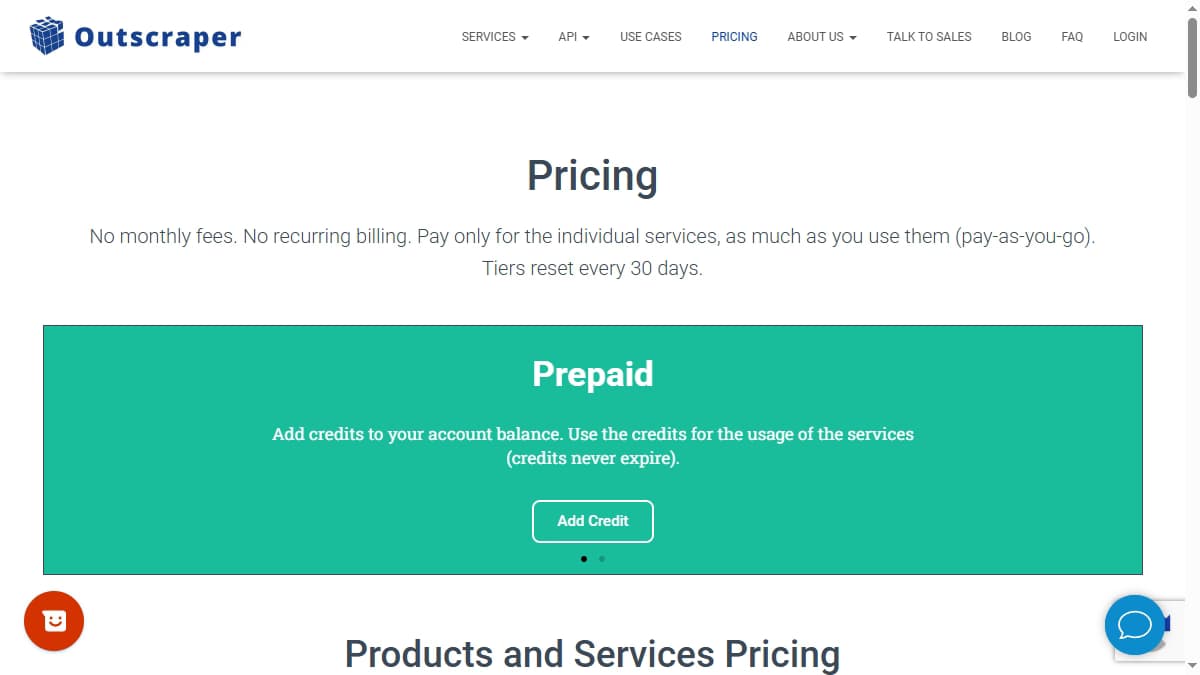
Outscraper pricing 2026 — pay-as-you-go with no monthly fees, prepaid credits that never expire, and tiers that reset every 30 days.
Outscraper Key Features
Google Maps Data at Scale
Outscraper's core engine is its Google Maps scraper. You query by category and location and it returns business name, address, website, phone, hours, ratings, reviews, and photos across 100M+ listings in 249 countries. With 5,490 recognized categories, you can target a precise vertical — dentists in Berlin, HVAC contractors in Texas, law firms in Sydney — and pull the full set in one job.
This is where Outscraper is strongest. For raw local-business data, the coverage and per-record cost are genuinely hard to beat, and the no-code dashboard means non-technical users can run jobs without engineering help.
Email, Contact, and Phone Enrichment
Beyond listings, Outscraper finds emails and phone numbers from domains and validates email addresses. These run as separate services billed per record. They are useful for turning a scraped listing into a contactable record — but the data is scraped, not verified against a maintained database, so accuracy varies and a validation pass is recommended.
REST API and Async Jobs
Outscraper offers what is widely regarded as the broadest API surface in the Google Maps scraping space — clean REST endpoints, asynchronous job processing for large pulls, and transparent documentation. For developers building Maps data into their own product, this is the standout feature and a key reason teams pick Outscraper over thinner scraping tools.
Reviews and Photos Extraction
Outscraper can pull Google Maps reviews and business photos alongside listings — valuable for reputation monitoring, sentiment analysis, and competitive research. Review extraction is a common use case for agencies tracking client reputation across locations.
No-Code Dashboard
The dashboard lets non-technical users configure and run scraping jobs, monitor progress, and download results as CSV or XLSX. Combined with the free tier, it makes Outscraper accessible to marketers and small agencies who would never write a scraper themselves.
Outscraper Data Coverage and Accuracy
Outscraper's coverage is broad but its accuracy is uneven, and the difference matters depending on what data you need. Listing-level data is reliable; contact-level data is not guaranteed.
For business listings — name, address, category, website, hours, ratings — Outscraper is dependable. It pulls directly from Google Maps, so the data reflects what is publicly visible on the platform across 100M+ records and 249 countries. If you need a clean list of every dentist in a metro, this is solid.
For contact data — verified email and direct phone — accuracy is where buyers get burned. Outscraper publishes no official accuracy benchmark. One Trustpilot reviewer cites roughly 85% contact accuracy, but threads on r/coldemail describe owner contact details as “hit and miss.” That tracks with what you would expect from scraped web data versus a verified database — generic info@ addresses are common, and direct owner emails are inconsistent.
This is the core distinction between scraping and waterfall enrichment. Outscraper grabs whatever a single public source exposes, while multi-provider tools check several sources and keep the first verified result. For outbound where bounce rate and deliverability matter, run Outscraper contacts through its email validation task, or a separate verifier, before anything is sent.
Outscraper Pros: What It Does Well
- Cheapest path to raw business listings. At $3/1,000 records (and $1/1,000 above 100k) with 500 free, Outscraper is hard to beat on cost for raw Google Maps data. For volume listing pulls, it is one of the most economical options available.
- No monthly fees, no lock-in. Pure pay-as-you-go with prepaid credits that never expire. You pay only for what you use — ideal for irregular or project-based scraping where a subscription would sit idle.
- Massive coverage. 100M+ business records across 249 countries and 5,490 Google Maps categories. Few tools match the breadth of geographic and category coverage for local business data.
- Broadest API in Maps scraping. Clean REST endpoints, async job processing, and clear docs make Outscraper a favorite for developers building Google Maps data into their own products.
- Genuine free tier. 500 records per service every 30 days lets you test real workflows before paying — and run small jobs at no cost indefinitely.
- 4.7/5 on Trustpilot across 250 reviews. Consistently praised for fast scrapes, an easy dashboard, and responsive support — strong social proof in a crowded scraping market.
Outscraper Cons: Where It Falls Short
- Costs stack across endpoints. The $3/1,000 headline rate only covers raw Maps listings. Producing a usable B2B lead — scrape, find email, verify, enrich — typically bills as three or four separate tasks, pushing the effective cost of a full lead profile to roughly $14/1,000. Budget against your real workflow, not the entry rate.
- No published accuracy benchmark. Outscraper does not publish official hit-rate or accuracy figures. Contact data is scraped rather than verified, so email and owner-detail accuracy is inconsistent — reviewers describe it as 'hit and miss' for owner contacts. Business-listing data is reliable; contact-level data is not guaranteed.
- Limited CRM depth. As of September 2026, Outscraper lists integrations with HubSpot, Pipedrive, Zoho CRM, and GoHighLevel, plus Zapier, Make, n8n, and webhooks — but Salesforce is not on the list, and scraped records still arrive raw, so expect post-processing before they are usable in a sales workflow.
- No sales workflow. There are no buying signals, no email sequences, and no outreach tooling. Outscraper is a data-sourcing layer, not an outbound platform. Sales teams must bolt on separate enrichment, verification, and sequencing tools to turn scraped data into pipeline.
- Email and verification are separate paid tasks. Finding an email, validating it, and enriching the record are billed individually. A clean, verified contact list requires running multiple jobs in sequence — each adding cost and processing time on top of the base scrape.
- Scraped data carries compliance and ToS risk. Pulling data from Google Maps and the open web at scale sits in a grey area around platform terms of service and data-privacy regulations (GDPR, CCPA). Teams in regulated industries should review usage and consent requirements before deploying scraped contact data in outreach.
- Built for volume, not targeting. Outscraper excels at pulling everything in a category or geography, but it lacks the firmographic and technographic filtering of a true sales-intelligence database. Narrowing to a precise ICP requires heavy post-export filtering.
Outscraper vs Apollo vs Apify
The comparison below covers Outscraper against Apollo (B2B sales prospecting) and Apify (developer scraping platform) — the tools teams most often weigh when evaluating Outscraper.
| Feature | Outscraper | Apollo | Apify |
|---|---|---|---|
| Starting Price | $3/1k records (501–100k); free for first 500 | $59/mo (Basic) | $0 + $49/mo for actor compute (Starter) |
| Pricing Model | Pay-as-you-go per task — costs stack per endpoint | Subscription tiers | Compute units + per-actor pricing |
| Primary Use Case | Google Maps + web scraping at scale | B2B sales prospecting & outreach | Developer scraping platform (actors) |
| Data Source | Scraped Google Maps + open web (100M+ listings) | 275M+ contact database | Bring-your-own scrapers (actors) |
| Email + Phone Accuracy | ~85% claimed (Trustpilot); no published benchmark | 60–75% (own DB) | Varies — depends on the actor used |
| Email Verification | Add-on — $3/1k emails (separate task) | Included | Separate actor required |
| Buying Signals | No | Basic intent via Bombora | No |
| Native Outreach | No — export only | Yes — sequences included | No |
| CRM Integrations | HubSpot, Pipedrive, Zoho CRM; Zapier/Make/n8n (no Salesforce listed) | HubSpot, Salesforce native | Via Zapier/Make/API only |
| Free Tier | Yes — 500 records/30 days per service | Yes — limited credits | Yes — $5 free compute/mo |
| Best For | No-code Maps scraping; raw business listings | All-in-one sales prospecting | Developers building scrapers into products |
Outscraper vs Apify
Apify is the closest direct comparison for developers. It is a broader scraping marketplace with thousands of pre-built actors covering Maps, LinkedIn, e-commerce, and more — versus Outscraper's focused, Maps-first toolset. Outscraper wins on simplicity and predictable per-record Maps pricing; Apify wins on breadth and flexibility for teams that scrape many different sources. See our guide to web-crawling APIs for lead gen for a deeper look.
Outscraper vs Apollo for Sales Teams
Apollo is the right comparison for B2B sales teams who evaluate Outscraper. Apollo has 275M+ verified contacts, a free tier, built-in sales sequences, native CRM integrations (HubSpot and Salesforce), and intent data via Bombora. Outscraper matches none of the database, sequencing, or intent features, and its CRM integrations do not include Salesforce — it is a scraping tool, not a sales platform. For SDR tooling and sales prospecting, Apollo is the more direct fit.
How Outscraper Works: From First Scrape to a Usable Lead List
Most of the cost and quality questions above come down to workflow. Here is how a typical local-lead pull runs in Outscraper, step by step, and where each billed task shows up.
- Run the base scrape. Pick the Google Maps Data Scraper, enter categories and locations, and start the job. The first 500 records each month are free; after that you pay $3 per 1,000 up to 100k records.
- Choose how you get results. Non-technical users download CSV or XLSX files from the dashboard. Developers call the REST API, run large pulls as async jobs, or set a webhook so results post automatically when a task finishes.
- Add contact tasks only where needed. Run the emails and contacts scraper on the websites you actually plan to contact, then email validation and phone lookup. Each is a separate billed task, which is how a full profile climbs to roughly $14 per 1,000.
- Clean before you send. Remove generic info@ addresses, drop records that fail validation, and filter to your ICP. Outscraper returns everything in a category, so the narrowing happens here.
- Push to your tools. As of September 2026, Outscraper lists integrations with HubSpot (through the HubSpot App Marketplace), Pipedrive, Zoho CRM, GoHighLevel, Google Sheets, Zapier, Make, Pabbly, and an official n8n node. Salesforce is not on that list, so Salesforce teams route data through Zapier, Make, or the API.
Two habits keep costs predictable. First, scope enrichment tasks to the subset of listings you will actually contact rather than the full scrape. Second, plan large pulls around the 30-day tier window: rates drop to $1 per 1,000 above 100k records within a window, and prepaid credits never expire, so there is no penalty for buying ahead.
Who Should Use Outscraper?
Outscraper is the right fit for:
- Local lead agencies and marketers who need to pull business listings by category and geography at the lowest per-record cost — and are comfortable processing CSVs themselves.
- Developers building Maps data into a product who want clean REST endpoints, async jobs, and predictable per-record pricing without maintaining their own scrapers.
- Researchers and analysts mapping a market, monitoring reviews, or doing competitive analysis where raw listing and review data is the deliverable.
- Low-to-mid-volume, project-based users who benefit from pay-as-you-go and would waste money on a monthly subscription.
Outscraper is not the right fit for:
- B2B sales teams running outbound. No verified contact database, no buying signals, no sequences, and no Salesforce integration. You would bolt on enrichment, verification, and outreach tools anyway. See Outscraper alternatives if you need a full sales workflow.
- Teams scaling past ~50k records/month. The per-task billing compounds as you stack endpoints, and raw scraped records that need cleanup create real operational overhead at volume.
- Teams that need verified, deliverable contact data. No published accuracy benchmark and scraped (not verified) emails mean higher bounce rates. A waterfall provider is the safer choice for outbound.
- Compliance-sensitive industries. Large-scale scraping of Maps and the open web sits in a grey area around platform ToS and data-privacy law. Review consent and usage requirements before deploying scraped contact data.
If scraped contact data with no published accuracy benchmark is a dealbreaker, SyncGTM is one alternative worth a look: it runs waterfall enrichment across 50+ data providers for verified emails and phone numbers, with native HubSpot and Salesforce integrations.