8 Best RB2B Alternatives for B2B Enrichment in 2026

By Kushal Magar · June 19, 2026 · 14 min read
Key Takeaway
RB2B is a person-level website visitor ID tool, not an enrichment platform — and as of 2026, person-level data is US-only and behind a paywall. If you need verified emails, phone numbers, global coverage, and outreach automation rather than just a LinkedIn URL in Slack, you need a different tool. SyncGTM leads with waterfall enrichment across 50+ providers; Warmly leads for live visitor engagement; Leadfeeder leads for affordable global company-level tracking.
Most teams searching for RB2B alternatives hit the same two walls: RB2B only identifies US visitors at the person level, and even when it works, it hands you a LinkedIn URL — not a verified email you can actually use.
Identification is table stakes. The job that actually fills pipeline is turning an anonymous visitor into a complete, outreach-ready contact record.
This guide compares 8 RB2B alternatives across five dimensions: contact data depth, geographic coverage, outreach automation, pricing, and integration fit. Every tool here has been evaluated against real B2B prospecting workflows in 2026. For a deeper look at the tool itself, see our full RB2B review.
TL;DR
- Best all-in-one alternative: SyncGTM — waterfall enrichment + AI outreach, global, from $89/mo
- Best for live visitor engagement: Warmly — person-level ID + AI chat, ~$15K/yr
- Best affordable global tracking: Leadfeeder — company-level ID + CRM sync, €99/mo
- Best for prospecting + sequences: Apollo.io — 270M+ contacts, $49/user/mo
- Best for custom data workflows: Clay — 100+ integrations, $149/mo
- Best enterprise company-level ID: Lead Forensics — real-time alerts, custom pricing
- Best for European traffic: Albacross — GDPR-friendly intent, €59/mo
- Best for enterprise ABM: 6sense — predictive scoring, $40K+/yr
Why Teams Look for RB2B Alternatives
RB2B did one thing that made it go viral: free, person-level identification of US website visitors, pushed to Slack with a LinkedIn URL. For a US-focused founder watching their pricing page, that was genuinely useful.
But the model has clear ceilings, and in 2026 several of them tightened.
Four reasons teams switch away:
- US traffic only. Person-level identification does not work for EMEA, APAC, or LATAM visitors. If your ICP isn't American, most of your traffic stays anonymous.
- It stops at the LinkedIn URL. RB2B tells you who visited — but to email or call them, you still need a separate tool to find a verified work email and direct dial.
- Person-level data moved behind a paywall. As of January 2026, the free plan is company-level only. Person-level identification now starts at $79/month, and the highest match rates (35–45%) require the $199/month Pro+ tier.
- No outreach automation. RB2B identifies; it doesn't sequence. Acting on a signal means exporting it to another platform.
According to G2 reviews of RB2B, the most-cited gaps are geographic coverage and the distance between identifying a visitor and actually reaching them. The alternatives below close one or both of those gaps.
1. SyncGTM
SyncGTM — waterfall enrichment across 50+ providers for B2B prospecting
SyncGTM is the best all-in-one RB2B alternative for teams that want to act on a lead, not just spot one. SyncGTM is a B2B data enrichment and outreach platform built around waterfall enrichment — sequentially querying 50+ data providers until it finds a verified email or phone number.
Where RB2B hands you a LinkedIn URL for a US visitor, SyncGTM takes any name, domain, or LinkedIn URL and returns a complete record: verified work email, direct dial, 76+ firmographic and technographic data points, and buying signals like job changes and funding. It works globally, not US-only — then automates outreach with AI-powered sequences.
For teams using RB2B mainly to feed an outbound motion, SyncGTM is the operational layer that closes the loop. See how it stacks up against other enrichment tools in our best waterfall contact providers comparison, and explore plans on the SyncGTM pricing page.
Pros
- Waterfall enrichment across 50+ providers — 80%+ verified email coverage on known prospects
- 76+ data points per lead: email, phone, LinkedIn, firmographics, technographics, buying signals
- Global coverage — not limited to US traffic like RB2B
- AI-powered outreach automation triggered by enrichment results
- Native CRM sync: HubSpot, Salesforce, Pipedrive, Attio
- Free tier: 50 enrichment credits, no credit card required
Cons
- No anonymous-visitor pixel — won't silently de-anonymize random website traffic the way RB2B does
- Smaller brand recognition than ZoomInfo or Apollo with procurement teams
- Best value comes from annual billing
Best for: B2B teams that need high-coverage, global contact enrichment and integrated outreach
Pricing: From $89/mo (annual); 50 free credits to start
2. Warmly
Warmly — real-time person-level visitor identification with AI-driven outreach
Warmly is the closest direct RB2B analog — person-level visitor ID, but with engagement built on top. Warmly identifies website visitors at the person level, scores them against your ICP, and triggers outreach via email, LinkedIn, and AI chat in real time.
Warmly stacks 20+ data providers in a data waterfall to lift its match rate, reaching roughly 65% at the company level on predominantly US traffic. Its standout over RB2B is action: instead of just dropping a name in Slack, Warmly can open a live chat or fire a sequence the moment a target account lands.
The catch is price. Warmly's paid plans start around $15,000/year — a very different commitment from RB2B's $79/month entry point. For a full breakdown of cheaper options, see our Warmly alternatives guide.
Pros
- Person-level visitor identification with real-time AI chat
- 20+ provider data waterfall lifts match rates above single-source tools
- Automated email and LinkedIn sequences triggered by visits
- Free tier covers up to 500 visitors/month for evaluation
Cons
- Person-level accuracy is strongest on US traffic — limited outside the US
- Paid plans start around $15K/yr — steep for SMBs
- Person-level match rates still land in the 5–20% range
Best for: Funded teams that want live, automated engagement of identified visitors
Pricing: Free (500 visitors/mo); paid from ~$15,000/yr
3. Leadfeeder
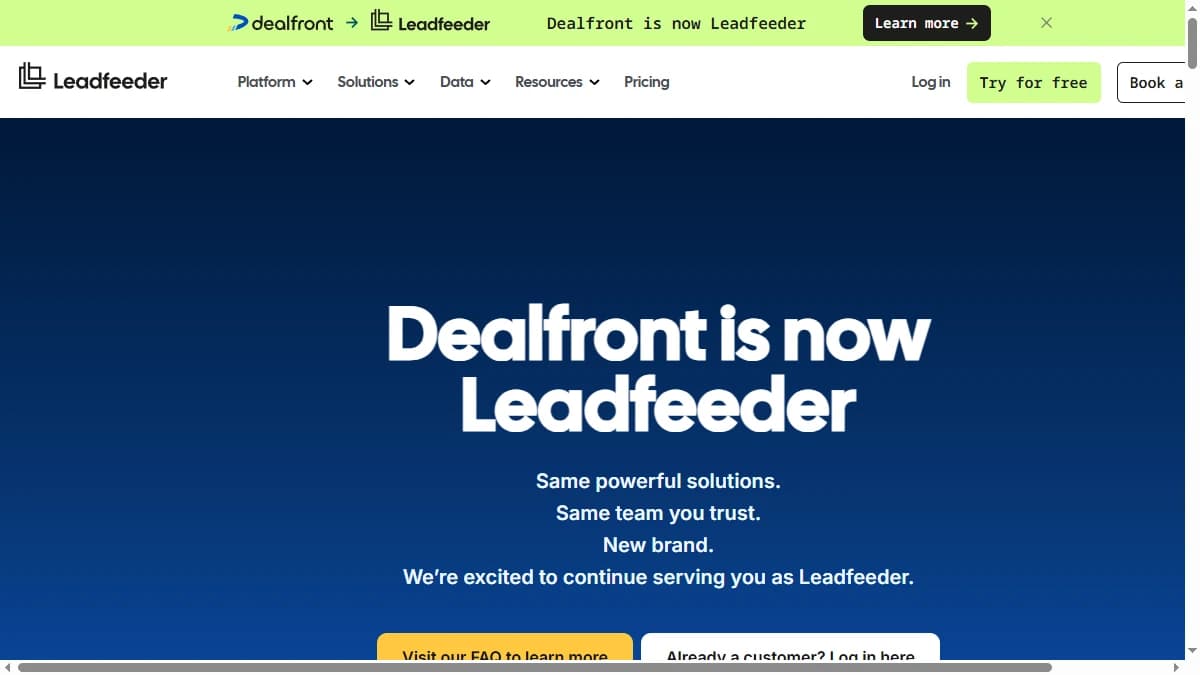
Leadfeeder — company-level visitor tracking with intent scoring and CRM sync
Leadfeeder is the affordable, global RB2B alternative for teams that care about accounts more than individuals. Leadfeeder (now part of Dealfront) identifies the companies visiting your website using IP-to-company matching, scores them by intent, and syncs to 50+ CRMs.
Unlike RB2B, Leadfeeder works worldwide — not just on US traffic. The trade-off is granularity: it tells you Acme Corpvisited your pricing page, not which specific employee did. For pipeline built on account-level intent rather than individual de-anonymization, that's often enough — and it ships with behavior scoring and automated lead routing.
Pros
- Global company-level identification — not US-only
- Intent scoring and behavior-based lead routing
- 50+ CRM and tool integrations (HubSpot, Salesforce, Pipedrive)
- Free Lite plan for basic visitor tracking
Cons
- Company-level only — no person-level identification like RB2B
- No verified contact data or email finder built in
- No native outreach sequencing
Best for: Global teams that want account-level visitor intelligence on a budget
Pricing: Free Lite; paid from €99/mo (annual)
4. Apollo.io
Apollo.io — 270M+ contact database with built-in email sequencing
Apollo.io is the best RB2B alternative for teams that would rather build target lists than wait for visitors. Apollo.io is an all-in-one sales intelligence and engagement platform with a 270M+ contact database, built-in email sequencing, and a dialer.
Apollo flips the RB2B model: instead of identifying who came to you, you search a global database by 65+ attributes, build a list, enrich it, and start sequences — all in one tool. The free tier includes 50 email credits/month, making it the most accessible paid-grade entry point on this list.
Pros
- 270M+ verified contacts with 65+ filter dimensions, globally
- Built-in email sequencer with A/B testing and reply detection
- Free tier with 50 email credits/mo — no credit card
- Native Salesforce, HubSpot, and Salesloft integrations
Cons
- Single data source — no waterfall enrichment to boost hit rates
- Email accuracy reported at 70–80% in independent tests
- No website visitor identification at all
- Sequences, dialer, and intent data become separate add-ons at higher tiers
Best for: SMB and mid-market teams wanting outbound prospecting plus sequencing in one tool
Pricing: Free tier; paid from $49/user/mo
5. Clay
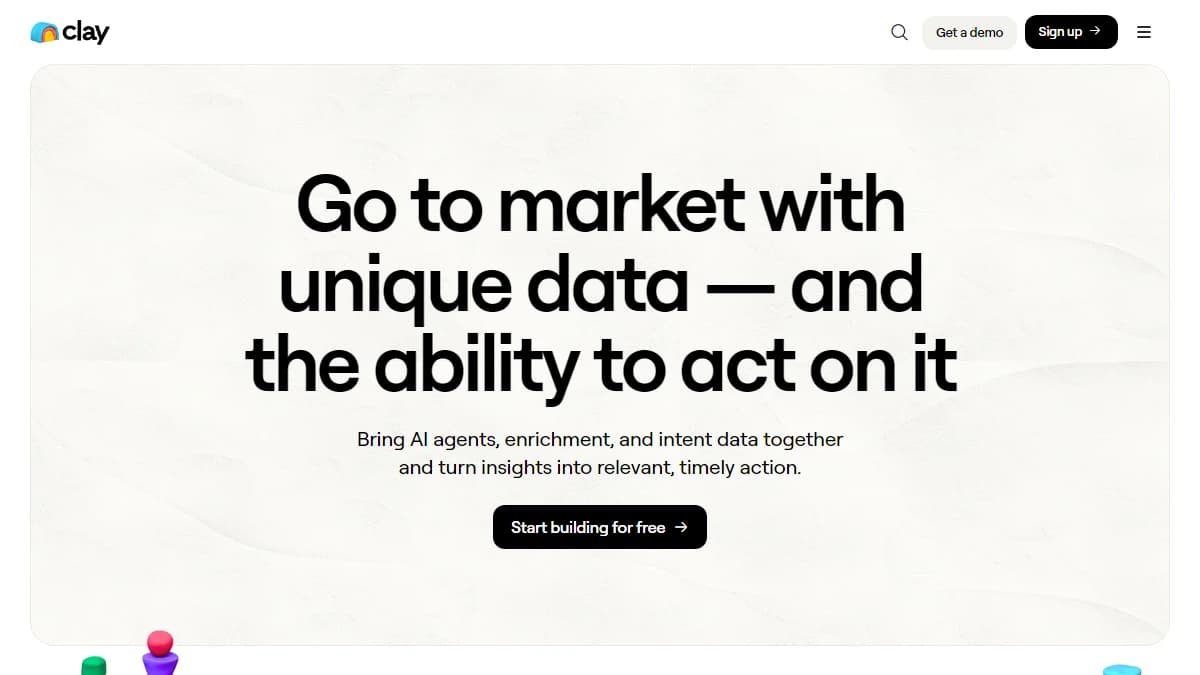
Clay — 100+ data source integrations in a spreadsheet-like workflow builder
Clay is the RB2B alternative for technical teams that want to build their own enrichment logic. Clay chains together 100+ data sources in a spreadsheet interface, letting you design custom enrichment and research workflows.
You can pipe RB2B's visitor data into a Clay table, then waterfall across Apollo, Hunter, Clearbit, and custom APIs to fill in the verified email RB2B never gave you. Claygent, its AI agent, researches prospects automatically. It's the tool of choice for RevOps and growth engineers who want total control.
Pros
- 100+ native data source integrations in one workflow builder
- Waterfall-style logic via conditional enrichment sequences
- Claygent AI agent for autonomous prospect research
- Free tier: 100 credits/mo for testing
Cons
- Steep learning curve for non-technical users
- Credits consumed per provider call — costs stack fast at scale
- No native website visitor identification
- No built-in outreach sequencing — export to a separate tool
Best for: RevOps engineers who want to build bespoke enrichment pipelines
Pricing: Free tier (100 credits/mo); paid from $149/mo
6. Lead Forensics
Lead Forensics — enterprise company-level visitor identification with real-time alerts
Lead Forensics is the enterprise-grade company-level RB2B alternative for teams with budget and a large sales floor. Lead Forensics matches anonymous website traffic to companies using one of the larger IP-to-company databases in the category, then delivers real-time alerts and full company profiles to sales.
It covers global traffic and layers on contact suggestions, lead scoring, and CRM routing. The catch is the commercial model: pricing is quote-only and typically lands in the five-figure-per-year range, with annual contracts. That makes it a heavier commitment than RB2B's month-to-month plans.
Pros
- Large IP-to-company database with strong global coverage
- Real-time alerts and detailed company profiles
- Lead scoring and CRM routing for large sales teams
Cons
- Company-level identification — not true person-level like RB2B
- Quote-only pricing, typically $10K+/yr on annual contracts
- No free tier — trial only
Best for: Enterprise teams that need global company-level visitor ID with full support
Pricing: Custom (typically ~$10K+/yr)
7. Albacross
Albacross — GDPR-friendly visitor identification with intent data and ad audiences
Albacross is the best RB2B alternative for European traffic and GDPR-conscious teams. Albacross identifies companies visiting your site with particularly strong European coverage, then adds intent data and the ability to build ad audiences from your visitors.
Where RB2B is US-first, Albacross is EU-first — making it a natural fit for teams selling into the markets RB2B can't see. It integrates with CRMs and ad platforms, and its pricing starts well below the enterprise tools, at €59/month on annual billing.
Pros
- Strong European coverage — fills RB2B's biggest geographic gap
- GDPR-friendly data handling
- Intent data plus ad-audience building from site visitors
- Affordable entry pricing from €59/mo
Cons
- Company-level identification, not person-level
- US coverage is weaker than RB2B or Warmly
- No verified contact enrichment or outreach built in
Best for: European B2B teams that need GDPR-friendly visitor identification
Pricing: Limited free; paid from €59/mo (annual)
8. 6sense
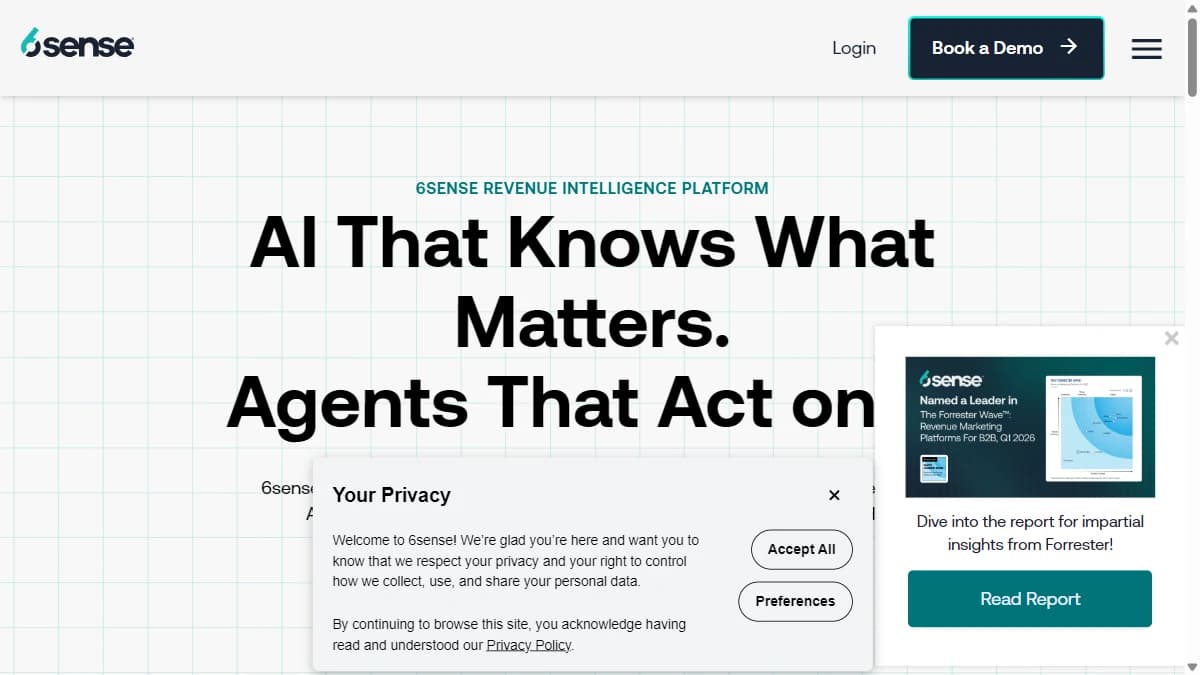
6sense — predictive ABM with anonymous buyer-journey mapping
6sense is the enterprise RB2B alternative for teams running full account-based marketing. 6sense uses AI and a large intent-data network to map the entire anonymous buyer journey, predict which accounts are in-market, and orchestrate sales and marketing around them.
It does far more than de-anonymize a visitor: it scores accounts by predicted purchase intent, surfaces buying-stage signals, and powers ABM advertising. That breadth comes at enterprise cost — typically $40K+/year — and a longer implementation than RB2B's pixel-and-go setup.
Pros
- AI predictive scoring across the full anonymous buyer journey
- Large intent-data network beyond your own website traffic
- ABM orchestration and advertising in one platform
- Global coverage for enterprise pipelines
Cons
- Enterprise pricing (~$40K+/yr) — far beyond RB2B's range
- Account-level focus — not built for individual visitor de-anonymization
- Longer onboarding and a steeper learning curve
Best for: Enterprise revenue teams running predictive ABM at scale
Pricing: Custom (~$40K+/yr)
Side-by-Side Comparison of the Best RB2B Alternatives
Here is how the 8 RB2B alternatives compare on the dimensions that matter most: what each is best for, geographic coverage, free tier, starting price, and standout capability.
| Tool | Best For | Coverage | Free Tier | Starting Price | Standout |
|---|---|---|---|---|---|
| SyncGTM | Waterfall enrichment + AI outreach automation | Global | Yes (50 credits) | $89/mo (annual) | 50+ providers, 76+ data points, AI agents, CRM sync |
| Warmly | AI-driven real-time visitor engagement | Mostly US | Yes (500 visitors/mo) | ~$15,000/yr | Live visitor ID, AI chat, automated sequences |
| Leadfeeder | Company-level visitor tracking + CRM sync | Global | Yes (Lite) | €99/mo (annual) | Intent scoring, 50+ CRM integrations |
| Apollo.io | All-in-one prospecting + email sequences | Global | Yes (50 credits/mo) | $49/user/mo | 270M+ contacts, built-in sequencer |
| Clay | Custom enrichment workflows for technical teams | Global | Yes (100 credits/mo) | $149/mo | 100+ data source integrations, AI row enrichment |
| Lead Forensics | Enterprise company-level visitor identification | Global | No (trial) | Custom (~$10K+/yr) | Real-time alerts, large IP-to-company database |
| Albacross | European visitor identification + intent | Global (EU strength) | Yes (limited) | €59/mo (annual) | GDPR-friendly, intent data, ad audiences |
| 6sense | Enterprise ABM with predictive scoring | Global | No | Custom (~$40K+/yr) | AI account prioritization, anonymous buyer journey |
How to Choose the Right RB2B Alternative
The right pick depends on what RB2B was failing to give you. Use these decision rules:
- You need verified emails and outreach, not just a LinkedIn URL: choose SyncGTM. Waterfall enrichment and sequences turn a visitor into a sent email.
- You want live, automated engagement of identified visitors: choose Warmly — if you can fund the ~$15K/yr commitment.
- Most of your traffic is outside the US: choose Leadfeeder (global) or Albacross (Europe). RB2B can't see it; these can.
- You'd rather build target lists than wait for visitors: choose Apollo.io for an all-in-one database and sequencer.
- You have a technical RevOps team and want full control: choose Clay to design custom enrichment pipelines.
- You're an enterprise running ABM: choose 6sense for predictive scoring, or Lead Forensics for global company-level ID.
For a wider view of the visitor-ID landscape, our LeadRebel alternatives and Common Room alternatives guides cover adjacent tools and signal sources.
Final Verdict
RB2B solved one narrow problem well: free, US, person-level visitor identification. In 2026, that free advantage is gone, and the US-only ceiling and the gap between an ID and an actual email remain.
If you only need US person-level alerts in Slack, RB2B is still a fine tool. But for most teams the bottleneck isn't identification — it's turning identification into pipeline.
SyncGTM is our top RB2B alternative because it closes that gap: global waterfall enrichment across 50+ providers, 76+ data points, verified emails and phones, and outreach automation — from $89/month. Warmly wins for live engagement, Leadfeeder and Albacross for affordable global coverage, and 6sense for enterprise ABM.
Stop collecting LinkedIn URLs you can't email. Start with SyncGTM free — 50 enrichment credits, no credit card required.
Frequently Asked Questions
What is RB2B and what does it do?
RB2B is a person-level website visitor identification tool. It places a JavaScript pixel on your site, matches anonymous US-based visitors to their LinkedIn profiles, and pushes real-time alerts to Slack with the visitor's name, title, company, and LinkedIn URL. RB2B's free plan is now company-level only (150 resolutions/month); person-level data starts at $79/month on the Starter plan. Its core limitation is geographic: person-level identification works only for US traffic, and it identifies roughly 5–20% of visitors at lower tiers (35–45% on Pro+).
What is the best RB2B alternative for B2B prospecting?
SyncGTM is the strongest all-in-one RB2B alternative. Where RB2B stops at identifying a visitor's LinkedIn URL, SyncGTM waterfalls enrichment across 50+ data providers to return a verified work email, direct dial, and 76+ firmographic and technographic data points per lead — then automates outreach. It works globally rather than US-only, and starts at $89/month (annual) with 50 free credits. For teams that want live visitor engagement specifically, Warmly is the closest direct analog at a much higher price point.
Is there a free RB2B alternative?
Yes. SyncGTM offers 50 free enrichment credits with no credit card required, and works globally rather than US-only. Apollo.io includes a free tier with 50 email credits per month and a 270M+ contact database. Leadfeeder offers a free Lite plan for company-level visitor tracking. RB2B itself still has a free-forever tier, but as of 2026 it is company-level only — person-level identification now requires a paid plan from $79/month.
Why do teams move away from RB2B?
The most common reasons are geographic coverage and the gap between identification and action. RB2B identifies US visitors only, so teams selling into EMEA, APAC, or LATAM see little value. It also stops at the LinkedIn URL — to actually email or call the person, you need a separate enrichment tool to find their verified email and phone. Person-level data also moved behind a paywall in 2026, removing the free-tier advantage that originally made RB2B popular.
Can SyncGTM replace RB2B?
For most prospecting use cases, yes — with one caveat. SyncGTM does not place an anonymous-visitor pixel on your website the way RB2B does, so it will not silently de-anonymize random traffic. What SyncGTM does better is turn a name, domain, or LinkedIn URL into a complete, outreach-ready record: verified email, phone, 76+ data points, buying signals, and automated sequences across 50+ providers, globally. Teams that want both pixel-based visitor ID and full enrichment often pair RB2B for capture with SyncGTM for enrichment and outreach.
How accurate is RB2B's person-level identification?
RB2B identifies roughly 5–20% of US website visitors at the person level on its standard plans, rising to a claimed 35–45% on the Pro+ premium-resolution tier. Match rates depend heavily on traffic mix: US B2B traffic from corporate or known networks resolves best, while remote and home-network traffic resolves worse. Non-US traffic is not identified at the person level at all. By contrast, enrichment-first tools like SyncGTM achieve 80%+ verified email coverage on known prospects because they waterfall across 50+ providers rather than relying on a single identity graph.